


Welcome to Project 3.18, a free weekly publication where a fan-first writer tells strange and surprising stories from baseball history and culture.
On March 10, 1933, the New York Giants and the Chicago Cubs played an exhibition game at Wrigley Field. The spring weather that day was perfect, as it nearly always was, because this Wrigley Field was in California.
Los Angeles didn’t have a major-league team until the Dodgers came in 1958, but the Pacific Coast League was a pretty good league in its own right, regarded as a near-peer of the National and American Leagues, whose territory ended at the Mississippi River. One PCL team, the Los Angeles Angels, was owned by William Wrigley Jr., who also owned the Chicago Cubs. Wrigley used his chewing gum money to build the Angels a fine ballpark in South Los Angeles in 1925, which he named after himself. He liked the sound of it so much that in 1927 Chicago’s Cubs Park became the second Wrigley Field.
In the 1930s, Southern California was an emerging center for major-league spring training. The Cubs trained on Santa Catalina Island, just off the Los Angeles coast, the Chicago White Sox trained at Pasadena, 11 miles northeast of the city, and the Pittsburgh Pirates were relatively nearby in Paso Robles. The New York Giants were the new guys in 1933, training at Wrigley Field in downtown Los Angeles for their second season (and forcing the Angels to couch-surf).
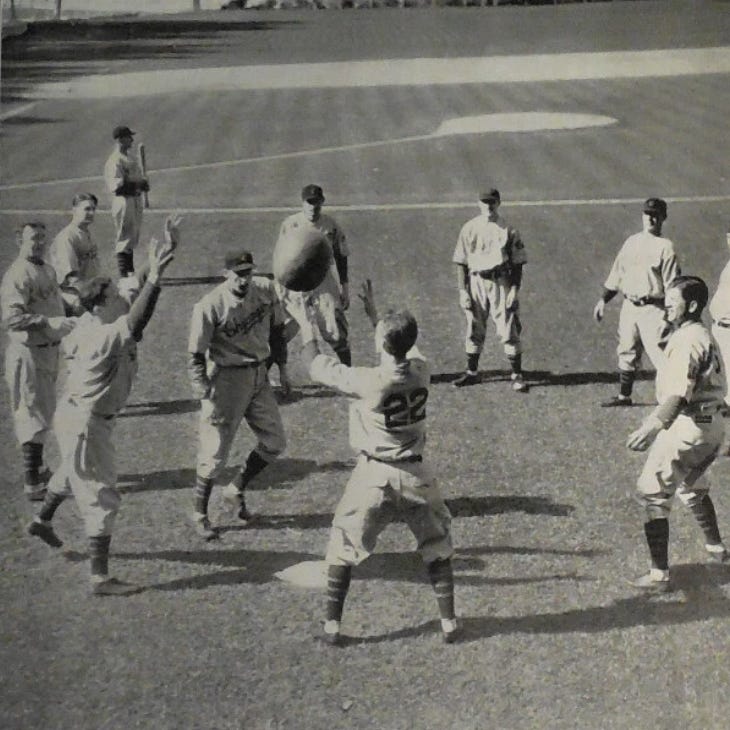
For one month each spring, Los Angeles was a major-league town. The teams played a few dozen games during their stay, against each other and a motley crew of local minor-league and semi-pro clubs. On March 11, for instance, while the Cubs and Giants tangled again, the White Sox were scheduled to play a team organized by the Pasadena Merchants Association. The full slate of exhibitions gave Los Angelenos and other Californians an up-close look at baseball’s best, and the clubs enjoyed a month in paradise.
The Giants won the March 10 game against the Cubs by a 5-3 score. After the players cleared out, Willie Schafer, the Giants’ trainer, indulged in some precious personal time, disappearing into a hot shower in Wrigley Field’s clubhouse.
The players mostly headed back in their hotels. The Giants and Cubs were staying at the same Los Angeles hotel, the Biltmore, while the White Sox were at a Pasadena hotel, the Maryland. With a few hours to kill before dinner, they drifted into various activities.
Charles Berry, a catcher for the White Sox, was getting a massage. Four White Sox were playing an intense game of rummy. Pitcher Milt Gaston remembered having a great hand: “three kings, three queens, and two aces.”
One Cub, name withheld, said he was enjoying a surreptitious glass of “South Carolina corn in toddy form,” which was Prohibition-speak for moonshine.
Bill Terry, the Giants’ first baseman and player-manager, was talking with several of the coaches in his room on the 10th floor. At 5:54 p.m., the electric lights over their heads flickered and went out. There was a sound, which Easterners described as “a peculiar roar.” And then the shaking started.
For one of the White Sox, the earthquake felt like being encased in gelatin. Another witness felt the hotel shift in one direction momentarily, only to reverse course and head back the other way, like “the snapping of a whip.” Some of the Giants staying on the 11th floor of the Biltmore said it felt like “being in a houseboat in a heavy sea,” as if the building was rocking several feet back and forth. Multistory public buildings like the Biltmore were usually designed to give three feet in every direction and now they gave their all.
Hung pictures appeared to dance and shelves emptied as if their contents had sprouted wings. Tables leapt toward diners. It came all at once and stayed long enough for confusion to give way to realization and alarm. People leapt up, prepared to run without knowing where to go, only to be thrown off their feet. A New York sports writer traveling with the Giants, Charles Houston, described his first earthquake as “eleven seconds of pitching and praying.”
Californians who’d been around for more than a few years knew to fight the instinct to run. They crawled under tables and desks or braced themselves in doorways. Lew Fonseca, the White Sox’ manager, was from San Francisco, where he had survived the devastating 1906 earthquake. In his estimation, this one wasn’t as bad, but that didn’t stop him from crawling under the bed in his hotel room.
Al Simmons, then an outfielder for the White Sox, was in a barbershop at street level, getting a shave. “When the main disturbance occurred,” he recounted, “I ran for the street without waiting to argue.”
It might be safer outside, but getting to safety risked the greatest danger. Near the epicenter of the earthquake, unreinforced structures began shrugging off their facades like snakes shedding skins. Even buildings that managed to stay intact dumped a lethal rain of bricks, plaster, masonry, and plate glass. Simmons was far enough away from the epicenter that he was able to reach the open skies safely.
At the Maryland Hotel in Pasadena, the White Sox were mostly in their rooms. When it stopped shaking the players all opened their doors. Many were Easterners who had never experienced an earthquake, and they were still comparing notes when a half-dressed older woman passed them on her way to the stairs. “Earthquake, earthquake,” she called, poking her head into each room and motioning for the occupants to follow her down.
Some of the hotel staff were less than helpful amid the crisis. Berry, the catcher, was facedown on the massage table and didn’t know what was happening. “We better get out of here,” the masseur said, but apparently he was using the editorial “we,” because he fled without telling Berry where to retrieve his clothes. Berry emerged from the hotel entrance wrapped in a sheet, “without a friend in the world.”
In Los Angeles, where the earthquake was felt more strongly, Cubs coaches John Schulte and Johnny Corrigan had only sat down in the Biltmore dining room when the shaking began, causing patrons to “absorb their soup externally.”
“Somebody tells me the shake only lasted eleven seconds,” Schulte said. “Well, if it did, you are looking at a guy who ran two hundred yards in that time, which makes me the world’s fastest human.”
But that title surely went to Willie Schafer, still showering in the clubhouse at Wrigley Field. When the earthquake hit, the clubhouse shelves, full of glass bottles of medicines and tinctures, suddenly evacuated their contents. Schafer said he didn’t recall much of what happened after that, but the next thing he knew he was standing on second base in the empty park, stark naked. He recalled looking up at the six-story clock tower built into the grandstand. An enormous crack ran down the entire structure. The clock had stopped at 5:55.
In the minutes after the initial shaking, a few of the traveling press went looking for Terry, the Giants’ manager. They found him in a room on the eighth floor, shaving. The reporters asked Terry if he wanted to make a statement.
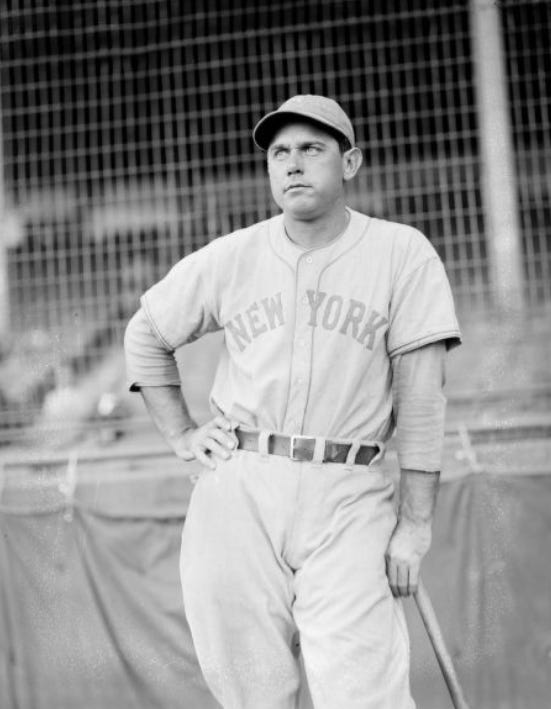
“Tell the public to have confidence. We are pulling through this very nicely and I thought that all things considered we had a good crowd out there today. We have proved we can beat the Cubs and we will beat them again.”
There was a confused pause.
“No, Bill, a statement about the earthquake.”
“Oh, so that’s what it was?” Terry said. “I didn’t know if we were supposed to mention it. If it’s all right to speak about it, I think this hotel is wonderfully constructed.”
Locals told the players the earthquake had been strong, but not a catastrophe. The “wonderfully constructed” Biltmore experienced only superficial damage. As a whole, Los Angeles fared relatively well. It would take some time for reports to begin arriving from points south, especially the city of Long Beach, 22 miles away. In Long Beach, the earthquake was a catastrophe.
At first the players were inclined to laugh off the experience and resume their evening. The initial quake, while frightening, had come and gone as a novelty.
As little as the players knew about earthquakes, they knew even less about aftershocks, but in the coming days they would learn. The Long Beach earthquake was really a series of dozens of seismic events of varying intensity. An Associated Press report after the first day documented 13 noteworthy shocks in the next six hours alone, employing some compelling descriptions:
5:50 - Jarring quake
5:55 - Severe shock
6:06 - Severe, but less intense
6:10 - Major shock
6:12 - Shock swayed area
6:16 - Another, lessening in intensity.
6:28 - Strong quake
7:25 - Strong quake
8:40 - Extremely heavy shock
9:10 - Even more violent than the first
9:19 - Another violent one
10:12 - Another quake
10:30 - Strong shock
10:59 - Buildings seemed to swirl
In California, buildings could swirl.
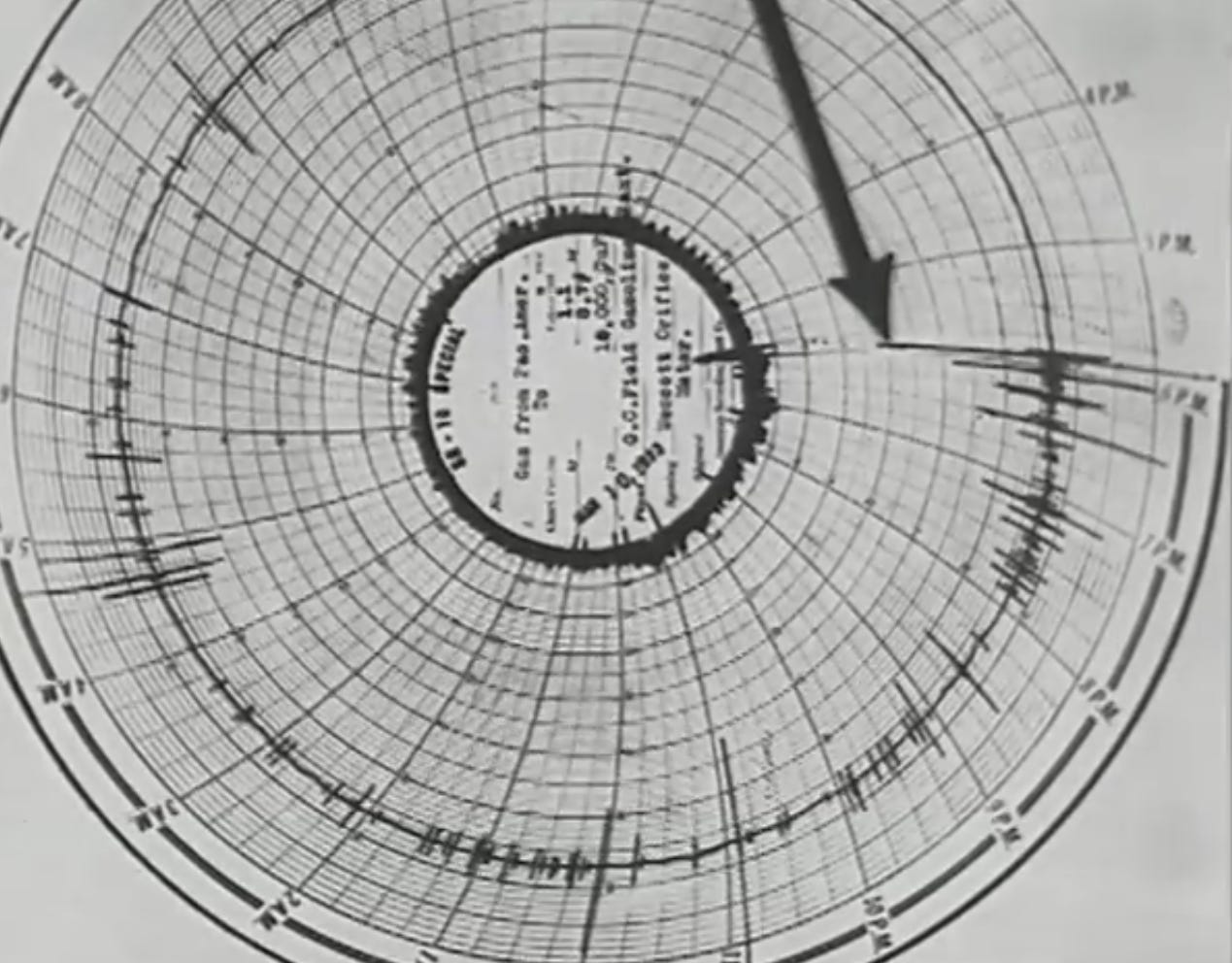
By around 6:10 p.m. (“Major shock”), the continuing tremors drove nearly all of the Cubs and Giants out of the Biltmore and into nearby Pershing Square. No one had told the players that earthquakes…kept going. The hotel shrugged off shock after shock, but many of the men were too afraid to go back inside. Terry tried to coax them, but he was met with crossed arms and planted feet. He couldn’t really blame them:
When the first wallop hit us, I was inclined to take it for a joke, and I remember making some crack about the shock of the Giants’ finally winning a game being too much. But when I started getting reports of how bad the thing really was, I’ll admit I was plenty scared.
As the hours passed, the temperature dropped, and a cold wind came up off the nearby coast. Many of the players were without coats. By this time Willie Schafer had joined them, and somehow the Giants’ players got Schafer to go inside and collect everyone’s outerwear. The elevators weren’t working, but Schafer, obviously a saint, made four trips up into the hotel tower, reappearing each time with armfuls of coats and sweaters.
Even in layers, the night sitting on the edge of a park brought “considerable discomfort” and strange sights. During one aftershock, Hughie Critz of the Giants saw water slosh out of a park fountain like a bowl of soup spilled by a clumsy waiter. It was the depths of the Great Depression and the financial crisis had gotten so bad that on March 6, the federal government had ordered all banks to close for at least four days until they could be assessed for stability and safely reopened. Looking around the shaken district, one of the Giants pointed out that the earthquake had managed to open at least one nearby bank by shaking out all its windows.
It was near midnight when somebody had the bright idea to shelter in the clubhouse at Wrigley Field. It would be warmer there than trying to sleep on the street. Wondering why they hadn’t thought of it sooner, the players hailed a fleet of taxis and made for the friendly confines of the ballpark.
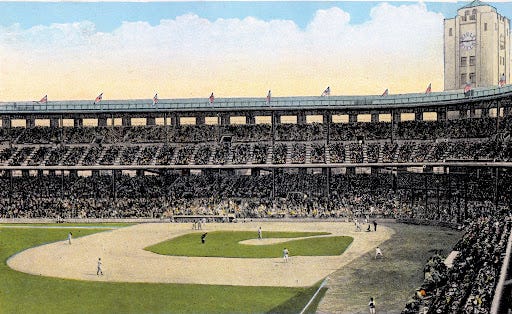
The players spread out. Some played cards all night, too shaken to sleep. Others lay down on the benches to try and sleep. When those filled up, some went onto the field and lay down on the grass. It felt warmer there, and the night was clear, illuminating the field with the light from stars. It might have been pleasant, except for the shocks. They camped in the outfield, far away from the damaged clock tower, which occasionally released a sickening sound they described as “crackling.”
In California, concrete buildings could crackle.
There was baseball on March 11. The Cubs and the Giants played another game at Wrigley Field, and the White Sox even kept their appointment with the Pasadena Merchants Association. As reports filtered north from Long Beach, where there had been enormous destruction and loss of life, the game went on.
The players were exhausted and literally rattled, “wondering from which direction the next blow would fall.” At least, for those that had spent the night in the park, the commute wasn’t bad. Despite the circumstances, 700 spectators showed up to watch the day’s game. They had their choice of seats, except for a central section of the concrete grandstand, which had been roped off after several unsightly cracks were discovered.
The game was played amid the continuing aftershocks. The umpire, Beans Reardon, decided the proper course of action was to call “time” until the ground stopped moving. Reardon’s family had lived in Los Angeles since he was 14, and he was described as the most relaxed person in the park. The writers in the press box wrote their copy as the structure “shimmied and swayed.”
The Cubs showed they were more tolerant of what locals called “earthquake weather.” Babe Herman hit a grand home run off Depression-era great Carl Hubbell, the ball “as well-kissed as a movie star,” and Kiki Cuyler tripled.
The Giants managed only five hits off two Cubs pitchers, Guy Bush and Charley Root. They lost, 4-1, but Bill Terry was willing to give them some grace. “Most of them got very little sleep last night, and I certainly couldn’t blame them, for I didn’t sleep any too comfortably myself.”
Things had settled down enough on March 11 that the players were persuaded to return to their upper-story rooms at the Biltmore, which had come through the tremors as sturdy as ever. Some of the men opted slept in their clothes, ready to make a quick escape. Charlie Berry was certainly among those so dressed.
At 5:15 a.m. on March 12, another aftershock, one of the most violent since the initial earthquake, sent everyone tumbling out of their beds and down the stairs once more.
Bill Terry almost moved the Giants out of Los Angeles right then. He asked Schafer how long it would take to get everyone packed up and cleared out. The manager decided to wait on the team secretary, Frank Tierney, who was returning from a barnstorming game in Santa Cruz. Tierney seemed to side with the manager:
Our sole purpose for being here is to get the players in shape for the opening of the championship. But how can that be done with such disturbances as we have been having ever since Friday night? Some of the players are not eating or sleeping at all. If this condition continues it would be practically impossible to get the team into shape.
After conferring with the Giants’ owner, Charles Stoneham, they decided to give California one more chance. “One more shock like that and we’re on the way,” Terry vowed. “The Giants will do the rest of their spring training in Phoenix, Arizona.”
The Cubs were showing strain, too. Second baseman Billy Herman had experienced “a nervous collapse” and was out of the lineup for the first time since 1931, and several others had reportedly not had more than a few hours’ of sleep since they went to bed on March 9.
Many players were reported to be losing the battle against their anxiety, saying they were so twitchy they didn’t expect to get another hit in California. That was all right for the regulars to say, but the Cubs’ fringe players didn’t have that luxury. Realizing they might be transferred to the Los Angeles Angels if they didn’t make the Chicago team, they redoubled their efforts to punch their ticket to safety.
The players handled the strain in different ways. Some were reported to have been “knocked right off the wagon,” looking for relief in illegal “snake-bite.”
Cubs right-hander Pat Malone went in the opposite direction. “I thought I wasn’t afraid of anything,” Malone said, “but that quake has taught me a lesson. It has made a Christian out of me.”
The original earthquake series concluded on March 13. A 9-7 New York win drew the teams even, an outcome that seemed fitting given all they had gone through together. The tremors had finally halted before the clubs went their separate ways. They scraped together various games with the White Sox, Pirates, and the local PCL teams until March 24, when it was time to head back east to begin the regular season.
The Chicago Cubs returned to their training camp on Catalina Island until 1947. The White Sox stayed in Pasadena through 1953. The Pirates stuck around, too. The Giants did not.
In 1934, Bill Terry brought his team to new spring quarters in Miami Beach, Florida, which they found much more to their liking. The Golden State had its charms, but after their bumpy visit in 1933, the New York Giants’ organization decided California wasn’t a good fit.
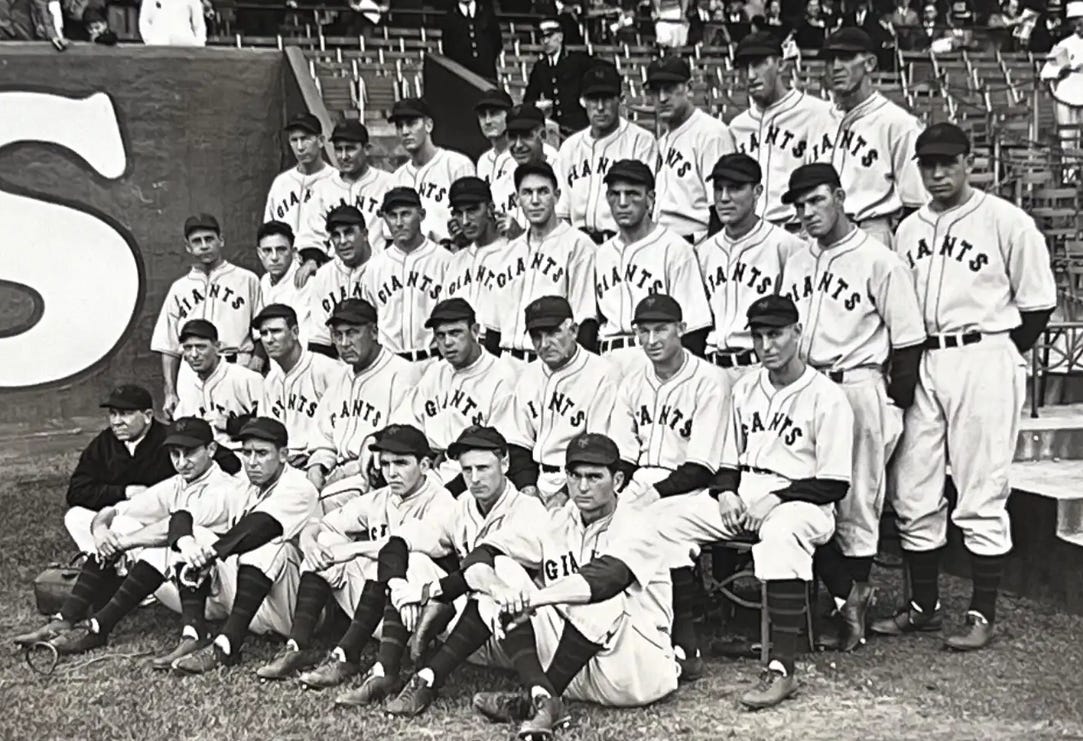

We intentionally wrote this story from the limited perspective of the baseball players who experienced the Long Beach earthquake from a relatively safe distance. The players departed unscathed (with some colorful stories to tell folks back East), but closer to the epicenter near Long Beach, between 120 and 140 people lost their lives. Nearly $1 billion (in 2026 dollars) of property—including nearly every public school building—was damaged or destroyed.
At least the earthquake became a galvanizing event in the modernizing California. The state went on to pass legislation mandating stricter standards for earthquake-resistant construction. If you’d like to learn more about the bigger picture of the earthquake, here are two suggestions:
Overview with first-person snippets and photographs
Archival footage with narration:
Over on Clear the Field:
Ted and I debuted two all-new stories on the podcast—it’s the first CtF world exclusive! The result is an All-Star lineup of tomato stories, the subgenre we never knew we needed. Grab some salt and pepper and dig in.

Terrific story and writing! Had never heard this story before.
Great work Paul!