


Welcome to Project 3.18, a free weekly publication where a fan-first writer tells strange and surprising stories from baseball history and culture.
Today is the 49th anniversary of Ted Turner’s managerial career, which began and ended on May 11, 1977. In between last week’s Part 1 and today’s conclusion, Turner passed away at age 87.
This story isn’t about Turner the billionaire or Turner the philanthropist or Turner the egomaniac. It’s about a 38-year-old go-getter who succeeded at everything he did until he got his hands on a major-league baseball team. Dave Bristol, the manager Turner briefly replaced, said his boss “burned a different kind of gas than the rest of us.” That’s what this story is about: a different guy at a wild time.

When the Hall of Fame inducted its second-ever class in 1937, one of the enshrined, Connie Mack, was wearing multiple (straw) hats.
Mack had managed the Philadelphia Athletics since the team formed in 1901, and he soon purchased a minority stake in the franchise. By 1913, Mack owned 50% of the club, and in 1937, the same year he was elected to the Hall, he acquired enough additional shares to take controlling interest of the Athletics. He did double-duty until retiring in 1950.
For most of that time, Connie Mack was the only owner-manager in the major leagues, but a handful of others came and went. In 1925, for example, there were three owner-managers. In addition to Mack, Branch Rickey managed the St. Louis Cardinals, a team in which he had a financial stake, and Wilbert Robinson managed the Brooklyn club, which had become so entwined with its manager that the team took on his name.
Mack, Rickey, and Robinson have three things in common: the tools of ignorance, plaques in Cooperstown, and sprawling baseball careers in which they started at the bottom—as players—and worked their way up, first to managing, then to ownership.
But there were others who took the Turner route: entering baseball as owners without any dugout experience until the day they succumbed to temptation and put on a uniform.
One of these audacious pioneers made his mark in the 19th century. Between 1895 and 1897, Chris Von Der Ahe, a brewer who bought a baseball team to sell more beer, made regular appearances as the manager of his St. Louis Browns.
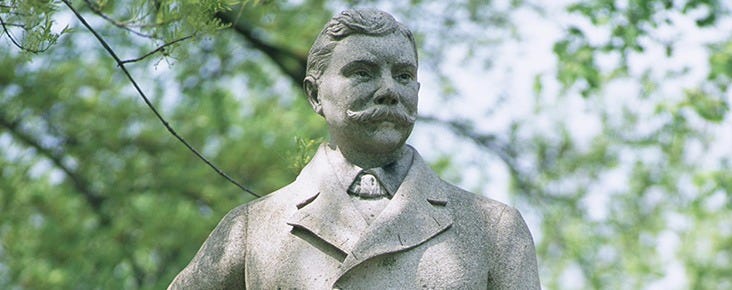
Field managers didn’t last long under Von Der Ahe, who had a pretty high opinion of himself—three years into his baseball career, the owner had a statue of his likeness installed outside the ballpark. Between 1895 and 1897 the Browns burned through 10 managers, and Von Der Ahe took several turns. He went 1-0 in 1895, 0-2 in 1896, 2-12 at the end of 1897, but after that his beer and baseball empire collapsed. Within a few years he’d lost everything, including the Browns, and went back to tending bar. The team thoughtfully held onto Von Der Ahe’s statue, and when he died in 1913 (cirrhosis of the liver), it was installed over his grave.
The most prolific top-down owner-manager was another Braves’ owner, Emil Fuchs. Commonly referred to as “Judge”—he served as a New York magistrate for one year in 1917 but kept the title for life—Fuchs, a lawyer by trade, became the principal owner of the Boston Braves in 1923.
In 1928, the team’s rookie manager quit early in the season and Fuchs replaced him with Rogers Hornsby, the Braves’ star second baseman. Despite Hornsby’s typically stellar hitting (he batted .387 that season) the Braves lost 103 games and finished seventh in the eight-team National League. Fuchs decided the team couldn’t afford Hornsby’s $40,000 salary and traded him away. The judge had only played one year in a fringe minor league back in 1897, but he decided to manage the 1929 Braves himself to keep costs down. Fuchs’ brainstorm was apparently encouraged by friendly Boston baseball writers, whom he referred to as “my board of directors.”
“I don’t think we can do any worse,” he said at the start of his managerial career. Well, yes and no. With Fuchs at the helm for the entirety of the 1929 season (except for most of May, when he left the team to argue a court case in New York), the Braves won more games but finished in eighth place.
Despite the dreadful results, the players were content with their new manager. They hadn’t expected to win anything, anyway, and the judge was charming, happy to sit on the bench smoking cigars and spinning yarns. He seemed a marked improvement over Hornsby, one of the most disagreeable individuals in the National League.
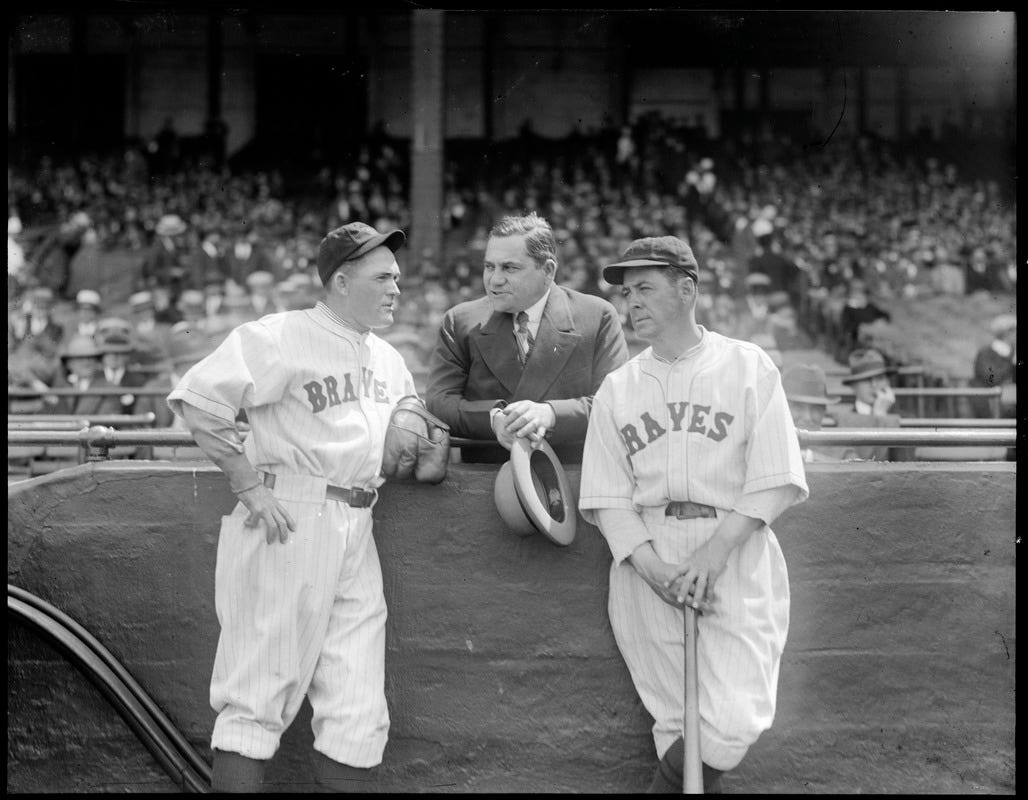
The distracted, chatty Fuchs stretched the title of “field manager” to its limits, rarely glancing in the direction of the field. A popular anecdote told of a Braves hitter batting with a 3-1 count. Johnny Evers, the team’s third base coach, looked in to see if the judge would make the “hit” or “take” sign, which Evers would relay to the batter, but Fuchs was in the middle of telling a story and not paying attention.
Evers called time and walked to the dugout. “Judge, it’s three and one,” he said. “What do you want him to do?”
Fuchs quickly assessed the situation and made the tough call. “Oh, tell him to hit a home run.”
After that the players mostly ran things themselves.
Fuchs’ “board of directors” must have had a change of heart after the team’s 1929 performance, because in 1930 Fuchs opened his wallet to hire Bill McKechnie, a respected manager.
From then on, the rest of baseball’s owners (save Connie Mack) kept well clear of the dugout benches. Until May 1977, when another novice manager took the helm of another struggling Braves team.
On May 11, 1977, the day Ted Turner managed the Atlanta Braves, an enterprising newspaper editor tried calling commissioner Bowie Kuhn’s home phone number to get a comment on Turner’s latest sacrilege. Alas, “Mr. Kuhn will be out for the rest of the evening.”
In fact, Kuhn and Chub Feeney, the president of the National League, were conveniently together, in Columbus Ohio, dedicating a new minor-league ballpark there. In this era, the individual leagues were separate and semi-autonomous, and Kuhn was glad to delegate when it came to disciplinary matters that did not involve money or cheating. That made Ted Turner Chub Feeney’s problem.
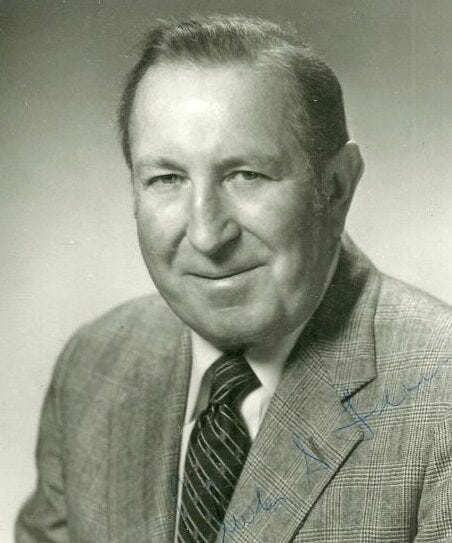
Speaking to reporters in Columbus, a cross-looking Feeney said Turner’s managerial move came as an extreme shock. “Let’s put it this way: it’s never been done before.1”
The Braves’ series with the Pirates concluded on May 12. Going into that game, Atlanta had lost 17 in a row. Sixteen of those losses were credited to manager Dave Bristol, now in seclusion at his home in North Carolina. The 17th loss went to “acting coach” Turner, who had every intention of returning to the dugout on May 12 to try and get back to .500 as a manager.
Turner donned his uniform as soon as he arrived at Three Rivers Stadium that morning. A reporter noted (without telling Turner) that the owner had put his socks on wrong, and he wondered aloud whether it was appropriate to wear sunglasses in the dugout: “No, I don’t think I should.” One of the Braves’ coaches, Chris Cannizzaro, filled out the lineup card and Turner signed it.
Chub Feeney got in touch about two hours before the start of the afternoon game, wanting to know what the heck Turner thought he was doing.
“It’s only a temporary deal,” Turner told Feeney. “Nothing’s going to happen to the Atlanta franchise. It’s going to be better over the long haul.”
Feeney asked Turner how he’d gotten around the contract requirement; Turner said he’d signed one, to be a coach. He promised to have Bill Lucas, the Braves’ general manager, fly to New York that morning to deliver the contract and prove that all was in order.
“It’s not the contract itself,” Feeney said, “but a relatively inexperienced man managing the team. I need time to mull this over.”
Feeney asked Turner to watch from the stands that afternoon, ostensibly so he’d have time to “mull,” but really to give him a few hours to search for a regulation that could forcibly keep Turner out of the dugout.
Crestfallen, Turner wandered onto the field and joined pitcher Andy Messersmith to run laps and work off some frustration. The jogging pace helped him dodge the gathering reporters, microphones, and television cameras. “I wish I could hit somebody,” he told Messersmith, “but there’s nobody to hit.”
The pitcher, who owed Turner for signing him off the owners’ unofficial blacklist, ardently defended him to the press:
He’s the best owner in baseball, and the other owners are trying to blackball him out of the game. They’re sticking it to him every way they can.
They’re just loving this nose dive we’re in because they can say, ‘See, you can’t have fun playing baseball, you can’t be loose, you can’t be interested in the fans and the players before profits.’ Ted may be off-the-wall, but he’s genuine. His word is good. Brother, in this game, that’s unique.
After the Braves’ pregame workout, Turner met with the players to explain that third base coach Vern Benson was taking over. His one day in uniform seemed to have softened Turner’s earlier “fight like men” sensibilities. In his last act as manager, he encouraged the players to “have fun.”
For once, they did.
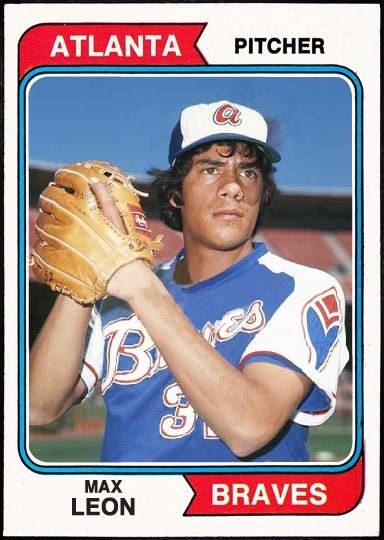
The Braves turned their hopes over to a converted reliever named Max León, who cut through the Pirates as no pitcher had done that year, chipping in a sacrifice fly in the third. In the eighth inning, the Braves scored four times, including a two-out single from León that scored two runs. Call it the Max León Game. Why not?
In the mostly empty stadium, Ted Turner’s congratulatory bellows carried everywhere. He was back in his usual spot behind the dugout, dressed in an open-necked shirt, slacks, and his Braves cap, spitting Red Man tobacco juice into a paper cup in between outbursts. After León’s eighth inning hammer blow, the owner leaned over into the dugout to slap the pitcher on the back.
“Managing isn’t all that difficult,” Turner observed as he settled back into his seat. “Just score more runs than the other guy.”
When the game ended in a 6-1 Braves victory, the owner jumped out onto the field and shook every hand in reach. “Alll riiiiigggghhhttt!” The losing streak was over and the clubhouse party was on.
One of the veterans, outfielder Jeff Burroughs, had ordered cases of beers and chilled champagne in anticipation of the moment. “Let’s play again right now,” Burroughs yelled. “We’re hot.” The stereo volume was cranked up.
“We’ve been snake-bitten and depressed,” Burroughs said, taking a pull from a champagne bottle. “But mostly we’ve just gotten our brains clobbered in day after day. It’s been pretty humiliating. After a while, it’s like being in the Twilight Zone.”
Ted Turner opened a beer and looked around wistfully. “I’d wish I’d been down there to take some of the credit for this.”
The owner eventually excused himself from the party to call Chub Feeney. At least one writer, Thomas Boswell of the Washington Post, seems to have gotten Turner’s permission to listen in on the conversation. Turner dialed Feeney’s office and his secretary picked up.
“Hey, give me the chief, please,” Turner said. “Tell him it’s the little Indian from Atlanta.”
A pause, and then the NL president came on the line. “Hey, Chuberoomboom,” Turner half-shouted. (Boswell did his phonetic best with that greeting.)
Feeney was ready, armed with a rule so old, dust wafted out the phone as he read it. Turner listened, then put his hand over the speaker. “He says there’s some rule against a person managing or playing for a team that he owns stock in.” He rolled his eyes. “They must have put that rule in yesterday.”
In fact they had put it in 50 years before—because of Rogers Hornsby.
In 1926, Hornsby had his weakest offensive season of the decade, hitting just .317 while he managed the St. Louis Cardinals to a World Series. By then Hornsby had acquired $60,000 of stock in the team, quite a sum compared to his annual $30,000 salary. But he had worn out his welcome in St. Louis, and even his status as a minority owner didn’t free Hornsby from the iron hands of the reserve clause. After the 1926 season the Cardinals traded him to the New York Giants.
Hornsby’s stock in the Cardinals created a clear conflict of interest, and the National League president at the time ruled that Hornsby the Giant must divest from his former club. Sam Breadon, the Cardinals’ controlling owner, offered to buy Hornsby’s stock back at $45 a share, the same price he’d paid for it.
Hornsby demanded three times that. Was he supposed to believe the Cardinals’ value hadn’t moved at all, even after he helped the team win a World Series? He accused Breadon of trading him to engineer the cut-rate stock buyback. The impasse threatened the integrity of the reserve clause; St. Louis could trade Hornsby, but they couldn’t make him sell.
The Giants, understanding that Hornsby’s drawing power sold tickets in every park he visited, proposed that the other, uninvolved clubs chip in to buy the stock back at Hornsby’s preferred price. Amazingly, all six uninvolved NL teams agreed to pay, averting the fiasco, but the owners were determined to avoid any more like it. In 1927, Major League Rule 20, Section E went on the books, the Hornsby Rule:
No manager or player on a club shall directly or indirectly own stock or any other proprietary interest or have any financial interest in the club by which he is employed except under an agreement approved by the commissioner.
Hearing Feeney recite the rule, Turner seized on its soft spot immediately. “Well, let’s ask the commissioner, the old super chief, for approval for me to manage this team of mine.”
The conversation continued as Boswell captured the side he could hear, word for word.
“Sure I want to do it. It’s my team. The worst that can happen is I lose some games, and I’m already losing plenty of them.”
…
“No, I don’t want to fight, Chub. Asking isn’t fighting. I just want you to ask the big chief. You’re the league executive. It’s your job.”
…
“I’ve only had one beer. I’m drinking Rolling Rock Premium.”
Feeney told Turner to wait 45 minutes and think it over, and then call back. Turner hung up, grinning. “Poor Chub. I think he really likes me, but the other owners give him so much grief he can’t show it.”
Exactly 45 minutes later, Turner called back.
“Yeah, Chub, I still want you to ask the super chief.”
…
“No, I’m being a good boy. No more lawsuits. I’m sick of court. I just want to get along with all the big chiefs.”
Turner hung up, shaking his head. “What’s the difference between the seats and the dugout bench—twenty feet? They take it all so seriously.”
In what we think was half a compliment, Boswell wrote that Turner seemed “as anarchic and creative as a child.” The owner was certainly childlike in his reaction to hearing “No.”
“I want to manage even more now,” he said, “because they don’t want me to.”
In Andrews, North Carolina, Dave Bristol, the Braves’ manager-in-exile, tried to get away on May 12, spending the day riding horses at a friend’s house. At least one reporter tracked him down there, and he obligingly gave an interview in the middle of a pasture, waving flies away. The “scouting trip” had not materialized. “I think they just threw that in the other day as I was leaving,” Bristol said.
The reporter asked him about Turner’s on-the-ground assessment of the Braves as “snake-bitten.”
“I don’t know,” the manager said, “usually when a snake bites you he just bites once and then crawls away.” To Bristol, the 1977 season seemed more like a boa constrictor.
“I’m planning to come back,” he said. “I don’t know exactly what I’m supposed to do right now because there’s no precedent for this. I want to come back. I don’t feel I accomplished what I set out to accomplish. But if Ted gets back in the dugout and they win a few more games, he might still be managing when the grapes turn ripe.”
The Braves returned to Atlanta on May 13. As it turned out, so did Dave Bristol.
Early in the day, Bowie Kuhn completed a whirlwind review of Turner’s request to manage the Braves, which Feeney had prohibited under Rule 20 Section E. The rule was obviously intended to guard against conflicts of interest, and there were none in Turner’s case2, so Kuhn fell back to his shelter of last resort: the best interests of baseball. “Given Mr. Turner’s lack of familiarity with game operations, I do not think it is in the best interests of baseball for him to serve in the requested capacity.”
“He said I couldn’t even sit in the dugout as an observer,” Turner complained. “A good leader is with his men when they’re in trouble. They needed a fresh approach.”
Immediately after Kuhn’s decision, Turner said he wasn’t sure if Dave Bristol would return, but saner heads, probably Bill Lucas’, prevailed, and Bristol was back in the trenches that night. The Braves lost that game and the next one, but Bristol said he was nonetheless “thrilled to death” to be back.
Ted Turner said he did not plan to fight the decision barring him from the dugout. “One lawsuit at a time.” But he was disappointed and frustrated.
“If you lose a million and a half dollars a year, you should be able to do what you want with a ball club,” he said. “Something’s gone wrong in this game. It’s like One Flew Over the Cuckoo’s Nest. I’m either the only sane one around here, or the only crazy one.”
A few days later, he was neither. On May 19, a judge upheld Kuhn’s earlier decision to suspend Turner for the season for tampering in Gary Matthews’ free agency.
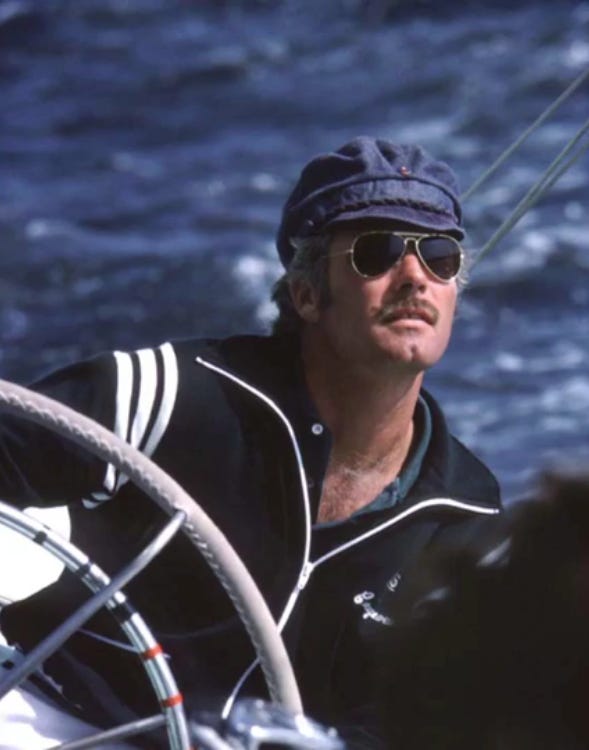
Barred from land warfare until 1978, the Braves’ owner returned the water. In the prestigious America’s Cup sailing competition that September, Turner redeemed his tarnished reputation as a skipper with a 4-0 sweep.
He even got to wear a uniform with sunglasses.
Feeney was quite wrong in saying an owner like Turner had never managed. From reading Project 3.18, you know more about the history of owner-managers than at least one president of the National League.
Tellingly, when Judge Fuchs appointed himself manager of the Boston Braves in 1929, just two years after the Hornsby Rule was ratified, no one tried using it to stop him.
Managing an MLB team is a sobering experience. . .even for a billionaire. Good piece, Paul.
Just goes to show ‘ya how much corruption is in the world & that includes baseball & judges (not Yankees #99).
Somewhere I seem to remember a National League owner of a club who was also Commissioner of MLB I think.
If this is in fact true… there exists no ‘conflict of interest’?
I hope I’m wrong as this is clearly out of the question illegal in my view.