


Welcome to Project 3.18, where a fan-first writer tells strange and surprising stories from baseball history and culture.
If you enjoy what you read today, please subscribe to receive our free feature stories in your inbox. And if you’ve been here for a while, we could really use your support as a paid subscriber. Paid subscribers receive access to exclusive content and help keep this publication going and growing.
Regulars at Project 3.18 may recognize the name “Charles O. Finley.” Finley was the most colorful baseball owner of the 1960s and 1970s and one of the most successful: His Oakland Athletics teams won back-to-back-to-back World Series championships between 1972 and 1974.
The owner of the Kansas City/Oakland A’s was flamboyant, abrasive, and impossible to trust, an overbearing control freak who saw himself as the protagonist in every room. He was gregarious and witty—in small doses—and a shrewd negotiator who did his best work when underestimated. Some of his ideas were well-intentioned failures, others succeeded by pandering to the crowd’s basest impulses, and one brainstorm somehow became the perfect capper for the career of a Negro Leagues legend.
Today we’re diving into one of Finley’s most successful and long-lasting partnerships. We refer, of course, to his connection with a sorrel-colored Missouri mule he named in honor of himself.

A mule is the offspring of a male donkey and a female horse. They are nearly always the result of human-directed interbreeding, because mules have been prized working animals for thousands of years. They possess the donkey’s intelligence, durability, and disposition, and the horse’s speed, agility, and willingness to be led. Some cultures prize them above the best horses; George Washington, America’s wisest Founding Father, was a huge mule guy.
Charles Darwin, the evolutionary naturalist, was also a fan:
The mule always appears to me a most surprising animal. That a hybrid should possess more reason, memory, obstinacy, social affection, powers of muscular endurance, and length of life, than either of its parents, seems to indicate that art has here outdone nature.
The state of Missouri has a long and proud association with the mule. As the gateway to the American West, Missouri became a prominent center for breeding mules used in agriculture, transportation, and war. One Missouri-based company supplied the United Kingdom with 350,000 mules used during World War I. The official state animal is…you guessed it:
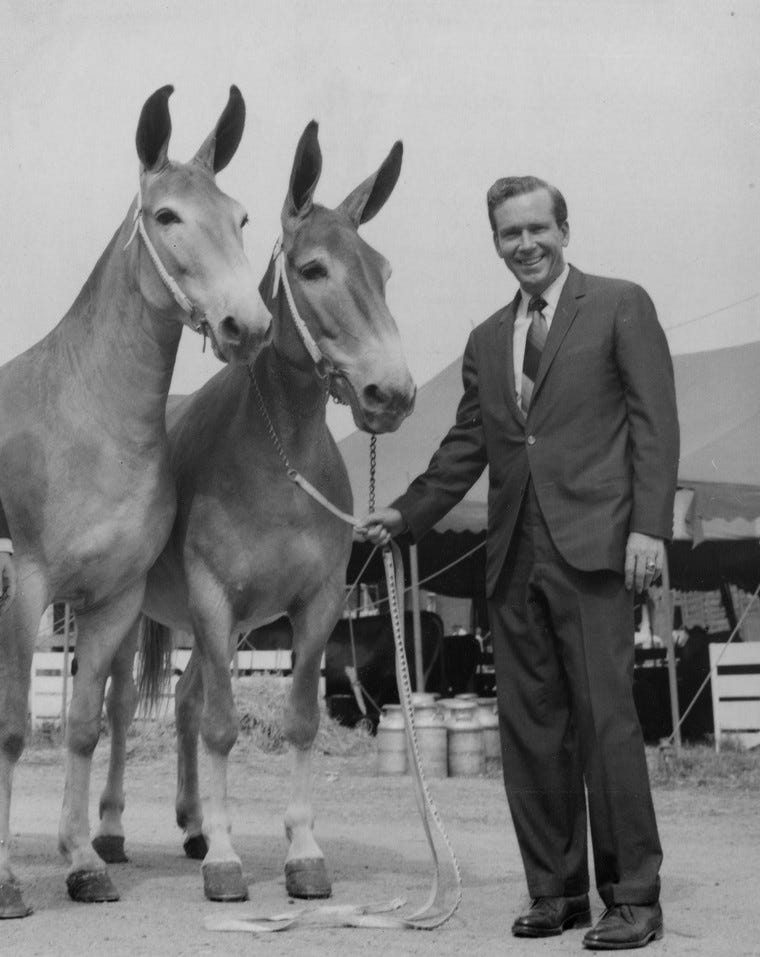
In the mid-1960s, just as pandas once served as a tool of rapprochement between the United States and China (really), Missouri’s beloved mule was sent to mend a growing rift between Kansas City and the eccentric Chicago insurance magnate in control of Kansas City’s baseball team.
Hostilities had erupted in 1964, when Charles Finley reversed earlier pledges to keep the Athletics in Kansas City and entered into two different agreements to relocate the team, first to Louisville, Kentucky, and later to Oakland, California. The other American League owners united to block both moves, but hard feelings proliferated in Kansas City. The rebuilding Athletics lost 105 games and drew just over 640,000 skeptical, disheartened fans, the worst and second-worst numbers in the league. Finley claimed that with what he spent to restock the team’s bereft farm system and the poor attendance, owning the Athletics had cost him $600,000.
Somehow the league persuaded Finley to sign a four-year lease to stay in Kansas City and make a go of things. In return, the city’s civic leaders made a concerted effort to embrace the A’s and convince jilted locals to hold their noses and support the team while they had the chance.
At a Chamber of Commerce meeting on February 8, 1965, Kansas City’s mayor, Ilus Davis, announced a drive by local businessmen to sell 5,000 season tickets. “This is a new era as far as cooperation between the city, the team, business, and state government in support of the Athletics.”
Until he could secure safe passage out of town, Finley had no alternative but to cooperate. He told the group, “We are doing everything possible to build a championship for Kansas City,” but “we need the support of Kansas City.” He also unveiled some new attractions meant to help smooth things over.
Back in 1961, Finley had imported a herd of sheep to graze on a sloped grass terrace beyond right-center field. Now he announced the sheep were out, because they were not “winning sheep.”
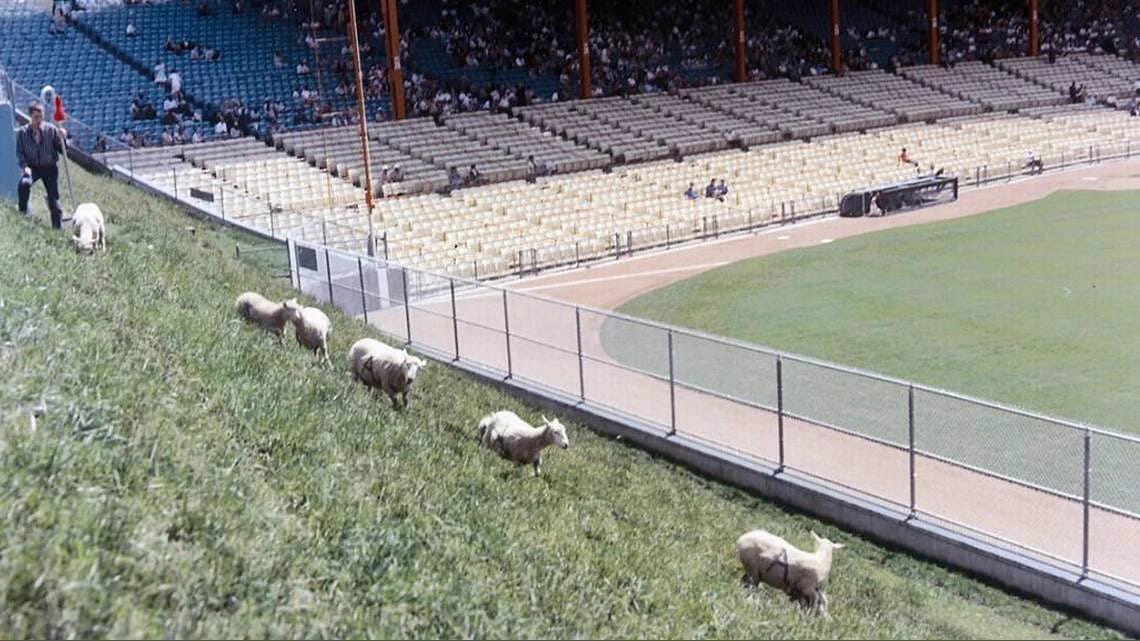
To Finley, any firing was a chance to trumpet a new hire, and this was no exception. He announced that a new animal was joining the A’s, one with deep local roots. “As long as I own the team, its mascot will be a Missouri mule.”
Warren Hearnes, the governor, broke in: “I’d consider it an honor and a privilege for Missouri to donate this mule to the A’s.” Finley accepted. Hearnes also said he would like to be the first to purchase a season ticket. The owner leaped from his chair and obtained the governor’s signature on the spot. These men no doubt hated each other.
A week later, after introducing former Athletics player Whitey Herzog as a new coach, Finley warned that the A’s needed to draw between one and two million fans in 1965 to break even. That was quite a target for a team that showed no obvious signs of improvement on the field. The owner also gave an update on the mascot. “I talked to the governor today and he said they think they have the right mule. He weighs 1,265 pounds and is 15 hands, 2 inches high. He’ll be a beautiful mule.”
He also unveiled the Name:
You know, when we decided to make our mascot a Missouri mule, somebody suggested I didn’t have enough guts to name him “Charlie O.” I said, “That’s where you’re wrong.”
Finley vowed to make his namesake “the most famous mule in the country.” The owner seemed to believe, or at least be open to the possibility, that parading the right animal around town could win over cynical hearts and minds. “When the A’s hit a home run, we’ll play this…” He reached down and played a record of a braying mule braying. He announced that the team’s new theme song would be “Mule Train,” an old cowboy song most famously recorded by Tennessee Ernie Ford. He also promised to show off Charlie O. at every park in the American League.
“I never do things by halves,” Finley said that spring. “I never take the middle course. I am an extremist.” It was hard to imagine that mule ownership could be taken to extremity, but if anyone could, it was Finley.
It didn’t take long. That night the owner called one of his favorite mouthpieces, a sycophantic newspaperman in his hometown of Birmingham, Alabama. Finley woke the reporter up in the middle of the night and seemed lost in an episode of mule-induced mania:
“Yes, I plan to ride our mule on opening night. Of course, I’ll ride him bareback. Not even [commissioner] Ford Frick would think about putting a saddle on a mule.”
“July 11 will be ’Mule Day.’ We are going to have the only high-diving mule in the world. This diving mule dives from a 50-foot high tower into a six-foot tank of water.”
“We’ll have races with Roman chariots pulled by two mules. I am going to invite the governor, the senator, even my good friend, Mayor Richard Daley of Chicago, to ride in the chariots.”
“It’s a great new day dawning for all mules. Charlie O. will be a leader, the handsomest mule of all.”
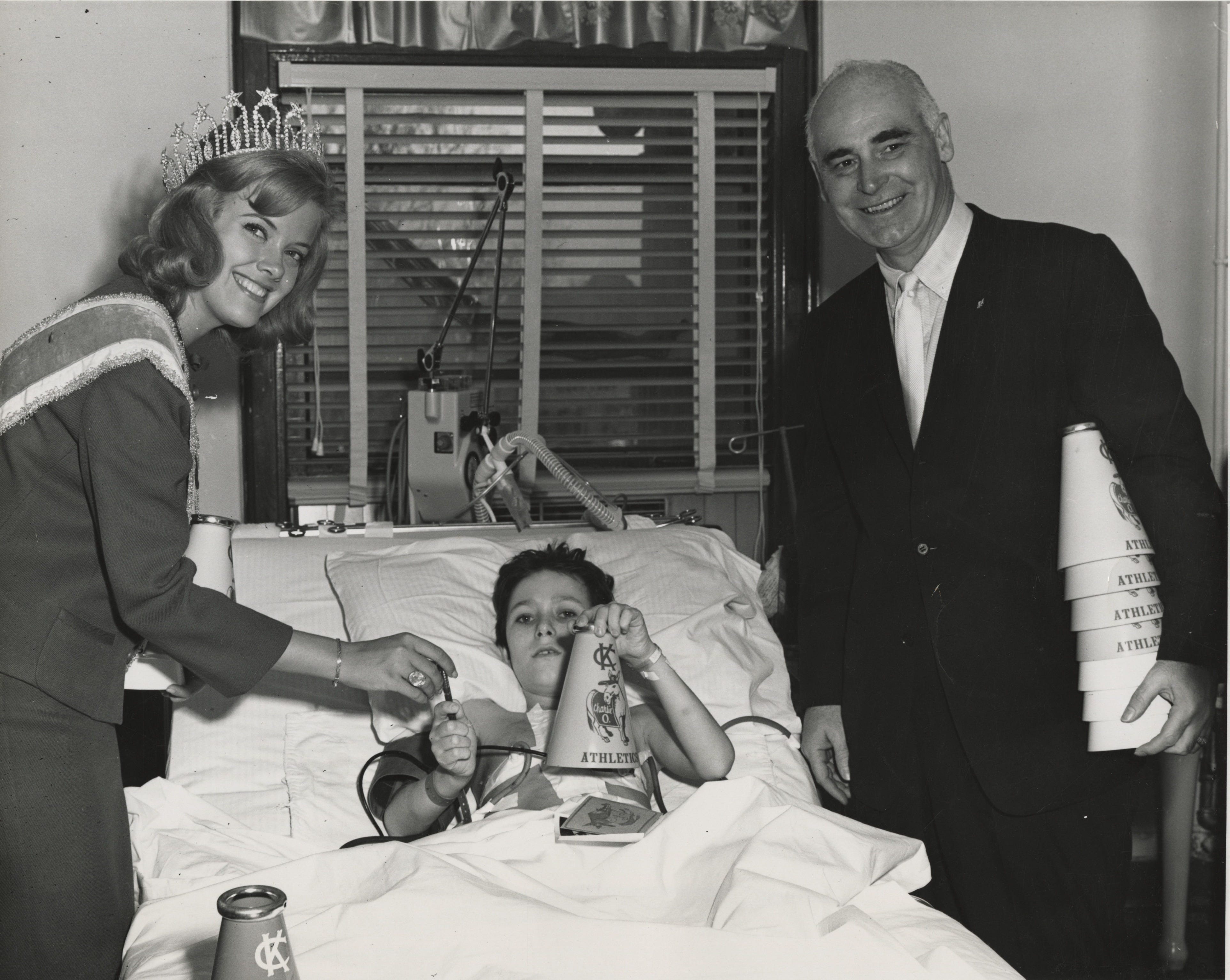
On March 30, the world’s most handsome hybrid met his public. The three-year-old mule was certainly a fine specimen, large, cream and golden brown, and good-tempered. He had completed a crash course of training at the riding stable where he’d live, overseen by a former trainer for the Ringling Brothers circus. “He’s got a very nice disposition, for a mule,” one of the stable owners said. “Mules aren’t usually ridden, but we’ve been getting him used to it.” Finley reiterated his plan to ride Charlie O. on opening night and, to cover all quadrants of audience interest, he’d commissioned the reigning Miss USA pageant-winner to throw out the first pitch and serve as “bat girl” for two innings.
There was a cake of carrots and apples, but Charlie O. passed in favor of the oats he knew his handlers had nearby. The reporters enjoyed coffee and pastries while Finley showed off the mule’s custom-built barn, generously donated by a baseball-loving local businessman who clearly knew what was good for him. The green and gold barn had its own hi-fi stereo system for delivering “soothing music night and day.” Highlights from the playlist: the aforementioned “Mule Train,” “Take Me Out to the Ballgame,” and “Missouri Waltz.”
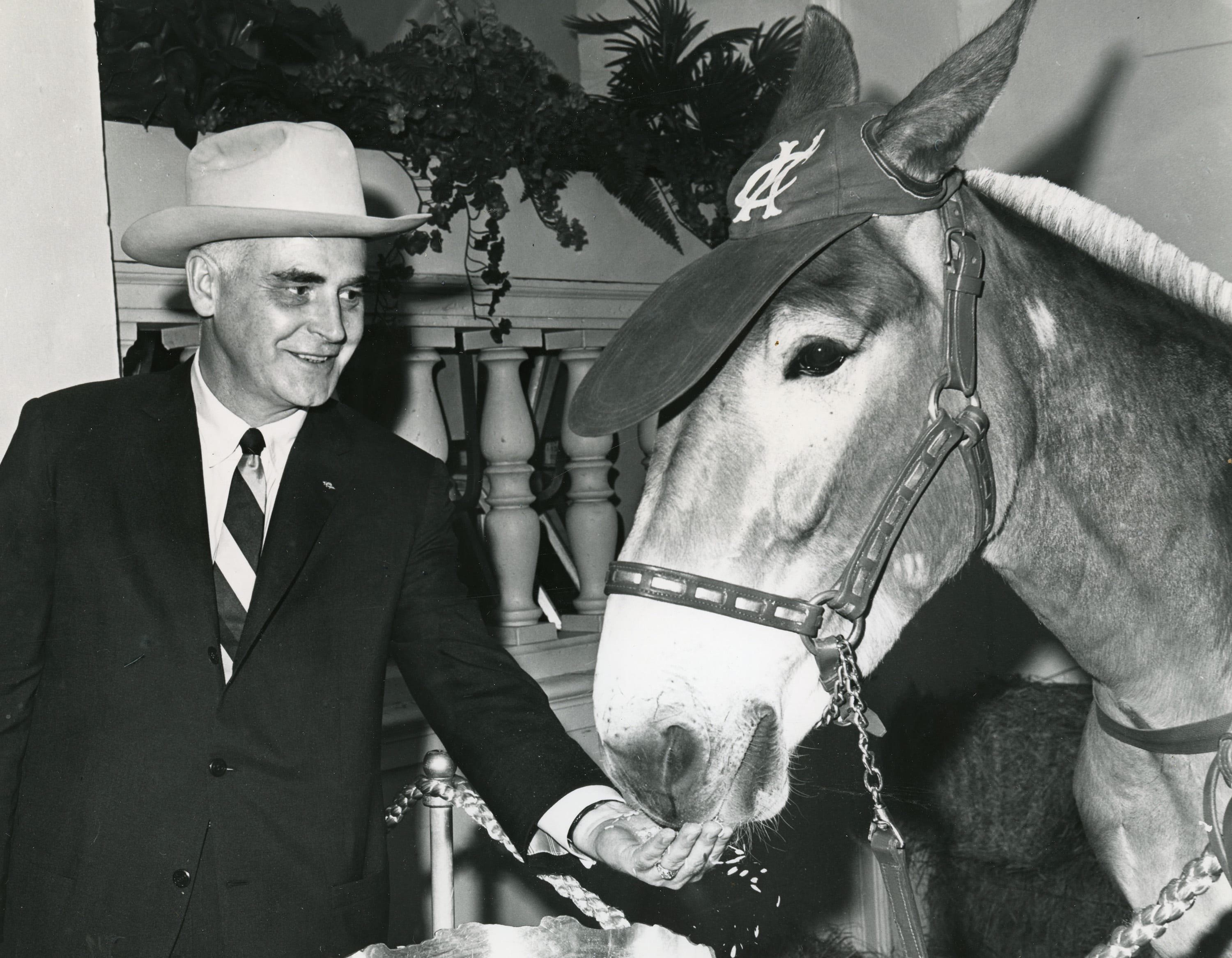
Charlie O. would also have special quarters at Municipal Stadium. During games he would be staked safely in an outfield picnic area planted with sugar maple trees. It would be a good life, Finley promised, with no hard labor. “We will feed him eight quarts of oats a day, and every time the A’s win he gets an extra quart. I figure that will help him maintain his interest in the pennant race.” By this point Charlie O. was up to just over 1300 pounds, mostly because of all the oats.
Next, reporters got to see what Charlie O. could do. The mule was proving a good student; he learned to bow during introductions and was being taught to nod or shake his head in response to questions.
The sports editor for the Kansas City Star had a question for the owner: “Why a mule mascot for the Athletics?” Finley had been preparing for this. If he didn’t have a photographic memory, he had something close to it, and he’d studied up on mules at the Kansas City Public Library. He recited a 900-word lecture on the history of mules, from ancient Mesopotamia to Lathrop, Missouri, citing dates, places, and names. (We read the whole thing; you don’t have to.)
The dissertation turned out to be a preamble for his actual answer. Mules had one trait Finley really identified with: “Mules are friendly—if you treat them right,” he said. “Treat a mule wrong and he’ll fight back. He’ll kick you.” Kansas City leaders, take note.
Speaking of kicks, the meet-and-greet was briefly clouded by breaking news. Earlier that day, a disgruntled former Finley employee named Frank Lane, now working for the Baltimore Orioles, warned reporters that Finley was planning to relocate the Athletics to Milwaukee as soon as the Braves completed their planned move to Atlanta. Milwaukee was much closer to Finley’s Chicago-based insurance company and northwest-Indiana home. Lane warned the baseball public that any show of reconciliation in Kansas City was a performance—Finley would bolt as soon as he got the chance.
Lane’s comments made for some uncomfortable party conversation when reporters pressed Finley to respond. “That’s what makes me mad about you guys,” Finley said. “We came out here on a nice day to show you the mule.” Questions about relocation to Milwaukee made poor barn-warming gifts.
And then a flash of Finley’s genius: “I think it’s more apropos for the mule to answer somebody like Frank Lane.” The owner asked Charlie O. if there were any plans for the A’s to leave Kansas City, and the trainer gave the signal. Recognizing the cue, the mule shook his head in the negative, “rolling his big brown eyes in horror.” Finley got out of the conversation and Charlie O. got another handful of oats.
The mule was quickly put at the front of a whole menagerie. Finley was an animal lover and he let his fancies run wild that spring, stuffing Municipal Stadium with as many critters as possible. A little-used left field picnic area was repopulated with two peafowl, an enclosure full of checker rabbits, several golden pheasants, and a small troop of capuchin monkeys obtained, surely under false pretenses, from Chicago’s Brookfield Zoo.
The topper was a short-haired German pointer puppy named Old Drum, donated by influential Missouri Senator Stuart Symington, who surely hated Finley even more than the governor did. At various points Old Drum was to be a companion for the owner, for the mule, or for the stadium grounds crew, but the plan to keep a dog among pheasants was flagged from the start: “The fear is that the pup…will become a mental case by the end of the season.” In fact it took nowhere near that long; Old Drum proved too unruly for the grounds crew and was donated to an umpire who had experience training dogs.
Finley was delighted to invite Kansas Citians to “the first and only zoo in the major leagues.” And if people stuck around long enough there would be a baseball game…but he made no guarantees as to its quality.
For opening night on April 12, Finley put together what he truly believed was “the greatest opening program in baseball history.”
The procession began with a large hay-cart laden with food for the zoo animals, green and gold blankets of English wool, bales of straw, and state and local government officials, all of whom had set aside their dignity in the service of saving Kansas City baseball. (Chicago’s Mayor Daley had not made the trip.)
The dignitaries were introduced at home plate and each symbolically provided some of the zoo’s critters to the A’s organization on behalf of a grateful population. The big moment came arrived as a green and gold truck towing a custom-built green and gold livestock trailer drove onto the field.
“Out stepped the most handsome mule I have ever seen,” Finley’s Birmingham-based sycophant wrote. “On his head was a green cap with the letters ‘KC.’ On his very wide back was thrown a stunning gold and green blanket.”
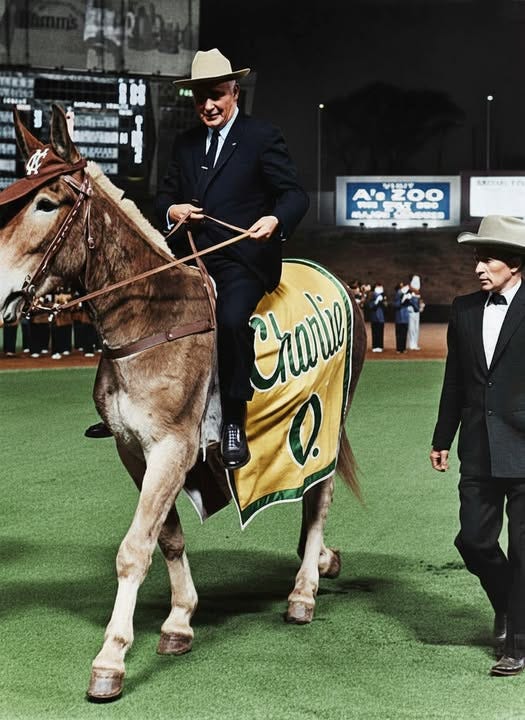
With a trainer holding a lead rope, Finley clambered onto Charlie O. and began a circuit of the bases. There was a dicey moment when the mule passed first base and seemed to consider whether or not he would consent to turn, but in the end the decision went Finley’s way and the owner grew bold enough to take off his white cowboy hat and wave as the animal was led around second. There were “whoops and hollers” from the crowd—and more than one impatient cry of “Play ball!” as the festivities ran long.
Next, Bobbi Johnson, the first Miss USA from the District of Columbia, threw out the first pitch. Ms. Johnson received her own set of “whoops and hollers” in the course of her task, but handled the moment with practiced grace.
The game started 25 minutes late, but Finley had one more surprise planned. In an earlier innovation, he installed a mechanical rabbit which emerged from the ground to provide the home plate umpire with fresh baseballs. In the bottom of the first inning, home plate umpire Bill McKinley stepped on the lever to summon the rabbit. The contraption emerged as usual but when McKinley opened the compartment holding the baseballs, a flock pigeons and pheasants escaped from inside1. McKinley was hardly amused, nor was Detroit Tigers catcher John Sullivan, who was hit by droppings as the prisoners made their escape and circled the field.
“If the program wasn’t the greatest in baseball history, it certainly was one of the longest,” a critical observer wrote, noting the crowd’s ironic cheer when the game finally got underway.
Finley’s mule and pheasant show might have gone over better if the fans weren’t freezing. It was unseasonably cold for Kansas City, with temperatures in the low 50s and falling. A sharp northerly wind turned noses red and kept people huddled under blankets. Coffee outsold beer. The frigid conditions had kept many animal-lovers away; only 18,109 fans came to the opener, despite the promise of a souvenir pen and photo of Charlie O. for every customer.
Finley had jumped out to an insurmountable league lead in “pre-game whoop-de-do,” but when the Tigers opened a three-run lead in the eighth, most people headed for the exits in search of warmth. It was another party Finley had thrown based on his own tastes—and another failure. “If only we could have gotten off on the right foot,” he sighed.
But by this point Finley was used to disappointment in Kansas City, and he hadn’t pinned all his hopes there, not when the American League had nine other baskets. From the first day he announced plans for a mule mascot, Finley had imagined taking it across the country. He seemed convinced that where the A’s had failed to inspire love or excitement, a mule in a baseball hat would succeed.
It was time to take Charlie O. on the road, in the custom trailer with leather furnishings, air conditioning, and, again, stereo. “Mules do not mind traveling so much when they have music to listen to,” Finley said, and most people would just take his word on that. Traveling to the sounds of “Mule Train,” the Charlie O’s rolled to Detroit, Michigan, the first stop on the mule’s first North American tour.
The Kansas City A’s tagged along. In the coming months, some of the A’s players were going to get closer to Charlie O. than they could have ever dreamed. Working for Charles Oscar Finley, “other duties as assigned” covered a lot of territory.
One listen—we dare you…
If you’re thankful for Project 3.18 and want to show your support, please consider becoming a paid subscriber.
You can also say thanks by sharing this feature on socials or restacking it here on Substack. Publishing a story is how we get on base; please help spread the word and drive us home.
Next week, it’s Charlie O. from coast to coast, except in Chicago, where he was banned. Expect hijinks. Until then, Happy Thanksgiving. Every year I am grateful for your eyes, ears, and support. Thanks for being here, wherever you are!
On November 30: “There’s a mule out there…but it’s not our mule.”
Over on Clear the Field:
New episode for your holiday weekend entertainment! Ted and I explore what happened in 1968 when an irritated umpire left the rulebook behind and applied the baseball equivalent of frontier justice to a suspected spitball pitcher.

Later in life, Charles Finley became a major donor to the American Society for the Prevention of Cruelty to Animals (ASPCA). We presume the organization was not consulted in 1965, when this great lover of animals deposited six birds in an underground box to play a joke on an umpire.