


Welcome to Project 3.18, where a fan-first writer tells strange and surprising stories from baseball history and culture.
If you enjoy what you read today, please subscribe to receive our free feature stories in your inbox. And if you’ve been here for a while, we could really use your support as a paid subscriber. Paid subscribers receive access to exclusive content and help keep this publication going and growing.
As the exhausted Chicago Cubs finish a weather-mangled final series against the Boston Red Sox, our pick for this week’s baseball story seems prescient. We’re looking at a marginal Midwestern postseason contender vying for home-field advantage in the final days of the regular season, whose efforts are hindered by powers beyond their control. Just like we drew it up, Cubbies.
But the culprit in this special Saturday story wasn’t a nor’easter or a hurricane or a fire. The Minnesota Twins’ push for the 2004 playoffs was disrupted by Goldy Gopher, who had powerful friends.

The Minnesota Twins clinched the American League Central division on September 20, 2004, but their place in the four-team AL postseason bracket was still up in the air in the season’s final days. The powerhouse Yankees were locked in the first seed; no matter what, they would host an American League Division Series at Yankee Stadium. In 2003, the Twins had drawn that pinstriped short straw and lost an ALDS to the Yankees in four games. A year later, they hoped not to retrace their steps.
Two days before the end of the season, the Twins still had a chance to begin the playoffs with home-field advantage, against a non-Yankees opponent. If they won their final two games against the Cleveland Indians and the Anaheim Angels lost their final game against Oakland, Minnesota could play their ALDS in the reverberating confines of the Hubert H. Humphrey Metrodome, where the noise from a World Series crowd broke a decibel measurement device in 1987.
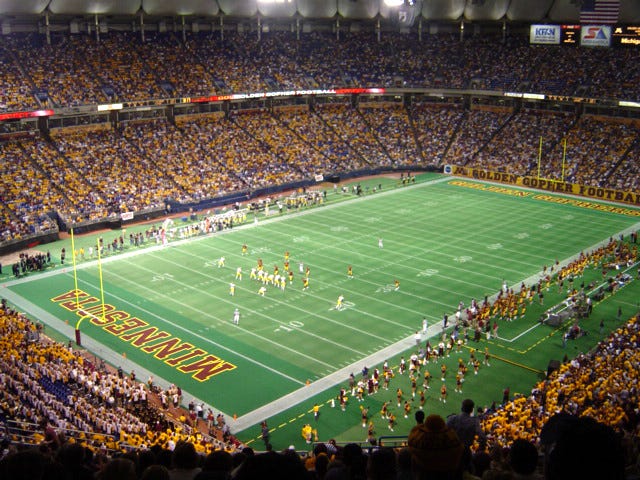
Early fall was a season for the Metropolitan Sports Facilities Commission, the regional civic authority that managed the publicly owned Metrodome. In the early 2000s, the facility was shared by the Twins, the Minnesota Vikings of the NFL, and the University of Minnesota Golden Gophers. On October 2, the final Saturday of the baseball season, the Twins and the Gophers football team were scheduled to play two different sports on the same field.
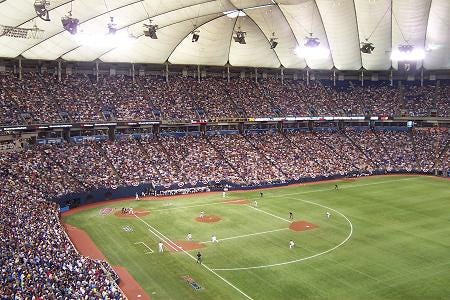
To make that possible, the Twins’ game against the Cleveland Indians was scheduled to start bright and early at 11:00 a.m. After playing a night game on October 1, the players had to be back at the ballpark at 8:30 the next morning to complete their game in time to reconfigure the stadium for the Gophers’ game against Penn State, due to start at seven o’clock that evening.
The Indians took an early lead in the early game, getting two runs off Twins starter Carlos Silva. They added a third in the top of the fifth when center fielder Grady Sizemore hit a huge home run that banged off the folded-up football seats in right field, but Minnesota came back to tie it with a string of chip-shot hits off pitcher Jake Westbrook, whose ground-ball game didn’t play as well on the Metrodome’s fast-playing artificial surface.
Another Cleveland home run in the top of the sixth, another Minnesota scratch run in the bottom. Both teams scored again in the seventh, locking into a 5-5 tie.
The score was still tied at the end of nine innings—the moment when the facilities staff and the MSFC began to sweat. The grounds crew needed four hours to flip the Metrodome between its baseball and football configuration, and at the end of regulation baseball, kick-off was less than six hours away.
Before the tenth inning began, the outfield message board warned fans that no inning could start after 2:30 p.m. The managers, Minnesota’s Ron Gardenhire and Cleveland’s Eric Wedge, received the same message. “I knew we were in trouble,” Wedge said, “when they came up to us and said, ‘Not to worry, in eleven years it’s never happened.’”
It was true—the Metrodome had successfully turned over every game at the facility since it opened in 1982, but in offering such assurances to Wedge, the MSFC had just dropped an enormous jinx onto the Twins’ playoff push.
In the process of emptying out their bullpens, both teams dipped into some of their better arms right around the time when somebody, anybody, had to score a run. Joe Nathan, the Twins’ closer, pitched the tenth and eleventh innings, while Minnesota used Rafael Betancourt, Matt Miller, and Cliff Bartosh. No one could break through.
Heading to the on-deck circle in the eleventh inning, Torii Hunter, the Twins’ center fielder, found the vicinity unusually crowded with security staff and grounds crew, looking less like landscapers and more like a NASCAR pit crew. “I said, ‘What the heck are you doing here?’ They said, ‘The game is going to be over if you guys don’t get a run.’ So we had guys trying to hit a home run.”
Hunter drew a two-out walk. Eric Wedge changed pitchers, bringing in Cliff Bartosh to face another home-run aspirant, first baseman Justin Morneau. When Morneau hit a playable ground ball to shortstop for the third out, it was 2:33 p.m.
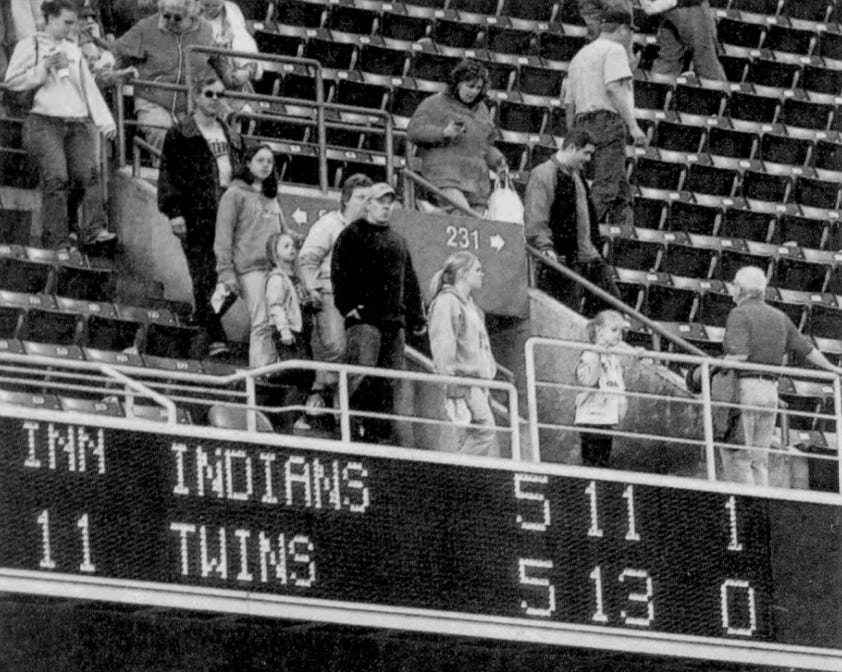
The crowd of 32,000 people booed. They’d been in their seats for over three hours, but now the umpires were walking off and the grounds crew was racing on, lowering the pitcher’s mound, covering up the infield sliding pits, and laying down hash-marks right and left.
“They have to do what they have to do, but I don’t agree with it,” Twins third baseman Corey Koskie said. “I’m disappointed and I’m sure the fans are too. It’s not who’s playing [the Gophers] that’s bad, it’s the fact that we’re double-booked.”
The game was suspended until the following day, when it would be played to conclusion prior to starting the final game of the season. Fans were invited back to enjoy both games from second-level seats that were usually left closed. If that didn’t appeal, they could receive a credit for a 2005 game of comparable significance.
Despite working through lunch, Twins outfielder Lew Ford had four hits that day. “I didn’t even know anything about [the postponement rule], he said. “When everyone started walking off the field, I thought they were kidding at first. I guess the crowd knew, though, because they all left immediately.”
Ron Gardenhire was said to be furious after the game was halted. “I don’t know what to say. It’s got me up in arms…pretty sad. We’re in the middle of a game. And we don’t need a stadium [of our own]? Come on.”
Life at the Metrodome could feel like a math problem, where fandom came with a distinct order of operations. The Twins and the other tenants were fed up of being sliced and diced at what was ostensibly everyone’s “home park.”
“It’s weird,” reliever Juan Rincón said. “We’re trying to prepare for the playoffs in Major League Baseball, get the home field. Now this. It’s like we’re not at home [here]. We’re pretty much screwed. It’s like someone from outside telling you what to do in your own house.”
“We battle our buts off, and then it’s over,” Torii Hunter said. “That’s terrible. We even had our own stadium in the minors. How come we can’t have our own stadium in the majors? I mean, it’s a college game. Why can’t they start it ten minutes or thirty minutes later?”
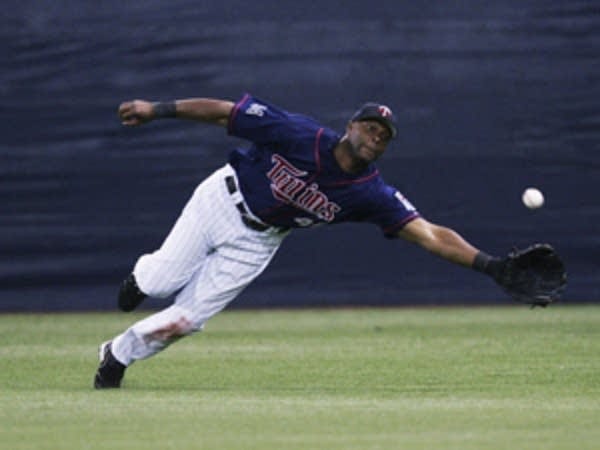
Hunter questioned whether MLB even had the authority to impose a doubleheader on the players under the circumstances. The rules allowed teams to abruptly alter the schedule in response to weather, but the Metrodome was…domed. Could a dome team just move games (or pieces of games) around willy-nilly?
The Indians, playing spoiler and trying—unsuccessfully—to finish with a .500 record and go home, had their own troubles. The change blew up most of their end-of-season travel plans, which were scheduled based on the scheduled start of Game 162, which was now delayed, not by an act of God, but, apparently, by an act of Gopher.
“This is going to kill a lot of our flights,” first baseman Ben Broussard said. “I think it’s bull. We’re a major league team and a college football team has priority? There’s a lot of important stuff going on here and we can’t finish the game?”
They could not. The rules1 governing the shared facility said that if the University of Minnesota was scheduled to use the stadium on a date which ended up as a Twins’ home playoff game, the Gophers would move. But October 2 was merely a game with playoff implications, so Big Ten Football had the right of way.
“The Twins weren’t very pleased,” the university’s athletic director said after the postponement, “but they have to understand, we’re not very happy about it either. More than anything, it really demonstrates what the problem is. You’ve got a Major League Baseball game with a team that’s going to the playoffs and they can’t finish. That doesn’t make any sense. You’ve got a Big Ten football game with a team that’s fighting for a championship and we can’t play when we want to. If we get a stadium, none of this happens.”
The Gophers wanted a new stadium on the East Bank of their Mississippi River campus, which they would eventually receive, in 2009. For their part, the Twins had been advocating for separation since the mid-1990s. Feeling fresh urgency after being pre-empted on October 2, 2004, the team successfully went to court in 2005 to get out of their lease. With better leverage, the team eventually came to an agreement with the Twin Cities that produced Target Field, a baseball-only facility that opened in 2010.
To Ron Gardenhire’s credit, he ended a strange, frustrating day with solidarity:
If we had knocked in a run earlier this could have been avoided, but it is a very sad situation and we’ll come back out and try this thing again. I hope the Gophers win. I really hope it’s worth it tonight. Come on, Gophers!2
On October 3, the Twins decided to have their fourth starter, Kyle Lohse, pitch on short rest for the first time in his career. Not only that, Lohse would finish the suspended game and then proceed into his scheduled start 20 minutes later. The pitcher reportedly learned of this assignment walking into the stadium that morning. Working both sides of this strange doubleheader gave Lohse, with an 8-13 record, the chance to win two games in the same day, so he took the assignment. “That’s more wins than I had in some months this year.”
The suspension might have been hardest on Grady Sizemore, who was a double short of hitting for the cycle and scheduled to lead off in the twelfth inning. “Don’t jinx it,” he warned an inquiring writer.
Lohse immediately deprived Sizemore of his cycle and got through the inning without damage. In the bottom of the twelfth, pinch-hitter Jason Bartlett walked and infielder Michael Cuddyer hit a game-winning double that split the gap in center-right. Bartlett just beat two relay throws and sparked a restrained walk-off celebration at home plate before everyone took a breather and resumed their positions for the second game.
Lohse struggled in his actual start, giving up five hits and three runs in four innings before leaving the game with a blister. Grady Sizemore hit another RBI triple in the ninth inning to help put the game away. The Twins had managed to overcome their Saturday afternoon pre-emption, but they lost home field advantage anyway.
The Minnesota players had come to work on October 3 with packed bags they hoped not to need, but the 5-2 loss sent them back to Yankee Stadium to face the 101-win Yankees, who would once again defeat them in four games, setting up a historic League Champion Series against the Bambino-cursed Red Sox. The rest of that story you probably know.
That was the tale we aimed to tell this week, of football bullying America’s once-national game in the cramped quarters between summer and fall. The result was another strange game for the Project 3.18 archives, one Michael Cuddyer described as both “the shortest game of the year and also the longest.”
We love the strange around here, but we also love the surprising, and near the end of our research for this piece, Eric Wedge, the Indians’ manager, provided a big one. While Ron Gardenhire fumed after the postponement, Wedge hardly seemed fazed after losing part of a game to football. “Another first,” was all he could say, shrugging his shoulders.
It turns out the Cleveland Indians were having a week full of “firsts,” and after what they’d been through, a traffic jam at the Metrodome didn’t rate as that weird. On Wednesday, September 29, the day they left for that final series in Minnesota, rookie pitcher Kyle Denney—wearing a blond wig and a cheerleading outfit—was shot on the team bus, requiring Eric Wedge to decide whether to divert to a hospital or make a break for the Kansas City airport.
So, yeah…that was a first.
Of course, Project 3.18 must tell that surprising tale, but, darn it, the University of Minnesota football game against Washington starts in a few hours, and they’re telling us we have to clear out. So let’s consider this one temporarily suspended, and we’ll finish it up on Monday morning.
Be sure to keep your ticket stub, and until then—come on, Gophers!
On September 28: “Craziest twelve hours I’ve ever had.”

If you enjoyed this baseball story and want to support Project 3.18, consider becoming a paid subscriber.
You can also really help us by sharing this feature on socials or restacking it here on Substack. Publishing a story is how we get on base; please help spread the word and drive us home.
Over on Clear the Field:
Last week was the anniversary of the great Satchel Paige’s final major-league appearance in 1965, pitching for Charlie Finley’s woebegone Kansas City A’s. A lot of people including the opposing Boston Red Sox assumed the pitcher’s appearance was all a stunt, but apparently Paige didn’t get that memo. We had a great time with this story—listen or watch it here on Substack or on YouTube.

Such was the power of the NFL that the only conflict in which the Vikings would yield was a World Series game. This happened once, in 1987.
For the record, the Gophers beat the Nittany Lions 16-7 on October 2, a crucial step on their path to the 2004 “Gaylord Hotels Music City Bowl presented by Bridgestone.”