


Welcome to Project 3.18, where a fan-first writer tells strange and surprising stories from baseball history and culture.
If you enjoy what you read today, please subscribe to receive our free feature stories in your inbox. And if you’ve been here for a while, we could really use your support as a paid subscriber. Paid subscribers receive access to exclusive content and help keep this publication going and growing.
On June 15, 1976, it rained in Houston. Thirteen inches of rain in about 13 hours. The kind of weather people still talk about 50 years later.
No place in the world could gracefully handle that much rain in such a short timespan. Bayous around the city overflowed and the water reached five feet in depth in some areas, especially the southeast part of Houston, where ambulance crews drove and then swam.
At 5:00 p.m., the Pittsburgh Pirates’ chartered bus left their hotel. It took the bus a half-hour, three times longer than usual, to make it to the Astrodome, but they got there. The Astros players made it in as well. While the teams got dressed and warmed up, Houston’s drainage capacity was overwhelmed and the water began pooling where it fell. Roads and freeways filled up. Many stalled vehicles were abandoned. One of those cars had tried and failed to bring the night’s umpires to the Astrodome.
A sportswriter named Gary Taylor tried driving to the stadium and gave up three hours later, abandoning his car to shelter in a cafe where the owner mopped ankle-high water out the front door and illegally served beer from his personal stock to several dozen stranded motorists, 50 cents a bottle.
Two hours and an unspecified number of bottles later, Taylor returned to his car to find the torrential water had relocated it from curbside to the precipice of a nearby drainage ditch. “Traffic on the streets and highways was unbelievable,” Taylor said. Working vehicles had to pick around cars “strewn at all angles across all lanes of traffic, abandoned by the thousands.”
Approximately 20 fans, “die-hards” taking that label far too literally, somehow navigated this post-apocalyptic traffic and showed up at the Astrodome. Conditions were reportedly “bone dry” inside the stadium, but its parking lots flooded, taking out many of the Houston players’ cars, at least for the night. Some ended up sleeping in their clubhouse.
The Astrodome had a chance to set a dubious record and host the smallest official crowd in major league baseball history (pre-COVID era), but the lack of umpires was a problem and the game lost half its viewing audience when the production truck responsible for beaming the game back to Pittsburgh packed up and fled while it still could. The players were in uniform and ready to go, but at approximately 7:15 p.m., 20 minutes before first-pitch, the game inside the Astrodome was postponed due to rain.
“We could have played,” Astros general manager Tal Smith said, “but if we announced the game was on, we would have been inviting misfortune. Many people would have tried to make it and would have become stranded.”
The two-dozen fans sheltering in the dome got a collector’s dream of a rain check and a free meal in the facility’s cafeteria. The players were treated to a picnic feast. Astrodome officials set up tables in the outfield behind second base and served both teams fried chicken and steak in the middle of the deserted “Eighth Wonder of the World.”
“The Pirates and Astros are sitting down to supper,” a team official said, eager to show off the Astrodome’s mastery of the elements. “It’s not exactly a rainout. It’s a rain-in.”
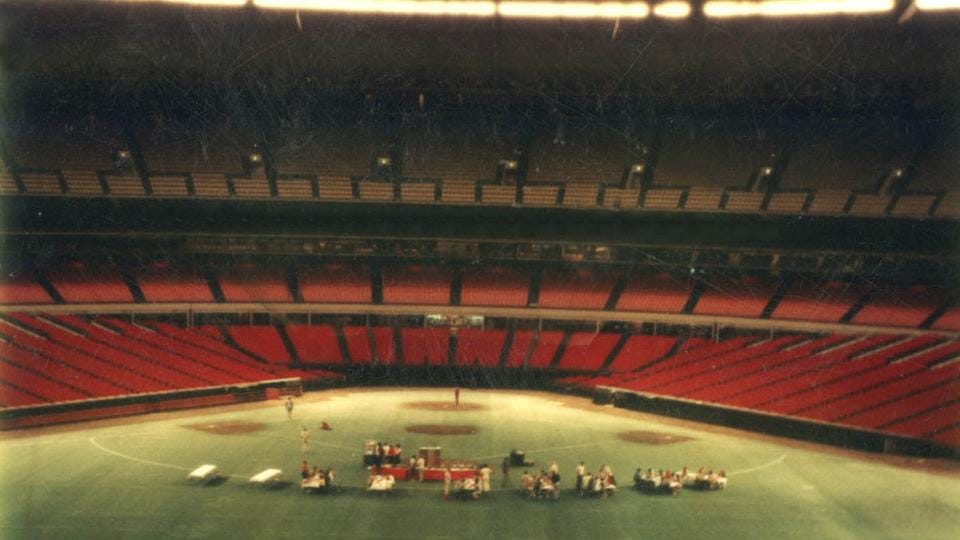
The festivities were slightly marred by one of the more ridiculous freak injuries in a game full of them. When the proverbial dinner bell rang, Pirates backup first baseman Bob Robertson was so eager to tuck in that he vaulted over a railing from the seating area onto the AstroTurf playing surface, landing wrong on his left ankle and tearing several ligaments.
The storms passed, the water drained, and on June 16 the teams concluded their Houston series with a 6-3 Pirates win. The teams had pushed back their scheduled starters. Doc Medich started that game for Pittsburgh while 22-year-old lefthander John Candelaria, in his first full season in the major leagues, got bumped back to Pittsburgh.
After an off-day on June 17, Candelaria and the Pirates beat…the Houston Astros, who had accompanied the Pirates back east. That series was shortened, too—the game on June 19, at uncovered Three Rivers Stadium, was rained out the old-fashioned way.
In 1982, the Hubert H. Humphrey Metrodome became the indoor home of the Minnesota Twins. The Metrodome replaced Metropolitan Stadium, an open-air ballpark that had helped lure the Senators away from Washington in 1961.
While the Astrodome provided necessary protection from Texas’ subtropical heat, the Metrodome had to protect people from all four of Minnesota’s ferocious seasons. To do that, the building incorporated some cutting-edge technology, none more amazing than the roof, which was essentially a big balloon.
The air-supported roof was an engineering marvel. Two layers of fabric—an outer skin of Teflon 1/32 of an inch thick and an inner fiberglass liner 1/64 of an inch thick—were separated by a void of pressurized air that acted as cheap, all-purpose insulation. Ten acres of fabric weighing more than a million pounds were kept aloft by a sophisticated system of 20 fans that pushed 250,000 cubic feet of air inside the dome every minute.
By late April 1986, the last of winter had passed in the upper Midwest, not that that mattered to the all-weather Twins, who were hosting the California Angels. John Candelaria had been traded to the Angels in 1985, but he was injured early the following season, dealing with an elbow issue that would soon require corrective surgery. Pre-operation, Candelaria was along for the ride on this particular road trip.
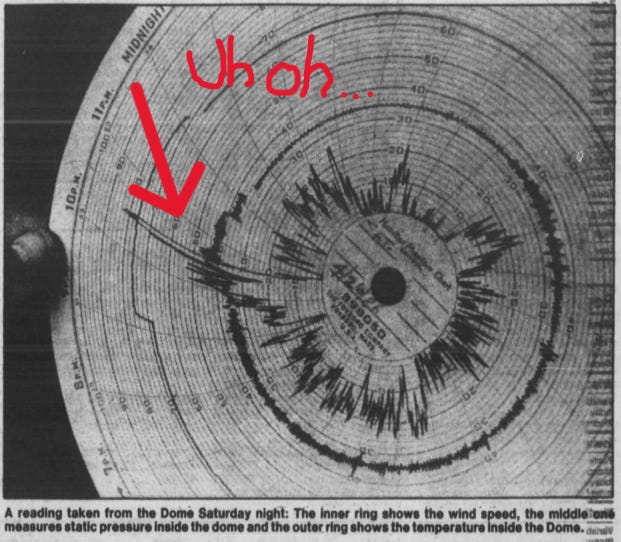
Amid the wettest April ever, another storm front was moving through southeast Minnesota on April 26, with heavy rains and strong winds expected. The positive-pressure inside the Metrodome could be calibrated based on the conditions outside, and the facility managers heeded the forecast and set the fan system to prepare for 35 mile-per-hour winds.
Thirty-two thousand fans, the second-largest crowd of the year, were inside the Metrodome that night, watching Twins starter Frank Viola face the Angels’ abrasive Don Sutton. But there was something eerie about enjoying a pastoral game in an enclosed space while the roof quivered under the fury of the unseen storm overhead. Early in the game, pitcher Bill Latham and the Twins’ bullpen considered what they’d do if the roof came down as the structure overhead rattled uncomfortably: “Mark Portugal said he’d crawl under the bullpen bench. But we finally decided we’d haul it for the dugout.”
And haul they would. During the eighth inning, a measuring device on top of the Metrodome roof showed that a jump in the storm’s intensity, from approximately 12 miles per hour to 80 miles per hour in “an instant.”
The atmospheric equivalent of a haymaker slammed into the east side of the soft-bodied roof and distorted it so much that a piece of the inner liner tore off the frame and drooped above the second-level seats in right field. The overhead light banks and speakers swayed wildly as the roof began to deflate. Seeing 10,000 pounds of electrical rigging dancing was enough for the Twins’ bullpen to put their plan in motion. After that, “we were on our way to the dugout,” Latham said.
As the roof lost its shape, a series of emergency plugs popped open to mitigate the water pooling on top. Gravity guided the water down and out through permanent holes in the inner roof—and onto the heads of some unlucky fans along the third base line, whose tickets had not reflected the possibility of cataract views.
The Twins’ Mickey Hatcher was batting when the ceiling began to sag. He turned to Bob Boone, the Angels’ catcher. “Boone, does the ceiling look like it’s going to fall?”
Bob Boone gave the situation in right field a careful appraisal. “Yeah, it sure does,” he said finally.
The little-used Hatcher said he wasn’t surprised to find his at-bat interrupted by structural collapse. “That’s just the way the season’s been going for me.”
The Metrodome public address announcer read pre-prepared instructions asking fans in the upper deck to evacuate into the concourse in an orderly fashion. Most people managed to keep their cool.
Meanwhile, the facilities team discovered something of a technological misunderstanding. The wind spike hit the Metrodome so hard that the computer regulating the interior pressure detected the extra pressure and decided to shut off some of the fans to compensate. But the temporary wind pressure was on the wrong side of the dome, and without the fans, the roof began to deflate. Once the fans were cranked back up, the roof regained its shape in just nine minutes.
Stadium officials informed umpire crew chief Ken Kaiser that play could resume. Kaiser had misgivings, but he gave the go-ahead. “I figured we had just a few outs to go and it looked like everything was safe again. To tell you the truth, we don’t have this kind of thing in New York, where I come from.”
Playing closest to the busted flap, the right fielders were leery. “I kept my eyes on the speakers above me,” Minnesota’s Tom Brunansky said. “I made sure I was standing between them, so I would have a good head start when they came down.”
The Angels’ Wally Joyner was particularly reluctant to return to work in right field. “I wanted to get out of there. I didn’t want the ceiling to fall on us. I’ve never seen anything like it. I thought the umpires were going to call the game and that was perfectly fine with me.”
Frank Viola had been playing the Angels like a you-know-what before the interruption, and the Twins had a 5-1 lead when play resumed. Minnesota added another run but then Viola gave up a two-run home-run in the ninth and his replacement, Ron Davis, gave up two more two-run home runs, leaving Twins fans more deflated than the building. Wally Joyner conquered his fear and hit a cinematic go-ahead shot to take a 7-6 lead that held up.
The next day, Gene Mauch, the Angels’ manager, likened that ninth inning comeback to a modernized version of The Natural:
We were talking about how we would take this script to somebody and they’d say, “Sure [Joyner] did. Sure he hit a home run with two outs and a 3-2 pitch and the lightning’s flashing and the lights are swaying. Sure he did. Go sell that crap somewhere else.”
On June 27, 1991, a “flash storm” passed through Montreal, Quebec, knocking out power and knocking down trees. The winds of up to 100 km/h (you do your own conversions with this international story) were particularly hard on Olympic Stadium and its retractable roof—the most visually striking roof in the history of sports.
We never had the chance to see a Montreal Expos game at Olympic Stadium, and maybe that’s for the best, because few ballpark images give us the heebie-jeebies more than these shots, taken by a capable amateur photographer as Olympic Stadium’s Kevlar-fabric roof was lowered from its perch in the overhead tower and spread over the uncovered bowl of the playing area. Our first thought was, “Nope,” and now we know where filmmaker Jordan Peele surely got his inspiration for the otherworldly flying monster in his film of the same name.


Olympic Stadium was the obligatory architectural flex that accompanied Montreal’s successful bid for the 1976 Summer Olympics. After the world went home, the plan was to move the Expos from Jarry Park Stadium to the gently-used, state-of-the-art sports megaplex left over from the games.
The stadium and its over-complicated roof were designed by a French architect, Roger Taillibert, and while the roof visuals would be striking, to say the least, other architects warned that the untried system of pulleys and cables was a taxpayer-funded dice-roll to the tune of $154 million (Canadian).
Montreal bit off a little more than it could chew with its pièce de résistance. The stadium’s iconic slanted tower wasn’t completed in time for the games, and with no place to hook it to, the retractable roof couldn’t be installed. Instead, it sat in a warehouse in Marseille, France for five years, racking up $1.25 million in storage fees, just a sliver of the largesse and waste that contributed to Olympic Stadium’s eventual $770 million price tag. The roof eventually reached Quebec and was stored at the stadium. For several years, the structure’s roof was stored in the basement.
The roof was finally installed in June 1989. A month later, just a day before the roof was to be ceremonially dedicated, a storm over Montreal called it into service, except officials didn’t get it down quickly enough and by the time they wanted it closed, the winds were too high. Instead, the Expos had to do as they’d always done and wait for the weather to clear. In November of that year, 8,000 attendees at a truck and tractor pull were evacuated when a roof lowering went bad and left rips in the lining several metres1 long.
Two years later, the roof was working and used sparingly, mainly to guarantee indoor spaces for trade shows and other money-making rentals. The Expos kept the roof open as much as they could, to avoid difficulties from the low height of the ceiling when it was closed. The roof was closed on June 27, 1991, when that “flash storm” pushed through the area. The damage across the city was minor, but Tailibert’s Kevlar flower was shredded.
Huge gashes were torn above right field, each triangular hole about 30 to 45 metres wide. The sky was plainly visible through the gashes and any protection the roof still provided was outweighed by the risk of further debris separating and falling into the stadium below. The cable system seemed intact, so the morning after the storm, the engineers coaxed the broken roof back into its lifted position, where it was secure enough to allow the night’s game against the Pirates (there they are again) to proceed.
Claude Brochu, the Expos owner, was a pragmatic man: “We’re not concerned at all about the ripped roof,” he said. “From our point of view it doesn’t matter if the thing’s up two days, two weeks, two months—however long it is. We’re considering the ballpark to be like any other open-air facility.”
That week, a new entry appeared on the Expos’ list of injured players, prepared by the team publicist, Rich Griffin. “Kevlar Roof” had been added, his status reported as “left hanging.”
He was still up there when the first-place Los Angeles Dodgers came to Montreal on July 11, up five games in the National League West and winners of 7 of their last 9. The Dodgers’ pitching staff was second-to-none, led by Mike Morgan, Ramón Martínez, and Tim Belcher. This was a staff on which Orel Hershiser, 7-2 with a 3.46 ERA, was the number-five starter.
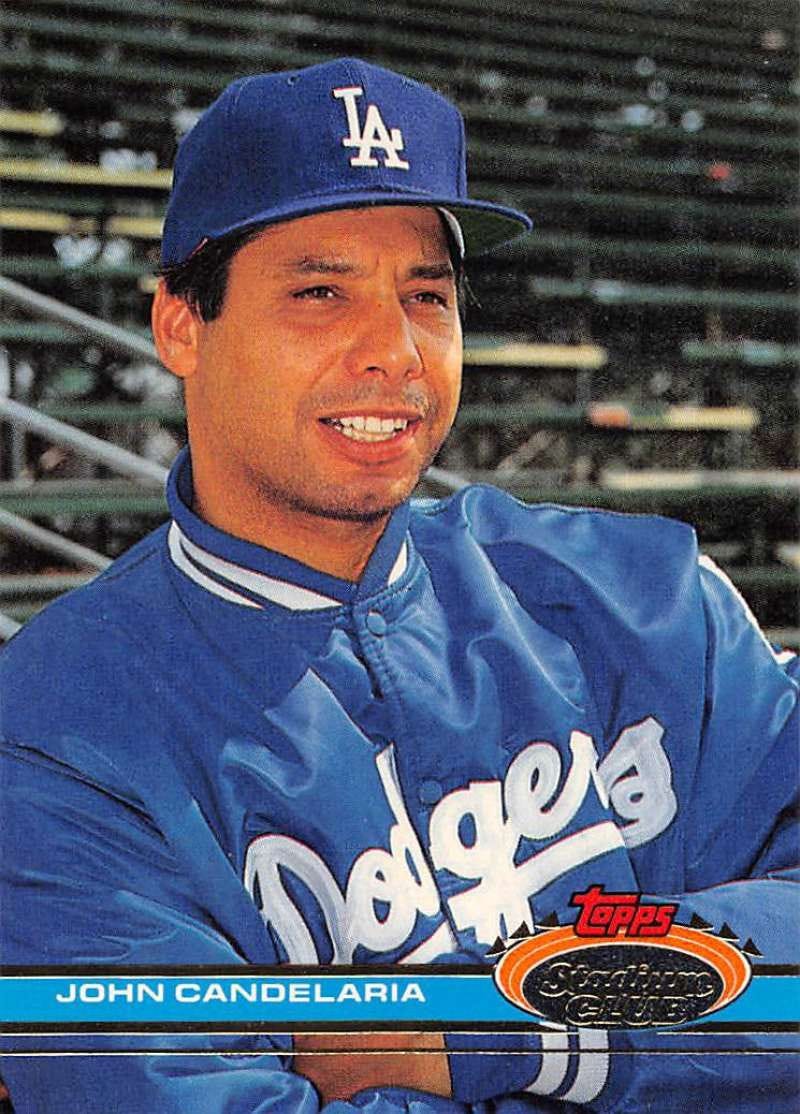
Down at the bottom of the Dodgers’ rarely used bullpen was 37-year-old John Candelaria. By 1991, Candelaria was well into his third decade in major league baseball, building up a journeyman’s resume worthy of your Immaculate Grid consideration. In between the Angels and the Dodgers, Candelaria pitched for six other teams, but he did not pitch in the first two games of the series, both of which ended in one-run Expos victories, sending spirits in Montreal soaring.
It rained on the night of July 13. Nothing awe-inducing, just gray skies and steady showers. It was the perfect night for a retractable roof, but the orange umbrella above Olympic Stadium wasn’t going anywhere. Kevlar Roof had been transferred to the 60-day DL, and the question was not when he would return, but whether he ever would. Repairs were estimated at $1.5 million over seven weeks and a total replacement remained a worst-case possibility. These were problems for the offseason.
“Our poor roof,” Montreal pitcher Tim Burke said. “It sure has spent a lot of time on the disabled list.” In fact, Olympic Stadium’s initial roof was only opened 88 times in its entire existence.
The teams waited under cover for several hours before making the decision to postpone. It was the first weather-related postponement at Olympic Stadium since 1986, several years before the roof was installed. We didn’t know Quebec had such excellent summer weather.
The Sunday finale became a Sunday doubleheader. The Dodgers’ Bob Ojeda shook his head. “You know how tough it is to take doubleheaders.” He looked up at the Expos broken umbrella, folded high overhead while the rain went on. “Even when the thing worked, it didn’t work.”
Burke agreed. “It seems to have been a mistake from the start.”
Mutterings about the Expos’ future were already audible in 1991. A long run of second-division finishes had dampened the spirit of what had once been an enthusiastic fanbase, and being a renter in a nine-figure national boondoggle hadn’t helped.
Mitch Webster, an outfielder who’d spent parts of three seasons with Montreal before being paroled to Los Angeles, said mismanagement was a big part of what ailed the Expos. “This has really got to make the taxpayers upset. At this point, if they lost this franchise, I don’t think it would make too many people mad.”
A Los Angeles Times writer named Bill Plaschke chatted with John Candelaria, just passing the time during the delay before the game was postponed. Candelaria had begun his career before the institution of free agency existed, and since then he’d been almost everywhere and seen everything. Still, Plaschke could hardly believe it when Candelaria mentioned that this was not his first run-in with precipitation inside a domed stadium. Or his second. “Now I’ve got three under my belt.”
The Expos won both games on Sunday, sweeping the four-game series away from the favored Dodgers. Sunday’s games became a sun-washed party, and Jack Todd of the Montreal Gazette said that the roof, “dangling like a wounded bird from its perch on the tower,” was better off where it was. If the team had lowered it for Saturday’s rain, Sunday’s game would have been played indoors. Instead, “the stadium rocked and rolled through 18 innings of sunlit baseball.”
“Trust me,” Todd said of the roof, “no one missed it.”

If you enjoyed this baseball story and want to support Project 3.18, consider becoming a paid subscriber.
You can also really help us by sharing this feature on socials or restacking it here on Substack. Publishing a story is how we get on base; please help spread the word and drive us home.
Remember, we’re in Canada, so it’s “metres.” “Meters” is American English.
Outstanding research and story telling. John Candelaria is the Forrest Gump of Rain-Ins.
Great story! Who would have thought that Candelaria was the thread connecting the three domed stadium “rainouts!”