


Welcome to Project 3.18, a free weekly publication where a fan-first writer tells strange and surprising stories from baseball history and culture.
Marge Schott looked out her bedroom window on the morning of April 1, 1996 and cursed the snow. Hardly any grass showed through the overnight accumulation, which smothered the early spring flowers and left Schott, the owner of the Cincinnati Reds, in a foul mood.
It was Major League Baseball’s Opening Day, and that meant the Reds were playing at home. The Reds always opened at home, a tradition honoring the 1869 Cincinnati Red Stockings, the first professional club in baseball history. The Red Stockings won their first game 45-9 and went 57 games without a defeat, but the team disbanded two years later—it turned out paying the players was bad for business. The modern Reds weren’t direct descendants of those Red Stockings, but the colors were right and Cincinnati still declared Opening Day a city holiday and threw a big parade.
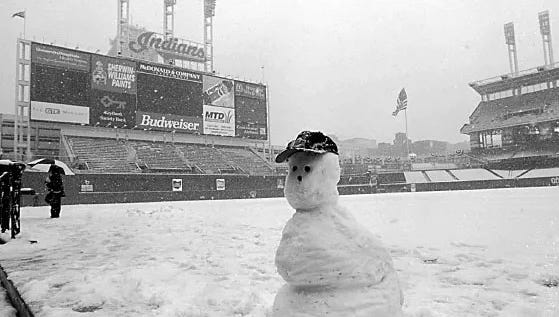
The Findlay Market Parade featured fire engines, marching bands, and a celebrity grand marshal, winding from the Findlay Market in the city’s Over-the-Rhine neighborhood through downtown. The wintry weather in 1996 added some complexity. “We’ve had snow before,” the parade organizer said, “but not 1.5 inches at six o’clock in the morning.”
It could have been worse. The snowstorm that grazed Cincinnati hit Cleveland head-on, wiping out the Indians’ home opener. A writer once said of Ohioans: “They do not consider Opening Day just as Opening Day. They consider it one small notch below Christmas.” Perhaps so, but this was taking it too far:
Since buying the Reds in 1985, Marge Schott had embraced the Opening Day traditions, but this one felt extra important, because in 1995 there was no Opening Day in the traditional sense. Instead there was a baseball strike, entering its second season. The strike lasted 232 days, obliterating the second half of 1994 and the first three weeks of 1995 before it was ended by court order. With the dull gray bunting of the strike finally pulled down, Opening Day in 1996 could be a revival. All they needed was some decent weather.
Schott made her way to Over-the-Rhine, accompanied by her omnipresent St. Bernard, Schottzie 02. She noticed the crowds in and around Findlay Market were smaller than in years past. Some of that was the cold, but the owner feared the lasting damage from the prolonged work stoppage. A year later, some fans still hadn’t come back to baseball. Who knew if they ever would.
She drove her worries from her mind, determined to give Reds fans a wonderful day despite the weather. She worked the line of bundled-up parade-goers, pinching cheeks, shaking hands, and showing off the dog. When it was time to start the parade, Schott sounded a siren and grand marshal Sparky Anderson, the beloved manager of the Big Red Machine, led the procession with aplomb. The sun broke through the leaden skies and began melting the snow, lifting Schott’s mood as she headed to the office.
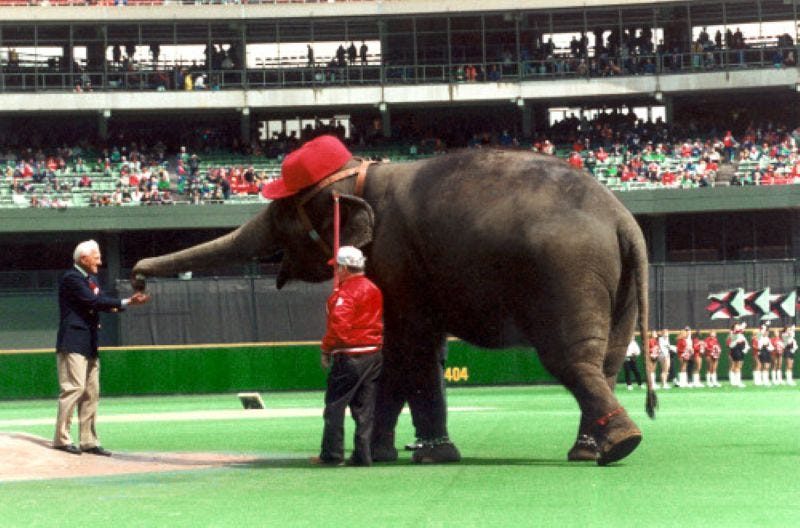
The party continued at Riverfront Stadium. Schottzie bounded onto the AstroTurf while a marching band performed. Draft horses led wagons in a circuit around the park and bunches of balloons danced in the crisp air. Sparky Anderson threw out a ceremonial pitch, caught by his former player, Ray Knight, who had been named the Reds’ new manager during the offseason. An elephant passed Anderson the ceremonial ball. Marge Schott loved elephants.
John McSherry loved baseball, and he loved being a major-league umpire. He was supposed to have a doctor’s appointment on April 1, but he put it off. Maybe he didn’t think it was a good idea to get a checkup on April Fool’s Day.
A National League umpire since 1971, McSherry’s crew was in Cincinnati for Opening Day, but his irregular heartbeat, a chronic arrhythmia, was bothering him enough that he scheduled a doctor’s appointment on the road. But when McSherry woke up on April 1, he was feeling better. He decided to reschedule his appointment for the following day, an off-day. His crew, Tom Hallion, Jerry Crawford, and Steve Rippley, were concerned, but McSherry didn’t want to miss Opening Day. “I’ll be here today,” he told them, “and I’ll get that (the doctor’s appointment) taken care of tomorrow.”
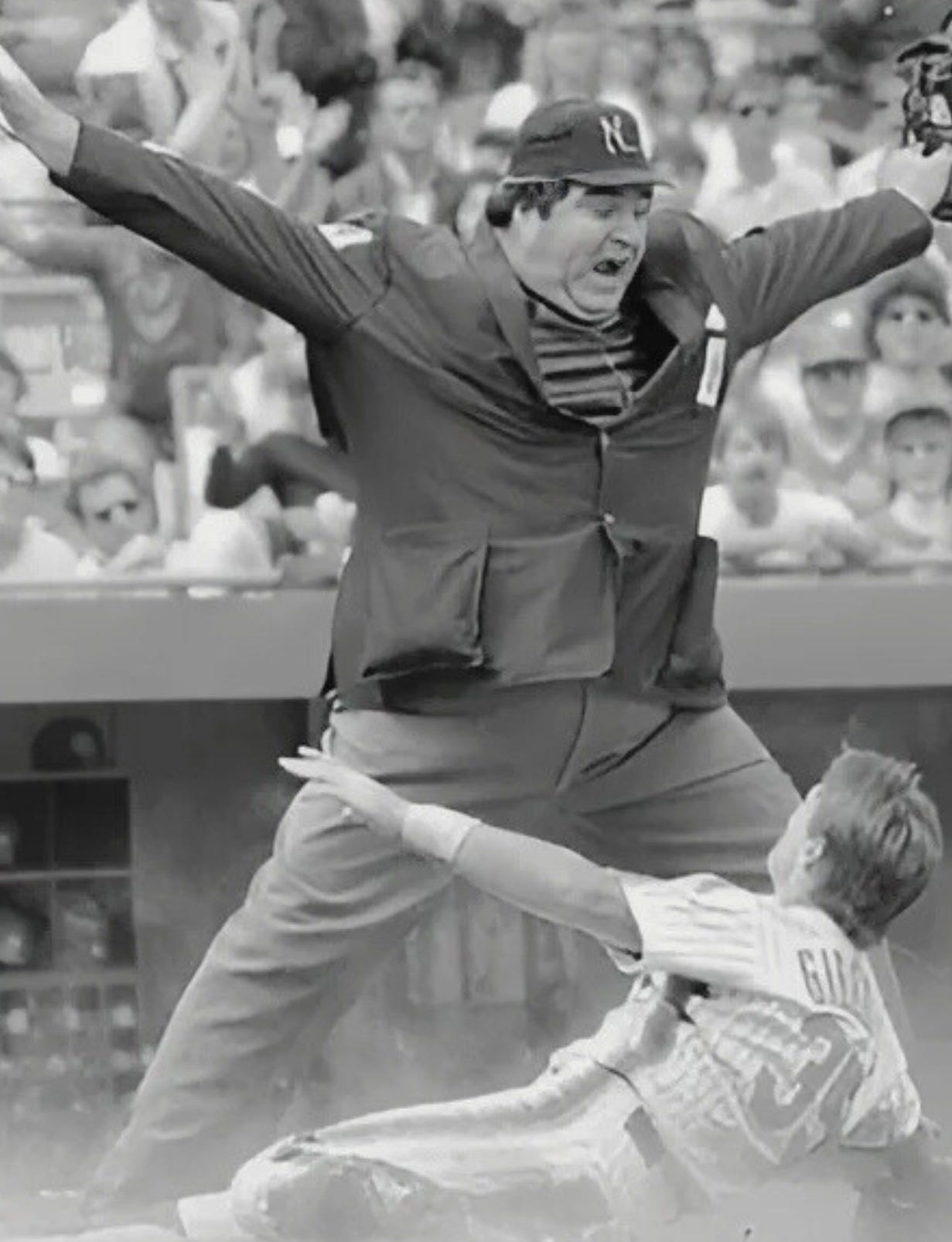
With 25 years of major-league experience, John McSherry was a familiar face to the Reds and their opponents that day, the Montreal Expos. When he arrived in the National League he was the youngest umpire on the circuit, but that was thousands of games ago, and his body of work showed him to be dedicated, fair, and particularly collegial.
He was named a crew chief in 1988, and he’d been given the honor of working one divisional series, seven league championship series, and two World Series. McSherry was behind the plate during Game Six of the 1977 World Series, giving him the best seat in the house for Reggie Jackson’s “Mr. October” triumph. “It was like being part of all your dreams when you were a kid,” he remembered. He’d seen his share of lowlights, too, like the time in 1984 when he got caught in the middle of a hot beanball war:
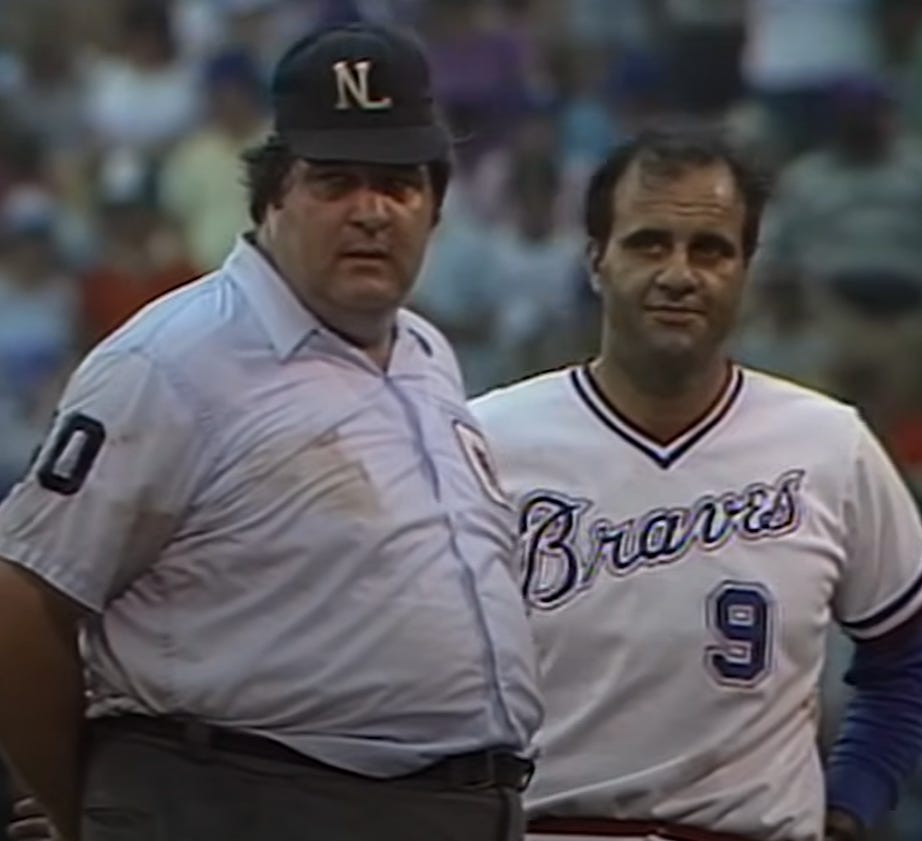
The players consistently rated McSherry as among the best umpires in the game. Working behind the plate or on the bases, handling disputes, interpreting and explaining the rules, he was passionate but not overzealous, tough but respectful. His character made him an ideal example for umpires coming up through the ranks, and he taught at the instructional school run by Harry Wendelstedt, another NL umpire, and took part in umpiring clinics in other countries.
Managers were reluctant to argue with him, but when they did, he responded with more forbearance than some of his peers. “You had to say an awful lot of bad things before he would throw you out of a game,” Tommy Harper of the Expos said. “You could have your say with John.”
Ray Knight, the Reds manager, remembered how McSherry taught him—in advance—the universal signal umpires would give an arguing manager to let them know their floor time was up: a little tap on the leg.
Despite being lauded as an “umpire’s umpire,” McSherry had come under increasing criticism for his increasing size. In 1996 he was six feet two inches tall and weighed somewhere north of 350 pounds. With measurements that more than exceeded the medical criteria for obesity, McSherry was one of several umpires labelled as unacceptably overweight for their job, no matter how well they did it. McSherry’s size never damaged his reputation, but he had left several games over the years because of dehydration or heat-related illnesses, and spent parts of six off-seasons working with a weight-loss clinic affiliated with Duke University.
McSherry never denied his weight was a concern, but in a time with far fewer treatment options for obesity, in a job that made it all but impossible to prioritize consistent, healthy eating habits, he was doing the best he could. In 1995, at age 50, he said he hoped to continue umpiring until he maxed out his pension at 57.
“But that will probably depend on my health,” he told his hometown newspaper. “I battle my weight all the time. You never know what that’s going to do eventually.”
The umpire was in good spirits as the game got underway. He was so eager to get started that he trotted to home plate after the Canadian national anthem was played, forgetting there was another anthem to go. He joked with the Reds’ catcher, Eddie Taubensee. “He said, ‘Eddie, you call balls and strikes the first two innings and we’ll be all right.”
The game began at 2:07 p.m. McSherry’s joke to Taubensee seemed a little less funny after the first pitch from Cincinnati’s Pete Schourek. “It was right down the middle,” Schourek said. “He called it a ball. It shocked me for a second, but he seemed fine after that.”
The Expos’ leadoff hitter, Mark Grudzielanek, popped out on the next pitch. Second baseman Mike Lansing struck out swinging on three pitches. The next batter was center fielder Rondell White. The count was 1-1 when McSherry unexpectedly stood up.
He motioned to Steve Rippley, the second base umpire, clearly summoning him in to take over behind home plate. Then he turned and walked with his head down, toward the gate leading to the umpires’ dressing room. A few steps from the gate he wobbled and fell to his knees, then pitched forward, sprawling on the artificial turf.
The trainers from both teams, always watching for signs of trouble on the field, were moving before McSherry reached the ground, the other umpires on their heels. The Reds’ team doctors, an ER doctor and an internist arrived. The two paramedics on duty brought the emergency defibrillator. Two more doctors leaped over the fence and raced to help however they could.
“The doctors just came in waves,” Greg Lynn, the Reds’ trainer, said. With so many capable hands they took turns administering CPR continuously until McSherry was placed into an ambulance waiting in the stadium tunnels. Lynn said they had a pulse, at first, and they fought to keep the umpire breathing. “We all tried.”
As the medical personnel knotted around McSherry, the crowd of 53,000 deflated as confusion was replaced with dismayed understanding.
“What’s going on? What’s wrong? What’s happening?” Marge Schott went on that journey in the owner’s skybox, accompanied by a Cincinnati Enquirer writer, Richard Green, who was shadowing her for Opening Day. A few minutes later, Schott found out.
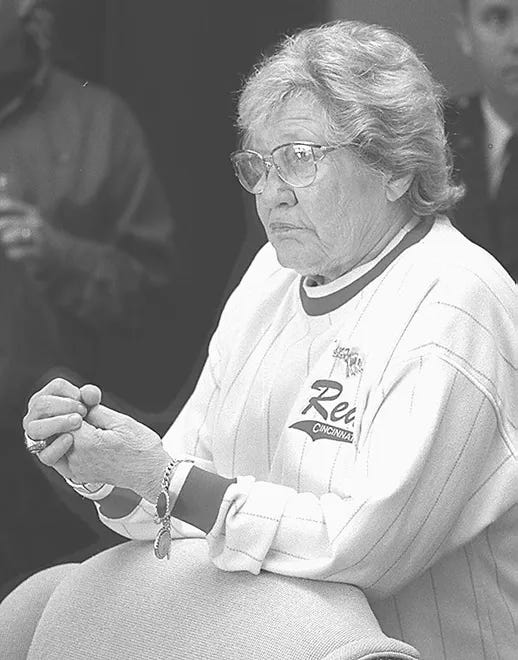
An aide took her on the long journey to the umpires’ dressing room. Tom Hallion had followed McSherry to the hospital, leaving the remaining officials, Jerry Crawford and Steve Rippley, to figure out what to do about the game. Schott joined the Reds’ general manager, Jim Bowden, and the managers, Knight and the Expos’ Felipe Alou.
Though shocked and disturbed, the umpires said they could continue. They seemed to feel McSherry had all but asked them to do so, summoning Rippley as he had. The teams agreed and Crawford update the waiting reporters, telling them, “We felt this is the best thing to do with the emotion.” At 2:40 p.m., the crowd was told the game would resume at 3:15.
A little after three o’clock, a telephone in the umpires’ dressing room rang. Crawford picked it up. It was Tom Hallion. Everyone who saw McSherry lying on the field had feared the worst, and Hallion told Crawford the worst had happened. John McSherry had died.
As the news of McSherry’s death spread through Riverfront Stadium, Crawford and Rippley told the teams they still intended to play on. Having already agreed to proceed, the stunned umpires were moving on inertia. The game would resume in 30 minutes. To Schott, that felt like too long a delay. “What about the fans who are waiting?”
Crawford stared at her. “We’ve got a guy who just died here.”
Bowden ushered Schott into an elevator. “Did he die?” she asked the general manager, as if it all might be some elaborate April Fool’s Day prank.
“Yes,” was all Bowden could say.
“I don’t believe it.” Schott said. “Snow this morning, and now this. I don’t believe it.”
Ray Knight couldn’t believe the umpires were planning to go forward. “I think the umpires felt it was their obligation to John. For a little while, I was struggling…I didn’t feel right about it.”
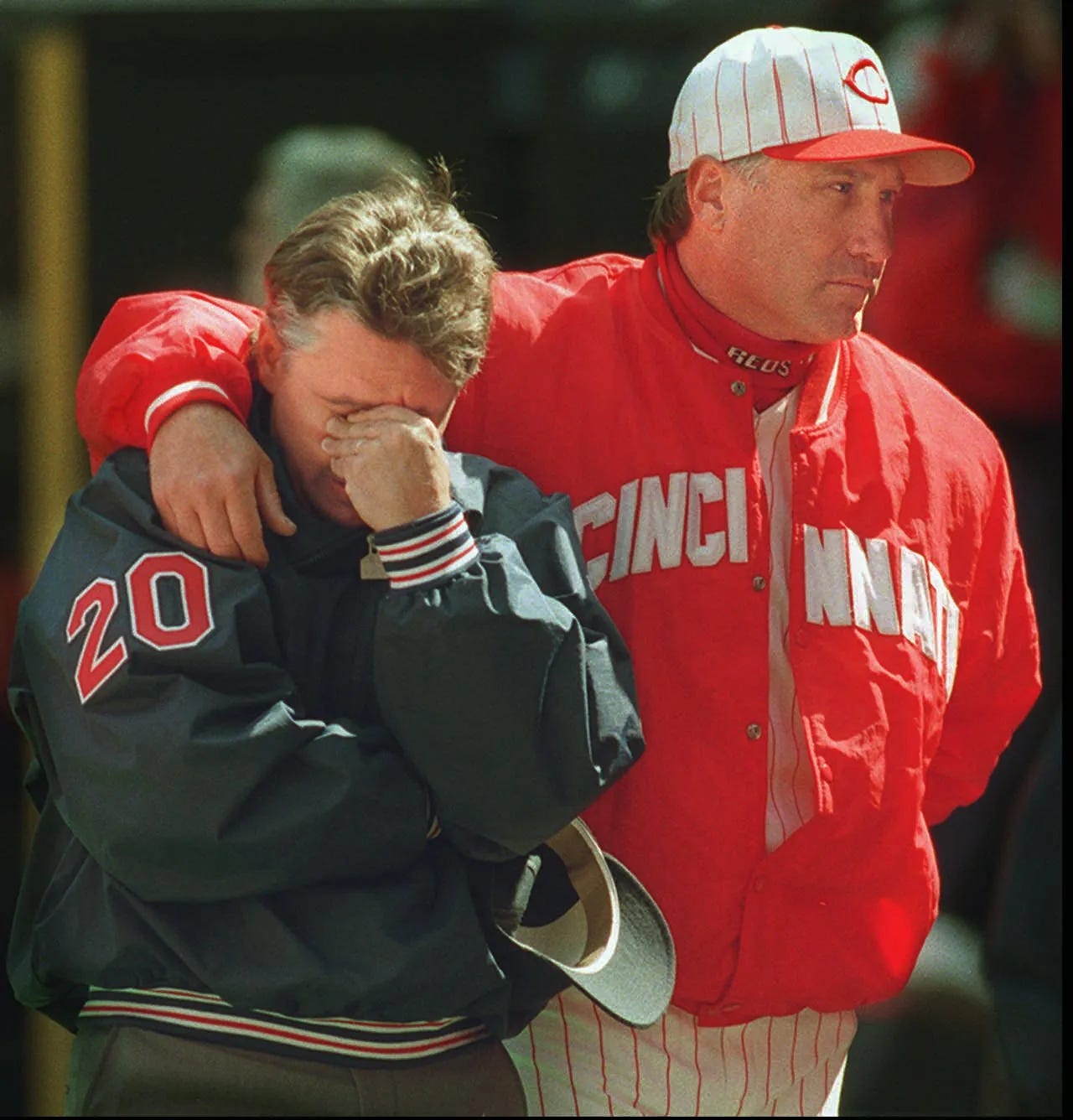
The manager took Crawford aside. “I want you to know right now you do not have to worry about not playing this game and I’ll support you 100%.” Crawford assured Knight they could go on, but his ashen face told another story.
“He was crushed,” Knight said. “We were all crushed. Jerry was walking about and didn’t know what to do.”
The manager entered a distressed Reds clubhouse. “We’re not handling it very well right now,” Taubensee, the catcher, said. “It’s the same as if it happened to one of us out there.”
Knight gathered the players and told them the plan was to continue. The players gently rebelled. Shortstop Barry Larkin, a clubhouse leader, was one of the first to say, “enough.”
According to Knight: “Barry told me very quietly and with very much emotion: ‘Out of respect for life, I can’t go out there.’”
“It was a no-brainer for me,” left fielder Eric Davis said. “If you had seen the umpires, you would have known they weren’t there. Those guys have worked with Mac for years and years. They weren’t going to say that Mac wouldn’t want us to play.”
Knight, Larkin, and Davis went to the Expos’ clubhouse and found a similarly shaken unit. Both teams understood what they had to do, the only decent thing to do, no matter who was going to be disappointed.
“There’s no way we could go out there and play baseball,” Expos pitcher Jeff Fassero said. “It wouldn’t have been fair to put [the umpires] through it.”
Larkin and Davis went to see the umpires in their dressing room. A few minutes later Crawford announced the game would be postponed. “It’s probably too traumatic,” he said.
“As players and umpires we’re at each other’s throats all the time,” Davis said. “But unity is more important right now than balls and strike calls. We’re in it together.”
Jim Bowden brought the news up to Marge Schott in her box. The Reds’ owner was distraught—over the wrong thing.
—“Why can’t they play with two umpires? What does it matter?”
—“He’s a baseball man. Wouldn’t he want us to play?”
—“We can play it in his honor.”
How about a moment of silence? A loudspeaker prayer? Schott, who owned a series of car dealerships, wanted to know what it would take to put the stricken umpires in her baseball game.
Bowden tried to talk her down, but she insisted on calling the National League office, where she spoke with a league official, Katy Feeney.
“Katy, this is screwy, I’m telling you. You can’t imagine the boos that are going on here. Why can’t we play the game? This man wouldn’t want to disappoint 50,000 fans. We don’t need to go against the fans anymore.”
Snow this morning, and now this.
Nearly an hour and a half after John McSherry collapsed and 20 minutes after he died, an update flashed on the stadium message board:
Due to the unfortunate circumstances during today’s Reds-Expos opening day game, the game has been canceled.
There were some muted boos, but most people were quiet, wondering what had happened to the umpire and where he was. And then the American flag at Riverfront Stadium was lowered to half-staff, and they knew.
Marge Schott watched the crowd file out, her nose pressed against the glass window. “I feel cheated,” she told Green, the Enquirer reporter. “This isn’t supposed to happen to us, not to Cincinnati. This is our day.”
It’s easy to blame Marge Schott for getting the moment so callously wrong, but the other umpires, stunned and unmoored, nearly came to the same result from the opposite direction. “This was his life,” Crawford said at one point, explaining the decision to try and continue. “He loved the game of baseball.”
A few minutes after the players effected the postponement, Crawford and Rippley left Riverfront Stadium to join Tom Hallion at the hospital. “They were relieved,” Knight said of the umpires. “They were giving consideration to playing because of the large crowd and their respect for the game, but we knew it wasn’t right.”
The manager reflected on his strange, sad managerial debut, shuttling from dressing room to dressing room, setting an early record for closed-door meetings.
“I saw tremendous compassion,” Knight said of the players, “tears that I hadn’t been sure were there. I saw a group of men who understand caring and loving. And it will make us stronger.”
The game was made up the next day. There was a moment of silence and a prayer. About half the fans came back, but all three of John McSherry’s umpire crew returned to work the game shorthanded.
Jerry Crawford took over behind the plate. “I just tried to stay as focused as I could on calling the pitches.” He teared up. “I think it was probably easier for me than it was for the other guys. They were out on the bases, and when you’re out there, unless there’s a runner on, there’s not a whole lot to do except think about what was going on.”
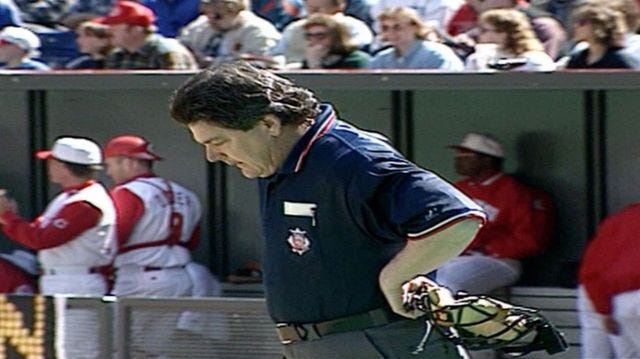
The Riverfront fans gave the three umpires a series of standing ovations. Crawford said it was the first time in 20 years as an umpire that he’d been cheered by a crowd.
“It’s nice to see you’re viewed as a human being,” Tom Hallion said. “I know with our profession, sometimes it’s overlooked.”
Thirty years ago this week in Cincinnati, no one knew what to do. Groping through the awful moment, they went down different paths: Marge Schott’s frantic self-pity and bargaining for normalcy. Crawford and Rippley’s commitment to duty and the dignity of work. The players’ decency in slowing down the onrushing world long enough to let the umpires catch up to their grief.
Looking back on it, the players got the moment right. There is no map for dealing with a sudden, public loss, but decency is a reliable compass. In giving a little grace to the friends and crewmates who survived him, the players found a fitting way to honor John McSherry, an man admired for his uncommon humility:
“He was one of the only umpires in the world,” one of the Reds’ players said, “who would come and tell you, ‘Hey, I missed that one.’”

I remember this so vividly. TV camera positioned behind the backstop caught the image so clearly. Somehow not surprised by Marge Schott’s reaction. What a miserable excuse for an owner.
From what I’ve heard of her on NY news stations she wasn’t exactly deserving of a ‘Mother of the Year’ award. I guess the one good thing about her was that she was a dog lover. Other than that she was a rotten human like so many are who have so much money they don’t know what to do with it.
His passing might’ve been avoided if he had not cancelled his appointment but hindsight is 20/20.
May he rest in peace. Hopefully other lives might’ve been saved by anyone else seeing how serious it can get.
She gets 2 thumbs up… she loved elephants too!
Good story Paul.