


Welcome to Project 3.18, where a fan-first writer tells strange and surprising stories from baseball history and culture.
If you enjoy what you read today, please subscribe to receive our free feature stories in your inbox. And if you’ve been here for a while, we could really use your support as a paid subscriber. Paid subscribers receive access to exclusive content and help keep this publication going and growing.
This week on Clear the Field, Ted and I did a show I’ve been wanting to do for a long time. With Halloween coming up, it felt like the right moment to revisit the eerie (and unexpectedly heartwarming) tale of Billy Earle, a catcher from baseball’s early years who became the living embodiment of bad luck among his superstitious colleagues.
I’m really proud of this episode, and Ted did some fantastic voice work bringing Billy’s words to life. The guy was a master storyteller and he had some stories to tell. I hope you’ll check out the show and I know you’ll enjoy it, especially if you’ve joined the Project 3.18 community in the two years since I first stumbled onto this story. The show is here on Substack, on YouTube, and if you prefer to listen, you can do that wherever you get your podcasts!
Earle got swept up in the irrational fears of his teammates and essentially spent his career on the run from their prejudices, so we talk a fair amount about superstition in the episode. Afterward, I wondered how all these adults convinced themselves that a hard-nosed catcher was actually a walking jinx. I started surveying my own rational experiences looking for superstitious beliefs, and that got me thinking about my grandmother.
Dorothy Hudson wasn’t the most expressive person, but one of the ways she cared was with cars. She worked at the local Department of Motor Vehicles and she took her cars seriously; it seemed like she upgraded every year or two, and instead of trading cars in, she liked to find them a good home in the family. And if she didn’t have what you needed, she’d accompany you to the local dealership and those salespeople better look out.
My grandmother stopped driving when I was in my early 20s. She’d held out as long as she could (and probably a little longer than she should have, but no harm done). Around that time, I found myself needing a car. Her last vehicle was a large, barely used hardtop sedan, the Cadillac of Toyotas. It wasn’t necessarily to my taste, but it had a V6 engine and it was available for a generous family discount.
The car came with a passenger. A small stuffed dog, a black and white Pound Puppy, if that rings any bells. Eighties kids will remember the brand, but my grandmother, a Thirties kid, liked them enough to have a few around the house and one in her car. I don’t think I ever talked to her about it, but when the car came to me, I decided to keep the dog in a cup holder or on the dashboard as a little Easter egg in her honor. It’s still there.
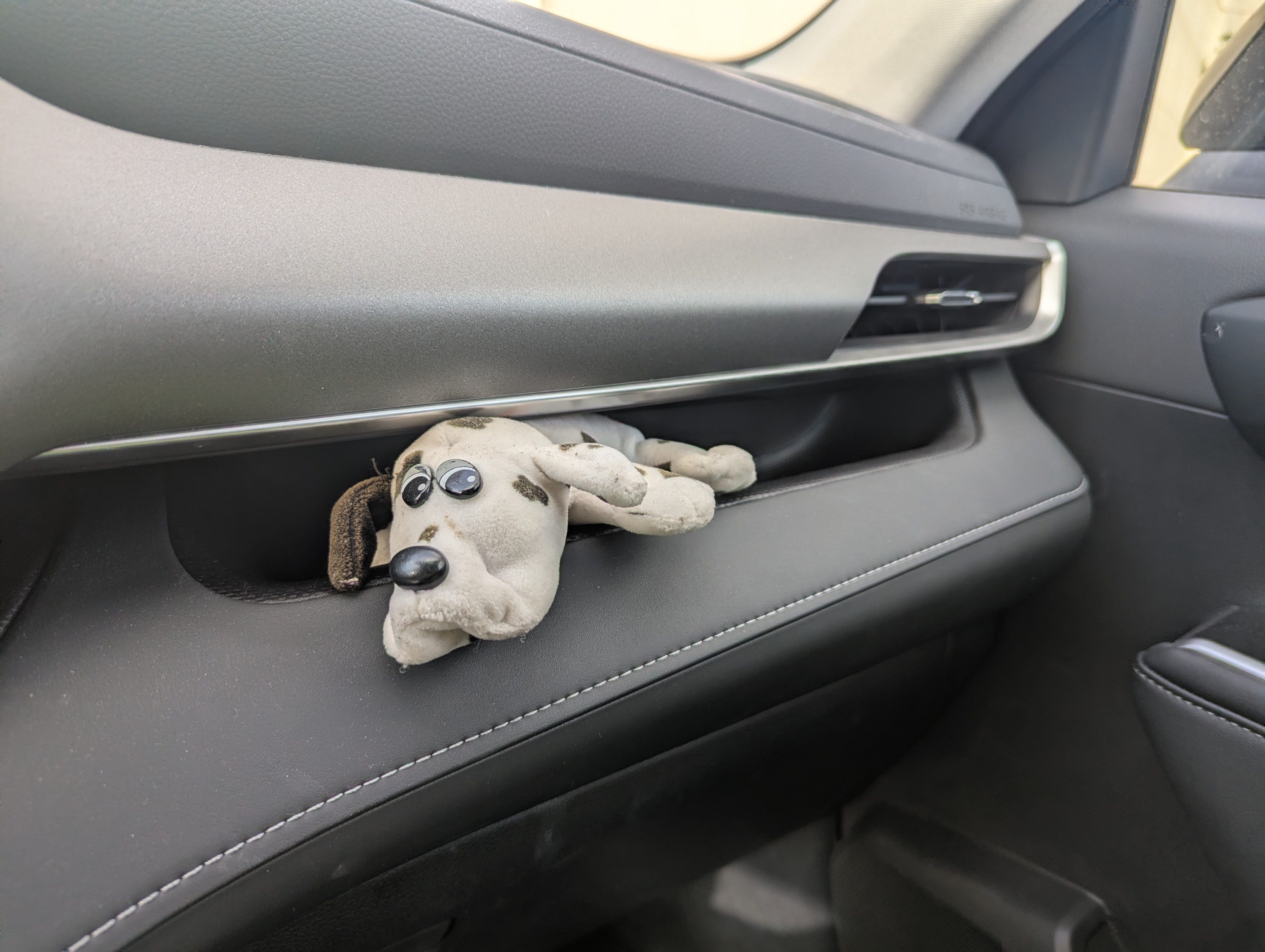
The dog’s black spots are turning brown and its red ribbon collar is now orange, but in the 20 years and four cars that we’ve been together, I have never caused or been involved in a car accident requiring repairs and my cars have never had a mechanical malfunction in a dangerous situation—not even a flat tire on a busy road. Now, you might suggest that my success is the result of a defensive driver buying reliable cars and springing for the recommended maintenance even when it seems scammy, but—hear me out—what if it’s the dog?
In 2010, my wife and I bought a new, smaller car, better suited for Chicago streets. Dorothy’s sedan, still in excellent condition, went to my parents, but the dog stayed with me. Just a few months later, my parents parked the sedan on the street across from my apartment in Chicago and while they were elsewhere, somebody hit it, totaled it, and drove away. Yeah, I’m pretty sure it’s the dog.
I don’t believe in ghosts, psychics, or astrology. I don’t worry about black cats or Friday the 13th, but you better believe that every time we get a new car, the first thing I do is move Dorothy’s stuffed dog into the proper place. No dog, no go.1
My confidence in that dog is an example of what psychologists call “magical thinking.” Even the most sober-minded of us have a stray magical thought or two, and athletes are more likely to have whole magical brainstorms. Studies have consistently shown that baseball players are the most superstitious athletes. The going theory is that baseball players look for professional help not just because baseball is difficult—all sports are difficult at the highest levels—it’s because baseball is so random.
Despite being the best at what they do, baseball players have remarkably little control over their fate compared to many of their peers. The best hitters make outs more than two-thirds of the time, sometimes based on the whims of an umpire’s fallible judgement. A pitcher throws a statistically perfect breaking pitch but a hitter throwing his bat at it manages to dump it steps in front of an outfield defender. More than one baseball statistic essentially aims to quantify a batter’s luck. We all know baseball is confounding because we say, “That’s baseball,” whenever it confounds. Since professional baseball’s earliest days, this capricious game has sent even the best players looking for help anywhere they can get it.

An 1897 article did a great job describing the precarious life of a professional ballplayer: “He is one day a hero, the next day a back number, and his work is like no other class, profession or trade. He is a wise, polished, shrewd, suspicious, and cunning fellow.” In his business, “his nearest friends are also his dearest enemies.”
Modern psychologists reading that description would see the perfect conditions for magical thinking, and sure enough, a 1905 article said, “Professional baseball players develop eccentricities more rapidly and violently than any other class of people in the world, possibly excepting school teachers.”
School teachers?
According to period accounts, baseball’s culture was maturing at the beginning of the 20th century, with an “intellectual” class of players replacing the “bummers and thugs” of the Pioneer Era. Many of those frat-boy teams of the late-1800s teams had embraced a “mascot” for luck, usually an individual whose race and/or physical attributes would have made them an outsider or an undesirable, except that the players had decided that good things happened when they were around. Mascots were invited to travel with the team, with the players paying their way—as long as the individual’s “luck” held. This era of “mascotry” was dying out by the early 20th century and social commentators at the time said, “Good riddance.” When social commentators from the 1900s thought a practice was too racist, you know it had to be really bad.
Not every mascot was an exploited person, however. In some cases the mascot was the one doing the exploiting. In 1906, the Detroit Tigers were in Philadelphia when a man “who looked like a tramp but talked like he’d seen better days” came to the team hotel, asking for the team manager, Bill Armour, who was extremely superstitious (i.e. an easy mark). The visitor said he was a good-luck mascot and offered his services. Detroit was stuck in a losing streak at the time so Armour let the guy join the team for the day. Call it an audition.
The Tigers won convincingly and the new mascot was invited back to Detroit. When the team won eight straight games, they bought the man a nice set of clothes and started bringing him on road trips (they would hide him from train conductors to avoid paying for another ticket). Such was the mascot’s prestige that two of the players had to share a bed on the team’s sleeper train car so he could have one all to himself.
Another Armour ritual had to do with the broom the umpires used to sweep off home plate. The broom was typically tossed to the left side of the batter’s box when not in use, but Armour insisted it be kept to the right. The umpires didn’t care, so they tried to oblige him, but the players eventually worked out what was happening and realized this was an opportunity to torment a manager and the officials in one go. Batters kicked the broom to the left side, requiring Armour to stop the game and request it be repositioned. On one occasion a fed-up umpire threatened to eject a group of New York Highlanders players if they didn’t stop moving the broom.
Another of Armour’s quirks made him something of a human scoreboard. He always managed in street clothes: a suit, jacket, and hat, usually a bowler or a straw hat with a flat brim. When the Tigers were winning, the hat was pushed back on his head, but in a close game, the hat was parallel to the ground. And if the Tigers were losing, Armour pushed his hat so far forward it was hard to see out from under it. Maybe that was the point.
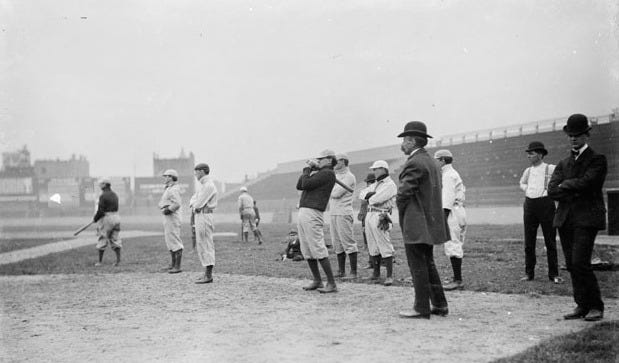
One superstition from this era has been entirely lost in modern times, but it used to be a Big Deal. For a large population of turn-of-the-century baseball players, barrels were one of the most powerful omens. “No baseball player dares to side-step the salute that the wagon-load of empty barrels demands of him, if he would be on an even keel with Lady Fortune.” I found a dozen quotes like this.
Consider this scene from Cleveland’s Euclid Hotel lobby in the summer of 1905. The visiting Washington Nationals were killing time, watching the action on the street through the hotel’s large plate-glass windows. In this period, Cleveland had a large barrel-making industry, and wagons loaded with new-made barrels rattled past the hotel at regular intervals, keeping the players on their toes.
The first player to spot a cart of barrels gave a signal: “Kegs! All hands up!” Each man was required to stand and lift his hat off his head. On this particular afternoon 14 carts of barrels passed by the hotel and the hats went up and down 14 times “as if moved by one lever.”
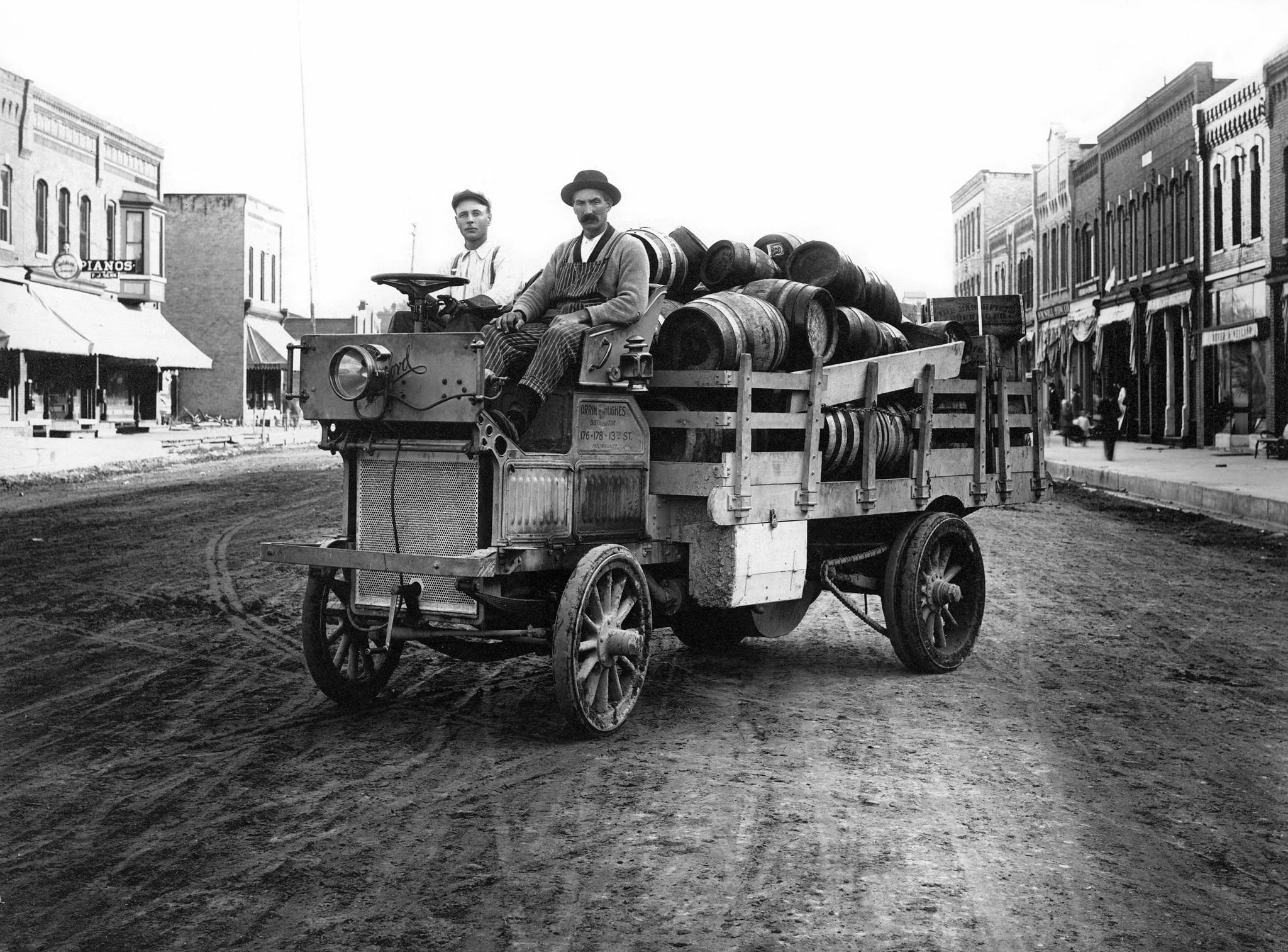
During one of these salutations, the trainer was apparently preoccupied petting the team dog (!) and failed to rise. The players glared at him and shouted, “Kegs, you goat-rubbing salve-hand!”2 The trainer scrambled to his feet and lifted his hat.
On the same afternoon, two cartloads of hay passed the hotel, and the older players recognized these haycarts as omens of success, which they acknowledged with a “sly-dog wink” and several blown kisses. Even the writer who documented this tradition said he had no idea where baseball players came up with this stuff.
An 1897 report said encountering hay on the way to the ballpark was such a powerful omen that players were liable to jump off their carriages and steal some, sticking the straw in their hair and caps to maximize their good luck.
Encountering empty barrels on the way to work was also good news. The turn-of-the-century New York Giants were known to tip carriage drivers whose route took the team past barrel trucks on game days, but there were conditions. The barrels had to be empty and the barrels had to be going the same direction—anything else was a sure jinx.
How did barrels acquire such supernatural properties, and when did they lose their power over professional ballplayers? Questions for future research, perhaps, but if any of you are scholars of 19th century coopering, now is your moment to shine in the comments.
A few more favorites:
Open umbrellas in a clubhouse were a no-no.
Bringing one in, even on rainy days, “would draw a cry of horror from the ball-tossers which would freeze the blood in a person’s veins.”
“More good luck for us, boys.”
Encountering a funeral on the way to a game was generally regarded as lucky, but crossing in front of or through a funeral procession was taboo.
Keep it rolling.
When a team was winning, the team bus or carriages were expected to take the same route to the park every day. Unless, presumably, it was necessary to divert to avoid a funeral.
Socks were a sacred commitment.
If a player accidentally put his socks on wrong-side out, he had to wear them like that all day. “No amount of persuasion could induce a player to fix them, as that is bad luck.”
In an ironic twist, red socks were apparently considered very bad luck in some circles. A Washington Nationals player named Case Patten didn’t get the memo and bought six pairs of bright red silk stockings during a road trip. He proudly showed them off to the players congregating in the hotel lobby, but drew cries of dismay and complaints that red socks were sure to “crab the whole trip.” A teammate forcibly escorted Patten back to his room to change. He later exchanged the red socks for a set of green ones “the same shade as tree toads.” Tree toads, we must conclude, were lucky.
“Last night I dreamed I was playing first base in my underwear and you were there pitching, so go warm up.”
Adrian “Cap” Anson, the longtime player-manager of the Chicago White Stockings, denied being a superstitious man, but as a manager he freely admitted to making pitching assignments based on omens from his dreams. “When a pitcher is unexpectedly called on to work, it is a sure sign that Anson has been dreaming.”
Lunch was the most prophetic meal of the day.
As professionals who earned their money in the afternoons, players started getting twitchy around midday. A pitcher named Danny Friend was famous for a belief that anyone ordering sour food at his lunch table meant he was going to lose the game. When his teammates uncovered this concern, they loaded up on pickles, to the extent that Friend was compelled to sit and eat alone to avoid the jinx.
Second baseman Cupid Childs believed that if his waiter spontaneously wished him luck, he would play a great game. These lucky servers received a generous tip, but another player tipped off the staff, and Childs got so many well-wishes he nearly went broke.
Players tried to keep their magic thoughts a secret because once they became public knowledge, it was open season. Centerfielder Roy Thomas, a player otherwise described as “quiet and sensible,” had to walk up to the plate via a route that took him behind the back of the umpire. One day a rascally umpire named Tim Hurst retreated all the way up to the wall of the stands behind home plate as Thomas approached, just to see what he’d do. Thomas briefly froze, but he realized Hurst was poised to mock him ruthlessly if he said anything. He dragged himself to the plate and struck out with his dignity intact.
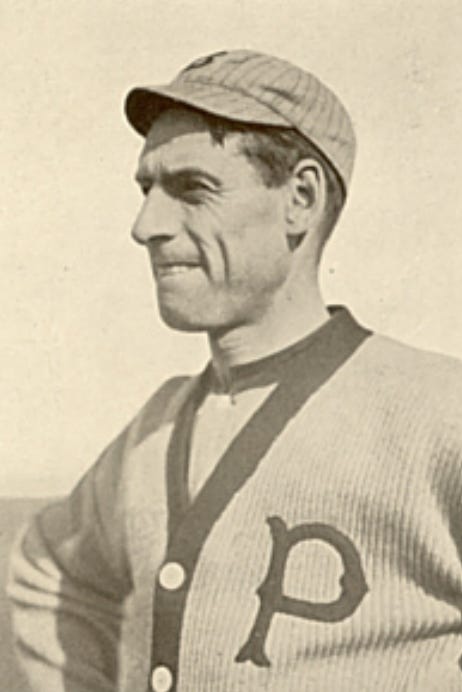
In the 1890s and 1900s, the field of psychology was still coming together. Mental health was mostly ignored up to a certain point and after that point people were whisked away to asylums, where more than one obsessive-compulsive Victorian ballplayer ended up. But even in this pre-DSM era, there was plenty of reflection on just what made ballplayers so quirky:
“The player uses [superstitions] as something to hide behind. They give him a chance to dodge blame by attaching that blame to something else, when the breaks are going against him. They can serve that purpose until the player or the team returns to ‘normal’ form.”
Superstitions are a tool for stabilizing an inherently unsteady world. No batter has ever worn a lucky undershirt in the hopes that it will make them a .500 hitter; they wear it to hit what is most optimally “normal” for them. In that sense, magic thoughts are often practical, merely a means of achieving one’s self-identified potential.
Our society has become less superstitious over time, but baseball has always stayed closer to the past. Modern baseball continues to be a deeply uncertain game where supernatural forces have plenty of room to maneuver. A former team psychologist for the Baltimore Orioles named Jim McGee observed that baseball players five generations apart still had a great deal in common, especially in their day-to-day anxieties. To cope, players “still do things in 1990 that they did in 1890.” And that observation got me thinking. Did they, really? How different were baseball superstitions a century apart?
Let’s find out.
Next week, we’ll follow McGee’s prompt and explore some of the magical baseball thoughts of the 1990s and 2000s. I’m going to predict barrels didn’t have staying power, but sock stuff probably hung around.

If you enjoyed this baseball story and want to support Project 3.18, consider becoming a paid subscriber.
You can also really help us by sharing this feature on socials or restacking it here on Substack. Publishing a story is how we get on base; please help spread the word and drive us home.
I’d love to see your comments on this one. Rational people: what is your secret superstition? Baseball people: what other old-time superstitions do you enjoy? School teachers: are you still one of the most superstitious segments of the American workforce?
Many people with superstitious beliefs are reluctant to discuss them, to avoid mockery, yes, but also to avoid “jinxing” a good thing. I can attest to this: It took me a minute to consider whether or not to describe my run of vehicular good luck in writing, but I decided the dog would be okay with it.
”Goat-rubbing salve-hand” is clearly intended as an insult here. “Salve-hand” might be a reference to the trainer’s role working on players’ sore muscles, but I have no idea why there’s a goat involved.