


Welcome to Project 3.18, a free weekly publication where a fan-first writer tells strange and surprising stories from baseball history and culture.
Today we’re finishing the story of a four-game showdown between Babe Ruth and Ty Cobb. The Tigers lost the first two games, but the head-to-head competition between the two stars was roughly a draw. But Detroit had made Babe Ruth mad, and that was a mistake.
Here’s the first part of the story.

On June 13, 1921, Babe Ruth played the “grudge game” of his career.
The day before, the Babe had been “publicly flouted and humiliated before 30,000 admirers.” His tormentor was the second-most famous baseball player in the world, Ty Cobb. Before the game, “in no uncertain terms and in effective pantomime, the sprightly Cobb derided the contour of the Babe’s piquant nose and the rather too bulky waistline that encircles his frame.”
In other words, Cobb had called Ruth a gorilla, and had later mocked Ruth after a particularly exaggerated strikeout. Cobb and Ruth continued jawing back and forth throughout the game, and according to the Buffalo Courier, the umpires and the Yankees’ manager had to step in to prevent a “violent onslaught against the offending Cobb.” A game-tying home run in the sixth hadn’t mollified Ruth, nor had the Yankees’ victory, which sent the Tigers into fourth place. Still feeling Cobb had gotten the better of him, Ruth decided that bludgeoning the Tigers’ pitchers with home runs was too indirect a form of retribution, as Cobb didn’t pitch.
Ruth, however, did.
By dawn on the morning of June 13, Ruth’s broiling anger had chilled into a plan. He was the first player into the team’s clubhouse that morning and he went straight for Miller Huggins, the manager.
“Let me pitch against Detroit,” he said to Huggins. “You may not think I’m in pitching shape, but I am. And I want to whip Ty Cobb and show him up.”
Ruth the hitter arrived in New York in 1920, but Ruth the pitcher stayed behind in Boston. With one exception: On June 1, Ruth started (and batted fourth) for the Yankees against the Washington Nationals.
A costly error behind him led to two unearned runs in the first, but Ruth worked three clean innings after that. When the first two batters in the fifth inning walked and doubled, Huggins banished him to the outfield, but he left with a 12-2 lead, and when the day was over the Babe had his first pitcher win in 15 months.
A year later and a year older, he now wanted to challenge Cobb, one of the most accomplished hitters of the past, present, and future, in baseball version of single combat.
Ruth proposed to take the place of Carl Mays, the Yankees’ best pitcher that season, giving the ace at least a few innings of rest during a summer of slugfests that was taking a toll on the starters and relievers. “If they make the ball much livelier, pitcher battles will become a thing of the past,” one writer lamented.
Huggins was reported to have “pounced” on the idea of letting Ruth pitch, which is a little hard to believe, but perhaps this was a showdown even he couldn’t resist.
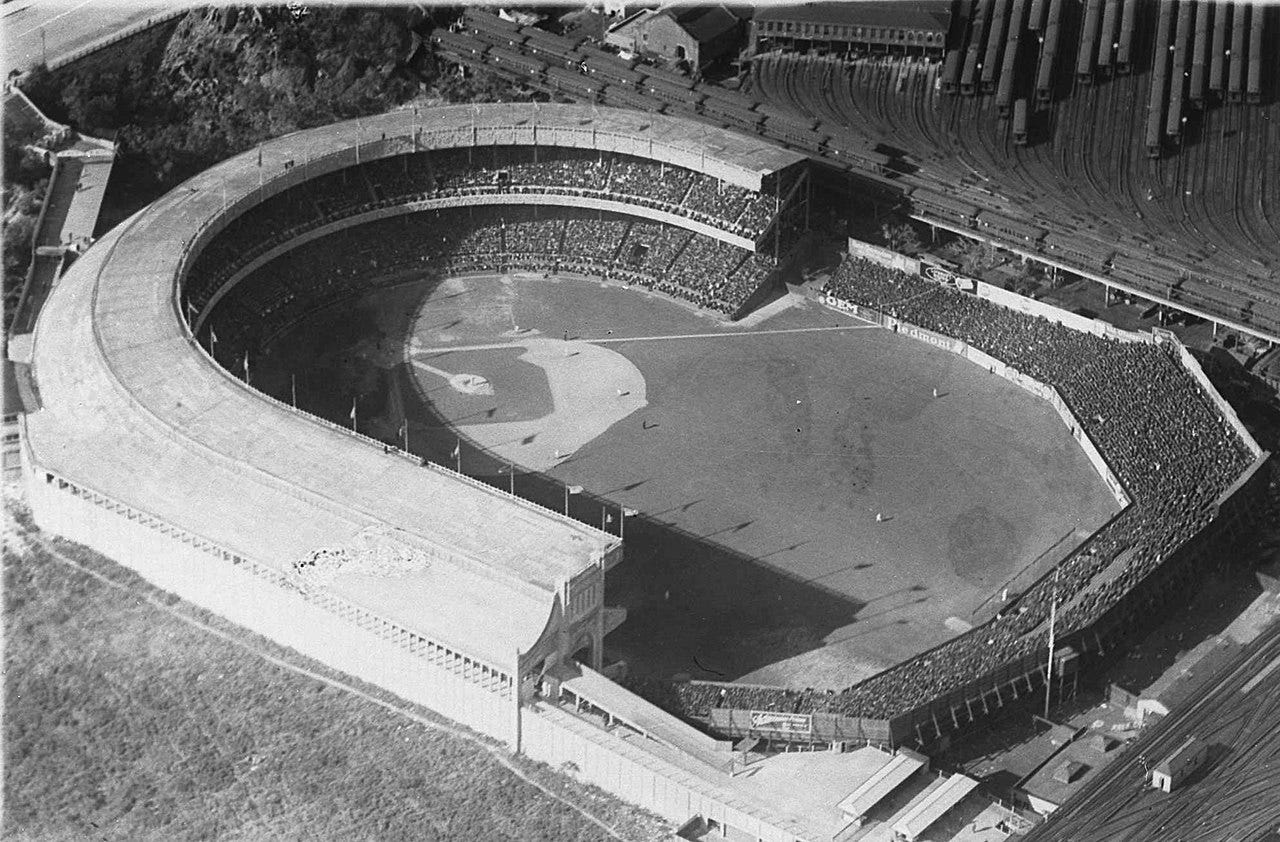
The plan came together so late that the 12,000 fans at the Polo Grounds that Monday afternoon expected to see Mays warming up on the mound, but an unmistakable figure appeared in his place. When Ruth was announced as the day’s pitcher, the crowd sounded like many more than they were. Not wishing to leave any reader out of the excitement, reporter W.S. Farnsworth wrote:
For the special benefit of that lonesome Laplander who may have floated into [New York] from some end of the world where they don’t know about our Babe, it must be explained that Ruth, in addition to being the greatest batter of his day, is now an outfielder and not a pitcher.
Seeing Ruth back on the mound, the Tigers mostly stood around, “pop-eyed,” but one of the Detroit coaches—apparently not at all superstitious—hooted: “What? You are going to pitch?” Ruth just smiled.
The first mano-a-mano moment arrived quickly, as Cobb batted third in the Tigers’ lineup. Ruth got the first out then walked Donie Bush, and facing Cobb for the first time, walked him, too. Ruth made the next two outs to end the inning.
On offense, he and his teammates got to work on the Tigers’ starter, Howard Ehmke, manufacturing a run in the first inning and adding two in the second on an inside-the-park home run hit by Ruth’s center field stand-in, Chicken Hawks.1
Ruth and Cobb hooked up again in the third. This time there were two runners on base, but Ruth got Cobb to fly out. Buoyed by that victory, Ruth batted in the bottom of the third and hit his 20th home run into the upper-deck stands in right field. The Yankees’ third baseman, the veteran Home Run Baker2, hit a two-run shot later in the inning.
When the Tigers came to bat in the fourth, they were losing, 6-0, and after a leadoff walk Ruth retired the side.
He’d had success, but Ruth the pitcher began wear out. He faced eight batters in the fifth as the Tigers broke through with the help of an error by Baker at third. By then the Babe was “a perspiring, overheated Behemoth, looking as if he had just come out of the surf.”
In the middle of that inning, Cobb and Ruth faced off again. Ruth brought everything he had and gave Cobb the “whipping” he’d been trying to land all day, striking Cobb out. Cobb became Ruth’s only strikeout victim that day. Ruth was so happy to have retired his rival that he gave up four runs and let the Tigers back in the game, 6-4.
Detroit’s embers of dignity were extinguished when the Yankees immediately answered with four runs of their own. With the cushion restored, Huggins sent Ruth back out in the sixth, but when he gave up a single and a walk, the manager ended the experiment and summoned Carl Mays to take over. Ruth, worn out and with all his revenge boxes ticked, made no protest. He caught his breath out in center field while Mays retired the side.
The Yankees led 11-5 when Ruth batted in the seventh. In line for a win and having fanned the great Ty Cobb after a year off from pitching, Ruth seemed to have found something even better than a grudge: he was at peace.
During that at-bat Ruth spotted a dawdling pitch from Ehmke and batted it away with an effortless swing. The crowd watched the ball travel into center field, a no-mans-land at the Polo Grounds.
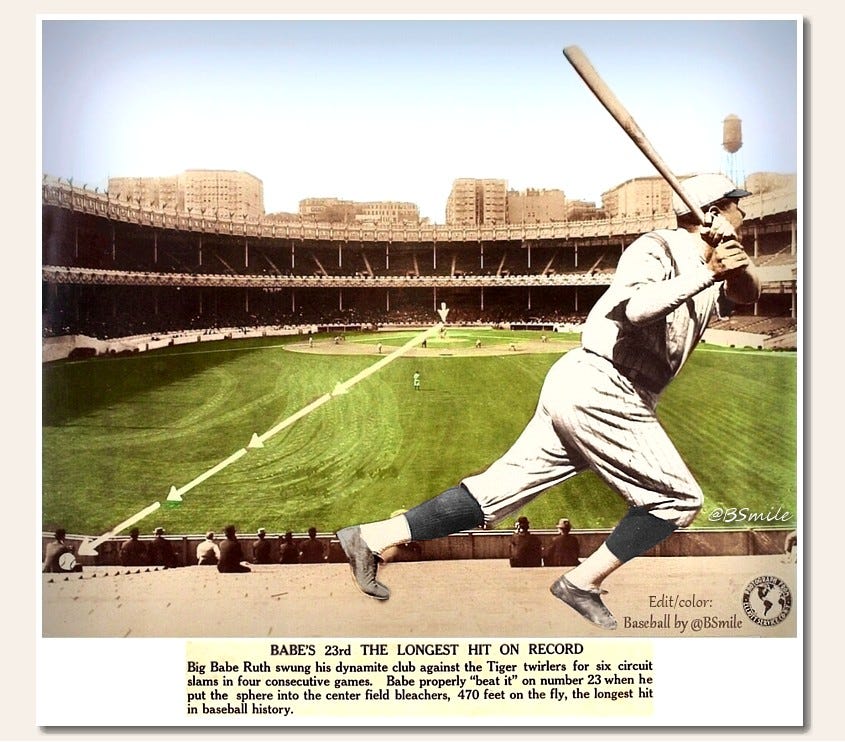
Ruth had always said he’d hit one out there, but Ruth always said a lot of things. In fact, no one had ever hit a home run into straightaway center field at these Polo Grounds, where the wall was 460 feet from home plate: “It’s so far out that bleacher fans there ought to get paid to sit there because there is precious little they can see.”
Ruth’s 21st home run sailed over that deep wall. The New York Herald reported, “The ball fell into the exit stairway of the bleachers and then down under the benches, where a mob of boys had a free for all for the prized memento.”
“Folks who have never seen the Polo Grounds haven’t the slightest idea what a hectic clout this was,” a San Francisco newspaper, the Bulletin, told its Pacific Coast readership. “Most of Ruth’s homers at the Polo Grounds go into right field, an easy drive, but the bleachers…whoops my dear!”
“It requires more than a pea blower to belt the agate where Ruth deposited it this afternoon,” a Detroit writer glumly observed in the quirky parlance of the time.
The record-setting blow moved Ruth 12 days ahead of his 1920 54-homer pace. Newspaper graphics departments got busy illustrating what a blast this was. Here’s a modern version we appreciated:
As Ruth “romped homeward,” he allowed himself a pause near second base, turning to the small figure out in the deepest part of center field and “sending out a shrill and mocking laugh.”
The Yankees’ superweapon had hit five home runs in four days. He had done the same thing in 1918, setting a record he jointly held with old-time Cleveland great Bill Bradley, who did it in 1904.
Ruth’s pitching “was not of the airtight variety,” the Herald reported, “but who is pitching airtight ball in these days of the ‘jackrabbit’ leather?” He had shaken off a year of rust to pitch four decent innings and in his only bad inning, he struck Ty Cobb out. June 13 was the day Cobb’s 1921 batting average dropped below .400 and Babe Ruth presided over the occasion.
The Tigers kept scratching, scoring three runs in the last two innings, but despite scoring 24 runs in the series, they fell to 0-3.
“When the day was over,” Farnsworth wrote, “Cobb seemed crushed and his shoulders slumped. The spotlight rays had passed from him to Ruth once more and he was left in darkness, prostrate in the dust of the Babe’s hefty heels.”
On June 14, Ty Cobb continued to abuse his thoroughly broken Detroit pitching staff by insisting they pitch to Ruth, who was having the time of his life. The next sacrificial Tiger was a right-handed pitcher named Hooks Dauss. When Ruth came up in the bottom of the first, the Tigers shifted to the right side to try and catch anything Ruth didn’t hit out of the park. Not only did Ruth not give their shift a chance, he hit Dauss’ off-speed pitch over the top of the left field wall. His 22nd home run bounced off a train car idling momentarily on the tracks beyond the Polo Grounds. Two runs scored, but Cobb refused to yield.
“Every time Ruth came to bat,” the Herald reported, “he looked out toward center field where Cobb stood backed against the fence. Every time the Babe laughed as Dauss, the non-deceiving, tried to baffle him.”
In the third inning, Dauss tried a fast one and the combination of the ball’s speed and Ruth’s timing and aim produced a perfect parabola on which the ball “rode into the great beyond” of center field. This one left the park right over the top of Ty Cobb’s head, landing five rows deep in the bleachers. Another two runs scored.
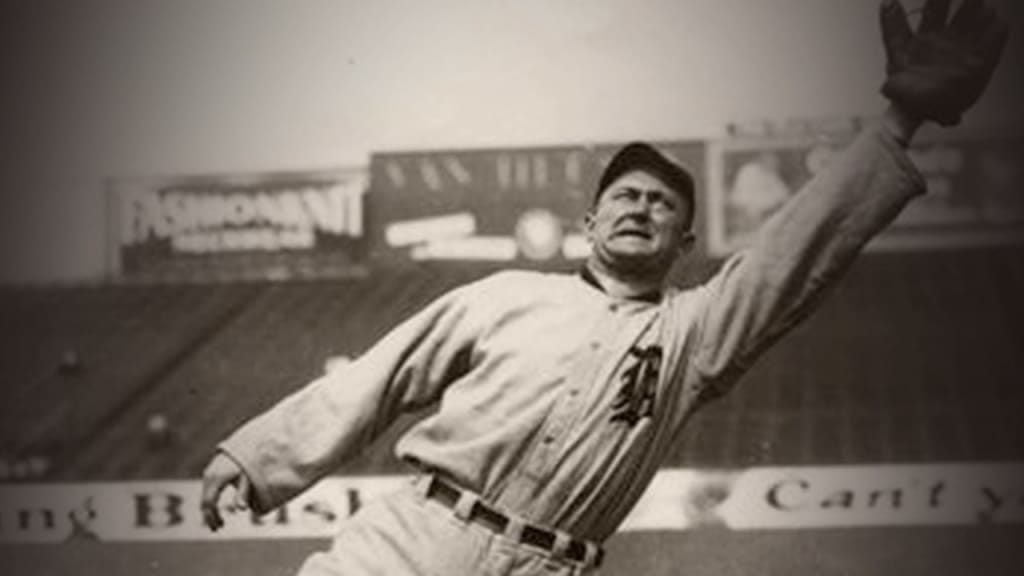
The crowd knew they were witnessing feats they’d be telling children and grandchildren about, and they showed their gratitude in hats:
Had some enterprising gentlemen thought of it, they could have laid in a supply of straw hats to provide a large population for several years. The zone in front of the grandstand from end to end was strewn with summer head gear that came like a snow storm.
The Stadium’s groundskeeper reckoned that ball went nearly 500 feet, erasing Ruth’s record from the previous game before the ink even had a chance to dry.
He had hit seven home runs in his last five games, and here old Bill Bradley saw himself out. Ruth’s 22nd and 23rd home runs put him 16 ahead of his 1920 place. “When the season opened it was speculated whether Ruth could even approach his 1920 mark. Now they are wondering where the battering ram will stop. What’s the limit?”
In the seventh, Ruth appeared for the last time and he smiled out to center field again. By this point he had accumulated 10 home runs off of Hooks Dauss, more than he had off any other pitcher.
Cobb signaled Dauss to walk the Babe.
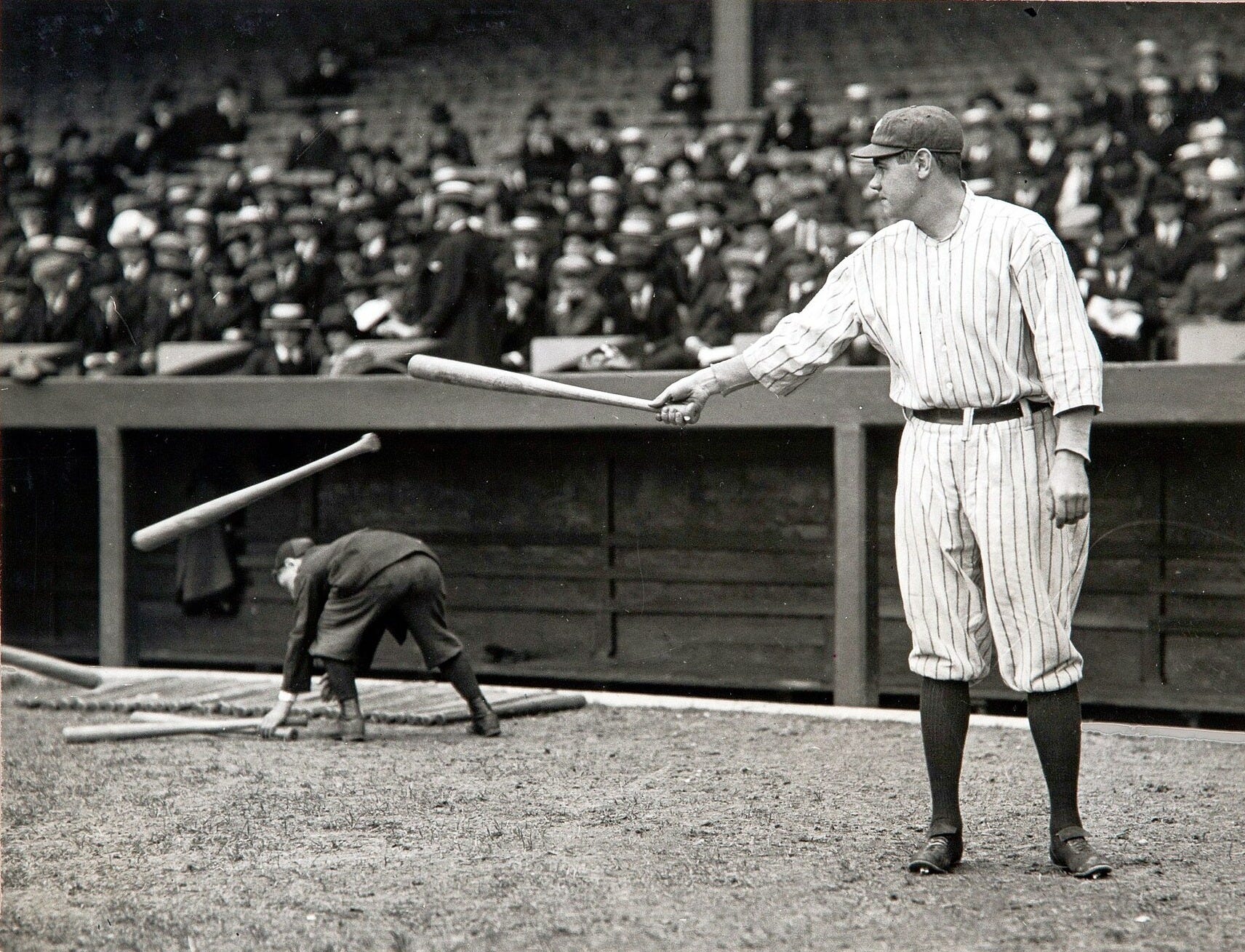
The Tigers never stopped trying, and their manager wasn’t too proud to change tactics himself. Down 5-0 in the sixth inning, Cobb himself hit “a sweet wallop,” the ninth of his 12 home runs that season. In the eighth, the rest of the Tigers assembled a five-run rally. Rarely had a four-game sweep elicited such respect from the writers:
No manager fought harder than Tyrus to overcome the mighty and uncanny batting that greeted his pitchers during his four-day stay. The Jungle Men did their share with the willow, but it was not enough. The Yankees always seemed to have a few more killing blows up their sleeves in time of need.
The Yankees’ 9-6 victory finished the sweep. Ruth’s biography, already populated with sensational moments, seemed to be bursting at the seams, and the hype around his exploits reached Biblical proportions:
If the Babe is human, then Adam started something which deserves far wider publicity and greater credit. If this crashing Titan truly is human, we have arrived at the physical superman, and Ruth is writing a remarkable postscript to Genesis.
If the series was a showdown between Cobb’s way and Ruth’s, the Tigers’ icon made a fine accounting of himself, going 7-for-18 at the plate with two doubles. He had three RBI, scored four times, and even hit a home run. But Ruth, “the Swatting Demon,” went 9-for-12, hit two doubles, drove in 12, scored nine runs himself, and hit six home runs.
It was the same story for the Tigers as a unit. They scored an average of seven runs per game in that series and still got swept out of the Polo Grounds, a grisly fate that could be mathematically traced back to Cobb’s insistence that his pitchers challenge Ruth despite his obvious moment of transcendence. Daring Ruth to hit the ball was a strategy “beyond the reasoning of sound judgement.”
“Where do the Tigers expect to get off,” the Detroit Free Press demanded, “if they—out of bravado or just the thought that some act of Providence will protect them—play with the battering Bambino? It’s like touching a match to a fuse in a bomb and holding the weapon in your hand.”
It would be narrative exaggeration to claim Ty Cobb left the Polo Grounds a beaten man, or to say that Ruth’s single-handed defenestration of Detroit’s pitching staff ended their season, but after losing four games to the Yankees, the Tigers went to Boston and lost four games there, too. In less than two weeks they went from third place to fifth place. By the time the season ended, Cobb’s Tigers were 27 games back of Ruth’s Yankees, who won the American League pennant for the first time in the club’s history. More would follow.
In a recap of the series, The Sporting News described it as a match between “the bull and the locomotive.” The magazine did not say who was what, but the Tigers had taunted Ruth and left the series thoroughly gored, so there’s that.
The cost of Cobb’s stubbornness became a warning to other teams who, with the jeers of their own fans in their ears, might be tempted to reach for their courage: “Ruth defies all laws and principles of pitching.”
Before that season, a former Boston teammate, Pinch Thomas, was more philosophical:
I am not so certain now that Babe is human. At least, he does things which you couldn’t expect a mere batter with two arms and legs to do. I can’t explain him. Nobody can explain him. He just exists.
In an era of newsprint hyperbole, the Babe hit, and therefore he was. He hit 59 home runs in 1921. That record stood until 1927, when he broke it again.

Two More Things:
1. “The home pastimers collected a trio of markers in the opening spasm…”
So begins a typical paragraph of 1920s baseball journalism, when the type was microscopic, the chronological narrative frowned upon, and every sportswriter fancied himself a Jazz Age Shakespeare.
Giving a full written play-by-play of games, reporters apparently held onto their sanity by making no two sentences sound anything alike, which is how “the home team scored three runs in the first inning” became something that barely qualifies as the King’s English.
But the worst part is that sports journalism at the time did not often involve talking to the athletes about what had happened that day and publishing their comments. Perhaps we could find some material if we devoted our lives to the task, but it is a fact that no major New York or Detroit newspapers printed any reaction from Babe Ruth or Ty Cobb during their Homeric clash at the Polo Grounds in 1921.
No one asked Babe Ruth how it felt to hit the longest home run in Polo Grounds history on the same day he broke his pitching sabbatical and struck out Ty Cobb. No one asked him what all had happened in the various arguments the day before. And no one seems to have even asked Ty Cobb why on earth he kept pitching to Babe Ruth during the heater of his life.
2. Three years later, Ruth and Cobb got into it again at Detroit’s Navin Field. A routine plunking sparked a brawl, but this time the fans got involved and thousands of people swarmed the field and ripped their seats out and started throwing them. Can you guess what happened next? That’s right, the game ended in a forfeit!
Of course Project 3.18 will cover that one at some point in the future, but not now. Too much 1920s newsprint gives us a headache.
Okay, Three More Things, Because This JUST Happened:
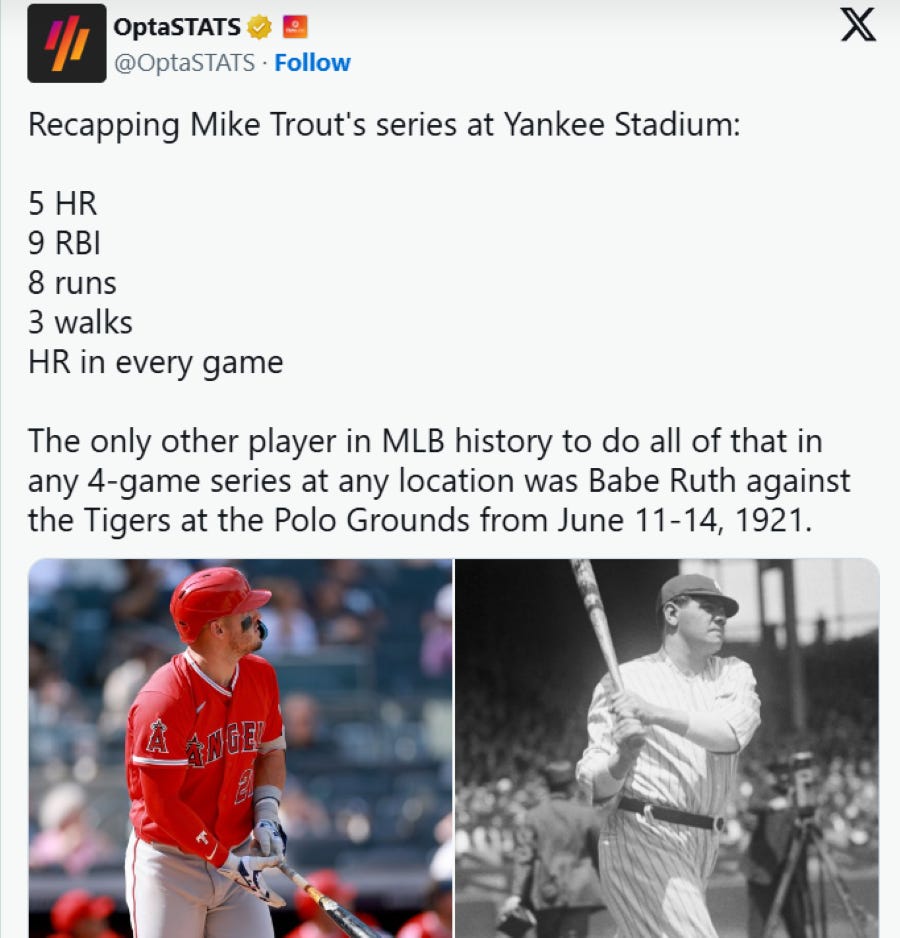
Yeah, but how was Mike Trout’s pitching?
Over on Clear the Field:
Our unexpected series on baseball true crime takes us back to 1900, when a couple of shady characters wired up Philadelphia’s ballpark and ran a sign-stealing operation that still seems sophisticated today.

Lu Blue got by us, but we did know about Chicken Hawks (real name, Nelson Louis Hawks), an inner-circle member of baseball’s All-Animal team. Don’t get us wrong, it’s a great nickname, but it’s a little too obvious for us.
Home Run Baker earned his nickname by leading the AL in home runs for four seasons and for some power-hitting heroics in the 1911 World Series. Baker was on the downswing by 1921, but still got to keep the nickname. Babe Ruth had some bad luck with branding. He missed out on “Home Run Ruth,” people were already using footage of him playing to make movies he wasn’t involved in, and he couldn’t even have a “Babe Ruth Candy Bar” because the company making the “Baby Ruth” successfully argued he was infringing on their intellectual property.
Whatever stats they come up with now Cobb & Ruth will always go down in baseball history.
When you have guys like McGuire, Pettitte, etc., gettin’ all juiced I don’t understand why MLB has two standards.
They came down on Pete Rose yet today MLB is making gazillions on betting.
The least they could’ve done is apologize to the man before he passed.
Long live the Babe!
“It requires more than a pea blower to belt the agate where Ruth deposited it this afternoon.” What delightful prose. Why can’t you write like that, Paul?