


Welcome to Project 3.18, a free weekly publication where a fan-first writer tells strange and surprising stories from baseball history and culture.
Today’s story was inspired by a recent piece by fellow Substacker The Retroist, which spotlighted the Reggie! Bar, a late 1970s candy phenomenon famously named after Reggie Jackson, a baseball player of some renown.

We were surprised to learn the secret origin of the Reggie! Bar, which was marketed as a brand-new product when it was released. But no matter where it came from, after the events of April 13, 1978, the confection belonged to Reggie Jackson, and that’s our story today.

In early October 1975, as the Oakland A’s prepared to face the Boston Red Sox in the American League playoffs, a New York Daily News writer named Phil Pepe interviewed Reggie Jackson.
It wasn’t hard to get a few minutes of the right fielder’s time. In the cramped A’s clubhouse at the Oakland Coliseum, his teammates joked that Jackson was the only one who wanted the locker by the door, the better to greet incoming reporters. If that was true, the feeling was mutual, because Jackson was one of the best “quotes” in any sport.
In their conversation, Pepe observed that Jackson had been an all-or-nothing hitter in 1975. His .253 batting average was below par for the times, but his 78 extra-base hits, including 36 home runs, more than made up the difference. “In many ways,” Pepe wrote, “Jackson typifies the A’s. They don’t hit often, but they hit when it counts; and when they hit, it counts.”
Jackson’s power production was all the more notable because he played half his games in the Oakland “mausoleum,” the worst stadium in the American League for home run hitters. Pepe suggested that if he’d played in a more slugger-friendly park, his numbers might have been even better. Jackson nodded in agreement.
“If I was in New York, they’d name a candy bar after me.”
The offhand comment, teed up perfectly by Pepe, was quintessentially Reggie: clever, bombastic, ambitious, and a little arrogant. It was also meaningless. Free agency didn’t exist in October 1975, and the A’s owner, Charles O. Finley, would have traded his beloved pet mule before he’d let Reggie Jackson go.
Candy was a billion-dollar industry in the 1970s, and though “new and improved” was a selling point in most businesses, Americans generally insisted that their sweets stay the same.
Nobody wanted to drive the same car their grandparents drove, but candy consumption was practically hereditary. In 1978, the most popular candy bars were Snickers, Reese’s Peanut Butter Cups, Milky Way, and Three Musketeers. Some of these products became best-sellers before the Great Depression, and they may even be familiar to readers today, another half-century on.
Around those towering milk-chocolate behemoths lay the discarded wrappers of decades of upstart products with splashy gimmicks that failed to make a dent in American snacking habits. In the early 1970s, the Quaker Oats Company paid $3 million to finance a film adaptation of Roald Dahl’s book Charlie and the Chocolate Factory, in exchange for the rights to market actual products using the names and likenesses of candy shown in the film. It seemed like a can’t-miss promotional springboard—we still get hungry watching Charlie Bucket eat his precious Wonka Bars—but it struggled to find an audience. Quaker’s Wonka product line failed to challenge any of the market heavyweights, and their chocolate bar never even made it to mass distribution.
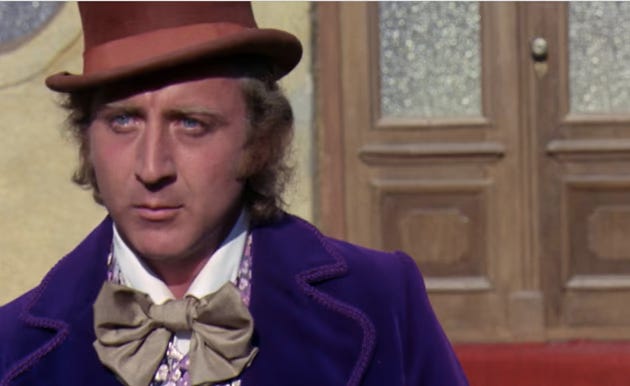
If Willy freakin’ Wonka couldn’t make it in the candy business, manufacturers were going to be much more cautious about a new candy marketed around Reggie Jackson, even if he was one of the most fascinating and well-known athletes in the country. And since he didn’t play in New York, the whole thing was a flight of fancy.
In December 1975, two months after Jackson’s now-famous hypothetical, an arbitrator’s decision initiated the series of events that led to baseball’s free agency. The open market for players didn’t appear overnight, but a year later Reggie Jackson was among the first small group of players with the right to sell their own services.
The New York Yankees didn’t necessarily need a left-handed bat, but the team had been swept in the 1976 World Series and the owner, George Steinbrenner, had gone a little mad. Determined to make the biggest, loudest purchase he could in the first round of free agency, Steinbrenner brought Jackson to New York and let the city work its magic. On November 29, 1976, Reggie Jackson signed a five-year, $2.9 million dollar mega-contract. A few months later, a candy company called.
Chicago-based Standard Brands produced the Baby Ruth—the “candy bar” Jackson had indirectly referenced back in 1975—and the Butterfingers. Those two brands made up about eight percent of all candy bars sold in the country at the time, making Standard Brands a serious player but fringy enough to risk a big swing.
It would be some time before Jackson’s candy bar hit the market. Early reports said it might be called, “Hey Reggie,” but Standard Brands still had to come up with a suitable product and prepare an extensive marketing plan. Ron Cappadocia, the company president, explained the challenge: “You can mix chocolate, caramel, nougat, and nuts in different proportions, but it’s hard to come up with something really different.”
Some of Jackson’s acerbic Yankees teammates rolled their eyes. Nodding to the outfielder’s oft-criticized defense, Graig Nettles said the bread companies had missed an opportunity: “They ought to name a loaf after him, not a candy bar.”
Cappadocia acknowledged that Jackson was a “controversial figure,” but he said that wasn’t necessarily a bad thing. “It does increase awareness, anyway, and we want awareness.”
On October 18, 1977, in Game Six of the World Series between the Los Angeles Dodgers and the New York Yankees, Reggie Jackson gave Standard Brands all the awareness they could ever hope for.
The Yankees escaped Los Angeles up 3-2 in the series, returning to the Bronx for a sixth and potential seventh game, but Yankees manager Billy Martin made a point of telling reporters, “We’re only going to need six.”
Game Six is its own story and then some, but in lieu of the full account, here are two immaculate paragraphs from Roger Angell, the greatest baseball writer of the 20th century:
Reggie came up to bat in the fourth inning (he had walked in the second) and instantly pulled Burt Hooton’s first delivery into the right-field stands on a low, long parabola, scoring Thurman Munson and putting the Yankees ahead for the rest of the game and the rest of the year. Jackson stepped up to the plate again in the next inning. “He’s going to hit it out of here on the first pitch,” I announced to my neighbors in the press rows, and so he did…It was a lower drive than the first and carried only four or five rows into the same right-field sector, but it was much more resoundingly hit; at first it looked like a double, or even a loud single, but it stayed up there—a swift white message flying out on an invisible wire—and vanished into the turbulent darkness of the crowd.
I did not call the third homer. One does not predict miracles. This one also came on the first ball pitched—a low and much more difficult pitch, I thought, from knuckleballer Charlie Hough. The ball flew out on a higher and slower trajectory—inviting wonder and incredulity—this time toward the unoccupied sector in faraway center field that forms the black background for hitters at the plate, and even before it struck and caromed once out there and before the showers of paper and the explosions of shouting came out of the crowd, one could almost begin to realize how many things Reggie Jackson had altered on this night.
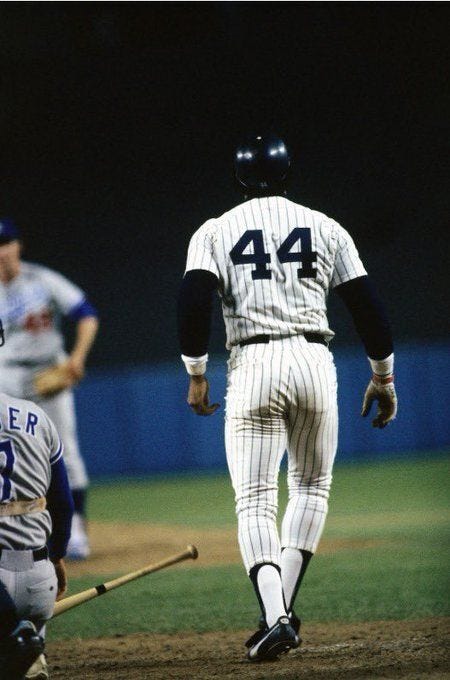
In hindsight, October 1977 would have been the perfect time to flood convenience stores across America with Reggie! Bars, but greatness arrived on its own schedule. “It sure would have been beautiful if we had the bar on the market now,” a Standard Brands official said, “but we don’t.”
A New York marketing executive was sympathetic. “Who expected [Jackson] to have that kind of a Series? He was a bum in the first few games.”
Jackson’s World Series heroics certainly set the marketing team back. Whatever work might have been done, the company immediately threw it out in favor of a plan to make the candy as much about the moment as the man. “We’re tying our marketing very closely to [Game Six],” Cappadocia, the company president, said. “That event will live on no matter what Reggie does. It was one of the greatest feats in sports.”
The Reggie! Bar debuted on February 22, 1978. George Steinbrenner was on hand—the Yankees had signed their own partnership agreement with Standard Brands—and loudspeakers filled the Terrace Room at New York’s Plaza Hotel with the sounds of a crowd chanting the slugger’s name. On one side of the room was a Plexiglas case containing the baseball Jackson had hit off of Charlie Hough to tie Babe Ruth’s record for home runs hit in a World Series game. The ball had its own security guard and someone asked if the ball belonged to Jackson. “Oh no,” the guard said, “this belongs to Standard Brands.”
Cappadocia and Jackson tugged on a golden rope, raising a curtain to reveal an oversized mock-up of the Reggie!, officially described as “Chocolaty-covered caramel and peanuts.” A quartet of musicians struck up a Dixieland tune while young women wearing Jackson’s #44 surged into the ballroom, passing out free samples and framed, autographed candy wrappers.
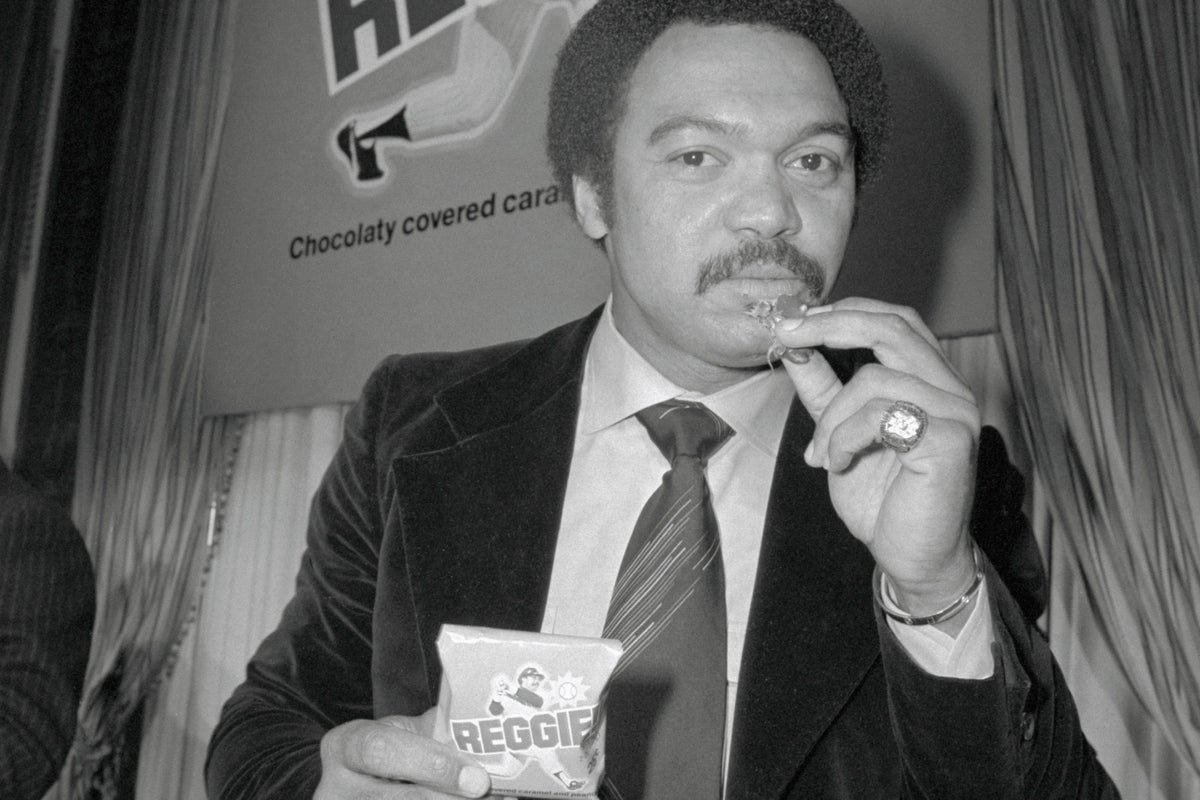
“The bar is chewy and sweet,” one early reviewer said, “and sets off the appropriate alarm bells about teeth in the conditioned mind. The taste is pleasant but not unfamiliar.” The bar was packaged in a bright orange and blue wrapper oddly evocative of the crosstown New York Mets. The wrapper showed Jackson in his swing follow-through; thanks to the deal with the Yankees, the pinstripes of his uniform and the logo on his cap were visible, but only just barely, so as not to deter fans in other markets.
The strangest thing about the Reggie! was its flat profile and circular shape. Cappadocia said this was a design decision that would make it possible to add “trading cards, statistical information, and other announcements” in the future. Jackson had big plans for his candy bar. “He feels it goes beyond baseball.”
The 1978 Yankees began the season 1-4, losing series in Texas and Milwaukee, but it was too early to worry about any of that. It was also too worry about Jackson, who had yet to hit a home run despite swinging very hard. The day before, in Milwaukee, he’d struck out four times.
April 13, 1978 was a particularly special homecoming for the Yankees, last seen at the Stadium on the night they won the World Series. Jackson himself had last been seen fleeing through a stampede of wild, triumphant New Yorkers who had invaded the field and forced the players to run for their lives. Six months later, they’d celebrate properly.
The players would get their World Series rings before the game against the Chicago White Sox, and the fans would get to see the 1977 World Championship pennant raised by two Yankee Legends, Mickey Mantle and Roger Maris. Mantle was a frequent VIP, but Maris, embittered by the treatment he received after breaking Babe Ruth’s home run record in 1961, had not come back to the Stadium since being traded to St. Louis after 1966.
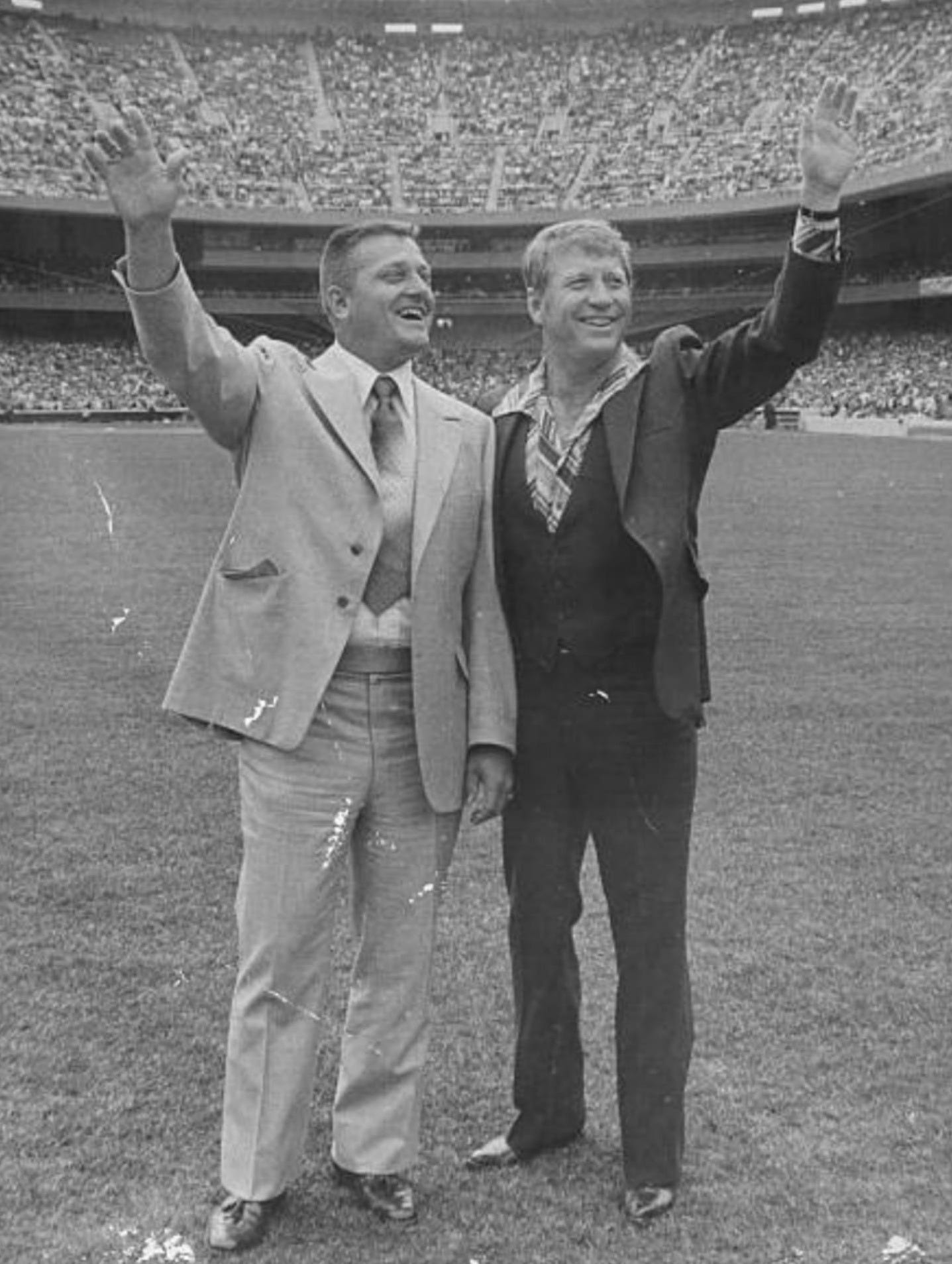
Reggie Jackson and Roger Maris had plenty to talk about. “He sympathized with me,” Jackson said. “We talked about how tough it is to play in New York. I understand that.”
1977 had been a year of whiplash for Jackson. The thrill and excitement of signing in New York, the cold shoulder from teammates, alienated by his salary and his own oblivious, self-aggrandizing comments. Benchings and battles with manager Billy Martin and finally the storybook ending of Game Six, writing his name in history with three swings of his mahogany ash bat.
“Seeing the flags flying and those two great players made me feel it was the World Series,” Jackson said before the home opener. “It was my first time back here and of course I had to be thinking about last year.”
Jackson said he felt things would be different with his teammates in 1978. “I think they feel I have earned my pinstripes.” he said. “I’m relaxed now, socially and mentally. This year’s going to be a much better year. And more fun. It’s sad the way they ran a guy like Maris out of here, with all the pressure they put on him. Well, they almost ran me out of here, too. But that’s all in the past.”
He also wanted to make sure people didn’t expect too much of him, saying his three home runs on three consecutive October swings were “a once-in-a-lifetime thing.”
Standard Brands wasn’t going to let Jackson’s Yankee Stadium return go unmarked. The company hired 18 young women, “models and airline stewardesses” according to crusty New York Times sportswriter Red Smith, to distribute a complimentary Reggie! Bar to every fan entering the park that day. 44,667 aerodynamic treats were passed out. “For reasons best known to themselves,” Smith wrote, “the recipients stowed thousands in pockets instead of stomachs.”
The White Sox had the honor of waiting around while the Yankees’ received their jewelry. When the festivities were complete and the golf cart bearing Mantle and Maris had disappeared, the game began with Ron Guidry, embarking on the season of his life, on the mound for New York. Guidry finished the top half of the first without much trouble, and the top of the Yankees’ order faced Chicago’s starter, Wilbur Wood.
Wood was nearing the end of a long career, which he’d extended by becoming a knuckleballer. The tricky pitch had served him well for most of the past 10 seasons, but in 1978 it was not as perplexing or obedient as it had once been. Second baseman Willie Randolph walked. Center fielder Mickey Rivers singled through the left side of the infield. Catcher Thurman Munson struck out.
Reggie Jackson walked to the plate, looking nonchalant as the crowd gave him a warm welcome. He had a friendly exchange with the White Sox’ catcher and then settled in, gripping the bat with a bare left hand and a gloved right, feet spread apart under his dangerous upper body. He took two outside pitches from Wood, never lifting the bat off his shoulders. On the third pitch, he uncoiled.
“Wood was just trying to throw a strike,” Jackson said. “He was behind in the count and still trying to get loose. I think I got loose before he got loose.”
Jackson hammered the pitch into center-right field. The White Sox’ center fielder, Chet Lemon, took off after it, racing to the blue wall. Lemon made an impressive leap, but the ball left the playing area inches over his glove. It was October in April as Jackson made it four in a row at Yankee Stadium.
As he circled the bases, two bright orange packets landed near home plate, tossed like miniature frisbees. Standard Brands had invented a perfectly throwable candy bar and then given thousands of them to rambunctious Yankees fans; now the fans knew why.
Reliever Sparky Lyle wrote, “It took the rest of the fans about ten seconds to realize the beauty of that act, and from the bleachers, from the mezzanine, from the upper deck, from the box seats came thousands of these Reggie Bars. They covered the outfield and home plate like a lawn overgrown with dandelions.”
Returning to the dugout, Jackson first held his hands up in a gesture of helplessness, as if he didn’t know what to do with the orange outpouring. But then he smiled. He realized he’d given New Yorkers a World Series encore, and now they were throwing their flowers.
After the game, both the Yankees and Standard Brands had to deny it had all been somehow prearranged—the candy, the home run, and the candy again. While the field certainly looked like some advertising agency’s magnum opus, the fans had done it themselves. “I got a free commercial out of it,” Jackson said.
The umpires halted the game and the grounds crew began picking up thousands of Reggie! Bars one by one, tossing them into buckets. Meanwhile, some kids in the crowd realized this was as close to a scene from a Willy Wonka story as they were ever going to get, and a few dozen of them hopped over the low walls near the dugouts and began picking orange dandelions. “At twenty-five cents each, they did pretty well for themselves,” Lyle said.
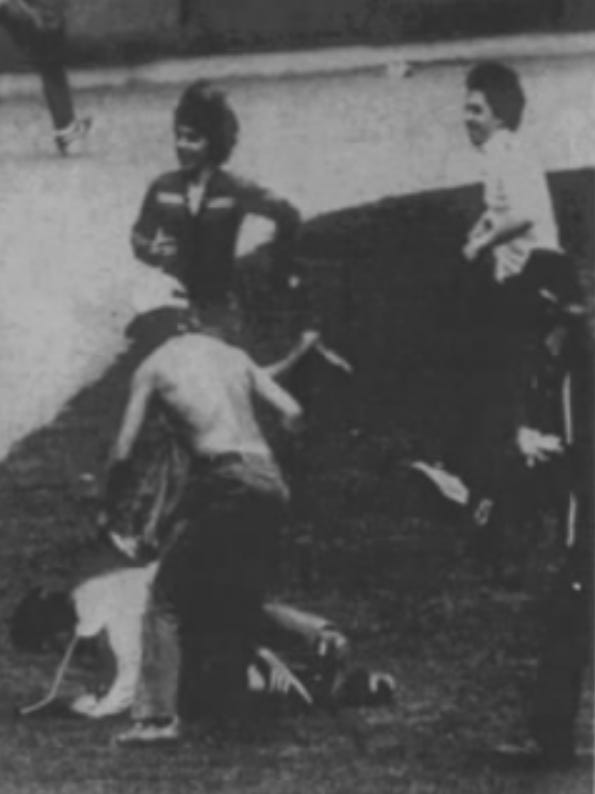
The Yankees’ eternal public address announcer, Bob Sheppard, administered a kindly scolding. “Please stay in your seats,” he urged, but the child labor was speeding things along, so nobody interfered. With their help, the cleanup was done in five minutes. Jackson watched from the bench, looking, according to Red Smith, “fairly immortal and altogether benign.”
Asked what he thought of the candy shower, Jackson said he appreciated it. “It was a nice gesture by the fans.” Tribute could take unusual forms at Yankee Stadium, but as long as the people were happy, Jackson was happy, too, but he warned that only the first Reggie! was free:
“The next time it will cost them a quarter to do that.”

We’ll have a lot more to say about Reggie Jackson’s stormy 1977 in our book. Speaking of our book, we’re going to be off next week, finalizing the manuscript!
It’s called The War at Home: Stories From the Decade When Baseball Ran Amok. One chapter per year from 1970 to 1979, each a deep dive into a wild on-field moment from that season, with the larger story of baseball’s 1970s labor revolution as a through-line. We cover Ten Cent Beer Night, Disco Demolition, and many lesser-known fiascos that haven’t gotten their fair share of lasting infamy—until now.
If you know any literary agents (this is Substack, after all) who might be interested in a Project 3.18-style book of baseball riots and labor battles, drop us a line. We’re seven months away from what is shaping up to be baseball’s most significant work stoppage since the 1970s, and this history has never been more relevant and compelling.
I love stories about Reggie. You know who else loves stories about Reggie? Reggie.
I betcha Reggie's candy bar comment was in turn inspired by the Baby Ruth bar, which funnily enough, was launched decades before Babe Ruth hit the sports page for the first time.
Baby Ruth referred to the "First Baby", born to the sitting president Grover Cleveland, who was elected as a bachelor and married while in office, becoming a high society sensation of the late-1880s and early-1890s.
When Ruth Cleveland was born in 1891, it was a media storm at the time, so much so that even the candy bar gained traction to become a long-term staple in the American market.
Decades later, when Ruth Cleveland had long since faded from memory, most people assumed that the candy bar was named after the most beloved sports figure of the 20th century.