


Welcome to Project 3.18, where a fan-first writer tells strange and surprising stories from baseball history and culture.
If you enjoy what you read today, please subscribe to receive our free feature stories in your inbox. And if you’ve been here for a while, we could really use your support as a paid subscriber. Paid subscribers receive access to exclusive content and help keep this publication going and growing.
We didn’t always intend to bring you this particular story today, but, as we will see, sometimes things just happen and you roll with it. A stray quote in our research led us from a preempted game1 between the Minnesota Twins and the Cleveland Indians to another incident from a few days prior. The Indians, it seems, were having a really weird week.

A lot of things had to go right for Kyle Denney to reach the majors, but they did.
From the tiny town of Prague, Oklahoma, Denney pitched for two years in community college before transferring to the University of Oklahoma. He entered the Major League Baseball amateur draft in 1999 and was selected by the Cleveland Indians in the 26th round. There were 50 rounds in that bygone version of the draft, and halfway through, the odds of selecting a future big-leaguer were slim. Just seven players taken after Denney went on to substantive major-league careers, a group headlined by Rich Harden, the future change-up artist of the Oakland A’s. Harden, a high-school pitcher, was drafted in the 38th round by the Seattle Mariners but chose to go to college. Good call.
Denney, 21, did not have that option. He signed and started at the bottom of the Indians’ minor league system, hoping to beat some pretty long odds. He pitched passably at each level but never well enough to accelerate his progression, let alone skip a step. His development was significantly hindered by an elbow injury requiring Tommy John surgery in 2001. He spent a year at each stop, reaching AAA Buffalo at the end of 2003. By then Denney was 25; in rookie years, that’s old.
He spent the 2004 season pitching for the Bisons, compiling a 10-5 record across 24 starts with an ERA of 4.41. He came close to getting called up to Cleveland a few times as other fortunes waxed and waned, but the assignment always went to someone else. No player of Denney’s considerable baseball ability wanted to hear themselves described as a “career minor-leaguer,” but in September 2004 that’s what he was.
And then he got lucky.
It started with a chain of other people’s misfortunes. In Cleveland, a pitcher named Jason Davis was removed from the starting rotation due to wildness. The team wanted to fill his spot with another pitcher, Kazuhito Tadano, but he went down with hip and back pain. Lefthander Cliff Lee could have stepped in, but the sub-.500 Indians were cutting back on Lee’s innings to save his arm for the future. But there were still four starts to cover in the present, and Eric Wedge, Cleveland’s manager, said the team’s plan D was Kyle Denney, Buffalo’s Old Reliable, with nearly double the starts and innings of any other Bisons pitcher that year. Even if he wasn’t really a major-league prospect, under the circumstances, Denney certainly deserved his chance.
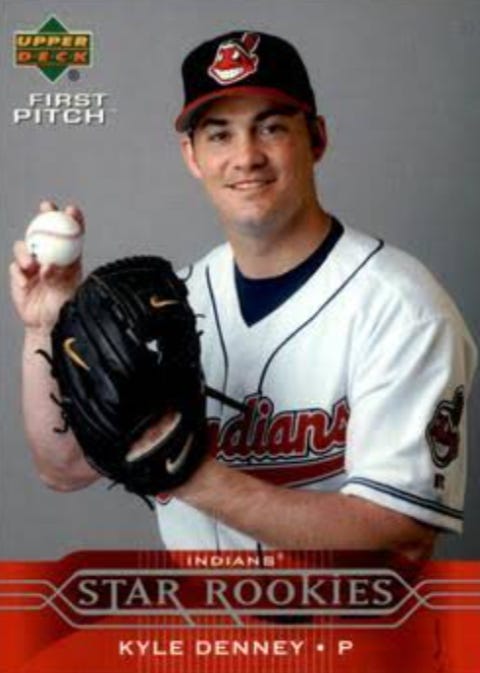
He was called up on September 14 to make a start against the Detroit Tigers at Jacobs Field. Expectations for the 27-year-old non-prospect weren’t exactly high—the Indians just wanted him to help them get through the season—but even shielded by low hopes, Denney’s debut was a disaster. A 64-win Tigers team hammered him for two home runs, four doubles, three singles, and one triple in just over three innings. Wedge seemed determined to stay out of his overused bullpen, but after Denney’s 22nd batter the manager gave up and pulled him, right around the time that an audible number of sarcastic fans in the home crowd seemed to switch allegiances and start cheering on the Tigers.
After the 11-3 loss, Denney was as poised and accountable as someone with a 21.60 ERA could be, taking responsibility for his many barreled-up mistakes: “You cannot throw the ball in the middle of the plate against anyone. I did, and it was pretty much batting practice for them.”
Somebody asked him what he’d learned in his first start. “I learned where not to throw the ball. I’ll go home tonight and think about it, and tomorrow I’ll forget it.”
Since the team had no better options, Wedge was sympathetic. “It’s his first one and it will get better. He tried to do a little too much. Hopefully he will be more relaxed and more comfortable next time.”
If a pitcher couldn’t get comfortable against the 2004 Kansas City Royals, they were doomed. The Royals were on track to break their franchise record of 100 losses, and since the September roster expansion they were mostly just trying out future contributors.
On September 19, Kyle Denney was able to do just enough against a team in full tank-mode. He lasted five innings and struck out six, but also gave up six hits and a walk. A timely home run by Cleveland first baseman Ben Broussard even got Denney his first major-league win. “You dream about getting to the big leagues,” the pitcher said after the game. “Some people have the perfect outing for their first time, some people don’t. I just felt much more relaxed out there today.”
His ERA had dropped below 10, but his next start was against the American League Central-champion Twins, and even though the Twins had let off the gas after clinching, they still ran over Denney, who gave up six runs on eight hits and again couldn’t make it out of the fourth inning. Most of the damage came in the fourth after he issued a four-pitch walk with two outs and no one on base. “Everything seemed to snowball after that.”
If September 24 was a snowball, September 29 was the avalanche.
In his last start of the year, Kyle Denney had one two personal goals: drop his ERA back to single-digits and pitch respectably in front of an audience including his mother and grandparents, who’d made the five-hour trip from Oklahoma. His mark across three starts was 11.25, and he knew that players on the wrong side of four digits were rarely given a second chance. At least he’d drawn the lowly Royals again, this time at Kauffman Stadium in Kansas City. The Royals were fighting against their own infamy, having lost that 100th game to tie their all-time-worst total and now trying to avoid sole ownership of the record.
In the Battle of Regrettable Numbers, Denney and the Indians prevailed, sweeping the Royals with a 5-2 win. Nonetheless, Kansas City seemed to be figuring Denney out; he lasted only four innings and gave up eight hits and three walks, leaving the bases loaded twice. It was a performance one writer likened to “a steeple chase,” but in giving up only two runs he shrunk his ERA to 9.54 and his team won, so the pitcher was all smiles after the game.
There were plenty more smiles in the visitors’ clubhouse when Denney approached his locker to find his street clothes missing. In their place was a cheap blond wig and a uniform of the style worn by female members of the University of Southern California cheering squad, the Song Leaders. As Denney was 6’ 2” and 190 pounds, there may have been some custom tailoring involved, but his teammate and dresser, pitcher C.C. Sabathia, had spared no expense, even adding a pair of non-regulation white knee-high boots to the look.
Sabathia was clearly going for maximum humiliation, forcing his rookie rotation-mate to wear not just a dress but also the cardinal and gold colors of any Sooner’s natural enemy. Denney squeezed into the outfit with good humor, and he wasn’t alone.
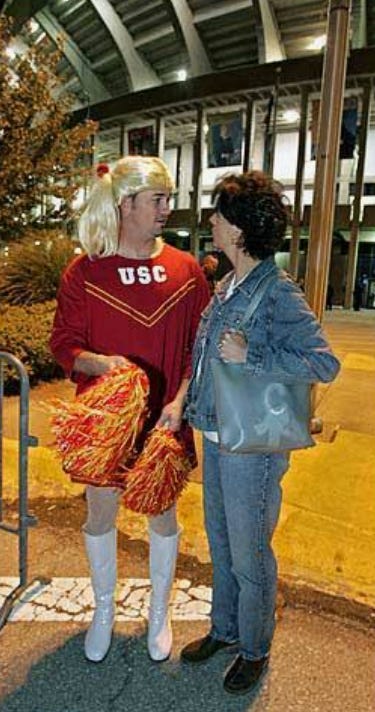
It was “Costume Night” for the Indians’ rookies. To let off some steam at the end of the season, the new guys were dressed in all sorts of outlandish costumes and made to wear them during the team’s final trip of the year. Kansas City was a great spot for Costume Night because the players had to go through the public airport concourse to reach their charter flight, ensuring a spectacle and lots of pictures. Multiple teams held such events in 2004. The practice has since expanded, but it has always had its detractors.
“There is an element of cruelty about it,” Bob Dolgan wrote in the Plain Dealer in 2004. Dolgan described Costume Night as “a form of bullying by veteran players against youngsters trying to fit in,” adding, “baseball would never have become America’s pastime if fans saw their heroes walking around in garb that would look weird2 at a Halloween party.”
But the veterans loved it and the rookies made the best of it. Cliff Bartosh, a left-handed member of the relief corps, was quite pleased with his detailed bumble-bee get-up, promising to wear it again…at a Halloween party.
The USC cheerleader outfit was probably a one-and-done, but Denney owned it. He was wearing it when he greeted his family, and he lingered outside Kauffman Stadium to sign autographs while the team buses prepared to depart. One uncharitable writer said he thought Denney looked more comfortable as a cheerleader than he had as a pitcher on the mound that night.
Two buses carried the team to the airport. Kyle Denney climbed into the second one, as did outfielder Ryan Ludwick, manager Eric Wedge, and most of the team’s training staff. Wedge sat in the manager’s customary position in the front seat on the passenger side. Ludwick found a seat on the driver’s side, in Row 20. Denney was sitting one row further back on the passenger side.
The buses rolled away from the stadium at around 11:00 p.m. Everyone was in a good mood, boosted by the win, the sweep, and the timeless satisfaction of a successful hazing. Ten minutes later the second bus was on Interstate 70 when everyone inside heard a bang. Some people thought it sounded like a rock hitting a window. Wedge recalled smelling burning metal. Kyle Denney thought somebody was lighting firecrackers on the rowdy trip, just another torment for the rookies.
“All of us jumped,” he said. But then he felt pain. “It felt like somebody came up and pinched me real hard on the leg,” or like someone had snapped a strong rubber band against his skin. Except that wasn’t possible, since he was wearing high boots. “I reached down to feel [my leg] and there was a hole in my boot. I put my finger inside and pulled it out and there was blood.”
“I’m bleeding,” he said, to no one in particular.
One row ahead, Ryan Ludwick knew something was amiss, even if he couldn’t explain what. His leg was stinging too, and when he heard Denney say he was bleeding, he called out for the trainers.
Nick Paparesta, a trainer for AAA Buffalo, had joined the Indians after the minor-league season ended. He made his way to Denney, removed the boot, and inspected the wound, feeling something hard inside. Lonnie Soloff, the head trainer, took over and began to “manipulate the calf.” Denney said after a few seconds of manipulation, something popped out, “like squeezing a pimple.”
The trainers looked at the crumpled bit of metal. “That looks like a bullet.”
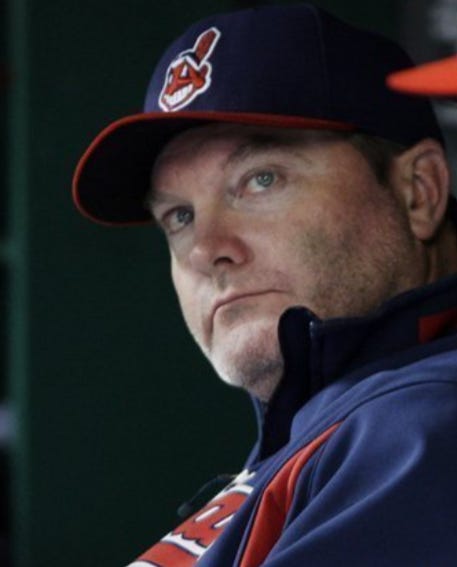
Now Eric Wedge had to make a decision. Stop the bus and wait for police and medical attention at the scene, or make for the airport and leave an unknown assailant behind. It wasn’t an easy choice, but Wedge got paid to make the tough ones, and he told the bus operator to drive on. “If the trainers thought Kyle was more seriously injured, we may have had to do something else. But I didn’t think it was a good idea to stop if the guy was still shooting at us.”
Wedge also called Mike Seghi, the team’s travel director, in charge of the first bus. “I think we got hit by a bullet.”
It helped that Denney’s wound was superficial. Soloff said there had been no need to wait for a doctor to remove the object, “and with the athlete’s discomfort level, it just made sense.”
Seghi got busy on his own phone. By the time the second bus arrived at the airport, representatives from three different police departments and an ambulance were waiting. An officer discovered a small hole about 15 feet from the front of the bus on the driver’s side. Around the same time, Ryan Ludwick discovered a hole in his pants and an abrasion on his leg. The bullet had entered by his legs, just missing him or ricocheting off something and producing shrapnel that lightly scraped his thigh. Then it went across the bus and through Denney’s boot into his calf.
Denney was taken to a nearby hospital by ambulance, where he expected to stay overnight. One of the trainers stayed with him while the rest of the team flew on to Minneapolis for their final series against the postseason-bound Twins, a series that would feature more strangeness but no mortal peril. As he left the team, the rookie was still wearing his cheerleading outfit. “He was sitting in the back of the ambulance [like that],” Mike Seghi said. “I told him, ‘You know, you can take the wig off.’” Someone decided it was appropriate to return Denney’s street clothes, given the extenuating circumstances.
The police held onto the right boot as evidence, leaving Denney with a left boot and a lot of hard-to-categorize memories. He called it “the craziest twelve hours I’ve ever had,” going from a battle on the mound to a costume party in the clubhouse to a police interview at the hospital.
“I think the boot really did help me,” he insisted. “It was kind of thick, and I think it slowed the bullet down. I have to give C.C. a big hug.”
The trainers said Denney wasn’t just making a crack: The thick material of the boot had helped slow down the bullet, keeping it from burrowing deep into the muscle of his leg. He was out of the hospital and on his way to rejoin the team the next morning.
In Minnesota he was observed to have just a slight limp but said he was feeling fine. He was also feeling famous, fending off bookers from the Today Show, the Early Show, and Jimmy Kimmel Live. “My friends cut me no slack,” he said at a team press conference. “They said, ‘well, it’s better to be known for being shot than having a 9.00 ERA.’ Hopefully I can work on that next year.”
Back in Kansas City, the police quickly ran through a few leads. A small-caliber pistol had been fired into the bus, but it wasn’t clear whether this was an accident or if the team had been targeted. The incident occurred on an active expressway and the bus didn’t stop. MLB arranged for the visiting Chicago White Sox to have a police escort during the last series of the year in Kansas City, but nothing happened and Denney’s case was eventually closed. Just one of those things.
Eric Wedge said Denney handled the whole affair “like a champ.” In a profession where “acting like you’ve been there before” was a virtue, Denney’s teammates were impressed with his composure. Ryan Ludwick said, “Kyle acted like he’d been shot a hundred times before” and meant that as a compliment.
If Kyle Denney’s major-league debut was measured on following orders and media savvy, he might have become an All-Star. But the Indians were paying much more attention to his ability to miss bats, and the numbers were not the kind that got a pitcher invited back to try again.
When the 2005 season began, he was back in AAA Buffalo again, putting up another chunky ERA over his first nine starts. It seemed as if Denney had spent all his good luck making it to the majors, leaving him exposed to one misfortune after another since reaching the top. In the middle of 2005, he was hit on the head by a line drive that fractured his skull. He recovered in time to make one final appearance for the Indians’ Low-A team, but that didn’t go great either and he was released at the end of the season. He had a few brief minor-league stints in other organizations followed, but his baseball career ended in 2007. For better or worse, the story of his major-league career was the one his friends had predicted.
So that’s our baseball story for today, featuring a player in a costume, randomly shot on the team bus after what ended up being his final appearance in the major leagues, saved from further injury by the boots that USC cheerleaders didn’t even wear. All that, and we think this might be one of the more relatable stories we’ve ever told on Project 3.18—hear us out:
Not many people can say they pitched in the majors at age 15 or became a member of the White Sox after a walk-on tryout. But everyone has been through something like Denney’s September 29, 2004—a pileup of experiences that defies categorization, a day when you have to shake your head and marvel at the Mad Lib of human experiences the universe wrote up, just for you.
We’ve all had days like that. Kyle Denney just happened to have the best day like that. Lucky him.

If you enjoyed this baseball story and want to support Project 3.18, consider becoming a paid subscriber.
You can also really help us by sharing this feature on socials or restacking it here on Substack. Publishing a story is how we get on base; please help spread the word and drive us home.
We dropped that Twins story over the weekend in the newsletter version of a “bit”:

A happy and strangely fitting update for those who’ve already read the story: the Minnesota Golden Gophers won a hard-fought thriller over Washington on Saturday. So hard-fought that the Gophers’ coach was smeared in blood afterward, but don’t worry, it wasn’t his blood. Who writes the Project 3.18 for football?
In claiming the great players of yesteryear never dressed to amuse, Bob Dolgan was shooting from his curmudgeonly hip. In fact, male ballplayers have occasionally appeared in skirts since the 19th century, but that’s a story for another day. Maybe Halloween.