


Welcome to Project 3.18, where a fan-first writer tells strange and surprising stories from baseball history and culture.
If you enjoy what you read today, please subscribe to receive our free feature stories in your inbox. And if you’ve been here for a while, we could really use your support as a paid subscriber. Paid subscribers receive access to exclusive content and help keep this publication going and growing.
Regular readers know that Project 3.18 has a soft spot for baseball’s rare forfeited games. Such an outcome is nearly inconceivable today, but games used to fall apart on a semi-regular basis, and usually for entertaining reasons. Today’s misadventure happened in 1954, when a win-at-all-costs manager ended up with a once-in-a-generation loss. In fact, this particular Bad Day was several years in the making, and we’ll start with some of those spicy preliminaries.

In November 1952, Terry Moore was relieved of his duties as a coach for the St. Louis Cardinals. Moore had been with the team since 1935, first as an outfield mainstay and captain of two World Series-winning teams, and later as a coach. Moore had survived three managerial changes in three years, but after a year on the job, manager Eddie Stanky was cleaning house.
The team released a statement saying Moore was leaving temporarily to focus on his own outside business interests. That explanation didn’t sit well with Moore: “I was fired,” he said on November 11. The Cardinals had offered to make up some other job for Moore (he passed), and he did own a bowling alley that needed attention, but that didn’t change the fact that he’d been kicked out of the coaching box by Eddie Stanky.
On his way out, the Cardinals’ former captain said he hadn’t thought much Stanky’s leadership: “The job was too big for him. When he loses, he acts more like a 9-year-old boy than a man.”
—
On July 1, 1952, Earl Torgeson of the Boston Braves got into an argument with Sal Yvars, catcher for the New York Giants. Yvars complained when Torgeson’s bat struck him on the shins during a back-swing and the two exchanged “harsh words.” When Torgeson singled and took off for first base, Yvars picked up his discarded bat and smashed it against home plate.
Torgeson waited until the next inning to respond. Coming off the field, he dashed to the Giants’ bench and punched Yvars, opening a gash over the catcher’s eye. A brawl ensued. The bespectacled Torgeson didn’t look like a guy who’d venture into enemy territory to take a swing at somebody, but he didn’t mind being underestimated.
—
Umpire Babe Pinelli wore glasses, too, but never on the job. Pinelli used them for reading, in restaurants, railway cars, and hotel lobbies. Most players who saw Pinelli’s off-hours glasses wisely kept their mouths shut. “Only one person ever risked a wisecrack,” he wrote. “Eddie Stanky, when he managed the St. Louis Cardinals in 1954.”
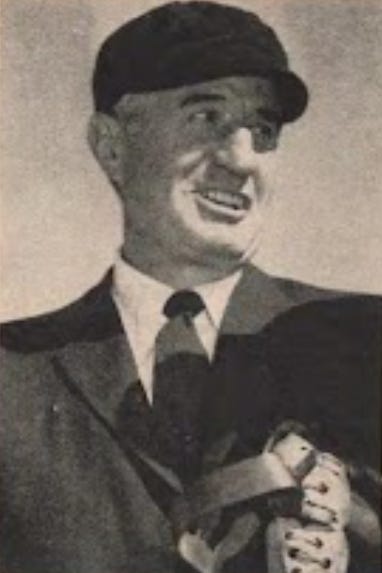
Pinelli was in a train club car, studying the tiny print of a dinner menu. The Cardinals’ manager entered with a group. “Well, it’s old Horn Rims,” Stanky said. “I always said you were as blind as a potato with a thousand eyes.” The line got a laugh from the crowd, but not from Babe Pinelli.
—
In December 1953, the eight National League owners voted in favor of a rule that didn’t make a lot of sense. It read:
The second game of a doubleheader may be started under lights and played to a conclusion, provided such game starts before 6 p.m., prevailing city time.
The intent was to discourage day/night doubleheaders. These were still unwelcome in cities like Philadelphia, where “blue laws” remained on the books, prohibiting certain events and activities on Sundays, especially later in the day.
Over the winter, Warren Giles, the president of the National League, realized that the rule as written was problematically broad. On March 23, in an omnibus pre-season memo to owners and managers, Giles wrote that doubleheader games should not begin under lights, but a doubleheader game that started in daylight could be finished under lights if necessary.
Unfortunately, Giles’ clarifying memo seems to have gotten lost on its way west of the Mississippi River.
On July 18, 1954, acquaintances were renewed at St. Louis’ Busch Stadium, where the Cardinals hosted the Philadelphia Phillies for what was, in theory, a daytime doubleheader. It would be a homecoming for Terry Moore. who had only just been hired as Philadelphia’s interim manager, replacing the abruptly-fired incumbent. Moore was on his fourth day at the helm, in the city where he’d spent his entire career, facing off against the guy who had sent him packing two years prior.
Before the game, reflecting on hundreds of colleagues in baseball, Moore said that his former boss was the only one he despised. “If there’s one man in baseball I want to beat, it’s Eddie Stanky.” Stanky would have recognized the sentiment, because he felt that way about pretty much everybody.


The Cardinals’ manager was famous for his willingness to do whatever it took. In 1939, Stanky inspired his manager, Leo Durocher, to offer a memorable line of praise: “He can’t hit, can’t run, can’t field. He’s no nice guy, but all the little SOB can do is win.” It was ruthless practicality that led Stanky to back teammate Jackie Robinson in 1947 when several other Dodgers were unhappy. The team was better with Robinson. The end.
Stanky’s aggressive antics were so inspired they sometimes became they earned their own line in the rule book. As a runner on third with fewer than two outs, he would stand behind the bag and time the arc of a descending fly ball so he could take off running and cross the base at full speed just as the outfielder caught the ball. He got so good at this that the National League banned it.
In 1950 he tried positioning himself directly behind his pitcher so he could wave his arms and jump up and down to distract or disorient opposing hitters during the pitcher’s delivery. The “Stanky maneuver” led to a protest so violent that police had to separate the teams. To restore peace, baseball’s commissioner, Ford Frick, declared the tactic would merit an automatic ejection in the future.
Betting on his competitive ferocity and creativity, the Cardinals acquired Stanky in 1952 and made him player-manager. His playing days were almost over; he barely played in 1953. A year later, “the Brat”—a nickname Stanky said he resented—was a manager only.
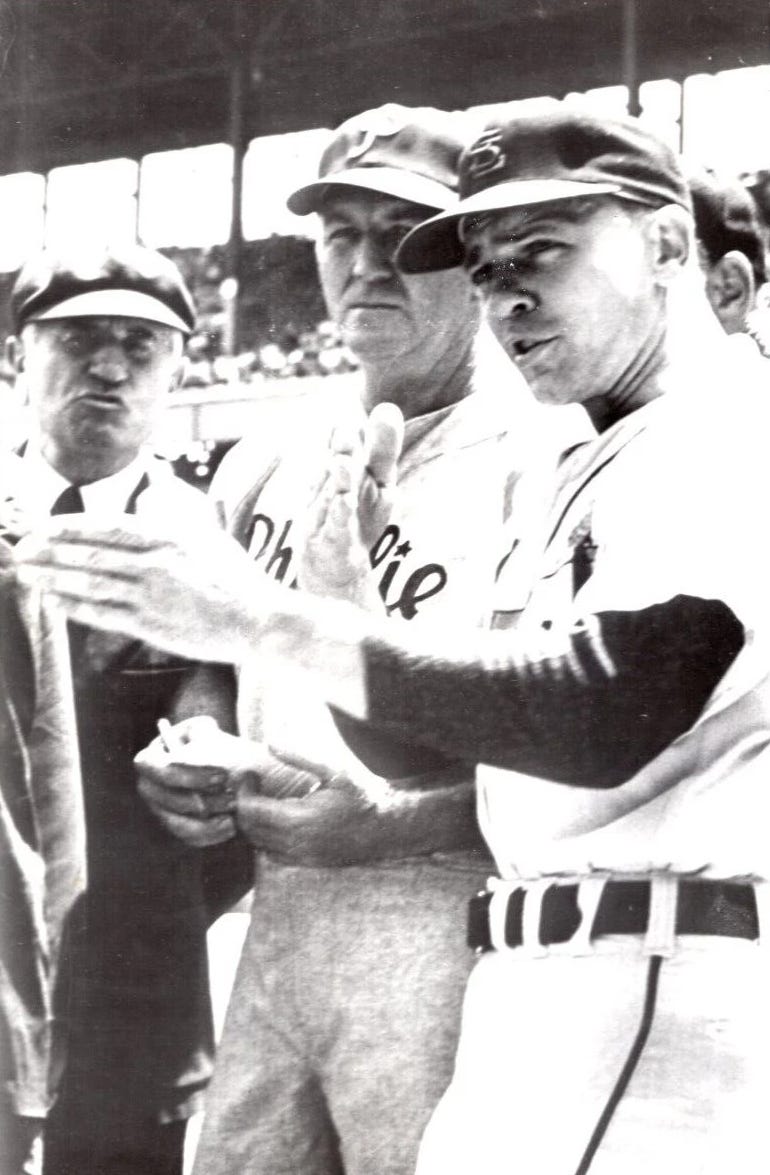
Before the first game of the July 18 doubleheader, Moore and Stanky were cordial when they met with the umpire crew at home plate. They posed for a picture and even shook hands. This was typical for Stanky, who was an amiable guy until the moment somebody shouted “Play ball!”
St. Louis was the southernmost city in the major leagues in 1954, and the July weather—well over 100 degrees with suffocating humidity—showed why major league baseball was mainly a northern sport. Perhaps the players’ collective discomfort contributed to the messy first game, which one Philadelphia writer described as “more like a married vs. single men’s picnic softball game” than a big-league contest. The slugfest featured four lead changes and 36 players littered the box score.
In the seventh inning, a drenching storm caused a 75-minute rain delay. Before the storm, the thermometer in the press box read 112 degrees. Afterward, things cooled down to “just” 102 degrees. The three-and-a-half-hour game was decided in the 10th inning when Philadelphia infielder Bobby Morgan singled and drove in a run. 19,000 fans began the day in the stands; after the 11-10 Phillies victory, several thousand decided they’d broiled long enough and left.
The players and umpires didn’t get that option. It was so hot before the storm that the catchers from both teams decided to trade safety for comfort and work without chest protectors. Nobody could remember another time in living memory this had happened.
And while it would have been easy for the umpires to shed their coats, league rules expressly prohibited them from doing so. During the rain delay the umpires retreated to their dressing room and squeezed sponges filled with ice water over their heads. One of the four officials, Bill Stewart, required medical attention during the first game and had to depart in the early innings of the second. Stewart said it was 120 degrees on the field. The remaining three umpires—Bill Engeln, Dusty Boggess, and Babe Pinelli—carried on without him.
The second game did not start until 6:48 p.m. Because of this late start, everyone involved was under the impression that the National League rules forbade the use of lights. No one seemed aware that Warren Giles had amended the rule. As a result, if the game was called on account of darkness before a full five innings were played, the whole thing would be scrapped and replayed later.
On offense, St. Louis’ hitters struggled against Bob Greenwood, a Phillies rookie making his first career start. Greenwood gave up one run on four hits in four innings and played a big role in the offense, scoring three runs in the third inning with a bases-clearing double. Joe Presko, St. Louis’ starting pitcher for the second game, gave up six runs in the third inning, and under the circumstances a darkness-related do-over seemed like the Cardinals’ best option.
Eddie Stanky made his first pitching change during that crooked third. By the time the inning ended, it was after 8:00 p.m.—the sun would officially set at 8:23. According to Red Schoendienst, the Cardinals’ second baseman, Stanky ordered the pitchers to throw wildly and walk as many batters as they could. The manager made pitching change after pitching change, plodding out to the mound for long conferences and calling for relievers who weren’t warmed up. When the Phillies scored a run in the fourth inning, Stanky brought in a third pitcher. During the fifth inning Stanky went to a fourth pitcher, Cot Deal.
Babe Pinelli was fuming. “Stanky complained I was hurrying his many pinch hitters,” Pinelli recalled, “even when they were practically playing piano on the bat rack selecting a stick.” He said he warned Stanky against stalling: “Keep this up, and you’ll pay for it.”
“I’ll run the team,” the manager told him. “You run the broom.”
Deal struggled to pitch poorly (you read that right) and notched two outs. A third out would make the game official, and the Cardinals’ stalling grew more blatant. According to Schoendienst, Stanky ordered Deal to throw behind the next batter and told the Cardinals’ catcher, a journeyman named Sal Yvars, to pick a fight with the next Philadelphia batter. That wouldn’t be difficult; the next batter was Earl Torgeson, the same guy who had once assaulted Yvars for breaking his bat. Both men had changed teams, but it was a small league.
With a runner on second, Deal began throwing up and in. Some accounts say it was one high-and-inside pitch, others say two. Torgeson remembered three in a row. He let Deal know he didn’t appreciate what was happening. “When I hollered something at the pitcher, Yvars tried to egg me into a fight. Well, we had a good one.”


Pinelli tried to pull Yvars and Torgeson apart, but he was shoved away. Meanwhile, other interested parties began arriving. Terry Moore was the first on the scene. Moore was renowned for having some of the largest, strongest hands in the industry, which he now applied to Sal Yvars, planning to wrestle him to the ground. Then Moore went sprawling, clipped from behind “in an old fashioned football tackle” executed by Eddie Stanky. “Stanky put Moore in a headlock,” Pinelli remembered, “and a dandy brawl was on.”
“We didn’t want a fight to happen,” Moore said after the game. “We just wanted to get the inning over so we could win. I tried to get there to stop it and before I knew it I was on the ground.”
Moore didn’t learn who’d brought him down until later. In the moment he was busy in the center of a pile of three or four players including Ted Kazanski, the Phillies’ baserunner, who got there early and landed several blows to Yvars’ head. Players and coaches squared off. “Everybody was on the field,” Schoendienst said. His impression of the Phillies was that “everybody was after Stanky.”
“Six players were blooded,” Pinelli wrote, “and ten more minutes were used up.” The latter clearly bothered the umpire more than the former.
“It was an astonishing amount of action,” a reporter1 for the St. Louis Post-Dispatch wrote, “but the casualties were almost nil, as usual in such brawls.”
The ushers, umpires, and St. Louis police eventually broke up the fight and sent all the challengers back to their corners. Torgeson and Yvars were ejected, but Pinelli, nicknamed “The Soft Thumb,” for his willingness to forgive rough stuff, let everyone else stay. According to Stanky, the umpire sent him a final warning via an intermediary: “One more ‘doubtful’ pitch, and the game is forfeited.” Stanky didn’t think there was such a thing as a “doubtful pitch”...but the umpire’s message was as good a reason as any to hold another mound conference.
Terry Moore said he never complained about the Cardinals’ delaying. “I left that strictly up to the umpires.” He said he’d told his players to “do everything as usual.” No swinging at wild pitches to hurry things along.
One of those players, Richie Ashburn, remembered the message a little differently decades later: “[Moore] told our team, ‘Everybody swing.’ Our hitters were swinging at pitches they couldn’t even reach.”
With Torgeson ejected, another Phillie, Johnny Wyrostek, was sent in to finish the two-out at-bat. Cot Deal’s first pitch landed five feet in front of Wyrostek, but he took a mighty cut anyway. Deal’s fourth pitch was so wild it reached the backstop and the runner at third scampered home. The score was 8-1.
Stanky plodded back out to the pitcher’s mound. After much discussion, he signaled for another relief pitcher, who began looking for his glove, which he seemed to have misplaced.
Babe Pinelli could hardly see in the gathering darkness, but could see enough. “I made up my mind,” Pinelli recalled. “To the announcer I said, ‘Tell the crowd the game is forfeited to the Phillies.’”
The field announcer shrank away. “Who, me? These fans will tear us apart.” Pinelli said he grabbed the microphone, planning to address the crowd himself, but the announcer “double-crossed” him and transferred his call to the press box.
And then the coup de grâce, one Pinelli had been imagining all year. On his way off the field, the umpire informed Stanky the game was over—and he’d lost. “I told Stanky, ‘Well, I won’t need my glasses to read the papers tonight.’” And he didn’t:

No announcement was made to the crowd, but people connected the dots as the umpires were surrounded by a ring of police and escorted off the field. The protection proved unnecessary. “As we walked off,” Pinelli said, “the fans gave me the loudest standing ovation I ever got.”
In the wake of the forfeit, the Cardinals invited Warren Giles, the NL president, to come to St. Louis and investigate the circumstances in person. On July 20, Giles ran a half-day tribunal out of his room at the Sheraton Hotel.
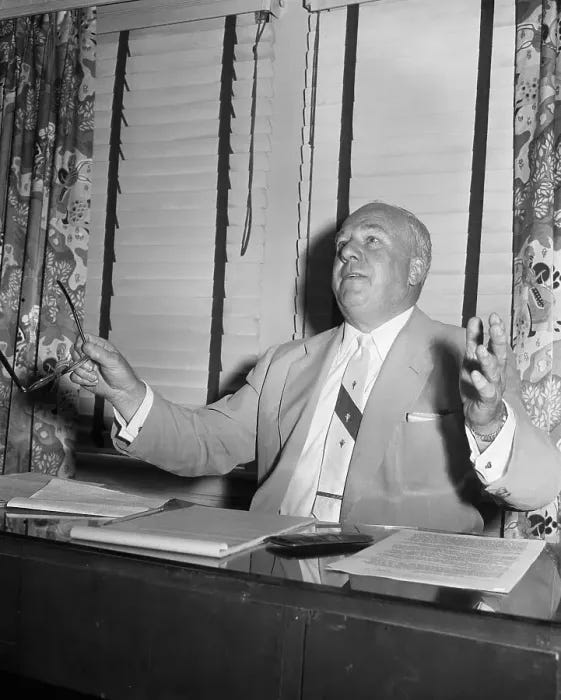
No punishment for Cot Deal; the pitcher was either just that bad or following orders to be that bad (1954 was Deal’s last season in the major leagues). No punishment for Terry Moore, the blindsided peacemaker. A two-day suspension for Earl Torgeson and a three-day suspension for Sal Yvars—the extra day was for throwing down his mask and mitt, which Giles deemed provocative.
The grand prize—a five-day suspension and a $100 fine—went to Eddie Stanky, whose stalling tactics turned a major league game into a “farce,” a word Giles delivered with disgust. “We will not condone unreasonable delays.”
Or unnecessary delays. In closing, Giles reminded everyone of his March 23 memorandum authorizing teams to finish their late-starting games under lights. All of the trouble on July 18 could have been avoided with the flick of a switch, but nobody in St. Louis seemed to know that… and if Babe Pinelli knew, he wasn’t telling.
The same day Giles doled out National League justice, a visibly emotional Eddie Stanky held a press conference, reading from several pages of hand-written notes. He was shaken, not by the forfeit loss or the punishment he’d received, but by the reaction from the St. Louis fans, who had cheered their own team’s loss.
One word has bothered me—”farce”—that I made a farce out of baseball. Baseball was a serious business with me when I was a player. When I played baseball, it was to win, no matter how, just win. When I became a manager, I continued to think and act as a player. Sometimes I believe this has been a detriment.
Stanky said his wife and friends had warned him there was a difference between being a player and a manager, but he had failed to see the distinction until the home crowd cheered his defeat. He vowed to improve his “human and public relations.”
The Brat was no more, he vowed. “This affair has opened my eyes.”
For a long time, Stanky’s Forfeit seemed like it might be the last. There wouldn’t be another forfeit until 1971, the longest run of orderly games in baseball history by far. The National League didn’t have another forfeit until the Dodgers held an ill-fated baseball giveaway in 1995.
This was the last forfeit precipitated by a brawl between players, and the last to involve daylight-related stalling. It was also a first, one Babe Pinelli was proud of. July 18, 1954 was the first time a game was forfeited short of legal length. That meant none of the records from the game counted. The everything that happened in the game was struck from history, except for the Cardinals’ loss.
In 1959, Pinelli, full of post-retirement bombast, complained that baseball had entered “the era of the alibi artist and the chronic kicker—Tearful Toms whose attitude would never get by in any other line of work.”
These bad actors caused “dragged-out, three-hour games that bore the customers.” He named Eddie Stanky as the worst of the worst in this regard.
Pinelli then told the story of the forfeit, though he omitted the part where he forgot the rules about turning on the lights. The retired umpire wanted people to know that he didn’t see a forfeit as a failure. A forfeit, Pinelli wrote, was a useful punishment:
“The key point here is that there hadn’t been a major-league forfeiture of any kind for five years. There should be more.
Hitting the stallers where they live—in the win column—is the only way to bring back fast, crisp, professional baseball.”

If you think baseball history should be preserved and shared this way, you can let us know by supporting Project 3.18 with a paid subscription.
You can also really help us by sharing this feature on socials or restacking it here on Substack. Publishing a story is how we get on base; please help spread the word and drive us home.
The St. Louis Post-Dispatch reporter we cited was named—we swear—”Dent McSkimming.” Maybe we need a piece on great baseball writer names.
Awesome. Has to be perfectly set up to get a belly laugh on "... but it was a small league." Great reading!