


Welcome to Project 3.18, where a fan-first writer tells strange and surprising stories from baseball history and culture.
On June 19, 1909, “electric light ball” came to the Palace of the Fans, the neoclassical ballpark of the Cincinnati Reds. That night, the infield and (in theory) the outfield were illuminated by 14 arc lights erected on five “mammoth” light towers set up by a Massachusetts inventor named George Cahill, eager to test what he hoped was a workable system of ballpark illumination. The Reds’ owner, Garry Herrmann, signed off on the demonstration, but not the use of his team. Instead, clubs representing the Elks Lodges of Cincinnati and Newport, Kentucky were used as major-league stand-ins.
The lights were shut off as 4,500 curious spectators filtered into the ballpark and groped for seats, but at the appointed time Cahill threw the switch and the crowd made what became a familiar sound in the years to follow, a collective “Ohhh!” that was surely music to the inventor’s ears.
The fans watched the Elks teams play seven serviceable innings without missing a pitch or a play. The outfield was not directly lit, so the players out there had a more adventurous time, but somehow they chased down every fly ball successfully.
While Cahill’s work wasn’t quite ready to be called up to the big leagues, the Reds’ influential owner was impressed. “Night baseball has come to stay,” Herrmann said after the exhibition. “It needs some further development, but proper lighting conditions will see the night sport become immensely popular.”
In August 1910, Cahill tried again, this time at Chicago’s Comiskey Park, which had opened just a month earlier. It was reported that George Comiskey, the White Sox’ owner, was ready to throw his weight behind night baseball and Cahill brought out his biggest guns to close the sale, arraying 20 lights, each one the equivalent of 137,000 candles, around the field.
Two Chicago City League teams, the Rogers Parks and the Logan Squares, faced off on August 27. Unfortunately, Cahill had overcompensated; the lights were too powerful, at least at first, throwing off a glare that half-blinded the players. Even more damaging, the electrical grid couldn’t keep up, and the lights steadily dimmed over the course of two hours. The Logan Squares won, 3-0, but after the literally lackluster event, the Sox’ owner lost interest.
Seventeen years passed before the next test. On June 24, 1927, teams from Lynn and Salem, Massachusetts, played on a recreational field owned by the General Electric Company, which had equipped their facility with state-of-the-art lights. Among the 8,000 spectators were members of the Boston Red Sox and Washington Senators, who had played in Boston earlier that day. The equipment worked perfectly and the players praised the field’s visibility. After that, professional baseball teams began placing orders.
In the 1930s, most minor-league teams lacked the financial support of a major-league club. The stock market crash of 1929 and the onset of the Great Depression imperiled many teams, especially those in the system’s lower levels which already operated essentially paycheck to paycheck. At the same time, hardening labor expectations kept daytime customers away.
“The average man still likes baseball but would rather take a dose of castor oil than go to his boss and ask for an afternoon off to see a ball game,” The Sporting News explained. Many jobs required employees to work six days a week, Monday through Saturday, and those lucky enough to be employed were afraid to make waves, knowing they could be easily replaced.
The Kansas City Monarchs, then an independent team in the Negro Leagues, were likely the first to accommodate their customers’ need for after-hours entertainment. In late April, 1930, the Monarchs staged a night game using portable 50-foot light towers. That same month, permanent lighting equipment was installed at two Western League parks at Independence, Kansas and Des Moines, Iowa.
On May 2, a night game between the Des Moines Demons and the Wichita Aviators attracted 12,000 people in a season where the Demons had been averaging 600 fans for daytime games. Seeing the turnout, the Demons’ owner declared that thanks to night baseball, the imperiled minor leagues “will now live.”
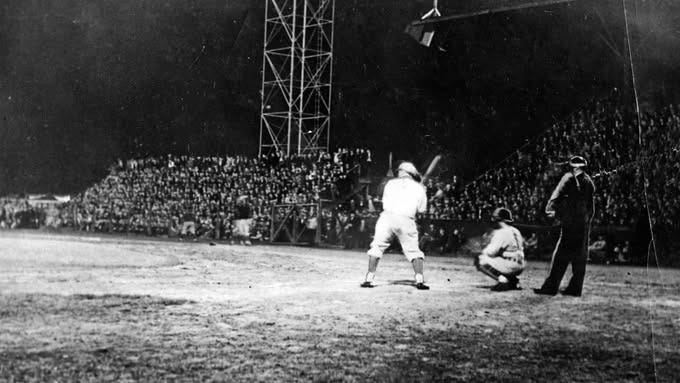
Other leagues lined up for salvation. The upper-level International League was soon awash in electric light—and cash. “I figure [night games] increased attendance about 400% throughout the circuit,” the league’s secretary reported in 1935. By the middle of the decade, 67 teams across the minors were playing under the lights, including a majority of upper-level clubs, and none had any regrets.
In February 1934, Sidney Weil, the unlucky owner of the Cincinnati Reds, threw in the towel. Weil had lost most of his fortune in the 1929 stock market crash, and the Reds of the first half of the 1930s were abjectly terrible, finishing in last place every season. Powel Crosley, Jr., an inventor, engineer, and industrial mogul whose businesses produced radios, refrigerators, and more, bought the flailing Reds. The new owner had previously started a powerful radio station to sell more radios, and in the same spirit he quickly changed the name of Redland Field to Crosley Field.
In acquiring the Reds, Crosley also obtained the services of the team’s vice president and general manager, Larry MacPhail, a red-headed human dynamo who came to Cincinnati in 1933, by way of Columbus, where he had rehabilitated the Red Birds of the American Association. MacPhail dived into night baseball headfirst in Columbus and doubled attendance there between 1930 and 1932. Brought to Cincinnati to engineer a similar turnaround, MacPhail successfully convinced Crosley to join him.
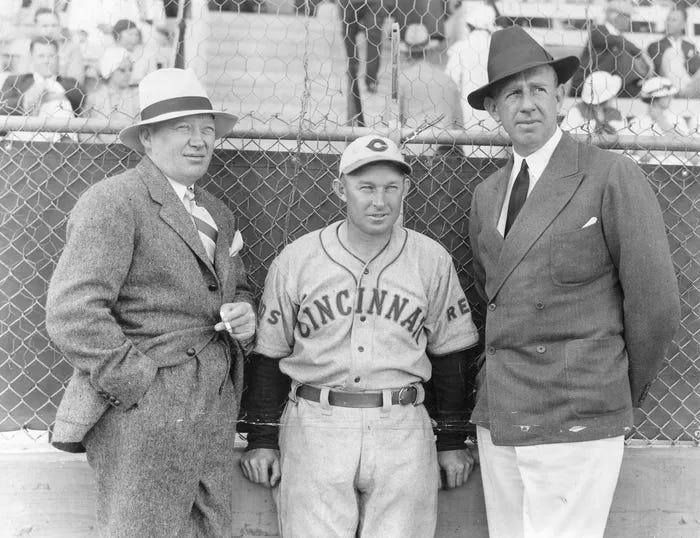
MacPhail wasn’t alone in his determination to bring night baseball to the major leagues. Sam Breadon, the president of the St. Louis Cardinals, extolled the financial benefits of night games, reminding his peers that Sundays, when most workers were off, had long been teams’ best opportunity to make money. Night baseball, Breadon said, “makes every day a Sunday.”
By early 1935, the National League had completed a careful study of the results of night baseball in three minor leagues, comparing players’ nocturnal and diurnal performances. The impact on play was minor—batters were slightly worse at night, but fielding was a little better. The impact on attendance and revenue, on the other hand, was profound.
Armed with this data, MacPhail browbeat the skeptics into submission. The eight NL teams agreed to a limited trial of night games in 1935, allowing individual clubs to schedule a maximum of seven, with strict limitations. No Sunday games, no holidays, and no team could be forced to participate in night games against their wishes.
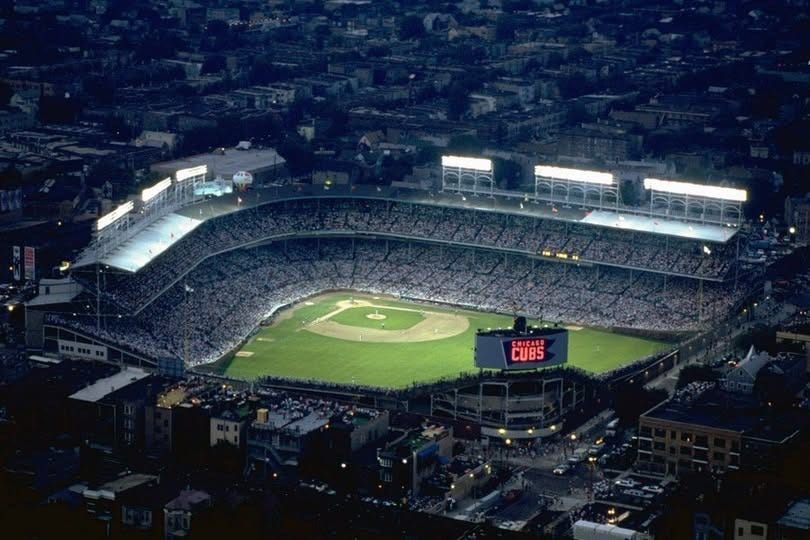
Despite the unanimous vote to proceed (the New York Giants abstained), teams continued to vacillate. In a bit of historic irony, the Chicago Cubs were rumored to be among the teams which would put up lights immediately. In fact, Wrigley Field stayed dark for another half-century. And while the Philadelphia Phillies were among the teams initially stating they would not participate in night games, MacPhail apparently won them over, because three months later, on May 23, 1935, they would join the Reds in the first-ever major-league game under lights.
Informed by his experience in Columbus, MacPhail consulted with several different firms to come up with an illumination system worthy of baseball’s best. The resulting plans arrayed eight double-banked light towers around Crosley Field, bristling with 632 high-powered arc lights. The system would essentially double the light output of Columbus’ Red Bird Stadium.
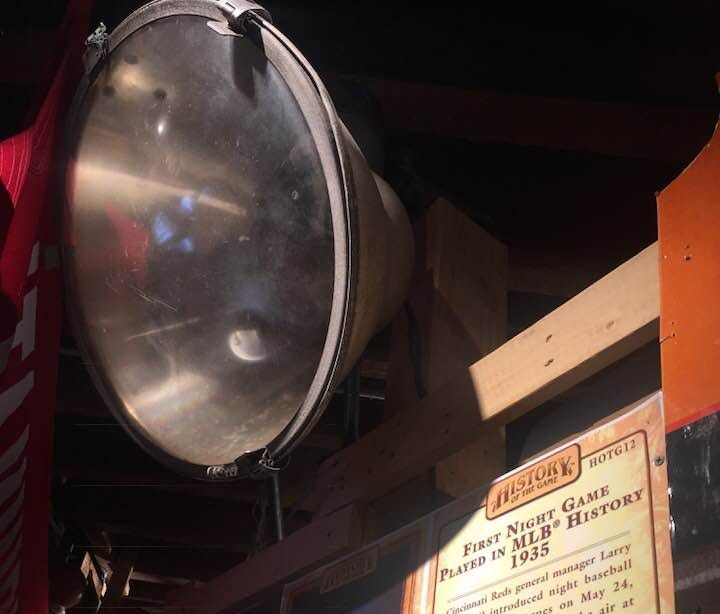
General Electric won the contract and promised to deliver 60-70 foot-candles of light to each of Crosley’s 137,000 square feet. Most minor-league parks delivered 50 foot-candles, to the infield only, and night football games were played in even dimmer conditions. MacPhail required the outfield to be as well-lit as the diamond and boasted that it would be possible to read a book four blocks away from each tower. The lights cost the Reds approximately $50,000—$1.2 million in 2026 dollars—to install and $250 to run each night. The system paid for itself in less than a year.
Most of the teams holding out caved as MacPhail hyped his new toys. Every team except the Giants eventually agreed to play a night game in Cincinnati in 1935. The Giants’ owner, Horace Stoneham, seemed to eschew night games on principle alone, declaring: “Baseball is a daytime game.” What more had to be said?
The Reds scheduled the first of their seven night games for May 23, featuring the once-reluctant Philadelphia Phillies. Thousands of tickets were sold in advance, and baseball executives from all over the Midwest made travel plans. The Reds invited the executives of their various farm teams and both Ford Frick, the NL president, and his AL counterpart, William Harridge.
MacPhail even solicited the President of the United States, Franklin Roosevelt, to throw out the first pitch. When Roosevelt couldn’t attend in person, MacPhail devised a ceremony in which the President would press a button in the Oval Office to transmit the signal to hit the lights in Cincinnati.
The Reds got their first taste of the future on the evening of May 22. They’d won a game against the Brooklyn Dodgers that afternoon, and MacPhail arranged for a local press organization to buy the players a nice dinner. After the meal, the Roaring Redhead gave a short motivational speech in which he told the team, then in sixth place, he was supremely confident that if they set their hearts and backs to the task, they could finish the season in fifth.
Then it was back to the ballpark, where the Reds’ manager, Charlie Dressen, led the team in their first nighttime practice. The light system was fully turned on for the first time at night and the Reds practiced for an hour, with many of the Brooklyn players filtering in to watch from the stands.
Glare from overhead lights had been a major concern with earlier systems, and some night-inclined teams had distributed special long-visored caps to help the players shield their eyes. The Reds now gazed upward, trying unsuccessfully to dazzle themselves. Several players threw off their standard caps and played bare-headed. They said it was like taking batting practice in the afternoon. Some tried using a fungo bat to hit a ball high enough to escape the bowl of light. None made it out.
If the weather hadn’t interfered, MacPhail probably would have had a sellout, but May 23 was unseasonably cold and light rain fell for hours in the morning, portending a miserable night for such a grand occasion. The teams quickly announced a postponement and moved the night debut to May 24. MacPhail wired the White House to see if the President could accommodate the change and received a warm reply within minutes from the Fan-in-Chief: “Am sticking with you. Will be glad to do my part tomorrow night.” The button wasn’t going anywhere.
The park gates opened in daylight on May 24, at 6:30 p.m. Early arrivals watched the teams take batting practice, and several drum and bugle corps performed. Officials took the novel step of lowering the American flag before the game, as the musicians played the bugle standard “To the Colors.”
At 8:30 p.m. the park was steeped in gloom. The public address announcer informed the crowd that President Roosevelt was preparing to give the signal. After a longer-than-expected delay, the light towers blazed to life and the crowd “Ooooh”-ed in a voice that sounded like a soprano in one writer’s ears. On cue, the Reds’ players sprang into a lively infield practice. It was a brilliant scene, according to one witness, “with the trim little figures running about on the field, as if it was a new baseball game board in the window of the corner drug store.”
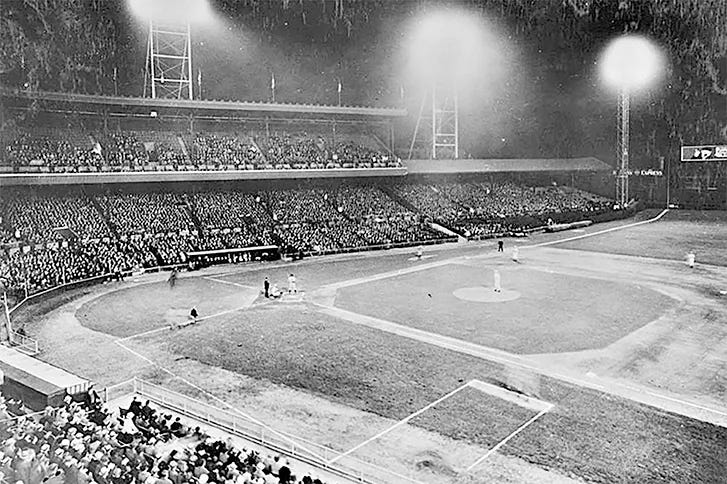
20,000 people turned out for the rescheduled “floodlight inaugural,” looking like a football crowd, stuffed into top coats and bundled under blankets. It wasn’t a sellout, but it was the Reds’ third-largest crowd of the season. “Anything that would draw so many people to watch the Phillies and Reds play must be conceded to be worth cultivating,” The Sporting News declared. “If played in the afternoon, this game would have done well to attract 2,000.” Sure enough, the same two teams played in daylight on May 25 and the paid attendance was a scant 2,085.
The Reds pulled every string to ensure the first game went smoothly. They sat most of their veterans, including catcher Ernie Lombardi, a budding star, in favor of rookies. In this scenario, the greenest players had the advantage of experience, as they were fresh out from the minors, where night baseball was commonplace.
These experts had no complaints with GE’s setup, and there were no errors or lost balls. Many observers felt the ball was easier to see in the lights than in daytime. James Golden, Jr., a writer for the Cincinnati Enquirer, marveled at watching a high pop fly reach its apogee, seeing it hesitate, and begin to fall again.
The ball shone through the thin clouds like a bald head in a steam room, and when there was no mist the sphere stood out against the sky like a pearl against dark velvet.
The night was cold and increasingly damp, and smoke from locomotives passing near the park drifted over the field and settled in the chill, creating a Gothic atmosphere. “Night games,” the correspondent for The Sporting News wrote, “will be better when played in warm weather.”
The Reds’ best pitcher, Paul Derringer, and the Phillies’ Joe Bowman pitched impressively, relying on “speedballs” to miss bats. The Phillies’ manager, Jimmie Wilson, insisted his players could see Derringer’s pitches fine—they just couldn’t hit them.
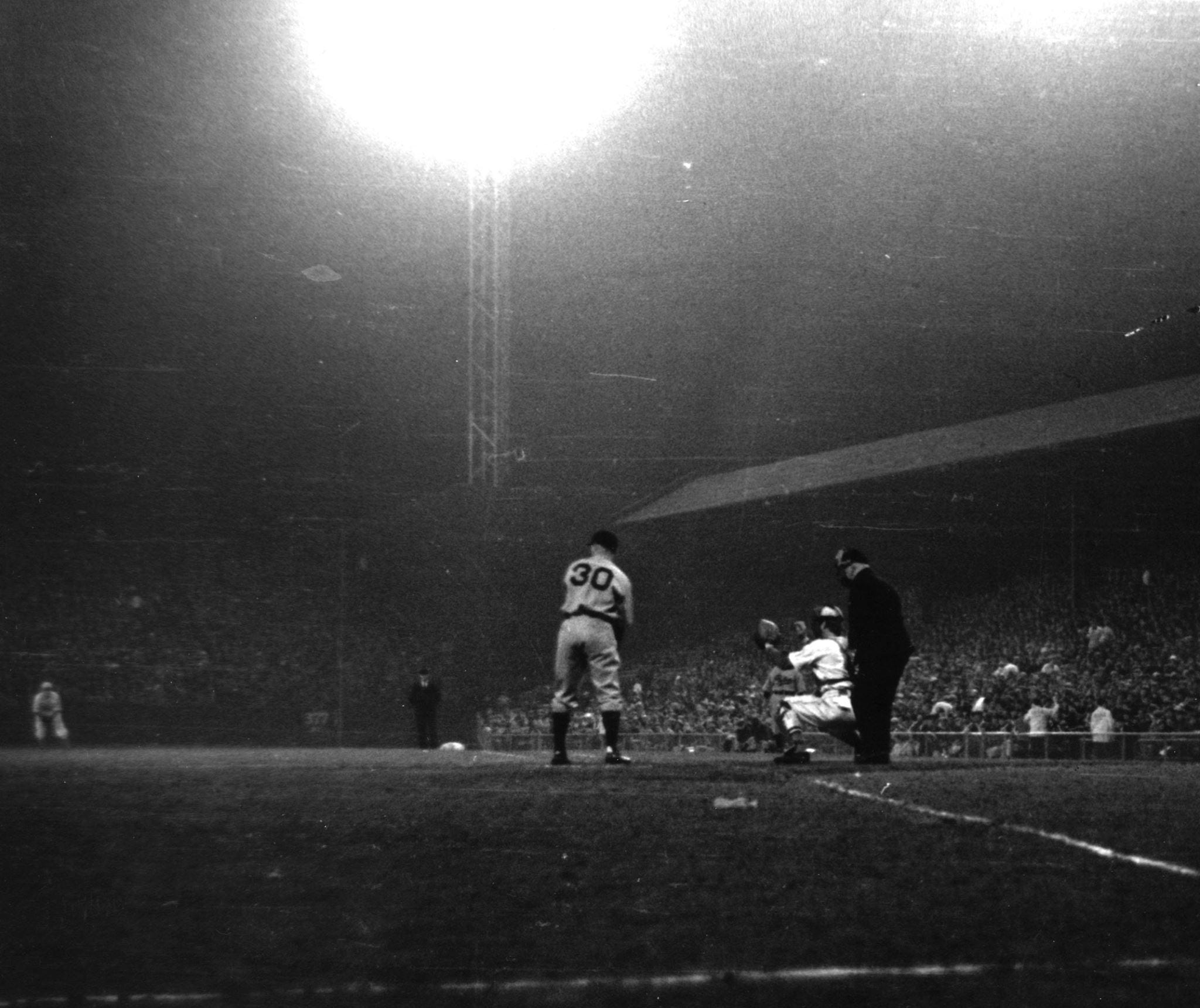
The game turned into “one of the most brilliant battles of the season,” featuring exciting catches, even deep in the outfield, where the Reds’ center fielder, Sam Byrd, crashed into the wall after making a running catch. Byrd stood plastered against the boards long enough to show he had the ball, before crumpling to the ground. The center fielder was the only of Cincinnati defender who had never played under lights in the minor leagues, but he got up to speed quickly.
The Reds scored in the first inning on a double and two groundouts. Singles in the fourth yielded another run. The Phillies manufactured just one run against Derringer in the fifth. The brisk game ended in under two hours, a 2-1 victory for the Reds. The park lights were still blazing when the last of the crowd filtered out of the park; President Roosevelt had apparently forgotten to turn them off.
Even the skeptics left impressed. Will Harridge said it was “the best spectacle I’ve seen in years.” Harridge’s American League had overwhelmingly voted against night games before the season—one owner reportedly voted “nay” because he held a regular card game in the evenings. It would be several more years before any AL teams actually tried it, but in 1935 at least one influential owner, Clark Griffith of the Washington Senators, began warming to the possibility1.
In a classy touch, the Reds had invited George Cahill, who orchestrated the first Cincinnati night game in 1909, to attend the second one as their guest. Cahill’s attempt was feeble by modern standards—each one of GE’s light towers produced more illumination than Cahill’s entire 1909 rig—but he’d continued his work and established a successful firm, installing lights from Forbes Field to Madison Square Garden to Wembley Stadium in London. Cahill saw validation in the first regulation night baseball game in the majors, declaring he’d had the right idea, 25 years early.
The fans were near-unanimous in their approval. In a survey taken later that season, 99% of respondents were in favor of making night games a regular feature at Crosley Field. The collective enthusiasm was best captured by another VIP who attended the May 24 game as the Reds’ guest. Charles Rieckel, of Cynthiana, Kentucky, had watched every Reds’ home opener dating back to the 19th century. Months away from his 100th birthday, Rieckel gave night baseball his stamp of approval and challenged doubters to get on board:
“If an old bird like me can see it, I guess the rest of you ought to.”
The Reds had hoped night baseball would attract 100,000 customers and return the club to profitability after years of losses—MacPhail had made waves by announcing his team had lost $200,000 in 1934. In August, after more than 30,000 people jammed into the park (with a capacity of 24,000) to see a night game between the Reds and the defending champion Cardinals, the team began renovating the outfield to add 6,000 additional seats.
When the final count was taken, 130,000 people had paid to stay up late, a greater number than nearly any other team at the time could draw with any seven day games on the calendar. When the season ended, the sixth-place Reds had gone from 206,000 fans in 1934 to 448,000, and even with the expense of the lights, the club made a $50,000 profit.
It would be wrong to characterize the Reds’ embrace of night baseball as a daring leap of faith. The practice was already endemic in the 1930s, spread as vulnerable teams sought protection from the pummeling forces of the Great Depression. By 1935, the 16 major-league parks were about the only places in America where fans couldn’t see the principal tenants play after dark.
Night baseball showed how far the Reds had come as pioneers. Under Larry MacPhail (and Powel Crosley) Cincinnati went from a “conservative stronghold” to “the proving ground of the major leagues.” MacPhail’s volatile restlessness put a charge into stagnating baseball like it hadn’t had in decades. From radio to air travel to arc lights and—later—protective head gear, MacPhail shoved the old-time game together with various amenities of the modernizing world and forced them to shake hands. Mostly they ended up getting along.
MacPhail and the Reds ended an argument in which both sides were right. Baseball was a daytime game—MacPhail ardently believed that and said so. But he and other trailblazing executives in the minor leagues and Negro Leagues saw opportunity in the darkness, and they flipped on the lights to see what might be out there.
Baseball, it turned out, was a night game, too.

Clark Griffith said he became a night-ball believer in August 1935, after 9,000 people came to the Senators’ ballpark to see a nighttime exhibition game between teams riding atop donkeys. Things got weird in the Depression.
Change is difficult. People just aren’t open minded to accept something new or they reject it.
The irony in Chicago was that there were no lights at Wrigley Field until 1988, but the Wrigley Building, at Michigan Avenue and the Chicago River was bathed in light at night for years. Nice recounting, Paul.