


Welcome to Project 3.18, a free weekly publication where a fan-first writer tells strange and surprising stories from baseball history and culture.
On April 8, 2026, Shohei Ohtani threw his first pitch of the game against the Blue Jays. The pitch was very low, an obvious ball. Ohtani adjusted his cap, and Will Smith, the Dodgers’ catcher, issued a rather head-scratching challenge.
On April 11, New York Yankees first baseman Ben Rice struck out looking. Rice tossed his bat away, the sign of a batter who knows he’s been beaten, and as he began to retreat from the plate he touched the top of his helmet. The home plate umpire, Dan Bellino, saw the gesture and interpreted it as the signal to challenge. Rice protested, saying, yes, he’d touched the top of his head, but not like that, but Bellino persisted and the Yankees lost a challenge.
The same day, in Chicago, Pirates pitcher Bubba Chandler had an 0-1 count when he threw a close pitch to the Cubs’ Moisés Ballesteros. Chandler had no apparent issue with that pitch being called a ball, but he did have a problem with his cap, and he moved his hand upward and put it on the back of his head to straighten things out. That was enough for the home plate umpire, Alan Porter, who initiated a challenge review. Chandler mildly protested but quickly stopped—it turned out he’d actually thrown Ballesteros a strike, so he won the challenge he hadn’t made.
All of this begs the question: Why is the symbol for an ABS review a gesture that players make all the time for completely unrelated reasons?
It is hard to imagine that this issue did not come up during the system’s extensive minor-league testing. Baseball players are notoriously twitchy and fussy. Ichiro Suzuki might be the most famous of this crowd, but 1970s infielder Mike Hargrove got the best nickname out of it: his routine of tics during a plate appearance earned him the nickname “the Human Rain Delay.” So why pick one of these same tics to serve as the challenge signal?
There must have been a reason. If you know it, please enlighten us in the comments.
In any case, all of these recent hijinks suggest a revision of the challenge signal may be in order. The internet is full of interesting suggestions:
“Why not point at the ump?” – Too confrontational, though we suggest the wagging finger of shame, best performed by Seinfeld’s Babu Bhatt, might be a fit for players with the dexterity to pull it off:

“Cross the forearms to make an ‘X’” – Too much like professional wrestling, and hard for a player holding a bat to do safely.
Speaking of professional wrestling: “Do the ‘crotch chop’ like D-Generation X.” – If we were going to give anyone that rude gesture, it would be the umpires, who could use it to signal that their original call was correct.
Others have suggested the scornful rasberry of John Cleese’s smug soldier on the ramparts from Monty Python and the Holy Grail, the ear-cupping headset pantomime baseball managers make for a play challenge (again, bats may cause difficulty), or drawing a square in the air, which is apparently something they do in soccer.
We suggested players must say “Challenge!” to confirm their order after a head-tap, but our podcast partner, Ted Walker, a former college catcher, warned us to avoid relying on any verbal signal, which maliciously compliant umpires might use to turn any mutter or grumble into a wasted challenge.
The good news is that further iteration is possible and will, hopefully, lead to players making some jaunty “finger guns” or another unmistakable signal instead of patting their heads. We’re still in the shakedown phase of the ABS rule, and as field testers, major-leaguers are second to none. They certainly showed that 58 years ago this week, when they put a new rule through a similar wringer, and that’s our story today.

With pitchers increasingly throttling hitters around the major leagues in the mid-1960s, a group of managers and general managers convened in Mexico City in November 1967 to discuss what could be done. One of their targets was the spitball.
While technically illegal, the existing rules banned the sneaky pitch without prohibiting the more obvious motions required to throw one, making them as effective as an arms-control treaty that banned nuclear weapons but invited nations to keep as much enriched plutonium around as they wished for recreational purposes.
Under those conditions, generations of pitchers had discreetly used wetted pitches to flourish. Some of these successes were getting out of hand: In 1966 Gaylord Perry went 21-7 and picked up his first All-Star nod with the spitter, but most offenders were less showy about it. Some managers, like Gene Mauch of the Philadelphia Phillies, estimated that as many as a quarter of the National League’s pitchers were loading up the ball in the mid-1960s.
Mauch was among the Mexico City group who agreed to try and get a handle on the spitballers with a new rule. That rule, 8.02 (A), got more explicit about banning the most obvious action a pitcher would take if he wanted to cheat:
A pitcher shall not bring his pitching hand in contact with his mouth any time while he is within the 18-foot circle surrounding the pitching rubber.
The new rule included a new sanction. Any time a pitcher brought his hand to his mouth on the mound, the umpire was to call his next pitch an automatic ball. Rule 8.02 (A) seemed straightforward enough, but it didn’t even make it through its first spring training unscathed.
The first assault came from the California Angels. After a ball was called on one of their pitchers for going to his mouth on the mound, the officials explained to the Angels that the pitcher had to step off the mound in order to do that. The “step off” provision was intended to give pitchers a safe harbor if they had a facial itch that needed scratching, but the Angels’ pitching coach moved quickly to abuse this kindness, ordering his pitcher to step off the mound after every pitch. The umpires threatened to eject everyone involved “for making a travesty of the game,” always a no-no. After that, the rule was amended to limit step-offs.
Making a travesty of the game was old hat to the Chicago Cubs’ manager, Leo Durocher. Durocher became curious if the new rule might actually be useful as a means of intentionally walking a batter without requiring the pitcher to throw. To test his idea, Durocher gave one of his pitchers a very specific order in a spring game. Once he got on the mound and the opposing batter stood in, the pitcher very demonstrably lifted his hand to his face and licked each of his four fingers one by one.
After a brief consultation the umpires sent the batter to first base.
Rule 8.02 (A) was quickly updated again. Henceforth, a batter could not reach base because of a hand-to-mouth violation. This neutralized Durocher’s finger-lickin’ idea but left other questions unanswered. If a pitcher did commit four straight violations, what would happen? No one could say.
Until May 2.
That night, Gene Mauch and his Phillies were in New York, playing the Mets at Shea Stadium. The big story of the game through seven innings was the pitching of an 21-year-old Nolan Ryan, whose fastball compared favorably to those thrown by Sandy Koufax and Bob Feller. That night Ryan had struck out 10 Philadelphia batters in seven shutout innings. Most pitchers in this situation would have been left in to finish the game, but Ryan’s control was as notorious as his heater. He had walked seven Phillies and as a result thrown more than 130 pitches.
In the bottom of the seventh inning, with his team down 3-0, Mauch decided to replace his own starter, Woodie Fryman, with a fresh arm, and he called for a right-handed pitcher named John Boozer
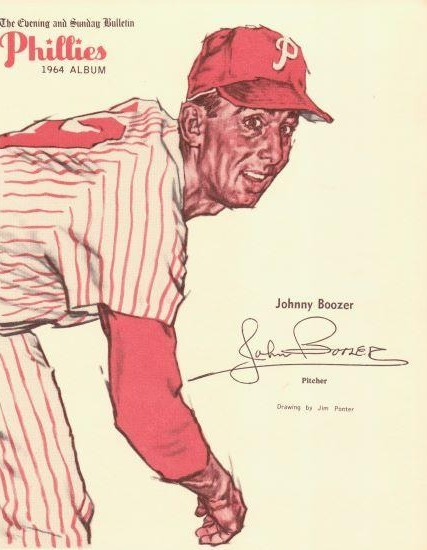
Boozer pitched for the Phillies between 1962 and 1969. He was a pretty unremarkable middle reliever for most of that time, better known, it seems, for being willing to eat anything on a dare and for spitting his omnipresent wad of chewing tobacco at the dugout roof in hopes of making it stick up there. While likely a poor dinner-party guest, he was a good-natured character, and before May 2, 1968, he had never been ejected from a game. That streak was about to come to a surreal end, courtesy of his manager.
As he prepared to enter the game, Boozer set about his warm-up routine, which began with “some preliminary landscaping” on the mound. One of his Philadelphia bullpen mates remembered, “Boozer had a habit of wiping the rubber off with his fingers to get it clean.” Home plate umpire Ed Vargo watched impassively as Boozer tidied up his workspace.
Boozer’s pitching hand became smudged with dirt, but he had a habit for that, too: Before he began his eight warm-up throws, he brought his hand to his mouth to clean it off. Now Vargo’s eyes narrowed, like a police officer coming upon an unsuspecting graffiti-sprayer preparing to sign their name on the side of a public building.
While the Mets’ batter, shortstop Bud Harrelson, waited in the on-deck circle, Boozer threw his first warm-up pitch to his catcher, Clay Dalrymple. Vargo had all he needed.
“Ball one!” the umpire cried, charging toward the mound. It would be hard to say who was more confused, Boozer, throwing to no one, or Harrelson, nowhere near the batter’s box. Gene Mauch leaped out of the dugout as if scalded from behind.
“What do you mean, ‘ball one’?” Mauch yelled.
“He went to his mouth inside the eighteen-foot circle of the mound,” said Vargo, “and that’s a ball any time.”
“How can he be charged with a ball on a warm-up pitch?” Mauch said.
“Show me where it says warm-up pitches don’t count,” Vargo said.
The manager went from pink to red. “Common sense tells you that!”
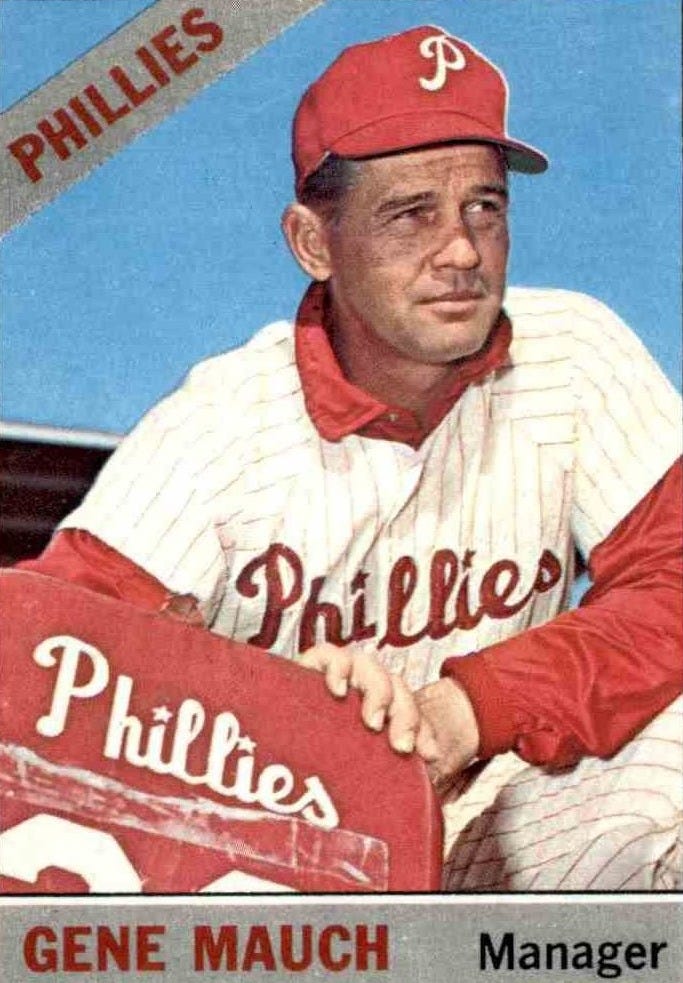
This was Ed Vargo’s version of “malicious compliance.” The rule said nothing protecting warm-up pitches and was equally silent on the application of common sense. Boozer had put his hand to his mouth on the mound before throwing a pitch. By Vargo’s understanding of Rule 8.02 (A), that was ball one.
But whose ball one? Harrelson’s, apparently. Mauch was outraged. “Next thing you know they’ll be calling it in the bullpens.” Or on the bases. Imagine an umpire ruling a runner out in the first inning for failing to touch a base during batting practice.
Mauch asked Vargo what would happen if he ordered Boozer to wet the ball again.
“I’ll call another ball,” said Vargo.
“Do it,” Mauch told Boozer. The pitcher had to wait while Mauch went back to the dugout and Vargo to his spot behind the plate. When all were in their places, the bewildered pitcher wet his hand and threw Dalrymple the ball.
“Ball two!” yelled Vargo. The parties returned to the mound. “One more and Boozer is out of the game and so are you,” the umpire warned.
“Wet it again,” Mauch said. Boozer complied.
“Ball three!” Vargo yelled, beginning to sound hoarse. “You’re out, Mauch, and so are you, Boozer.”
“What if the next pitcher does it?” Mauch asked.
“I’ll forfeit the game to the Mets!”
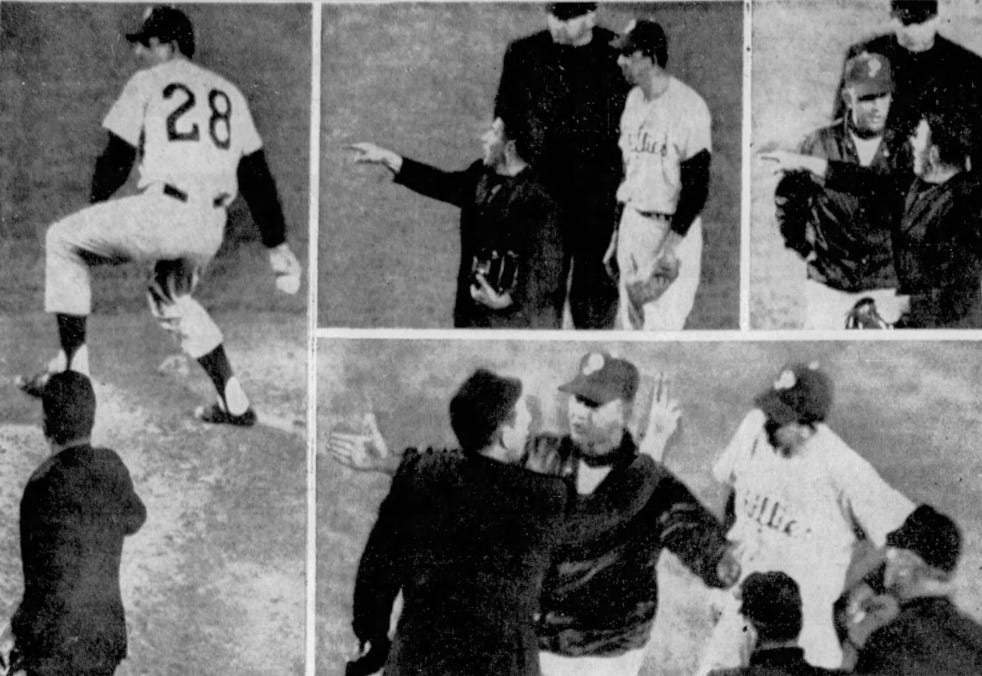
Boozer departed for the bench. His only contribution to the game records that day was his removal. Mauch replaced him with Dick Hall, variously described as “an elongated underhand thrower” and “a giraffe on roller skates.” As Hall arrived on the scene, not having any idea what had transpired, Vargo cautioned him to keep his hand well clear of his mouth during his warm-ups.
Mauch objected. “I’ll handle my pitchers and I’ll tell them what to do.”
The manager decided he’d gone far enough. He planned on making an official protest of the game, “and if the umpires forfeit, my protest has no chance. So I didn’t have Hall do it [a fourth time].”
Hall completed his eight warm-up throws without incident. Vargo summoned Bud Harrelson into the batter’s box and reminded everyone the count was 3-0. It was the first time in history a batter had begun with such a handicap. Harrelson used it to take two strikes and ground the ball weakly back to the pitcher.
A master of pitch placement despite his unorthodox delivery, Hall retired the next five batters he faced, but the extra scrutiny took a toll: “I just kept thinking, ‘I can’t go to my mouth, I can’t go to my mouth.’ It made my mouth water just thinking about it.”
After the game, Mauch exercised his God-given right to complain. “It’s a silly rule,” he said. “It just gets in the way of the game. I’ve seen everything. I’ve seen managers over-manage, but this is the first time I’ve ever seen umpires over-umpire.”
Despite having participated in its creation, Mauch believed the hand-to-mouth rule was flawed in empowering the umpires like Vargo to treat all players and violations the same. There was something darkly ridiculous about a justice system where petty theft and murder followed the same sentencing guidelines.
“It’s weak-kneed and wishy-washy,” Mauch said. “Seventy-five percent of pitchers in the game today don’t have any intention of cheating. Everybody knows who the other twenty-five percent are. Punish the man who tries to cheat.”
Young Nolan Ryan offered some advice to Boozer, Hall, and the other pitchers struggling to keep their hands out of their mouths in baseball’s new era of law and order: pickle juice. The Mets’ trainer had prescribed pickle brine to treat blisters on Ryan’s throwing hand, telling him to keep his ailing finger in a jar of the stuff as much as he could.
“I don’t like pickles,” he said, “but the brine is doing the job. But I really don’t like the smell. It bothers me, especially when I bring my hand to my mouth…outside the eighteen-foot circle, of course.”
It had been a strange experience for the crowd of just under 10,000 people, most of whom didn’t know what all the trouble had been about. For 15 minutes, instead of watching baseball, they had watched a series of umpire conferences, some heated, with nonsensical outcomes.
Then as now, the cardinal rule of umpiring was to stay out of the spotlight. If no one knew who umpired a game, that official did a good job. Whether or not Ed Vargo had intentionally turned the seventh inning into a farce to bring attention to the problems with the new rule, he had created a scene one columnist, Bob August, swore came right out of a Marx Brothers comedy, “in which logic is turned inside out and dignity trampled.”
He pointed to poor, blameless John Boozer, ejected for throwing to an empty batter’s box: “[Vargo] couldn’t have done better comedy with a seltzer bottle and baggy pants.”
If playing rules were to apply while the game wasn’t being played, for the sequel, August suggested “disqualifying a horse from the Kentucky Derby for impeding another horse’s progress in the parade to the post, or penalizing a football team for holding during the pre-game handshake.”
Warren Giles, the National League president, didn’t laugh when he read the report of the game. “He probably doesn’t like the Marx Brothers, either,” August said.
On May 3, Giles rewrote Rule 8.02 (A) for a third time. “Vargo was correct in his translation of the rule as written,” the weary executive said, “but I am quite certain the rule was not intended to work that way.”
The president sent a clarification to the National League’s five umpire crews with some updated language:
Rule 8.02 (A) as amended states that any time a pitcher touches his mouth while inside the 18-foot circle, the ball penalty shall be called. The rule does not apply while the ball is ‘dead’ as when the pitcher is taking his preparatory pitches.
He also clarified that there was no forfeiture clause in the spitball rules—Vargo had simply made that part up. Well, what would happen, someone asked him, if a pitcher (or pitchers) threw four straight illegal pitches to one batter? Giles offered an alternative that was as clear as the mud used to rub up the league’s baseballs:
Had Dick Hall violated the rule for a fourth time, Giles said, the umpire should have let him pitch. But, if Harrelson made an out, that pitch would have been “disallowed,” and Harrelson would have been returned for another 3-0 chance. Before the 1968 season ended, this business of “disallowed” pitches would lead to another farce:

Maybe the league president was a fan of the Marx Brothers after all.
Many rules are extensions of logic, but the former is not a substitute for the latter. Relying only on the rule and disregarding the underlying reason often leads to nonsense, which in turn leads to revision of the rule. It would be years before MLB landed on a version of the spitball rule that could stop Gaylord Perry and the legions of other spitballers, but the process was moving.
Hopefully it won’t take as long of a process to land on a better signal for an ABS challenge. How about pointing at the scoreboard where the challenge result will appear? It would be fun to let every player have a chance to “call his shot,” and just as amusing to see him end up being wrong.
Give us your best suggestion for a new challenge signal in the comments—after all, we’re just spitballing here.

Why not a double or even a triple tap of the head to challenge? This would eliminate the accidental adjustment of the hat or helmet.
Great story! I have often wondered about spitball history.
It kinds of sums up how baseball players can be humorously petty in their enduring effort to find loopholes when confronted with change. Intentionally obtuse to suit an agenda or to simply pushback against authority.
This is part of the forever cat and mouse game in baseball. From sandpaper to pine tar, HGH to sign stealing. That little edge is sought until it becomes a mountain. Then the rules rein it in. Rinse and repeat. :)