


Welcome to Project 3.18, where a fan-first writer tells strange and surprising stories from baseball history and culture.
If you enjoy what you read today, please use the button below to subscribe and receive our free feature stories in your email. And if you’ve been here for a while, we could really use your support as a paid subscriber. Paid subscribers receive access to exclusive content and help keep this publication going and growing.
In case you missed it, last week Project 3.18 added a paid tier. Wow! After two years, four months, and one week on Substack, we’re building for the future with our Project 3.18 Partners.
And what better way to ease our discomfort at asking for money than by rolling out a stack of baseball stories and podcasts related to currency, labor, and, in today’s finale, coinage!
In July 1952, a new era in ballpark entertainment dawned in Chattanooga, Tennessee. Joe Engel, the team president of the Class AA Lookouts, famous for his giveaways, was going to give out the one thing everyone wanted, as described in the Chattanooga Daily Times: “Joe is going to give some lucky fan all the money he or she can carry unassisted.”
With Engel, there was always a catch, a gimmick, or a gag, and so it was with this latest inspiration, sometimes called “Cash and Carry” and other times “Pot o’ Gold (or Silver)”:
Engel has promised to place a tub of $2,000 in coins—dollars, half-dollars, quarters, dimes, and nickels—no pennies—in the pitcher’s box and let the fortunate person take a shovel and fill a bag with as much of the cash as he or she can carry off the field.
The Lookouts’ president had enlisted a banker (the suitably named Tom Rich) to test the weight of coinage and estimate how much a person could lift. Rich figured a strong man might heft as much as $1,200.
Engel didn’t announce when exactly the new promotion would debut, inspiring fans to buy tickets for a suite of home games over the course of the month in the hopes that they’d get lucky in more ways than one.
Studious Engel watchers predicted July 19 would be the night. The Atlanta Crackers, the Lookouts’ main rival in the Southern Association, were in town, and the teams were essentially tied for first place. When the gates opened at 6:00 p.m., long lines had already formed. The park quickly filled up to capacity, but the fire code never stopped Joe Engel. When the gates finally closed, fans were draped over signage and stashed along the foul lines and outfield wall. A few were even deposited inside the organist’s booth.
It was the largest crowd the entire Southern Association had drawn that season and the second-largest weeknight crowd Engel had ever brought in. Among that throng was Archie Nale, a resident of Daisy, Tennessee and a father of seven. When Engel called out the number on Nale’s rain-check ticket, the 41-year-old machinist emerged stoically from the overflow crowd along the right field foul line.
Cash and Carry lacked the frenzied energy of later “money scrambles” (a later Engel invention). Instead, this stunt relied on suspense. There was no time limit; the conflict here was man vs. self, with Engel standing nearby and giving color commentary into a public address microphone.
Nale walked to the pitcher’s mound, where an armored truck had deposited a large silver washtub full of coinage. He was required to physically pick up and carry is winnings as far as an exit near the Lookouts’ dugout, and Engel had him sign a waiver at the mound, releasing the club from responsibility for a “strained back, fallen arches, or any other injuries.”
Described as “a husky fellow,” Nale later said his goal was to lift his approximate weight: 200 pounds. He periodically stopped scooping to lift the sack up onto his back experimentally. When he set the sack back down and shoveled in more coins, the crowd roared its approval.
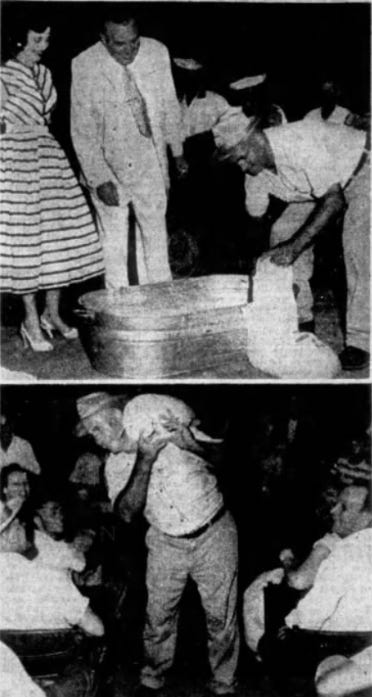
After a final straining assessment, Nale made a powerful hoist and took the bag over his shoulder. Buoyed by encouraging cheers, he walked, “as straight as a soldier,” to the appointed exit. He even gave a postgame interview. “The only thing I regret is that I never got down to the big silver.”
Engel had not missed a trick; the tub’s silver dollars and half dollars were at the bottom, buried under several protective layers of perpetually backfilling nickels. “I couldn’t get my scoop through that stuff,” Nale said. Still, his 200 pounds of metal became $684 worth of paper, or $8,500 in 2026 terms. Not bad.
For Engel, Chattanooga’s minor-league maestro since 1929, Cash and Carry Night was a triumph. The Lookouts beat the Crackers in a twelve-inning walk-off thriller and took over at the top of the league standings. Even better, the ticket proceeds from 14,000 fans made the pot o’ gold look like the chump change it was. “It was a good stunt for the ball club,” he said, “cheaper than giving away those automobiles that cost us $2500 or more.” Engel put on many cringey stunts, some of which have aged like fine milk, but this one had a little bit of genius, weaving an Icarus-like drama from the relatable avarice of the common man.
Before he became the “Barnum of the Bush Leagues” (or, from the less charitable, the “Baron of Baloney”), Joe Engel was a little bit of everything. Engel’s father, William, was a German emigrant who dropped the “von” off his surname and became a successful entrepreneur in Washington D.C., running several bars. These included Engel’s Beer Garden, where his children, including young Joe, regularly encountered reporters, politicians, and local baseball players. These absorbing formative experiences apparently didn’t help Joe put down roots, because he claimed to have run away to the circus at age 13.
He drifted to vaudeville, where he once shared a stage with acclaimed stage performer Al Jolson, but by the late 1900s he was back in Washington and had leveraged his earlier baseball connections into a job as the batboy for the Washington Senators. That seemed to set him on a path, and he later attended St. Mary’s College and flourished as a four-sport athlete.
In 1912, Engel was pitching in a semi-pro league when his father persuaded Clark Griffith, the new manager of the Senators, to give Joe a look. Griffith liked what he saw; he signed Engel and (in what would prove an ironic decision) brought the 19-year-old directly to the majors.
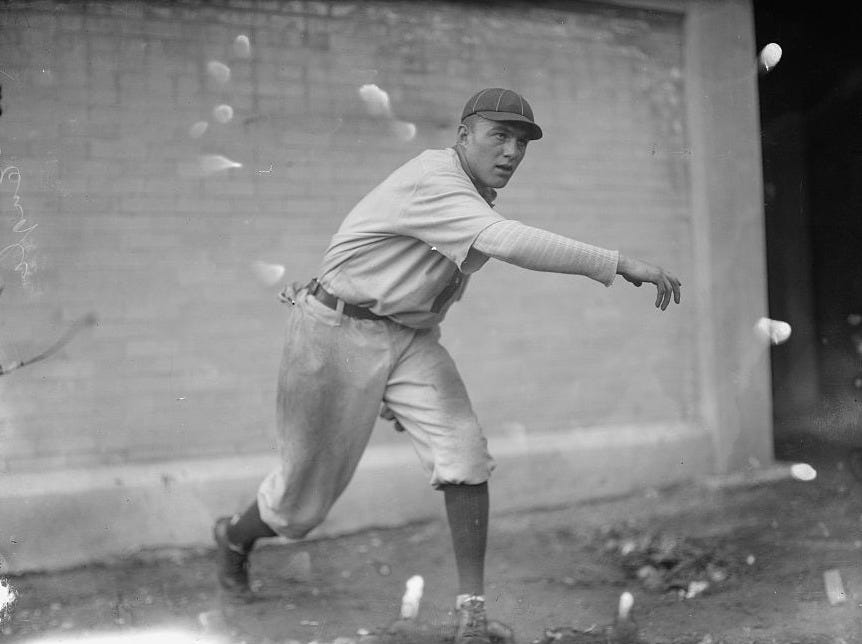
Modern statistics report that Engel’s contributions as a player were essentially nil, but his career was good for the regulars at Engel’s Beer Garden, where drinks were on the house whenever Joe pitched a scoreless inning. Engel recalled one occasion where an unscrupulous and/or thirsty reporter told William Engel that his son was pitching when in fact the Senators’ starter was his teammate, Walter Johnson, far likelier to put up zeroes. “Joe” pitched a 13-inning shutout that day, nearly putting William’s saloon out of business.
The real Engel struggled with wildness, and in 1915 Griffith had him arrange his own trade to a mutual acquaintance who managed a minor-league team in Minneapolis. Griffith saw it as almost a joke, but Engel negotiated a good deal, impressing the Senators’ manager. The pitcher spent a few years in the minors, made unsuccessful make-good attempts in Cincinnati and Cleveland, and returned to Washington in 1920 for one final appearance. After that, Griffith hired Engel as the Senators’ first full-time scout.
Engel excelled at scouting, signing many players that contributed to the 1924 and 1925 World Series teams, earning him full World Series shares and a $10,000 bonus from Griffith. In the winters, when there was less scouting work, Engel branched out. He worked on riverboats moving grain to Southern markets and managed a vaudeville baseball act anchored by two former pitchers turned renowned baseball clowns, Al Schacht and Nick Altrock. “They were always squabbling,” Engel recalled of his clients. “But they were so funny that you could forgive them.”
In the late 1920s, Griffith decided to purchase a minor-league team and use it as a proving ground for future Senators. This was before farm teams became standardized, and the independent minor-league teams weren’t necessarily interested in a major-league overlord. To get around that resistance, Griffith sent Engel south to act as the buyer of record and de facto team owner. After a failed attempt to purchase the Atlanta Crackers, Engel set his sights on another Southern Association team, this one in Chattanooga, one of the weakest franchises in one of the smallest cities on the circuit.
Engel was allowed to purchase the Lookouts. The other owners were suspicious of his ties to Griffith, but the duo quickly showed the power of patronage. Engel dumped a poorly performing Lookouts team and used his scouting talents to rebuild the roster, while Griffith passed along $150,000 to build a state-of-the-art new ballpark. The name for the new park was chosen by a poll of grateful local fans.
Engel Stadium became a staging ground for nearly every decent player Washington could claim in the 1930s and 1940s, but it would be several years before the Lookouts could stand on their own competitively. In the meantime, the former vaudeville man gave away houses, staged fanciful historical reenactments, and chased headlines.
In April 1931, Engel staged one of his most enduring stunts. He also ran a traveling women’s team, the Engelettes, and just before an exhibition game against the Yankees, barnstorming their way north after spring training, Engel signed a 17-year-old Engelette pitcher named Jackie Mitchell to a contract with the Lookouts. He promised Mitchell would pitch against the Yankees, drawing newsreel cameras to his little ballpark in Appalachia. The game, we should note, was initially scheduled for April 1, but weather delayed it until April 2.
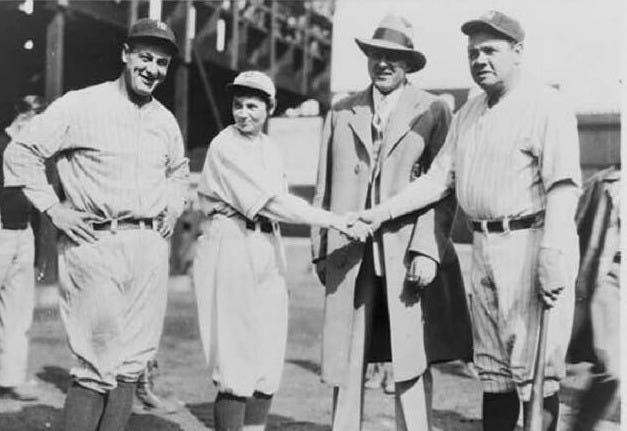
The story of what really happened when Jackie Mitchell struck out Babe Ruth and Lou Gehrig (and walked Tony Lazzeri) is a rabbit hole we can’t dive into today, but whether staged or legitimate, Mitchell’s performance achieved exactly what Engel had intended, drawing enormous regional and national attention. It was soon said of Engel Stadium: “If it didn’t happen there, it didn’t happen.”
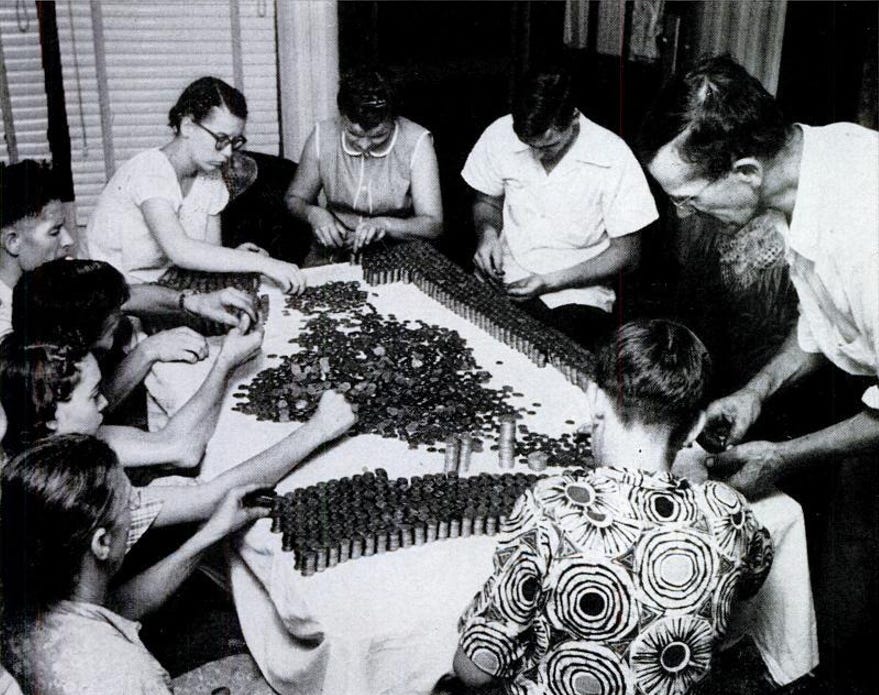
Two decades later, another Engel promotion, Cash and Carry, began drawing national interest, and for the second staging, LIFE magazine was on hand to capture the action. This time the honors went to Ray Cox, a 25-year-old electrical student who weighed, by his account, approximately 130 pounds. He decided to split the pot with a friend who did the shoveling, and somehow Cox got his deceptively strong arms underneath 195 pounds of change.
LIFE followed the winners home, where nine people were still counting coins at 3:30 a.m. When the sun rose, the pair split $930, including seven silver dollars, $49 in quarters and half-dollars, and nearly 17,500 nickels. Still, money was money, and money rarely went further than it did in the 1950s: Cox planned to use his $450 to buy a whole house, while his friend put down a deposit on a gas station.
Boosted by the success of three Cash and Carry Nights (and, to be fair, a pennant-winning team on the field), the Lookouts led the Southern Association in attendance in 1952 and drew more than a quarter of a million people, the club’s all-time record. While far from perfect, Engel’s run of success with a minor-league team was practically unique. Chattanooga regularly finished second in attendance to Atlanta, a city more than twice its size, and the Lookouts were the rare farm club that did not require cash infusions from the parent team to keep its doors open.
Engel’s money promotion returned for 1953, when he finally explained the genesis of both his stunt and of course alcohol was involved:
A bunch of us were in New Orleans one night and we’d been having quite a time on the town. We were just turning in when we ran into a couple of fellows in an armored car. They were putting sacks into a truck. I stopped and asked one of the fellows what he had in the sack. He said it was full of nickels. One word turned into another and it turned out he was an old ball player and I noticed the sack was pretty heavy for him. That gave me an idea.
He said his favorite time running the stunt featured a husband and wife duo. In that installment, the wife had helped with the loading, but the husband was required to do the carrying, a dynamic which produced the kind of interpersonal conflict that adds so much to professional wrestling:
I’m standing out there with them and holding the microphone over their heads, and they don’t know they’re on the air. The wife tells him he’s overloaded and will never make it to home plate with that sack, and he says, “You let me handle this, will ya?” His wife then tells him, “Don’t forget your hernia operation last month.” The crowd is roaring. He makes it to home plate and gets a big hand.
Engel’s mic work was what made the stunt shine. He expertly played the role of a jovial, Southern-fried emcee, genially ribbing the contestants and their efforts to amuse the crowd. Three other cities in the Southern Association eventually put on Cash and Carry Nights of their own, but all of them used Engel, a rival club president, to do it. Of all the various “Barnums of baseball,” from Bill Veeck to Charles O. Finley, only Joe Engel had real stage experience, and he ran his baseball circus like a practiced ringmaster.
By 1955, the Senators, still Chattanooga’s major-league parent, had fallen on hard times. The latest last-place Washington team drew just 425,000 fans, and Clark Griffith, the driving force of the club since 1912, died at age 85. Griffith had never minded the way Engel stunted his way to profitability in the bush leagues, but the major leagues were something else. The Senators’ owner enjoyed the baseball-centric antics of an occasional coach-turned clown, but the gates to Griffith Stadium had long been kept closed to Engel and his circus.
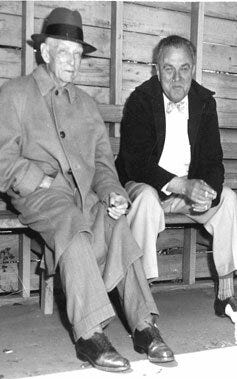
After Clark Griffith’s death, the franchise passed to his adopted son, Calvin. Calvin and Engel were former co-workers; the younger Griffith spent several seasons running the Chattanooga Lookouts in 1937, while Engel was put in charge of expanding the Senators’ insufficient three-team farm system. At the time, 25-year-old Calvin was said to be exasperated by the way Engel did things: “How in the hell can you spend $2.01 and bring in $2.00?” Griffith cut back on promotions to save money, and Chattanooga’s fans made themselves scarce until their free-spending prince returned.
Nineteen years later, Calvin had a better appreciation for what had kept the Lookouts in good shape through depression, war, and, worst of all, a proliferation of entertainment alternatives.
“You can’t run a baseball club any more on the seat of your pants,” Engel said. “Time was when the game was a staple. Everybody was interested in it and it was the one game they knew. And most had played it. Now you have all sorts of competition. You’ve got to hustle.”
It was time for the Senators to let go of some of old Griff’s hang-ups. “[Clark] was the club’s public relations all by himself,” Calvin Griffith said. “I’m not the ‘public relations’ that he was, so we have to go out and do a little more promoting than in the past.”
In August 1956, with the team in seventh place and attendance trending even lower than the year before, the Senators got to hustling, starting with a convertible parade of “Miss Washington” pageant contestants wearing Senators caps. Press accounts assured readers that the women were all “tastefully attired.”
Clark Griffith had run his stadium as a dry venue for decades, but in 1956 the Senators finally applied for a liquor license. Beer was sold inside the park for the first time on August 9, but only in one designated section in the left field stands. Strict rules required spectators to be seated when drinking, and guards were posted to enforce the rule. The “beer pen” had a capacity of just 170 people.
And what was a circus without a ringmaster? In a gesture of evident respect, Calvin Griffith called up the man his father had long ago sent down. “The Senators,” one commenter said, “could use a little from the pot o’ gold themselves.”
On August 11, Joe Engel ran a major-league “Cash and Carry” event before a game between the Senators and the Boston Red Sox. “It’s not as easy as it sounds,” the Washington Post explained. “The record is only $930.”
The lucky winner that night was Sandy Eubanks, a D.C. resident who worked as a gas station attendant, married with a five-year old son. Eubanks left his upper grandstand seat and joined Engel in front of the mound, where the familiar washtub of hard currency was waiting. The promoter kept up a running commentary as Eubanks shoveled and tested. Finally he closed the bank sack, tied it, and tried to lift it onto his shoulder.
It seemed like Eubanks might have bitten off more than he could chew. He teetered dangerously, struggling to stabilize the sack. Joe Engel milked the moment for as long as he could before leaning in to give Eubanks a friendly boost. He knew people wanted to watch a struggle, not a failure. The encumbered fan veered right and left, but finally found his footing. Watching Eubanks stagger for the safety of the field gate, Engel was satisfied. On Cash and Carry Night, the money went to one fan, but each halting, determined step became a reward for everyone in the crowd.
And because this was the big leagues and not the bushes, Eubanks’ worries were over once he stepped off the grass. The Senators counted the coins ($820) and sent him home with a check.

If you enjoyed this baseball story and want to support Project 3.18, consider becoming a paid subscriber.
You can also really help us by sharing this feature on socials or restacking it here on Substack. Publishing a story is how we get on base; please help spread the word and drive us home.
Over on Clear the Field:
Ted and I travel to the 1970s to continue the story, and instead of a tub of change, it’s paper bills strewn all over major-league parks from Houston to Philadelphia to Cleveland, featuring some showmanship that would make Joe Engel proud.

With his negative WAR, Joe Engel was more successful as a scout and team owner than he was as a pitcher. What a character! Have there been any ‘cash grabs’ in the last decade or so? I know there are bobble head and jersey and other giveaways but I can’t think of cash giveaways in recent years.
A great story about a Veeck-like figure, Paul. I remember Harry Caray musing on air that he and Norm Cash should partner in a check-cashing business called, wait for it. . .”Cash & Caray.”