


Welcome to Project 3.18, where a fan-first writer tells strange and surprising stories from baseball history and culture.
On February 2, Project 3.18 turned two years old, but the big day slipped past me. It’s been two years (and four months) since I emailed 20 bewildered friends and relatives a baseball story:

Can you believe I started off with the Mets?
That risky move appears to have paid off; there are many more readers here now and none of you seem bewildered.
I’m sorry I missed the big day, but turns out there’s another anniversary coming up: June 16 marks three years since I became a writer (again). Permit me to start with that story today.
I hate to brag, but I’ve been in this business for a long time. When I was seven, my collection of observational A/B rhyming poems wowed the judges of a state-wide writing contest. I recently rediscovered my copy of the award-winning Poems, Poems, Short and Long and flipped through it for the first time in 35 years. No poems about baseball, but here’s a representative meditation on rocks:
    Rocks, rocks,
hard and round,
those big things
don't make a sound.
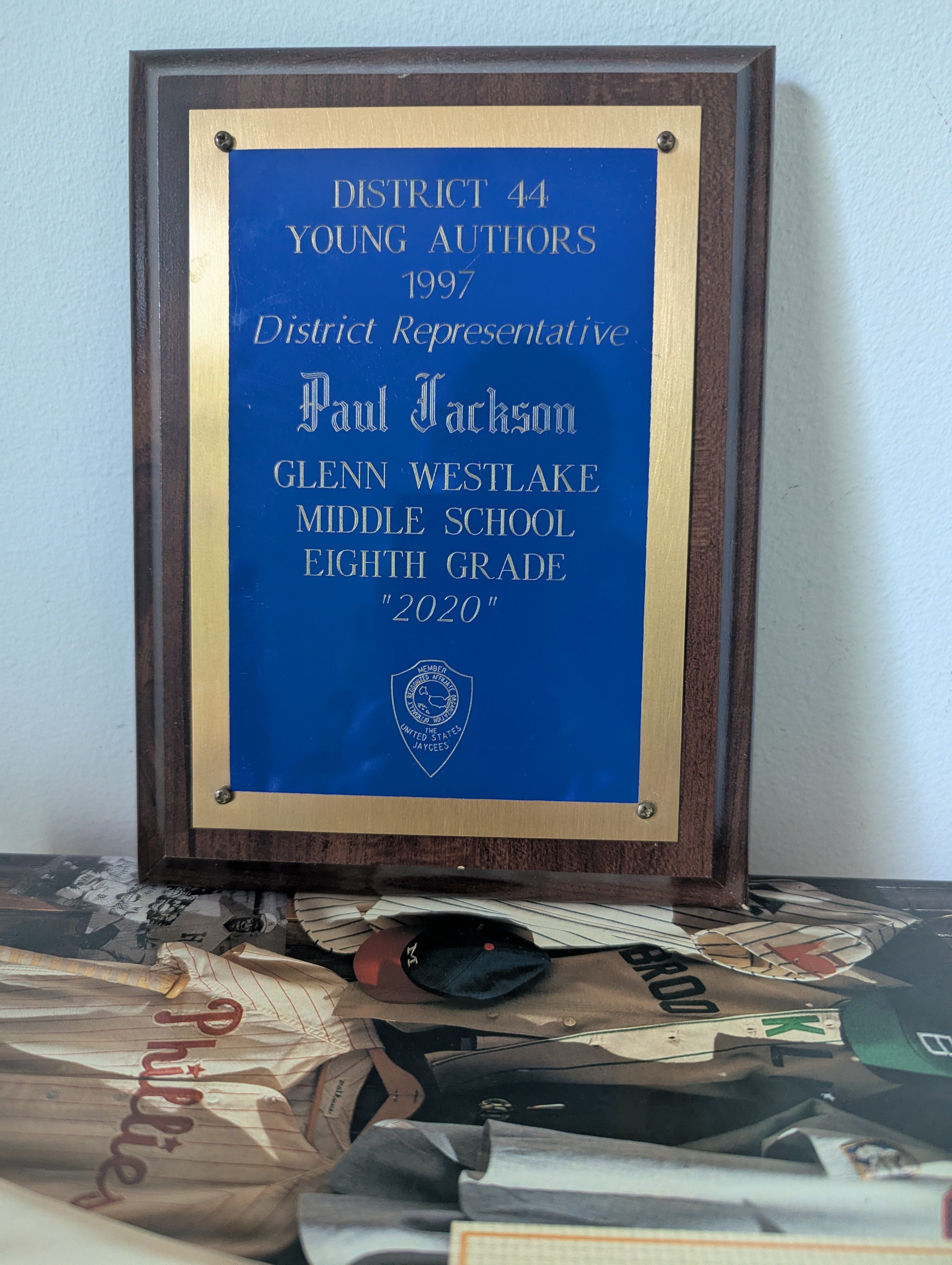
A few years later, I discovered prose and never looked back. Thirteen-year-old me wrote a short story set in the far future: the year 2020. I’d describe this story as “Die Hard…in a mall…on a freakin’ space station.” This high-concept pitch earned me more district-level accolades and a plaque which remains in my office:
Fast-forward to 2008, when I finally found my niche: baseball history. That year, I submitted a few pieces to ESPN.com and two of them ran on Page 2.
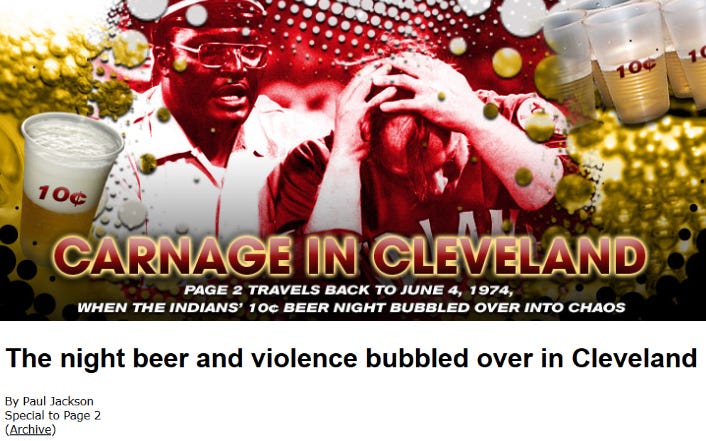
Somebody made me a source on the Wikipedia page for Ten Cent Beer Night. When that happened, I was sure my career was taking off. And it was—just not the one I was thinking about.
That same year—2008—I took a full-time job at the college where I was a graduate student. I needed the job to keep up with the college’s tuition and the hiring department desperately needed a warm body. From that low-stakes beginning, I rose through the org for the next 17 years. I loved that place and my six progressively responsible jobs there.
I got married and had two daughters in the 2010s, and the blur of parenting finished what the job had started. Between 2013 and 2022, I wrote recreationally just once, and then only because my mother asked me to write something, anything, as her birthday present. Sally Jackson carried a lonely torch for my writing dreams long after most people—including me—moved on. My book will be dedicated to her.
I was 39 years old when my mid-life crisis arrived early and I belatedly learned, the hard way, what should be everyone’s first lesson of external employment: No matter how much you love a job, it is not going to love you back. Thus, the upcoming anniversary: June 16, 2023 was my last day in a place I once thought I’d never leave.
When I told my wife that I wanted to change careers and spend a year writing, she had my back—and took a lot of responsibility on her shoulders. Well, it’s been 36 months. The book will be dedicated to her, too.
Project 3.18 is what changed the timetable. What started as a trial run on Substack blossomed into a full-time enterprise, and with your help, I’m hoping it might become a future.
Before beginning what would become Project 3.18, I made one cardinal rule:
Do not half-ass Project 3.18.
I vowed to approach this newsletter like any other job I’d loved and give it my all. In this hectic world, I knew making my best offer had to include my best effort, every week. Looking through the archives, I see I’ve given that.
Each week I select a topic; 90% of the time I don’t know much before diving in. The delight of discovery is a big part of my fun and something I try to pass on in my telling. But going in cold means research, hours of sifting through tiny, crowded newsprint and period idioms—so many idioms. What does it mean that Tom Seaver “threw a dinner salad game,” or when Jackie Robinson “went out to the opera”?*
*I made those idioms up. The confusion you felt reading them is how I spend most Tuesdays.
Then comes the notetaking and writing and rewriting and hunting typos as the clock races. Sometimes I feel sure the clock is going to win, but here we are, 117 weeks and 135 on-time posts later.
Now, three years into this journey, I’m asking for your financial support to help me keep Project 3.18 going and growing.
As of this week, Project 3.18 has a paid tier. If you’ve been a longtime reader or you eagerly open this newsletter every Monday, I hope you will consider becoming a paid subscriber, a Project 3.18 Partner.
Substack is the place for championing independent creators, and I’m as independent as it gets. Your support, roughly $1.04 per issue on an annual $50 subscription, will go a long way here.
Plus, I’m going to do some special things for Project 3.18 Partners, things any fan of this newsletter won’t want to miss:
Partners-only Postscripts, shorter stories that follow up on an earlier feature
Feature Footnotes (regular readers here know how much fun I have in the footnotes) will be for Partners only
Every December, I’ll finish the year with a multi-part saga exclusively for Partners. I might turn this into a “basebrawl” feature, going deep into some of baseball’s most epic bench-clearing rumbles, as I did with “The Battle of Atlanta” in early 2025; or dwell on a favorite topic, like I did 1940s head protection in last winter’s “Arms and Armor.” Whatever it is, it will be epic…and just for paid subscribers
I expect the list of perks will grow, but that’s what I can promise right now. Maybe I’ll even share those award-winning poems.*
*The manuscript for “Die Hard in space” has, alas, been lost to history.
PLUS If you sign up in the next month, I’ll send you a secret story from baseball’s World War II-era carnivals. A link to this story, “Baseball Backs the Attack,” will be sent to paid subscribers on sign-up.
To be clear, the weekly feature story, usually on Mondays, will continue to be free and unlocked. I believe history is for everyone, and I believe that baseball is for everyone. If you share those beliefs and enjoy my work, I hope you will consider contributing $50 a year to support what I do.
I get it—I’m a paid subscriber in some places and a free subscriber in others. If you aren’t able to become a paid Project 3.18 subscriber right now, or you’re new here, I hope you’ll continue being a free subscriber. You can still help me: by sharing or restacking stories and contributing memories and conversation in the comments or on Notes, Instagram, or Facebook.
Whatever you do—thank you.
Now, let’s get to that baseball story. I’ve been saving this one, and it really is about the dignity of work.
Proving, once again, that there’s a baseball story for everything.

Postscript: Revenge of the Hamburger People
Recommended Reading:

On April 9, 1974, Ray Kroc, owner of the San Diego Padres, jumped on the public address microphone at San Diego Stadium to fry his own team, telling the crowd, “I’ve never seen such stupid ballplaying in my life.”
Kroc, the Chairman of the Board of the McDonald’s Corporation, had acquired the Padres only months earlier. He was famous for taking the fast food assembly line invented by brothers Richard and Mac McDonald and building a franchising empire, but San Diego’s four-game losing streak to start the 1974 season was the opposite of “Speedee Service.”
Kroc’s tantrum shocked the baseball world. To the skeptics, it showed just how out of his league he was. Other than being an ardent Cubs fan, Kroc had no connection to the game until the day he swooped in and bought 4% of it. He swiftly apologized, but the faux pas continued to simmer in the public discourse.
The Houston Astros were on the field when Kroc held his personal Open Mic Night, and his criticism applied to them, too. Several Astros players pushed back afterward, led by infielder Denis Menke, the team’s representative to the MLB Players Association.
“You may be able to do something like this at McDonald’s,” Menke began (already off to a bad start). It got worse:
So you criticize somebody and he quits and you get another manager or something. You can’t do that in baseball. It takes so long to bring along a player to the major leagues.
He isn’t dealing with hamburger people, he’s dealing with professional athletes.
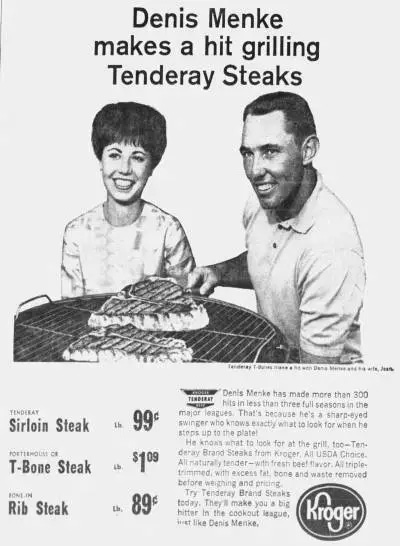
Denis Menke, you see, was a steak man:
Other Astros offered similarly snobbish remarks, negating any sympathy they might have earned in a war of words with one of baseball’s richest owners. The insinuation that fast food employees might deserve the kind of castigation and public humiliation Kroc had dished out was properly named and shamed. “So what makes a professional athlete any more immune to criticism than ‘hamburger people’?” one writer demanded.
Menke’s comments were all the worse for their thoughtfulness. The player rep had clearly considered what he wanted to say, and he said it. But some players’ comments came right off the cuff, and a one-liner tossed out by third baseman Doug Rader became the headline:
What a bunch of horse****. He thinks he’s in a hamburger convention dealing with a bunch of short-order cooks.
On April 11, a man named Andy Nagy became the first short-order cook to offer a public retort. The owner of Andy’s Diner (a Seattle institution for 25 years) told a paper there he found Rader’s statement “tasteless,” and demanded an apology on behalf of short-order cooks everywhere. The wire news services eagerly amplified his criticism until it could be heard nationwide.
With no Instagram to flood with nastiness, unhappy food service professionals avoided the middleman and called Rader’s home telephone. On April 13, the fully scorched player followed in Ray Kroc’s footsteps and offered a public apology for his impulsive, misguided remark. “I was only trying to make an analogy,” Rader said. “I certainly didn’t mean to say anything bad about short-order cooks.”
In doing the right thing and apologizing, the Astros’ third baseman created a perfect public-relations opportunity for the Padres, who were eager to smother the outrage over Kroc’s intemperate scolding. What better way to do that than by turning the whole thing into a joke?
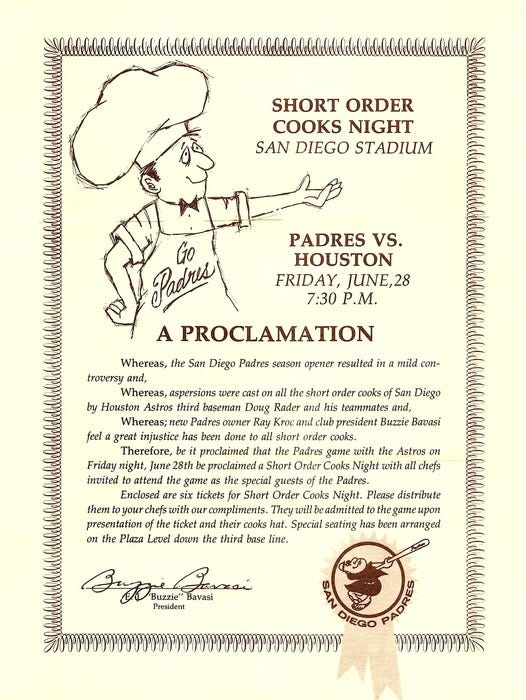
In what was almost certainly a product of the agile mind of Padres president Buzzie Bavasi—who had been turning the tables on baseball players in contract negotiations for decades—the Padres announced that on June 28, when the Astros returned to San Diego Stadium, the team would host “Short Order Cooks Night.”
Bavasi’s marketing staff sent 9,000 ticket vouchers to 1,500 local restaurants, along with the letter below. Any person in possession of a voucher and a chef’s hat would be allowed in for free on June 28, to populate a special section of seats immediately behind Doug Rader’s post at third base. More than 1,000 culinary professionals accepted the Padres’ invitation.
Bavasi called Rader to give him a heads-up on the promotion, and the Astros’ third baseman understood he had to wear this one: “Kroc was completely in the wrong, so he put it on my back. I’m not going to let that bother me.”
Before the game, Rader asked Preston Gomez, the Astros’ manager, for permission to attend the home-plate meeting with the umpires and deliver the team’s lineup card. Initially Gomez didn’t think much about the request. “Sure, why not? You’re the team captain,” he said. Later, as he walked down the tunnel from the clubhouse to the dugout, Gomez realized he might have erred: “There was Doug, wearing this funny hat and putting on an apron.”
Rader was also armed with a frying pan, and as he approached the umpires at home plate, he flipped the lineup card like a flapjack, drawing approving roars from the crowd. “What’s your pleasure?” he asked the officials. “Rare, medium, or well-done?”
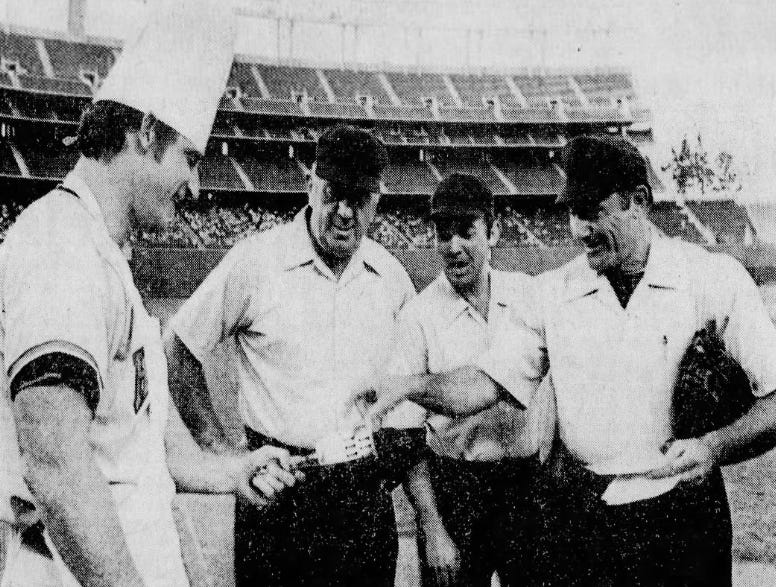
Rader said he’d considered wearing a sign promoting rival chain Burger King or dressing up like Colonel Sanders, but the simple attire of the cook seemed a better way to make amends.
The 1,300 cooks in attendance still booed him when he ran onto the field between innings, but Rader’s costume had effectively turned the tables on the table-turners. “The fans were good,” he said. “Sometimes in a thing like this the people can act like animals. It can get out of hand.”
Rader gave the cooks rooting against him a lot to cheer about that night. He popped up, struck out, made an error, and was thrown out trying to stretch a single into a double. “I didn’t have much of a night out there but at least I pleased the cooks,” he said afterward.
With two outs in the top of the ninth inning, Rader had a final chance to turn the tables on the table-turners. With the tying run on second base in the 5-4 game, he took the Astros’ final at-bat…and flew out, sending the cooks and everyone else home happy.
Good writing and good baseball stories make a great combination
As always, I love your writing, Paul, and of course, the baseball-adjacent stories are brilliant and entertaining!