


Welcome to Project 3.18, where a fan-first writer tells strange and surprising stories from baseball history and culture.
If you enjoy what you read today, please subscribe to receive our free feature stories in your inbox. And if you’ve been here for a while, we could really use your support as a paid subscriber. Paid subscribers receive access to exclusive content and help keep this publication going and growing.
When it was over, the umpires retreated to their dressing room under Yankee Stadium and locked the door.
“I’ve never seen it as bad as it’s been the past three days,” third-base umpire Tim Welke said.
The first-base umpire, Durwood Merrill, had more than 30 years of experience. “That was the first time in my entire career I feared for my safety. There’s just too many people coming at you, and you have no idea what they’re thinking.”
“It’s getting ridiculous, really ridiculous,” Drew Coble, the crew chief, said. “What are you going to do, put a security guard at every seat in the front row? These idiots will still find a way to get on the field.”
One day earlier, on September 17, 1993, nine fans, eight men and one woman, made a mad dash onto the field at Yankee Stadium, interrupting the game between the Yankees and the Boston Red Sox. Most were looking for 15 seconds of fame, but few got that many before pursuing security officers brought them down. But every trespasser was a person of unknown motives, charging in the general direction of the exposed backs of the umpires and the players. It took a toll.
Coble said Buck Showalter, the Yankees manager, felt it too. “We talked about it before the game. He says he worries about coming out of the dugout on the nights the Yankees lose. I told him, ‘Buck, at least you can stay in the dugout.’”
Not everybody out there was fun-loving. A fight would break out in the stands and ripple outward. There were six such disturbances on September 17, some of which drew in an entire section of seats. The game was a fiasco.
But it was nothing compared to what happened the next day. From the umpires’ perspective, September 18 was a disaster.
“What happened out there today killed a great game,” Merrill said. “It leaves a hollow feeling. We busted our butts and now we’re in here feeling bad.”
Coble cut him off. “It wasn’t our fault. We did the best we could. If this game was played in Boston and it happened to the Yankees, we would’ve called it the same way.”
Tim Welke had borne the brunt of it. “It’s a shame it had to end like this,” he said, slouched in a chair. “All because of one fan.”
Coble laughed. “One fan? There were two of them. You didn’t even see the other one, did you?”
Athletes like to take care of their own business and not worry about the scoreboard. This is what the first-place Toronto Blue Jays were doing in the last few weeks of the 1993 season. The reigning world champions ripped off nine straight wins between September 10 and September 21.
The New York Yankees, on the other hand, needed help. As recently as September 5 they had been tied with the Blue Jays atop the American League East, but they dropped their next four games right around the time Toronto forgot how to lose. When the Red Sox beat them on September 16, the Yankees were three games back with 14 to play.
On September 17, as fans scampered hither and yon and security personnel churned up the turf chasing them down, the Yankees won a seesaw game on a fielder’s choice hit by third baseman Wade Boggs, who commented on the night’s track and field events. “Boy, there were some good open-field tackles tonight. Some of those [security guards] ought to play defensive back.”
Buck Showalter, the Yankees’ professionally nondescript manager, saw nothing worth admiring. “I’d like to comment,” he said, “but I’ll pass. It’s really not funny.”
The Yankees got a much-needed win—especially as the Blue Jays “W” was already up on the scoreboard—that kept them three games back with 13 to play, with a head-to-head series against Toronto looming in late September. Until then, all New York could do was hang on and hope for a break. The Blue Jays notched another quick win against Minnesota on September 18, putting the Yankees back on the brink.
The second biggest crowd of the year packed Yankee Stadium on a cold, wet afternoon in the Bronx. New York had their ace, Jimmy Key, starting against a Boston rookie named Nate Minchey. Key gave up a two-run home run to Mo Vaughn in the first inning, ensuring the Yankees would have to come from behind. The game was held up for an hour due to rain—more time to watch the scoreboard.
Key issued a bases-loaded walk in the third, and all the Yankees could do against Minchey was a seventh inning home run by right fielder Paul O’Neill. O’Neill also made the last out of the eighth, striking out against Greg Harris, a right-handed Boston reliever.
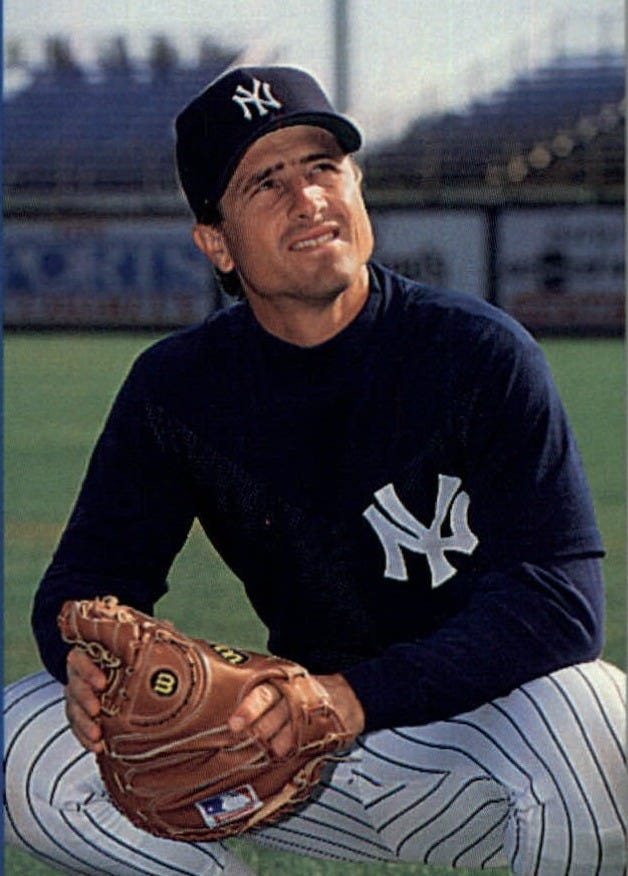
The score was still 3-1 in the bottom of the ninth. Harris got the first two batters to ground out to shortstop, putting the effective end of the Yankees’ season one out away. Harris hit second baseman Mike Gallego with a pitch. Showalter pinch-hit with his best available hitter, catcher Mike Stanley. Stanley fouled off the first pitch and took the next one for a strike. Harris’ third pitch was a very good curve ball, and Stanley took the bait, lofting a harmless fly ball into left field, where Mike Greenwell camped underneath it and made the routine 27th out.
At least, that’s what it looked like if you were watching the ball. Third-base umpire Tim Welke wasn’t watching the ball. He was watching the fan.
Around the time that Greg Harris threw his third pitch, two young men vaulted over the barrier at two different spots and raced toward the middle of the field. Security personnel jumped out of their chairs and started after the intruders. Welke saw a kid wearing a maroon cap streak in front of him, past Clete Boyer, the Yankees’ third-base coach. “I threw my hands up and yelled ‘Time,’ before Harris could begin his windup, but it was so loud he couldn’t hear me.”
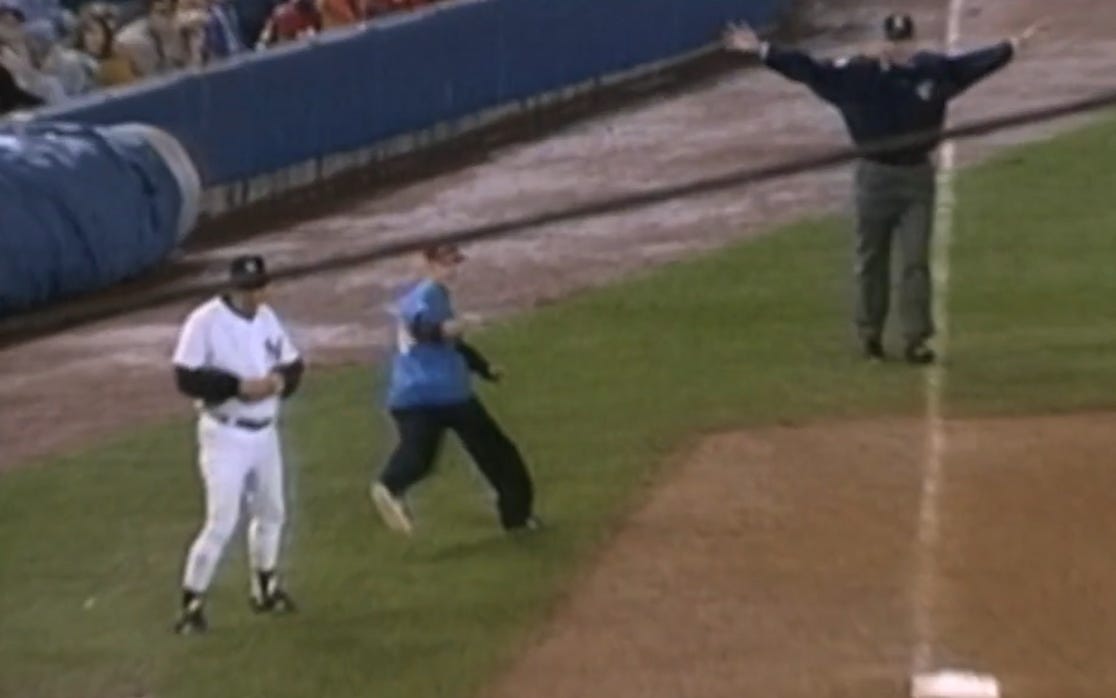
Perhaps sensing that he had jumped the proverbial gun, the kid’s eyes darted toward the scene at home plate. In his baggy mid-90s uniform (the oversize t-shirt over the long-sleeve shirt is a classic) and with his eyes and legs pointing in different directions, he slipped on the wet infield grass and went down, easy pickings for four pursuing security personnel. The Red Sox players had initially started leaving the field, thinking, reasonably, that the game was over, but Welke was vehemently signaling that it was not. As soon as Welke saw the fan, he’d called time, before Harris threw. Anything that happened after he waved the game off didn’t count.
“When the fan got to the coach’s box, I’m waving my arms, trying to be demonstrative,” Welke said afterward. “The first-base umpire was also calling time. This wasn’t even close. It was unfortunate, but it was obvious.”
“Yeah, out of the corner of my eye I saw somebody running down the steps,” Mike Stanley said. “You usually don’t see that, but with all the fans on the field yesterday, I guess I was conscious of it.” But he also denied that the distraction made a difference. “It’s the same swing I would have taken. I can make an out of that curve any day of the week. But there was a distraction.”
Butch Hobson, the Red Sox manager, ran out to argue the game should be over. He and Harris insisted it was. “That’s the [bleeping] worst call I’ve ever seen,” Harris said. “They say Welke put his hands up, but the ball was already three-quarters of the way home. I already threw the ball. He said he called it before but there’s no way.”
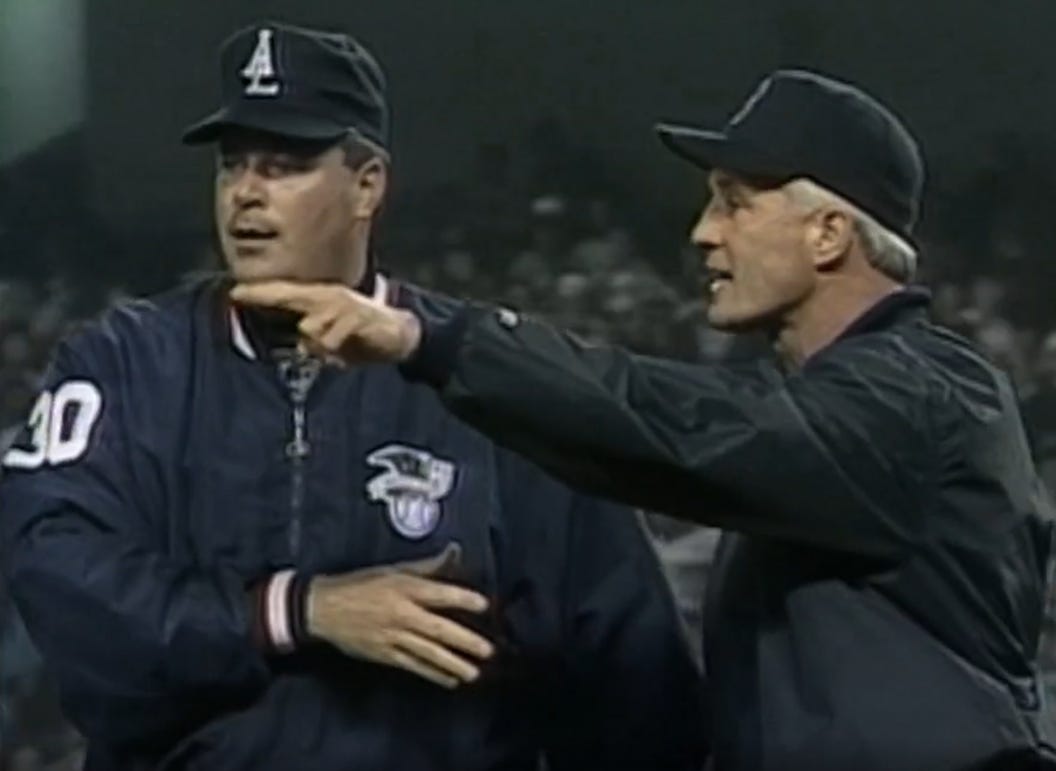
The decisive testimony came from Scott Cooper, the Red Sox’ third baseman: “I did hear the umpire…it scared me. It all happened so fast, but I don’t believe the ball was out of Harris’ hand yet.”
Cooper, Boston’s MVP for integrity, told his manager as much and Hobson stalked back to the dugout. The Yankees’ public address maestro, Bob Sheppard, passed on the good news: “Your attention please…ladies and gentlemen…the game is not over.”
Boston players who had briefly raised their hands in celebration went back to their positions with the look people make after an imminent sneeze veers off at the last second. Hobson’s path briefly crossed with the young fan in the blue shirt, who was being led away via the dugout tunnel. Hobson reportedly hurried him along “with an earful of abuse.” Greg Harris climbed back up the mound, looking for another out.
He never found one. Mike Stanley singled through the left side on the next pitch. Wade Boggs hit a bouncer up the middle but the second baseman couldn’t make a play. Dion James worked a long count and walked. Calling the game for CBS alongside Greg Gumbel, former pitcher Jim Kaat marveled at the liminal space the trespassing fan had opened. “A game that ended twelve minutes ago is still not over. How do you explain that?”
Dion loaded the bases for the Yankees’ captain, Don Mattingly. Historically, this was good news. “Donnie Baseball” thrived under pressure, which was why New York loved him. More immediately, however, Mattingly had been scuffling, hitting .200 down the stretch. He was 0-for-4 that day. “A week ago they wouldn’t have wanted me up there,” he observed. But no one was hanging onto the Yankees’ slim playoff chances more grimly than Mattingly, in the twelfth season of a career almost perfectly placed in the longest postseason drought in team history.
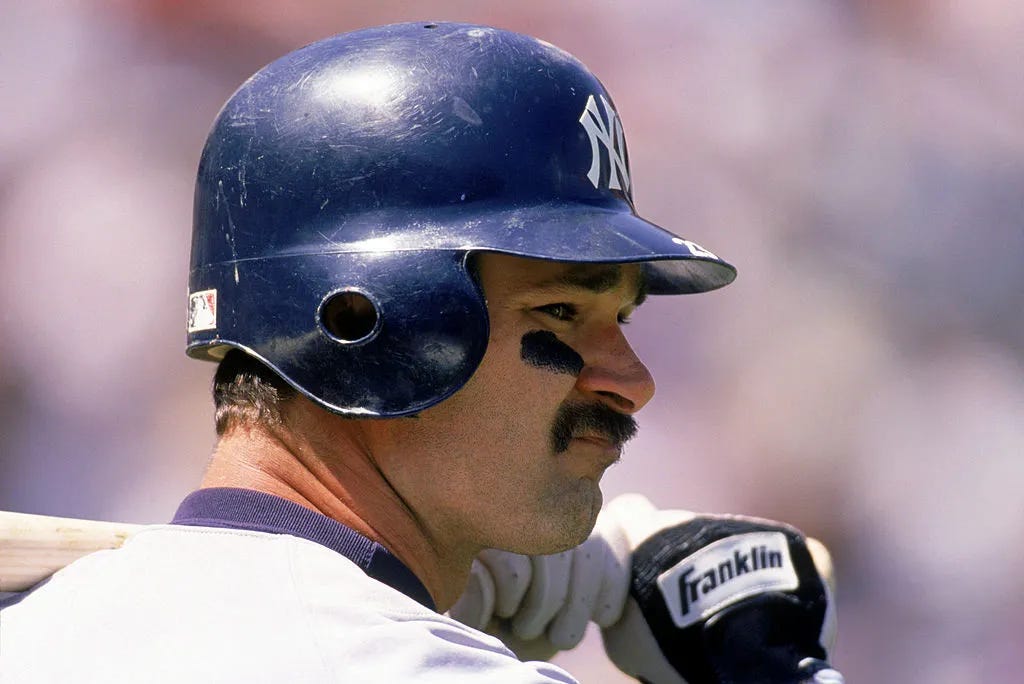
He hit a shot up the right side. The ball bounced once in the dirt and escaped into the grass. “I knew I hit it hard, and when I looked up, it was through.”
Two runs scored, turning an extra out into a walk-off, season-saving win. Mattingly and right fielder Paul O’Neill celebrated so hard they butted heads, leaving O’Neill with a bloody nose to go with his pleased grin. “If you buy season tickets, these are the ones you pay for.”
Closing out the broadcast, Greg Gumbel struggled to sum up the night’s complexities, but he got there: “Life’s not always fair,” he told the audience. “Sometimes it’s a little weird.”
The Yankees left the delirious crowd and whooped and fist-pumped their way into the clubhouse. Given the way they won, staying three games back felt like first place.
Mattingly was pumped up enough to agree it might have been “the biggest hit” of his career:
At least, I can’t remember any of the other ones. Everybody dreams about getting a hit in that situation. Things like this, these are the things you miss when you quit playing. I don’t think you get this high any other way.
Mike Stanley was toasting the kid whose criminal trespass started it all:
We were all trying to get the fan in here to thank him. We’re ready to pay his fine if he needs to be bailed out of jail. As far as we’re concerned, that fan was the most valuable player of the game.
The Red Sox’ October fate had already been sealed, but in this rivalry there is always plenty of pride on the line. Boston’s players felt cheated, none more so than Mike Greenwell, who gloved the 27th out-that-wasn’t.
“We beat the Yankees,” Greenwell said, “but then an idiot ran on the field.” He wanted the Yankees to pay a price. “This is the perfect time to set an example. The home team should be punished. I think the Yankees should be punished. It sure as hell wasn’t a Red Sox fan out there.”
Stanley had to agree that if the same events had played out at Fenway and an interfering fan had given the Red Sox a victory, ”we’d be trying to find him…and not to buy him a beer.”
The NYPD’s 44th Precinct maintained a substation in the lower level of Yankee Stadium. The fan was taken there after he was removed from the field, and sitting in the cramped office seemed to have scared him straight. While the madness he unleashed played on a small TV on the wall, the kid pleaded for mercy. He assured the police he’d never do anything like this again. Tears were shed. When Don Mattingly hit the walk-off single, the fan seemed to hardly notice until the officers congratulated him.
“Usually we get adults,” one of the officers told a reporter for the New York Daily News, “drunks. They’re really wild. This one was different.” The kid was sober and sorrowful. “He just really wanted to be out there on the field.”
Reports vary, but according to the Daily News account, the kid with convincing tears was released without charge. He walked out with his friend, who had stayed on his feet and slid into second base without upending a pennant race.
Since he was 15 years old, the police wouldn’t give the now-famous fan’s name. “Nothing we can do,” one of the officers said, suppressing a smile. “It’s a serious infringement of the rules, but he’s a minor.” Plus, all the cops were Yankees fans.
The circumstances around the kid’s trespass seemed to demand forgiveness. Some invisible power had asserted itself out there and transformed stupidity into serendipity. The universe was talking, and Mike Stanley, for one, was listening.
“A lot has happened this year to make me feel like we might win it all,” Stanley said. “It seems to be some sort of destiny that we win this division.”
Buck Showalter said he wasn’t the type to pay attention to “whimsical things.” “I’m sure there are things we don’t understand, but in my job, I can’t get involved in fate or destiny.”
“I try to look for the positive in people,” Mattingly said, “and I don’t think these fans are out to hurt anyone.” A chaotic moment created an opportunity, and the players had capitalized. That was their job. Even so, the Yankees’ captain said he was open to more whimsy, down the road.
“If we win it all, it’s a game of destiny.”
Unfortunately for New York, the Toronto Blue Jays’ destiny was more straightforward. On September 19th, the first-place Jays won their eighth game in a row, and the Red Sox beat the Yankees, 8-3. Four games out with 11 to play. The team hadn’t been that far back since June.
Another fan took the field that day, making a brief circuit in the outfield before being apprehended. When the “nitwit du jour” was led off the field through a left-field gate, past a fence in front of the Red Sox bullpen, the relievers stared him down. Paul Quantrill said, “We were hoping they would bring him by so we could slap the crap out of him. It’s lucky they didn’t take him off through the dugout. Somebody might have killed him—probably Butch.”
New York lost its next two games against Minnesota, and that was it. Destiny had nothing on math.
The Red Sox made as big a stink as they could In the aftermath of the 28-out spectacular. “The game should have been over,” Lou Gorman, the Red Sox’ general manager, said. “The home team did not control the fans. This is obviously a problem they need to address here, and we should not be penalized for that.”
Looking to have the Yankees’ win overturned, the Red Sox lodged an official protest with Bobby Brown, the president of the American League. Gorman explained their case:
There’s a league rule that requires the home team to control the fans in the ballpark. Our position is that they did not do that, as indicated by the eight or ten fans who were in the field the night before and the fans on the field at that crucial time in the ballgame yesterday.
It was a long-shot argument, but the protest gave the league an opportunity to reckon with the impact of trespassers and send a signal to teams to crack down and get their houses in order. Instead, Brown followed a hallowed tradition of league presidents and managed to squeeze his whole person behind the smallest technicality, ruling against the Red Sox essentially because they didn’t properly file their paperwork.
“Talk about ducking the issue,” Thomas Boswell railed in the Washington Post. “This isn’t a murder trial. It’s just baseball. Don’t split hairs. Get it right.” In “the age of the empty suit,” Boswell complained that the inmates had been left in charge of the asylum. “Wandering teenagers are influencing who wins the pennant.”
After a few days of hearing her son alternately lionized and condemned as a “jerk,” the fan’s mother gave a radio interview. The cost of giving her unconvincing defense—“You know how thrilling it must be for a teenaged boy to get out on that field; you know how boys are.”—was her son’s anonymity. Reporters began calling the family home. The hate mail from New England began arriving soon after.
It’s hard to know whether the Yankees’ deflating end helped the kid or hurt him. If New York had made the playoffs and won it all, generations of baseball fans would have kept his name on an eternal list of notorious ticketholders in New York and Chicago and elsewhere. He might well have become the most infamous fan, immortalized for a youthful lapse in judgement and persona non grata north of Connecticut. On the plus side, free drinks for life in at least four of the five boroughs.
When the postseason drought continued and the furor died down, the fan got his own do-over. He got to keep his privacy and he even got back into Yankee Stadium, but he never took another shot at second base. He’d given his promise to never try anything like that again. That, and the fact that the stadium security guards started carrying Tasers.

If you enjoyed this baseball story and want to support Project 3.18, consider becoming a paid subscriber.
You can also really help us by sharing this feature on socials or restacking it here on Substack. Publishing a story is how we get on base; please help spread the word and drive us home.