


Welcome to Project 3.18, where a fan-first writer tells strange and surprising stories from baseball history and culture.
If you enjoy what you read today, please subscribe to receive our free feature stories in your inbox. And if you’ve been here for a while, we could really use your support as a paid subscriber. Paid subscribers receive access to exclusive content and help keep this publication going and growing.
This is the second half of a whole-alphabet piece featuring outstanding alliterative player names. Project 3.18 is making the tough choices, handing out flowers, and calling out a serious lack of effort by the N’s.
Here’s the first part, in case you missed it:

M: 190 names
The most loaded letter of the alphabet.
Hall-of-Famers: Mickey Mantle, Minnie Minoso, Mike Mussina
Honorable Mention: Mason Miller, Michael Mimbs, Mike Minor
Runners-up: The Moxies
Moxie Manuel—Marquis (or Mark) Garfield Manuel was an ambidextrous pitcher who played for the Chicago White Sox in 1908. “Moxie” was a childhood nickname, earned for unspecified gutsy antics, climbing trees, eating bugs, that sort of thing. One of Manuel’s gutsier White Sox performances led to the “pitcher win” rules as you know them today. In the minor leagues he once tripped over a wheelbarrow playing the outfield and another time he actually hit the cover off a ball. This guy is his own entire post, but in lieu of that I heartily recommend the SABR biography of Mark G. Manuel written by…Mark G. Manuel. That’s a typo, right?
Mox McQuery—William McQuery was an 1880s player who apparently rarely went by the nickname forever assigned to him. He was a good hitter and had an outstanding mustache. After baseball, McQuery became a police officer and died in the line of duty in the year 1900, after being shot during the turn-of-the-century equivalent of a traffic stop gone bad.
Moxie Meixell—It took a village to bring us the purest alliterative name in baseball. It started with Meixell’s parents who purposefully named their child “Merton Merrill.” Later, Meixell’s friends or teammates gilded that lily with a fitting nickname. The result is an MMMM moniker that is both pleasingly snappy and a tongue-twister, depending on your needs.
Meixell played in three games for the 1912 Cleveland Naps. He took two at-bats, made one hit, and disappeared back into the minor leagues and obscurity, but if anyone deserves to have his name remembered on its own merits, make mine Moxie Meixell.
Winners: The Muncys
It’s fair to say that most of us missed the Golden Age of player names, an era that ended on June 15, 1958, when the last player ever to go by “Rube,” Rube Walker, took his last at-bat in the majors.
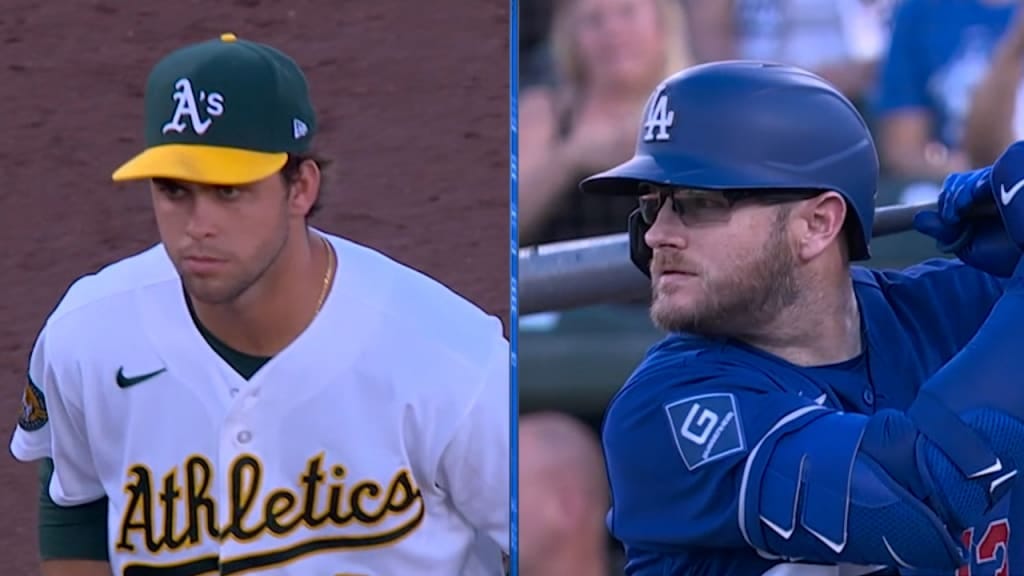
But the present has its wonders, too. All of us, right now, are living in the Muncy Age, when two different players named Max Muncy are active, playing the same position—third base—for California teams and having the same birth date, 12 years apart. These are the only two Muncys (or Munci?) in baseball history, and on June 29 of this year, they faced off in the major leagues for the first time, and third baseman Max Muncy hit a ground ball to third baseman Max Muncy. Wonders.
N: 90 names
Not a lot going on with N, which was a surprise and a disappointment.
Runners-up: Nick Neugebauer, Nelson Norman
Winner: Nyls Nyman
Nyls (pronounced “Niles”) Nyman Jr. wins a lackluster category. The White Sox outfielder’s mid-1970s career was derailed by shoulder injuries for which there were no treatments at the time. As far as I can tell, no one ever called him “Nails.”
O: 7 names
Runners-up: Ossie Orwoll, Ozzie Osborn1
Winner: Orval Overall
The name my podcast partner Ted was sure I was making up. Orval Overall was a big-time curveball pitcher for the 1900s Chicago Cubs, the Tinker-to-Evers-to-Chance championship teams which were all the North Side had to hold onto for more than a century. Overall’s given name needed no embellishment by his teammates, but the 6’ 2”, 214-pound pitcher was sometimes dubbed “Big Groundhog.” Can you guess the date he was born on?
P: 33 names
Runners-up: Parson Perryman, Pretzel Pezzullo, Pid Purdy
Winner: Pinky Pittenger
A 1977 obituary for Clarke Alonzo Pittenger, a reserve infielder with the Red Sox, Cubs, and Reds in the 1920s, described him as “a short-line-drive hitter and fancy fielder,” and stated that Pittenger “acquired his nickname from a comic-strip character in the 1920s” without specifying which one.
I took that as a challenge.
The hunt for Pinky’s comic namesake became a post of its own, and I’m making it a special Thursday postscript for Project 3.18’s awesome paid subscribers.
Q: 0 names
No surprise here. This one is on the parents. There are 61 player surnames beginning with Q and not one of them was named Quentin.
Winner: Wimpy Quinn
Here is an apologetic researcher trying to find something interesting to say about 1941 Cubs pitcher Wimpy Quinn:
He did bat .500 in the majors (1-for-2).
R: 126 names
Hall-of-Famers: Robin Roberts, Red Ruffing
Runners-up: Ribs Raney, Rip Repulski, Roxey Roach
Winner: Randy Ready
Randy Max Ready was ready from an early age. At 13 years old he was living in Alaska where his father was employed in petroleum production, and young Ready was also working (extralegally?), performing odd jobs on those same oil fields. By the time he reached the major leagues in 1983, Ready was an unremarkable 5’ 11” and 180 pounds, measurements which gave him the advantage of surprise. “I don’t know what’s going on in that little man’s head,” teammate Tony Gwynn said of Ready, “but something is definitely clicking.”
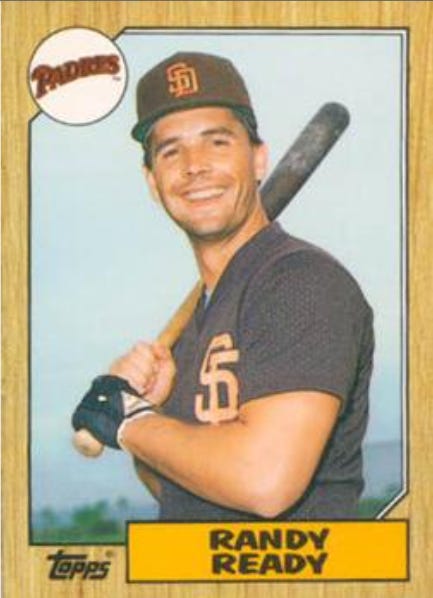
Ready had his best year in 1987 with the San Diego Padres, while simultaneously dealing with the devastating aftereffects of a heart attack which left his wife Doreen permanently disabled. That season accounted for more than half of Ready’s total career value, but he spent 12 other seasons as a part-time infielder all around the major leagues. A gamer’s gamer who woke up scrappy and went to bed pesky, Ready became a minor-league coach and manager in the 21st century, tutoring a new generation of players in everything except launch angle.
S: 129 names
Runners-up: Sixto Sanchez, Skeeter Scalzi, Socks Seibold/Socks Seybold, Steamboat Struss
Winner: Sibby Sisti
A Brave for life, Sebastian “Sibby” Sisti joined Boston’s National League team in 1939 when he was 18 years old. During Sisti’s time with the team, it changed its name—from Bees back to Braves—and its home city, relocating to Milwaukee in 1953, a year before Sisti retired at age 33.
Despite a relatively niche career in Boston, the odds are that more people reading this have watched Sibby Sisti in uniform than any other player featured in this post. Sisti was living in Buffalo, New York in 1983, when a movie called The Natural began filming there. The retired player became a technical consultant, helping the production accurately capture his bygone era. In an acknowledgement of his contributions, Sisti got to don one last flannel uniform to play the sad-eyed Pittsburgh Pirates manager who calls in a fireballing lefty to face Robert Redford’s Roy Hobbs in the film’s electric final sequence.
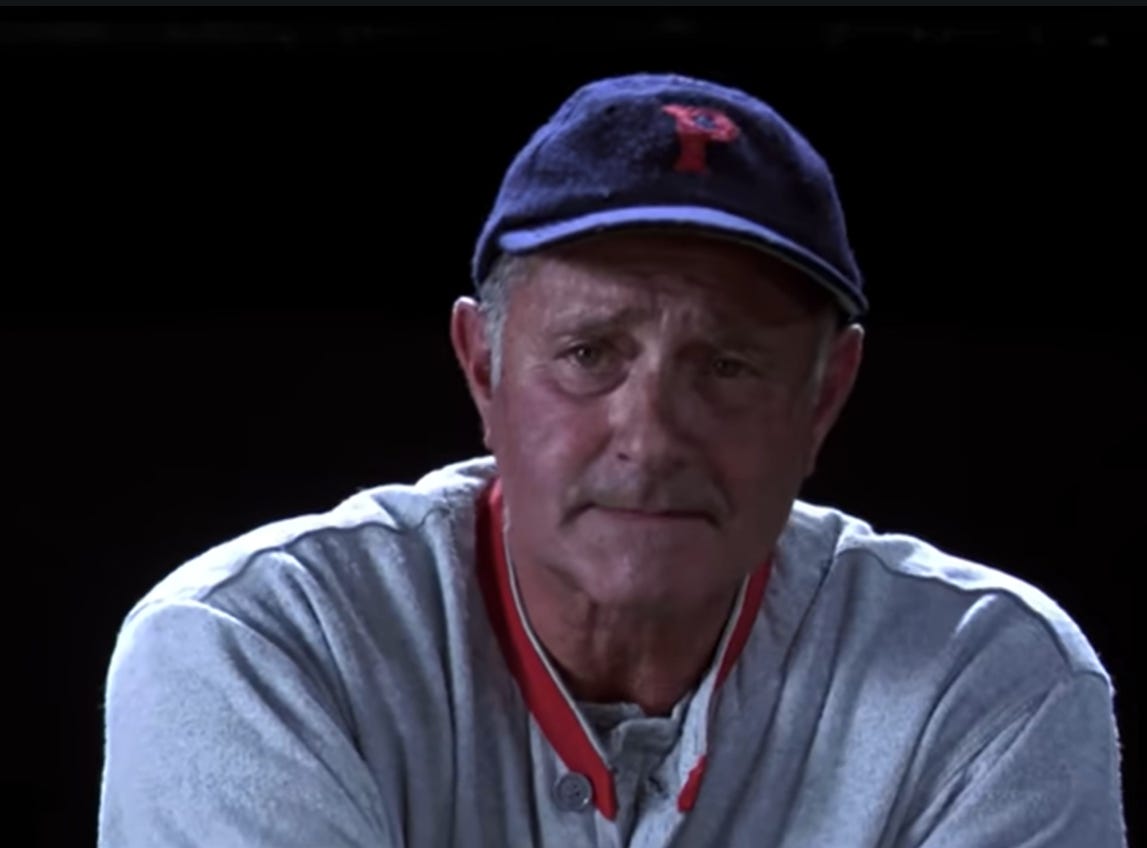
Telling the story of his movie career, Sisti promised he’d do things differently than his character if he was really calling the shots:
“This time, on the first pitch, Redford’s going right down on his ass.”
T: 77 names
Runners-up: Townsend Tapley, Taylor Teagarden, Tip Tobin, Twink Twining, Turkey Tyson
Winner: Touki Toussaint (TOO-key TOO-sahnt)
Dany Gilbert Kiti Toussaint, who pitched between 2018 and 2025, is of Haitian and Kenyan heritage. He got his called name from his family: It’s a portmanteau made from his parents’ surnames, “Toussaint” and “Kiti.” He never got a baseball nickname. If it ain’t broke, as they say.
U: 1 name
Winner: Ugueth Urbina
This was a tough one, because the name works but it turns out these awards need a “good character” clause. Urbina, a proficient back-end reliever for six teams, spent seven years in prison in his native Venezuela for participating in what was classified as an attempted murder of several people at his farm. Urbina did his time and after being released went back to pitching, playing with a Venezuelan Professional Baseball League team, the Leones del Caracas, as recently as 2023. At that time, Urbina was not closing the door on a future return to MLB. Can I close it?
Biography aside, Urbina’s alliterative name is a gem with one imperfection. His given names are “Ugueth Urtain” and “Urbina” is his paternal surname. But Urbina also has a maternal surname, “Villareal.” Let’s call that a disqualification and move on.
V: 7 names
Runner-up: Vito Valentinetti
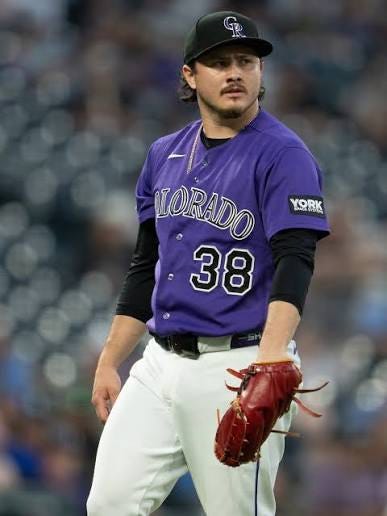
Winner: Victor Vodnik
Colorado Rockies reliever Victor Vodnik wins his category more or less by default. Victor is his given name, and since no nicknames are indicated, I’m going to propose “Dr. Doom,” since he’s basically halfway to Victor von Doom already and it’s a great marketing tie-in with Avengers: Doomsday, releasing this winter. He’s even got a good villain stare.
W: 65 names
Hall-of-Famer: Willie Wells
Runners-up: Wild Bill West, Winfield Welch
Winner: Weldy Walker
On May 1, 1884, Moses Fleetwood Walker played catcher for the American Association Toledo Blue Stockings and became the first Black player to appear in a major league baseball game. On July 13, Moses’ brother, Weldy Wilberforce Walker, became the second, appearing in the Toledo outfield for the first of five times that season.
Progress had sprinted ahead with the Walkers, but prejudice caught up after 1884 and Black players were iced out of the American Association and the National League. It would be another 63 years before a third Black player played on an integrated major-league team. Guy by the name of Robinson.
Some minor leagues continued to allow integrated teams in the years after 1884, but the freeze was spreading. In 1887, 13 Black players including Weldy Walker were rostered in the Ohio State League. Before the 1888 season, the league reorganized, becoming the Tri-State League, and in the new configuration, an earlier by-law permitting teams to sign Black players was repealed.
On March 5, Walker wrote the Tri-State League’s president, a Mr. McDermitt, to protest and challenge the rules change. When he received no response from McDermitt, Walker took his letter to a national magazine, The Sporting Life, which printed the message in full. Here are the final three paragraphs:
The [repeal of the] law is a disgrace to the present age, and reflects very much upon the intelligence of your last meeting and casts derision at the laws of Ohio—the voice of the people—that say all men are created equal. I would suggest that your honorable body, in case that black law is not repealed, pass one making it criminal for a colored man or woman to be found in a ball ground.
There is now the same accommodation made for the colored patron of the game as the white, and the same provision and dispensation is made of the money of them both that finds its way into the coffers of the various clubs.
There should be some broader cause—such as want of ability, behavior, and intelligence—for barring a player than his color. It is for these reasons and because I think ability and intelligence should be recognized first and last—at all times and by everyone—I ask the question again: why was the “law permitting colored men to sign repealed”?
Yours Truly,
Weldy W. Walker
X: 0 names
Winner: Leovigildo Xiqués
There is just one player on the entire roll of major-leaguers—again, a list of nearly 27,000 names—with a surname beginning with X. The distinction goes to Cuban outfielder Leovigildo Xiqués, who played three seasons with the Indianapolis Clowns in the mid-1940s. Apparently he was sometimes known by his maternal surname, Lugo, but there is no way I’m taking the only X in baseball history and shoving him in with the L’s.
Y: 3 names
Runners-up: Yasuhiko Yabuta, Yoshinobu Yamamoto
Winner: Yam Yaryan
Hailed (faintly) as “one of the greatest minor-league catchers of all time” and “the Babe Ruth of the Western League,” Everett Yaryan was signed by the Chicago White Sox, a team which did not need any catchers. Ray Schalk was in the middle of his Hall-of-Fame career and this was in the 1920s, when injuries didn’t exist and no one took days off, so Yaryan mostly caught batting practice. At least he got a nickname out of it—assigned by White Sox second baseman Eddie Collins. Collins said he wasn’t willing to call the catcher by his given name and couldn’t remember his last name. So he came up with something pleasingly memorable. Collins was lazy, but he had good taste in alliteration.
Z: 1 name
Winner: Zip Zabel
Three cheers for George Washington Zabel, dubbed “Zip” by someone who would have enjoyed this post, though his SABR biographer sniffs at the nickname and refuses to use it. Nevertheless, Zabel is both the only entrant and a deserving winner in this category.
Zabel pitched for the Chicago Cubs between 1913 and 1915. His greatest day in baseball came late in his major-league career, on June 17, 1915, when the Cubs’ starter, Bert Humphries, took a line drive off his hand and had to leave the game in the first inning. Zabel was called to replace him, and replace he did—for18 innings.
The Cubs and the Brooklyn Robins were tied, 2-2, when the game went into extras. Each team tacked on another run in the 15th, and the game did not end until the 19th inning, when the Cubs scored a two-out, walk-off run. Zabel got the win and a record for innings pitched in relief that is nigh unbreakable. Meanwhile, Zabel’s Brooklyn counterpart, Jeff Pfeffer2, pitched all 19 innings for the Robins and got only a loss for his trouble.
Arm issues cropped up after that (shocking, isn’t it?) and Zabel was sold to a minor-league team in 1916, ending his big-league career. That hardly bothered the scholarly Zabel, who used baseball as a means to pay for college. He became a renowned metallurgist, a materials scientist with a baseball record safer than Joe DiMaggio’s 56-game hitting streak.

This post is dedicated to the legion of scholars who contribute to the Society of Baseball Researchers’ Baseball Biography Project, an invaluable resource for anyone exploring the history of the national pastime. While I do as much original research as possible for Project 3.18, the nature of this piece meant leaning on the dozens of diligent, committed writers who have generated thousands of essay-length biographies on players whose careers were in some cases shorter than the time it took to write them up. It’s heroic work, and I thank them.
Next week Project 3.18 will look at some of baseball’s strangest weather. The game has always lived and died by meteorological conditions, but in the second half of the 20th century, roofed ballparks promised to keep the weather out of the schedule. It should have worked, but one player seemed to have rain clouds following him wherever he went.
Even when he went indoors.
On July 27: “Rained In”
The timing suggests Danny Osborn’s nickname was a reference to heavy metal’s “Prince of Darkness,” who rose to prominence with Black Sabbath in the same period that Osborn debuted with the White Sox.
”Jeff Pfeffer,” I said to myself. “That’s a nice name.” Curious to see if his parents had bravely named their young Pfeffer Jeffrey, I checked him out. In fact, his given name was Edward, but the rabbit hole was only beginning, because his brother was also a major-league player, and his name was Big Jeff Pfeffer “Ah,” I said—talking to no one—“That must be an older brother and his name must be Jeffrey.” Big Jeff Pfeffer was older, but his given name was Francis.
I know these last two articles were really time consuming for you. I learned a bunch. For one thing there are 74 guys I share my birthday with.
Very interesting indeed.
Thanx Paul!
I know I’m easily entertained, but I find it amusing and amazing that there are two players named Max Muncy AND they are both 3rd basemen AND they share the same birthday! You’ve created an interesting sort of database! Who’d have thought the name Jeff would be a nonsensical nickname for two brothers. I always enjoy your two-parters, Paul!