


Welcome to Project 3.18, where a fan-first writer tells strange and surprising stories from baseball history and culture.
If you enjoy what you read today, please subscribe to receive our free feature stories in your inbox. And if you regularly enjoy this newsletter, we could really use your support as a paid subscriber. Paid subscribers receive access to exclusive content and help keep this publication going and growing.
Earlier this week Ted and I welcomed a special guest on Clear the Field. Gordon (The Athlete Archives) joined us to celebrate a few of history’s great “baseball names.” We brought four or five excellent real names of current or former players…and everyone threw in a fake name to keep things interesting.
The names gave way to some amazing biographical details. For example, 1930s playboy pitcher Boots Poffenberger had a very specific fear of telephones. Would not use them or even acknowledge them, according to multiple sources. Marvelous. I hope you’ll check out the episode (and Gordon’s outstanding work on YouTube, where he is blowing up).
(We’re working on adding podcast episodes on YouTube for people who like to watch that way. I made this title card and I’m pretty proud of it!)
I decided that the best way to prepare for the show was to look at ALL the names. That meant consulting a dataset from baseball-reference.com containing a shade under 27,000 current and former players. I looked at given names, full names, and “called names,” the surname with which the player was most associated. For example, George Herman Ruth’s “called name” was “Babe,” so that’s the name you find at the top of his BR player page. He had other nicknames, of course, which are listed separately in their own section, but indexing the Alternate Nickname database can be a project for some other sicko.
Names are a tiny window into people, especially in the aggregate. You can see a little bit of the culture that might have produced a nickname, learn what names were popular and not, take a quick tour through names originating all over the world, in Ireland, the Dominican Republic, Cuba, and Japan. Long before the fraternity of players started bestowing ironic nicknames on their teammates, some of their parents were already riffing on their newborns’ birth certificates, and that tells you something about them.
Going through the list, I noticed a lot of alliterative names, and that made me happy. When neighboring words use the same sounds, usually at the beginning, that’s alliteration. There are 17 alliterative players enshrined in the Hall of Fame, but that’s just the head of a group of 1,600 professional players from Andy Abad to Willie Wynn.
So let’s have some fun today and honor the best alliterative name for each letter of the alphabet…and hopefully uncover what household appliances made them nervous.
A: 54 names
Runners-up: Al Alburquerque, Army Armstrong
Winner: Art Allison
With no standouts, we’re giving the win to baseball pioneer Arthur Algernon Allison, whose parents wanted to be sure their son’s name would appear at the top of every alphabetical list he might ever be included on. 177 years later, their plan is still working.
Speaking of firsts, Art Allison participated in what is considered the first-ever major league baseball game, on May 4, 1871, between the Cleveland Forest Cities and the Ft. Wayne Kekiongas1 of the National Association. Allison played center field for Cleveland and recorded the first strikeout and stolen base in major league history during that game.
B: 275 names
The largest number of contestants in any category.
Hall-of-Famer: Bert Blyleven
Runners-up: Boom-Boom Beck, Bob Blewett, and Buddy Burbage
Winner: Boardwalk Brown
Pitcher Boardwalk Brown beats out a crowded field because I wrote five interesting things about him, including the origin of his nickname, for an earlier piece. I’ll just leave a link to that and on we go.

C: 155 names
Hall-of-Famers: Charles Comiskey2, Candy Cummings
Runners-up: Callix Crabbe, Cupid Childs, Creepy Crespi
Winner: Choo-Choo Coleman
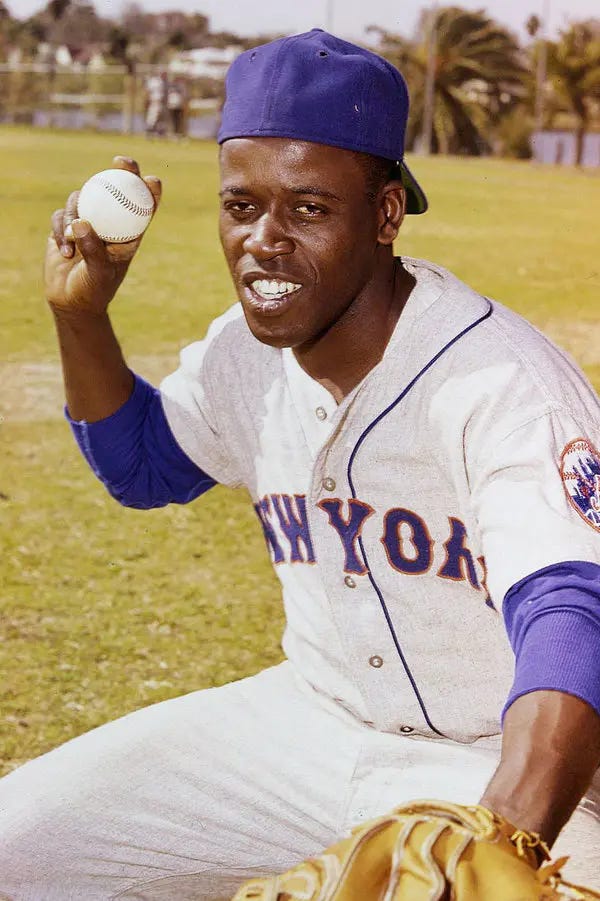
Mets catcher Choo-Choo Coleman was cagey about his nickname for a while, but eventually gave an anticlimactic explanation, saying he got it as a kid, “because I was fast.” Coleman appeared in a few games for the Philadelphia Phillies in 1961 before being selected by the New York Mets in the expansion draft that stocked the team, and he proved to be a great fit for the 1962 Amazin’s. His manager, Casey Stengel, remarked that he’d never seen a catcher as fast at retrieving passed balls as Clarence Coleman. Along with “Marvelous Marv” Throneberry, Coleman became an early standard-bearer for a team of beloved misfits, adored in New York for the simple and inarguable fact that the Mets were better than nothing.
D: 101 names
Hall-of-Famers: Dizzy Dean, Don Drysdale
Runners-up: Dell Darling, Daisy Davis, Dick Drago
Winner:
Long before Dizzy and Daffy3, there was Dory. After the famous first professional team, the Red Stockings, left Cincinnati in 1870, six years passed before a new team, the Reds, stepped in to fill the breach. Dory Dean, an accomplished amateur pitcher in the area, became that club’s second pitcher, and then the club’s only pitcher when the first guy was released.
His stuff was hit hard in professional play, so Dean came up with a new delivery, “facing second base with the ball in hand, and then turning quickly, letting it come in the general direction of the stand, without any idea of where it really was going to land.” This novel approach didn’t do much to change his fortunes: He went 4-26 on a team that went 9-56, a record that led a reporter to remind the Reds’ bumbling owner that people paying to see major-league games expected to see actual major leaguers play. For all his innovative pluck, Dory Dean was not one of these.
E: 15 names
Plenty of potential wasted here, and it’s a shame.
Winner: Eddie Eayrs
I assume this surname is pronounced “Ay-ers,” but just in case it’s pronounced like “Ears,” Eddie gets the win.
F: 29 names
Hall-of-Famer: Frankie Frisch
Runners-up: Frank Fleet4, Frank Funk
Winner: Ferris Fain
Ferris Fain was one of the best hitters of the late 1940s and 1950s. He overcame poverty and abuse to find success, but his struggles left him quick to anger and ready to fight. Philadelphia reporters made Fain an easy winner in this category, dubbing him “Furious Ferris,” “Fearless Ferris,” and the Firebrand.” One less alliterative writer observed that Fain took any defeat as a personal insult, calling him “the Angry Champion.”
Fain retired to a hilly farm near California’s Sierra Nevadas, but his exploits made news again in 1985, when he was arrested for growing marijuana. He was still at it three years later when authorities discovered an industrial-scale growing operation in his barn, making this a full-on Breaking Bad-type situation. Fain, age 67, did 18 months for his crimes, but Fiery Ferris did not do remorse:
I grew them because, damn it, I was good at growing things, just like I was good at hitting a baseball.
G: 78 names
Hall-of-Famer: Goose Goslin. I know some might say Goose Gossage should also be here, but I’m a rule-follower and on Baseball Reference that player is listed as “Rich Gossage,” so he’s out.
Runners-up: Gus Getz, Gary Glover, Gary Gray (middle name George), Gene Green
Winner: Goose Goslin
When Clark Griffith, owner of the Washington Senators, came to see Leon Goslin play in a minor-league game in 1921, the left fielder was clearly a work in progress. One fly ball reportedly hit Goslin on the head that day, and another just missed. In that same game, however, he hit three home runs, and that was good enough for Griffith to make him a Senator.
Goslin’s defensive growing pains continued in the major leagues, where amused teammates watched him track fly balls waving his arms like he was trying to take off. A clever Washington writer played that off his last name, dubbing him “Goose,” a name which stuck even as the hits kept coming. That once-pejorative nickname is now on his plaque in the Hall of Fame, listed alongside many offensive accomplishments.
No defensive accomplishments are mentioned.
H: 72 names
Hall-of-Famers: Harry Heilmann, Harry Hooper
Runners-up: Harvey Haddix, Heath Hembree
Winner: Hinkey Haines (and Hunky Hines)
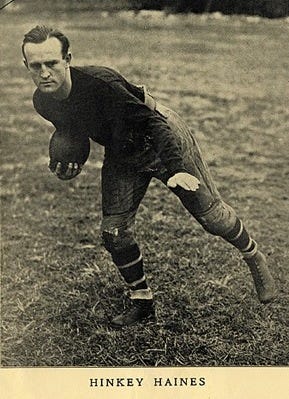
Surely every New Yorker knows all about Henry “Hinkey” Haines, the only athlete to ever win a World Series ring (with the 1923 New York Yankees) and a National Football League championship (with the 1927 New York Football Giants—over the New York Football Yankees).
Haines, a superb athlete, played a reserve role on the first Yankees team to ever win a championship, in their first season at Yankee Stadium. But on a team loaded with bats, his never broke through. In football, however, he shined, earning accolades for his for cunning on the field and the golden hands that made him a talented wide receiver who helped the Giants to their best-record victory in 1927, beating out the football Yankees, led by Red Grange.
And there’s more—so much more. Haines once participated in a stunt catch, receiving a pass thrown 324 feet down from the top of a newly built 24-story New York skyscraper. Oh, and there’s the story about the time Haines snuck his pal Babe Ruth into a Giants practice to participate as a tackle, his identity known only to Haines and the coach. Ruth retired from football after two plays. The name is the least interesting part, just a nonsense name someone dropped on him in college that happened to stick.
And that brings us to Henry “Hunkey” Hines, who appeared in three games for the Brooklyn Grooms in 1895. Hines earned his nickname in the minor leagues in 1890, where the local paper described as:
…the only man in the team thus far who boasts a mustache. This hirsute adjunct is dark and heavy, as is his hair—which he wears a la pompadour. His face is rather long, and his eyes dark blue and deep-set.
Two outstanding names, but since Hunky Hines won no championships in any sport and never snuck Babe Ruth into anything, it’s Hinkey Haines by a whisker.
I: 0 names
Baseball has had 83 players whose surname began with the letter I, suggesting some real opportunities were left on the table here. Nobody from that group was ever nicknamed “Ivy” or “Iggy” or “Ike.” What about “Ice Box?” Anybody?
Winner: Bert Inks
Albert Inks pitched in the 1890s. “Inky” Inks was right there for the taking but nobody made a move!
J: 115 names
Hall-of-Famer: Judy Johnson
Runners-up: Jelly Jackson, Janson Junk, Joe Just
Winner: Judy Johnson
In the years after World War I, William Julius Johnson, who would become the best third baseman in the history of the Negro Leagues and an essential figure in both preserving the history of Black Baseball and recognizing the greatness of the men who played it, came to Philadelphia to join the Hilldale club. His new teammates decided he bore a resemblance to an in-and-out teammate of theirs named Judy Gans.
When Johnson arrived, Gans was gone, and the other Hilldale players decided to maintain their status quo: “They said I looked so much like him they called me Judy, too.”
Gans was a solid player, but the new Judy would prove to be something else entirely.
K: 35 names
Hall-of-Famer: King Kelly
Runners-up: Katsy Keifer
Winner: Kenny Kelly
The obvious winner here is Mike “King” Kelly, the “$10,000 Beauty,” baseball’s first crossover star, a central figure in the game’s early professional history and the only major-league player with a firm grip on that royal title. But I’m giving the win to Kenny Kelly, an early 2000s outfield prospect who appeared in a handful of major-league games, so I can share the picture used to represent him on his otherwise carefully detailed Wikipedia page. This is easily the worst identifier image I have ever seen:

Kenny Kelly was a two-way baseball/football talent in college. He was drafted by the Tampa Bay Devil Rays in 1997 for $450,000 and later signed a four-year, $2.7 million dollar contract that secured his full commitment to baseball. That’s over $3.1 million for -0.1 WAR and 14 major-league at-bats.
Back in 1886, Mike Kelly was sold from Chicago to Boston for $10,000, a historic sum at the time, even for a player who accumulated 46 WAR in his career. $10,000 in 1886 is significantly less money than $450,000 in 1997. Looking at it that way, I think we can all appreciate who the real king is.
Know a great alliterative name that didn’t make our list? Represent your guy in the comments (A-L only, please; M-Z stans, hold your fire for one more week).
L: 42 names
Runners-up: Lerrin LaGrow, Lyn Lary, Lou Limmer, Lep Long
Winner: Leonidas Lee
Leonidas Phyrrus Lee pitched in four games for the St. Louis Brown Stockings in 1877. Named after two famed generals of Greek antiquity, he was a slam-dunk winner here…until we read somewhere that his original last name was “Funkhouser.”
Disqualified!
…which is not to say “Leonidas Funkhouser” isn’t a great name in non-alliterative competition. I bet he and Boots Poffenberger would have been friends.

If you enjoyed this baseball story and want to support Project 3.18, consider becoming a paid subscriber.
You can also really help us by sharing this feature on socials or restacking it here on Substack. Publishing a story is how we get on base; please help spread the word and drive us home.
Here’s the star- and scrub-studded second half, starting with M. And when the winner is NOT Mickey Mantle or Minnie Minoso, you know it’s a loaded category.

In a newsletter all about names, I’m happy to report that Kekionga means “blackberry patch” in the language of the Miami people indigenous to the Ft. Wayne region.
Charles Comiskey might not count as alliterative since the beginning consonant sounds are different, despite using the same first letter. Since Choo-Choo Coleman’s given name was Clarence, his place at the top is safe.
Some versions of Abbott and Costello’s immortal “Who’s on First?” routine used Dizzy and Daffy Dean’s unusual nicknames to segue into the bit, even adding a third Dean whose name is pronounced “Gou-fay”—a French cousin of the two American pitchers.
“Goufay? How do you spell that?”
“G-O-O-F-Y, of course.”
Frank Fleet was an alliterative OG, right up there with Art Allison—and “Fleet” beats “Allison” in head-to-head competition. Fleet, a pitcher/infielder, played for a museum of National Association teams between 1871 and 1875: the New York Mutuals, the Brooklyn Eckfords, the Elizabeth Resolutes, the Brooklyn Atlantics, and the St. Louis Brown Stockings. We seem to know almost nothing about him, but he played every position (not surprising for the era) and was once included in a list of New York’s more notorious baseball rogues. I’m hoping he was fleet of foot, at least.
I’m adopting the Goose Goslin strategy, Paul - promote the thing I do well and ignore the thing I don’t do well - maybe it’ll get me into the Hall of Fame.
Leonidas Lee Funkhouser… I know Larry David loves sports - just wondering if he stole Leon’s name for Curb.
Nah, I doubt it but I do find those early years of baseball names rather interesting although in one Seinfeld George picked the name “7” for a baby. You don’t find any of those good wholesome names anymore but yesterday I learned the Kardashians have a kid named Northwest… good to know in case you’re out camping & get lost.
Do they call her NW for short?
Does she have any cousins named Southeast?
And BTW Paul… I once tried finding a girl’s number by going through the phone book like you read 18,000 names. At least YOU had success in your endeavors.
TY for the mention @Yankee Stadium, appreciate it.