


Welcome to Project 3.18, where a fan-first writer tells strange and surprising stories from baseball history and culture.
If you enjoy what you read today, please subscribe to receive our free feature stories in your inbox. And if you’ve been here for a while, we could really use your support as a paid subscriber. Paid subscribers receive access to exclusive content and help keep this publication going and growing.
In early August 1999, Todd Greene, a reserve catcher with the Anaheim Angels, requested a new locker assignment, and made no bones about it.
“Are you kidding? That locker has caused two Hall-of-Fame-type guys to get released and a guy to hit .230 and get demoted.” Keeping one’s unmentionables in a cubby like that was pure folly.
Greene knew his history. The locker’s 1997 occupant had been 41-year-old Eddie Murray, who began the 20th and final season of his career with Anaheim but was released in midseason. In 1998, the Angels signed Cecil Fielder. Certainly not a “Hall-of-Fame-type,” as Greene declared, Fielder was a Hall-of-Pretty-Good-type, and the Angels hoped he’d fill the role Murray could not, so much so that they gave him the same locker. Unfortunately, Fielder followed Murray’s course in Anaheim so closely that it ended the same way, cleaning out the same clubhouse shelves.
The locker’s third casualty was Greene. He’d been sent down to AAA Edmonton on July 7 and recalled on July 30. Returning to the Angels, he was taking no chances. The day he changed lockers, Greene had two hits and scored two runs, reinforcing his suspicions. He spent the rest of the season safely in the majors, and, looking at his numbers, it’s hard not to give the locker change the credit.
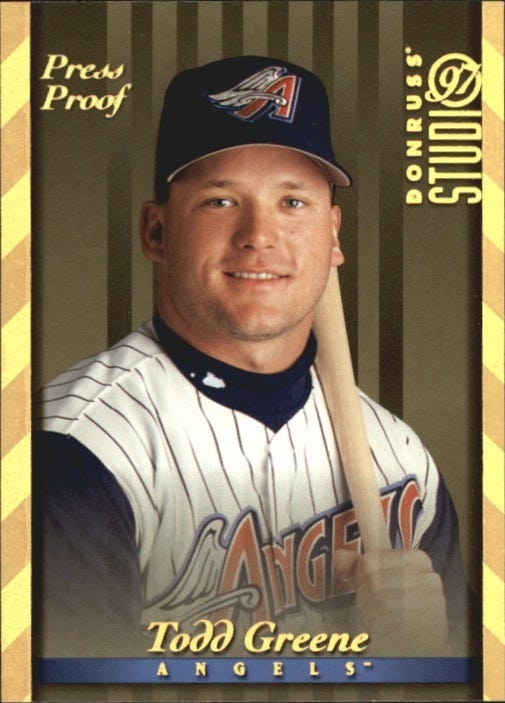
Greene’s request, and the motivation behind it, surely surprised no one. Baseball players are superstitious by nature. The more desperate they are, the more magical their thinking becomes.
1999 was not a great season for Todd Greene, wherever he hung his hat, and it was a pretty bad year for the Anaheim Angels, too. After promising seasons in 1997 and 1998, the team had fallen back into the cellar of the American League West. By August 4, Anaheim was 19.5 games out of first place.
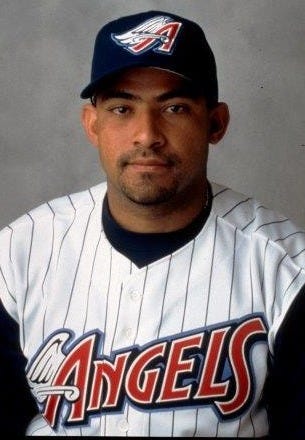
The Angels had put up some gaudy numbers to be that bad. The team had lost 16 of their last 18 games, powered by an 11-game losing streak, and had already lost the series with the Kansas City Royals going into the final game. These Angels could not hit. They had been shut out seven times, including twice in their most recent four games. More often than not they were held to three or fewer runs. The team was last in the American League in runs scored and second-to-last in team batting average and home runs. If there had once been ethereal entities boosting fly balls into home runs, they seem to have departed when Disney bought the team and redesigned the uniforms—modeled by players throughout this story—which were a blasphemy of mid-90s design excess.
There were injuries, too. First baseman Mo Vaughn signed a six-year, $80-million-dollar contract with the Angels, the biggest contract in baseball, and on his first play in the first game of the 1999 season he tripped on the dugout steps at Edison Field chasing a pop foul and badly sprained his ankle. In early August, Vaughn had just returned when he came down with a fever that was traced back to a staph infection in the ankle.
Right fielder Tim Salmon sprained his wrist. When he returned, the Angels were swept by the first-place Texas Rangers. Shortstop Gary DiSarcina broke a bone in his forearm. When he made it back, the Rangers were waiting, and Anaheim was swept again. At least Texas wasn’t on the schedule when the Angels recovered one of their most important players. Center fielder Jim Edmonds had missed two months after shoulder surgery. He was cleared to resume batting on August 2 and rejoined the team as its designated hitter. Edmonds’ much anticipated debut came and went quickly: He grounded out on the first pitch he saw. The Angels lost, 12-4.
“Everybody thinks we’re going to be great because Jim Edmonds is in the lineup,” manager Terry Collins said. ”It’s going to take him time. It’s not easy to play the game at this level. If there’s one guy who can make it look easy, it’s Jim Edmonds. But it’s not easy.”
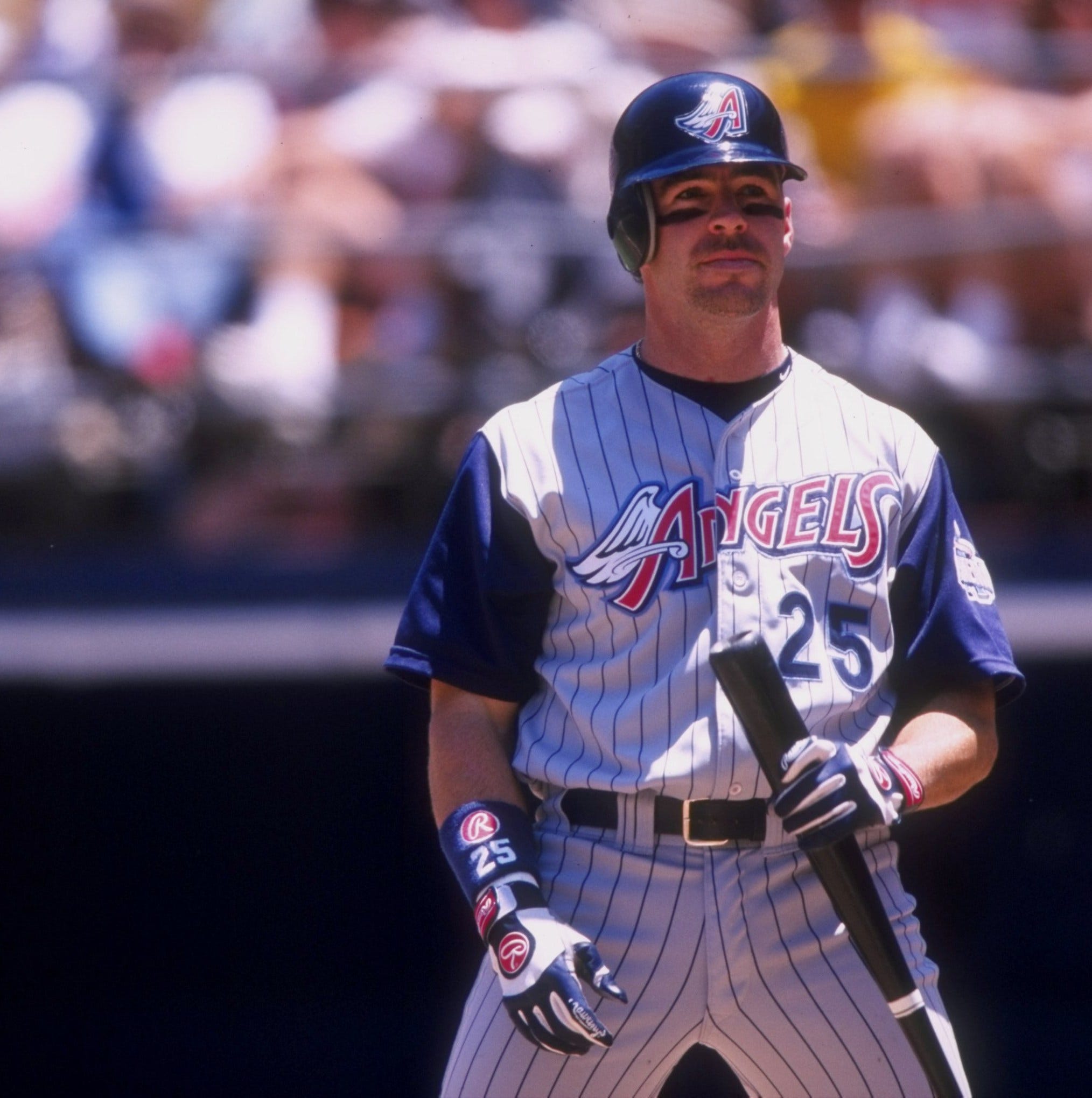
The last-place Angels went full-”build for the future” and called up a promising rookie catcher named Bengie Molina (so new that his manager called him “Ben”). Molina was given the start on August 4, his first appearance of the year for the Angels and just his third game overall.
He was stepping into a weird clubhouse. The Angels’ hitters were struggling and anxious. Quality at-bats petered out and the players went to and from the dugout as if on rails, with only a brief wait in the on-deck circle to break it up. Frustrated teammates had begun sniping at each other in the press. Something had to be done, and everything serious had already been tried.
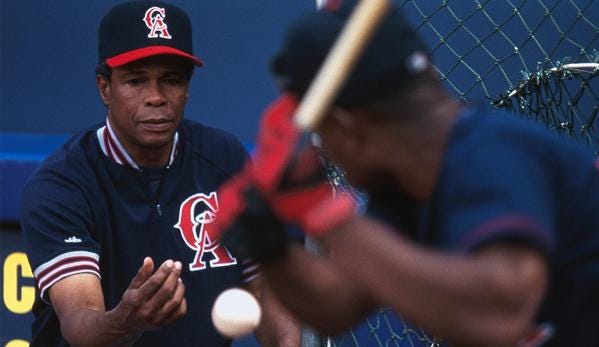
The unserious idea came from Rod Carew. Carew, 54, was in his seventh year as the Angels’ hitting coach. Hall-of-Famers don’t always make good teachers, but Carew had made the transition, described as a “guru” to Angels hitters including Garret Anderson, Salmon, and Edmonds. Seeing his disciples floundering, Carew came up with something new. So new it had never been done before in the history of major league baseball.
Terry Collins learned of the plan only after it was in motion. Before the series finale against the Royals, as the Angels tried to avoid a sweep, Collins overheard the players deliberating.
“I heard somebody say, ‘Can we use one with the tape on it, so I can have a grip?’ I didn’t know what the heck they were talking about.” The manager went over to investigate. “Somebody told me the first time through the lineup they were all going to use the same bat.”
“It was something the hitters talked about last night,” Carew said at the time. “You’ve got to try and change something.” The club needed loosening up, so why not make batting a team effort again, hearkening back to humbler times when nobody got a bat with their name on it.
“We said, ‘Let’s go back to Little League and see what happens,’” second baseman Jeff Huson said. “Just like Little League. If you strike out, just hand it off to the next guy.”
The players were game, but agreeing on the specific bat (To tape, or not to tape… That is the question…) nearly derailed the experiment, until the respected Carew broke the stalemate.
“[The bat] was random,” he told the Hall of Fame in 2016. “I just pulled it out of the bat rack and said, ‘OK guys, we are going to use this bat through the lineup.’ All of the guys were satisfied with the way it felt.”
The chosen bat belonged to Jim Edmonds. It was a black Louisville Slugger 34-32 C271, in the Goldilocks zone for all nine hitters. Or at least eight of them. Rookie Bengie Molina probably didn’t get much of a say. He was going to make his first start of the year with somebody else’s bat.
Collins was read into the plan and gave it his blessing. “All I said was, ‘Well, there better be some hits in that bat.’”
In true 1999 Angels fashion, the plan nearly fell apart immediately. The bat was in leadoff hitter Orlando Palmeiro’s hands when he looked at a called strike three and was rung up by umpire Tim Tschida. In his annoyance, Palmeiro apparently forgot the plan. Instead of handing the bat to number-two hitter Gary DiSarcina, waiting on deck, Palmeiro simply dropped it at home plate, and Tschida didn’t like that at all. Taking the bat-drop as a sign of disrespect, the umpire ejected Palmeiro on the spot.
Palmeiro was stunned. “What are you talking about? Why did you throw me out?”
The outfielder’s teammates and Collins quickly rushed to his defense. DiSarcina explained the arrangement. “I said, ‘Tim, I’m going to use that bat. The whole team is using the bat.’”
The shortstop said this explanation drew “a few expletives” from Tschida, who muttered, “I thought I’d seen it all in this game.”
In the end, the umpire was persuaded of the misunderstanding. DiSarcina recalled him saying, “Well, I’m going to have to do something that I’ve never done before and throw a player back into the game because there’s no reason to throw him out.” Tschida walked away, shaking his head.
“He un-ejected him,” Huson said. “First time I’ve ever seen that. He just waved it off like an inadvertent flag.”
Overhearing the conversation, Chad Kreuter, the Royals’ catcher, was having a hard time keeping up. “He was like, ‘What do you mean you guys are using the same bat?’” DiSarcina said. “He kept asking me, so I finally said, ‘Are you deaf? Yeah, we’re all using the same bat.’”
In permitting Orlando Palmeiro to stay in the game after ejecting him, Tim Tschida contributed his own “first” to the day’s ledger. Even Palmeiro knew it:
Once [the umpires] make the decision, they don’t change it. But it was a misunderstanding. I don’t think that’s ever happened before. It may be a first, but I don’t want to be famous for that.


Before any decisions were subject to replay or challenges, umpire “judgement calls” were final. A strike was a strike, a ball was a ball, a player was safe or a player was out, and a player bounced from the game stayed bounced even if the umpire had second thoughts. It had always been that way. The umpire was never wrong, even when he was. This attitude was essential to maintaining the official’s authority over the game and its participants even after making an obvious mistake. The umpires’ unrepentant confidence is so important that umpire schools train their students to never change their minds and avoid body language suggesting they are even considering it. Any official who can’t master that trick won’t even make it out of Little League in one piece.
When it came to ejections, every umpire for more than a hundred years, right or wrong, had stuck to his guns. Until Tim Tschida in 1999. Orlando Palmeiro was the first uniformed player we could find whose ejection had been rescinded. Like it or not, he’d made history.
Facing Royals’ starter Jay Witasick, DiSarcina walked and passed the bat to Garret Anderson. Anderson hit a sharp ground ball that bounced off Witasick’s elbow for a single, suggesting there might indeed be some hits rattling around in the bat.
In the second inning, Chad Kreuter missed an easy pop-out near the first-base dugout for an error, and Darin Erstad used the free swing to hit a single. Jeff Huson singled, and Bengie Molina used the bat to record his first major-league hit, a double that scored a run. Palmeiro, truly living on borrowed time, came up again, and he hit a ball down the left field line that would have dropped harmlessly foul, except Royals left fielder Johnny Damon caught it, allowing Huson to tag and score.
The same lineup that had five hits the day before went 4-for-8 with a walk while sharing Jim Edmonds’ bat. With a lead in place, the others returned to familiar lumber, but Molina opted to carry on. He singled in two more runs in the fourth, chasing Witasick from the game. He singled again in the fifth, to intensifying applause.
“We haven’t had a lot to clap about lately,” Collins said. “We needed something to break the tension.”
“They ended up having fun with it,” Carew said. “Some of them used the same bat twice in the game. They started swinging good and they were happy. Someone said, ‘That one’s for the coach!’ I thought, ‘I’ll take anything that gets us hits.’”
None of the claps or hits went to Jim Edmonds, who was struggling in his return from injury. “I guess we took all the hits out before he got them,” Huson said. That, or his wand had simply chosen another wizard. After the game ended in a 4-3 Angels victory, the outfielder gifted the bat to Molina.
The Angels won again on August 5, thrashing the Boston Red Sox, 8-0. Molina had another two hits and two more RBIs. And after that…the team lost seven straight games. Anaheim was a bad team, and no stunt was going to change that. Anything could happen in a single game, but over the long season, reality usually won out.
But the eternal promise of baseball is that anything might happen, including any number of things you haven’t seen, and maybe something that no one has witnessed. That night featured two remarkable firsts, curiosities that stand out long after most of the 1999 Angels season has been rightly forgotten.
“I’ve never seen a team use one bat before,” Collins said. “But then again, I’ve never seen anyone get thrown out, then get to get back in, either.”
One of the wonderful things about the National Baseball Hall of Fame and Museum is its appreciation that, in a game built of routines, the strange is special, even precious. Hearing that one team had shared a single bat, the museum quickly placed a call to Edison Field in Anaheim, offering to take that bat and put it under glass where it belonged.
“The decision was, should Bengie keep the bat for personal reasons or should he have us all sign it and send it to the Hall of Fame?” DiSarcina recalled in 2016. “Bengie ended up letting the Hall of Fame have it.”
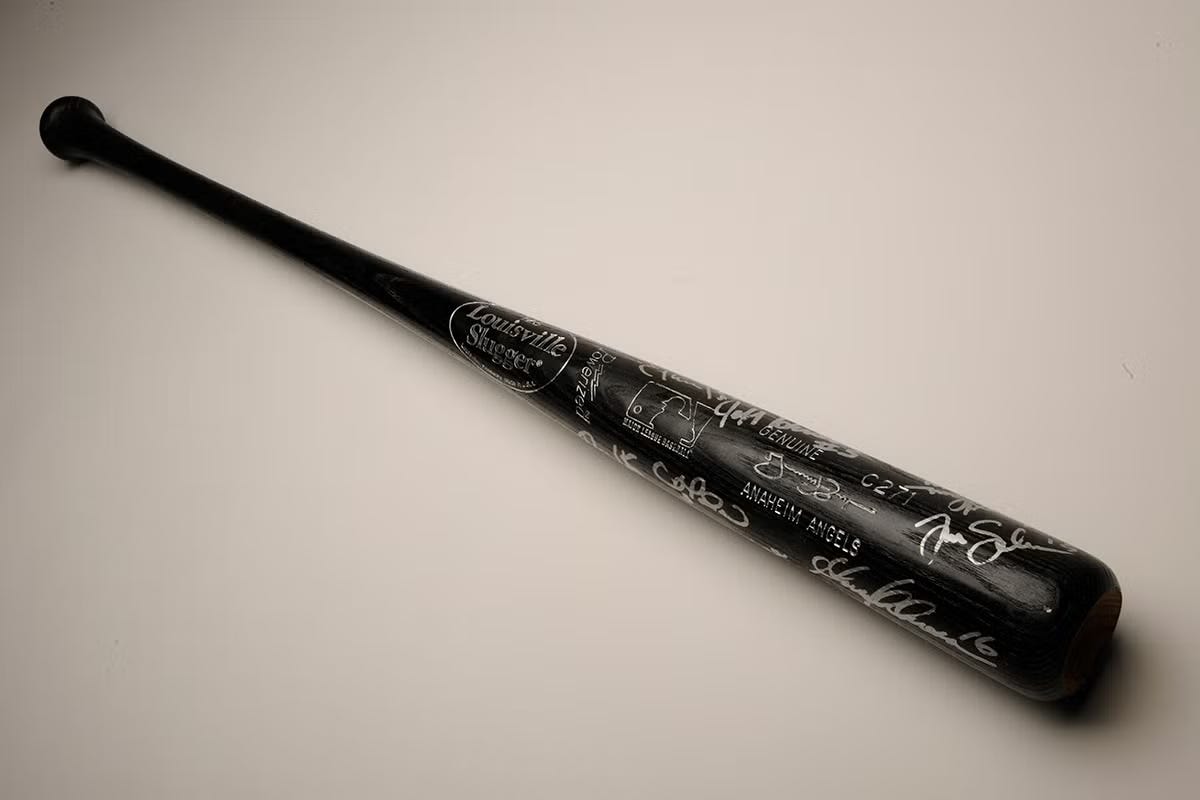
“It was a fun thing,” Rod Carew said. “They had fun. It turned out to be a big deal.” A flight of fancy worthy of Cooperstown, and worth remembering.
Along with the cautionary tale of those late 1990s Angels uniforms. Hideous.

If you enjoyed this baseball story and want to support Project 3.18, consider becoming a paid subscriber.
You can also really help us by sharing this feature on socials or restacking it here on Substack. Publishing a story is how we get on base; please help spread the word and drive us home.
We chose our words carefully in describing Orlando Palmeiro’s brush with history. He was absolutely the first person in uniform to be ejected and returned to action, but he was not the first banished party to be allowed back on the field. That honor goes to Youppi!, mascot for the Montreal Expos, and when he made that history, he was wearing his pajamas.
As we are quickly approaching the 37th anniversary of Youppi’s landmark accomplishment, let’s give that story the Project 3.18 treatment next week.
On August 17: “The Mascot Wars”
Over on Clear the Field
Continuing an inadvertent “flapping” motif, Ted and I have officially entered the “all-video” era of our baseball storytelling podcast, and we kicked things off with a look back at Dave Winfield’s 1983 close encounter with a ring-billed gull.

The listen-only options are still there (and I don’t blame you) but for those who’d like to watch, enjoy some choice images (and perhaps some video snippets in the future), we’re here for you. And we’re also on YouTube.
Wherever you watch or listen, if you enjoy the show, please follow us and take a second to leave a rating. We need our angels, too!
Maybe the Angels should have considered putting Carew in the lineup - that dude could hit.
Love the story. Just goes to prove how superstitious players are. The team should be glad they decided on the bat ritual rather than wearing the same socks for a month.
PS - I like the uniforms!
Then again what do I know about fashion?