


Welcome to Project 3.18, where a fan-first writer tells strange and surprising stories from baseball history and culture.
If you enjoy what you read today, please subscribe to receive our free feature stories in your inbox. And if you’ve been here for a while, we could really use your support as a paid subscriber. Paid subscribers receive access to exclusive content and help keep this publication going and growing.
Let’s start with a picture. It’s pretty famous:
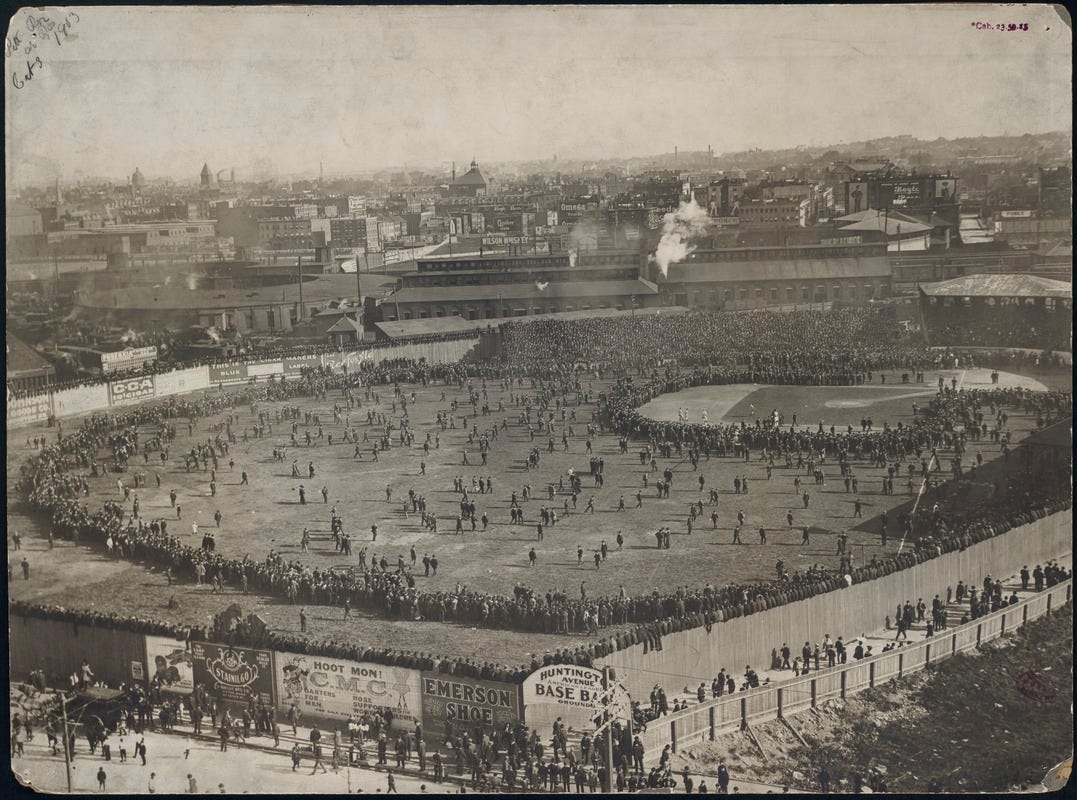
That is Boston’s Huntington Avenue Baseball Grounds on October 3, 1903, an hour before the third game of the best-of-nine “World’s Championship Series.” The first incarnation of what became the World Series featured the Boston Americans (don’t call them “Red Sox” until 1908) and the Pittsburg Pirates (don’t use the silent “h”, at least not between 1891 and 1911).
The picture first appeared on October 5 in an edition of the Boston Globe. The photographer’s identity is unknown—an accompanying caption identifies him only as “a Globe man.” Credit Mr. Globe for hauling his camera equipment up somewhere where he could capture one of the most enduring images of turn-of-the-century baseball.
The story of the first World Series is a challenge for a modest weekly newsletter. It’s a book-length subject, and those books are out there to enjoy. This is also some pretty crunchy history, even for us. The newsprint is tiny, the language is archaic, and the sportswriters cite Chaucer and Virgil more often than they quote the players. There are a few recognizable landmarks: Honus Wagner, Cy Young, “Tessie,” maybe, but for the most part this history is so far away it risks feeling like homework. (We can’t help but notice it gets little quieter around here when we do old-time stuff.)
We still do the older stories because—consider it—you just looked at a picture from 1903 and instantly understood its subject: an important baseball game. Not only that, you can probably directly connect with this picture from the distant past because you’ve participated in the same activity, though hopefully you stayed in or around your assigned seat…
Baseball is such a powerful cultural time machine that we can go 123 years back and still keep our bearings. As a result, that’s a trip worth taking, and today we’re going to highlight a few Project 3.18-worthy selections from the story of the first World Series—including what’s going on in that famous picture.
The first World Series was arranged by the teams, not the leagues.
The plan for the first “world’s championship series” formed in the later months of the 1903 season, the first full season of peace between the formerly feuding National and American Leagues. The Pittsburgh Pirates were the presumptive favorites in the National League, well ahead in the race for the pennant, their third in a row. On a glide-path to a three-peat, the Pirates’ owner, Barney Dreyfuss, challenged the American League club owners: your best versus our best, for an interleague championship that would sit above the pennant flags teams spent all summer trying to capture.
By September, the Boston Americans were the frontrunners in the younger league, and Dreyfuss entered into negotiations with the Americans’ owner, Henry Killilea, on what the series would look like. At one point they considered playing a best-of-eleven format, but settled on a best-of-nine. Wouldn’t want to overdo it.
Dreyfuss was on good terms with the Pirates’ players, and they agreed to extend their season in return for a significant chunk (at least 50%) of the ticket sales from the games, a compensation structure that wasn’t used for intra-league games. Killilea dragged his feet at the idea of cutting the players in, but the Americans heard what the Pirates were getting and they weren’t pushovers. Some of them were finishing up their contracts and had no obligation or reason to keep playing unless it was worth their trouble. Killilea eventually backed down and the Americans received essentially the same deal as the Pirates.
On September 19, the club owners signed a contract to play “a series of nine games for the world’s championship” beginning on October 1. That bulky description was soon whittled down to just “the world’s series.” Nobody seemed to mind or notice that the “world” in this context was really just the northeastern quadrant of the United States (plus St. Louis).
The two participants were seen as evenly matched, but there might have been some doubts or lingering insecurities among Boston fans. A huge, overflow crowd of 16,000 people attended the first game of the series at the Huntington Grounds, requiring the club to put hundreds of people in the outfield, but when the Pirates won, 7-3, Boston seemed to deflate. Attendance for the second game was 9,400, well under the park’s 11,500 seating capacity.
The true believers who came out that day were rewarded when right-handed pitcher Cy Young, age 36, shut out the Pirates to even the series. Young’s victory blew away the cloud of imposter syndrome above Boston’s baseball district and made the third and perhaps final home game into a must-see regional event.
“Reading accounts of far-away ball games in the newspapers is not what the fans crave,” a radically honest Pittsburgh journalist wrote. “They want to see the players in the flesh performing.”
The closer the better.
The most famous picture of the first World Series shows a game on the brink of being canceled.
How many people the Huntington Avenue Baseball Grounds could accommodate depended on who you asked. Boston’s public safety authorities would have probably given a number close to the park’s 11,500 seats, but the team routinely added several thousand more. The land had previously been used to accommodate a whole circus; as a ballpark, the elephantine outfield—530 feet to center and 440 feet to left—created some flexibility. With all that standing room available, fans often formed a de facto outfield perimeter during high-interest games.
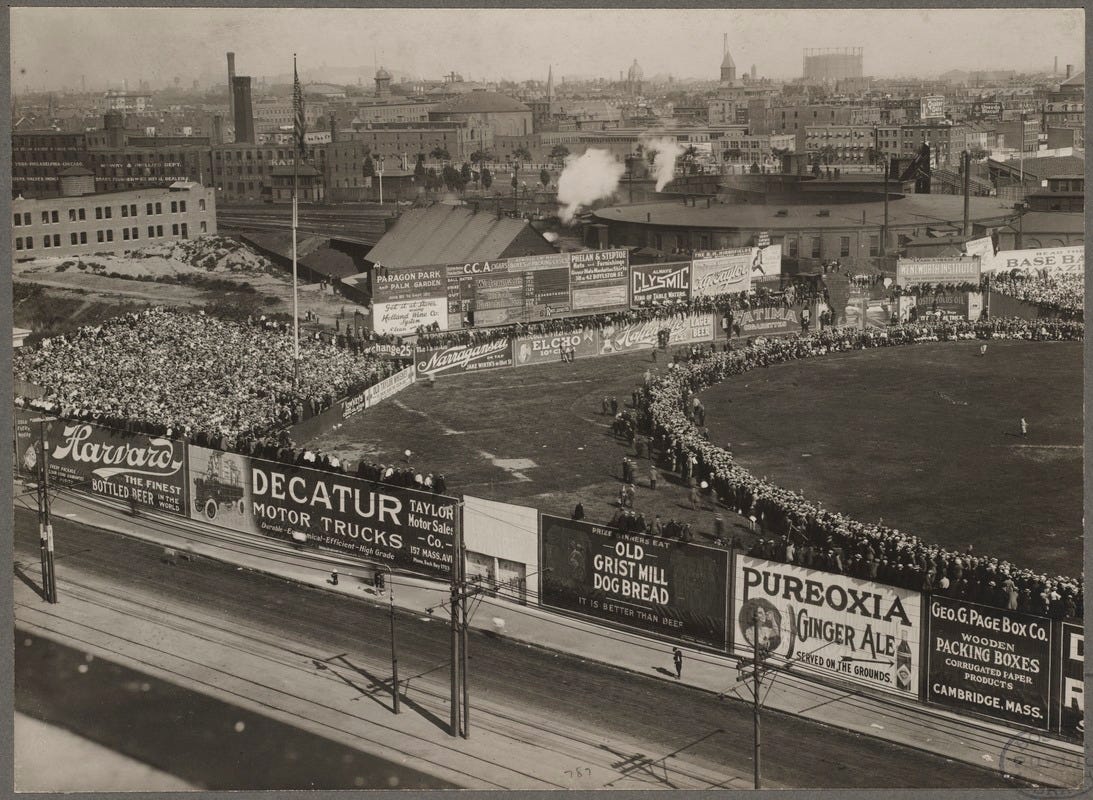
When the park gates opened at noon on October 3, 3,000 people were already waiting, men, boys, “and some few women.” Business was so brisk that the ticket sellers stopped trying to organize the money and just dumped it on the floor. When they sold through the park’s seating capacity, sellers instructed fans to “go way back and stand up,” in other words, watch the game from behind a rope cordon set up deep in the outfield.
The people stuck out there created an opportunity for the kids who sold peanuts and score cards to run their own racket obtaining chairs and boxes for people to stand on for a better view. The best boxes supported three people and cost $1 per person, which was more than the club charged for a standing-room ticket.
“All the time the tide of humanity was flowing in,” the Boston Globe recounted. “In some places it was steady and smooth, but in others there were signs of quick water and tide rips. Over-anxious people pushed and elbowed and fumed and grew red in the face because they couldn’t move faster.” There were still thousands of people trying to get in, but soon the ticket booths were closed and even the scalpers sold out.
By 1:45 the crowd behind the outfield rope was a dozen deep from one foul line to the other. We’ve often written about the wishful thinking that was crowd control in the early 20th century, and here again, the Americans seemed to think their outfield rope was imbued with magical powers.
When the players came out onto the field for a “limbering-up throw-around,” a few men from the standing crowd ducked under the rope and jogged toward the infield to get a closer look at their heroes. The club had 50 police officers inside the park (up from 35 the day before) to help manage the crowd, and some of these officers moved to push the intruders back. Seeing uniformed police ruining a good time sparked a rebellion in the outfield:
Now they came in dozens, scores, half-hundreds, and great masses. The comfortably seated fans shouted encouragement, jeered the police, who were up against a hopeless task, and laughed and cheered every time an officer made a rush to keep more from coming.
Soon, thousands had flocked from all fields and covered everything except the pitchers box and a small area around home plate. The players were crowded out of practice room.
Seeing so many fans out of place, Mr. Globe grabbed his camera and found a high place from which to capture the rowdy tableau for posterity.
The more athletic and determined people stuck outside the park took advantage of the chaos inside and began scaling the high wooden fences. Some perched along the fence-tops only to be pushed inward by people coming up behind them. At least 1,000 people got in over the top.
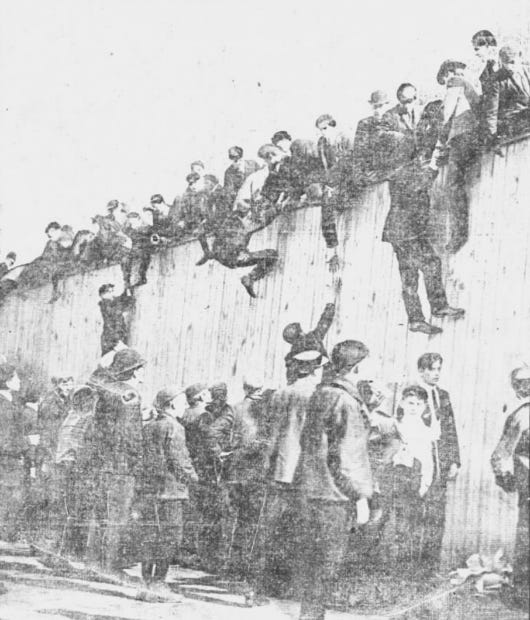
And a few more under the bottom, perhaps:
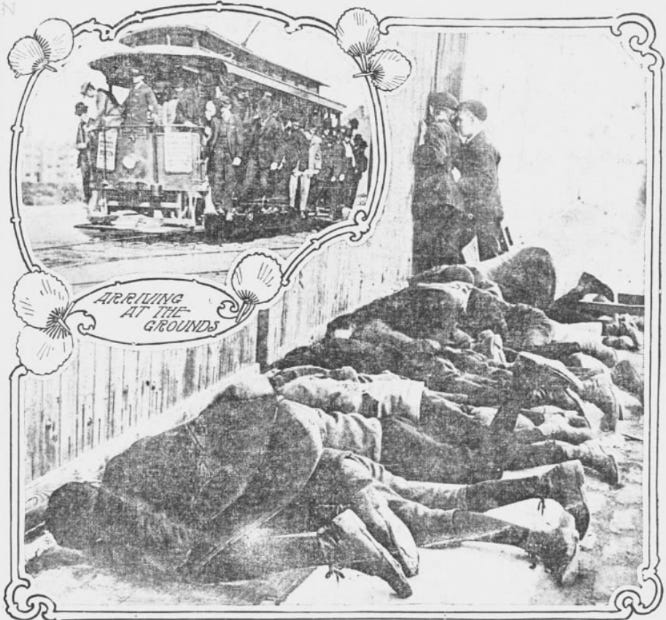
The team later claimed that 18,000-19,000 people were inside the park on October 3, but knowledgeable observers declared this was a gross undercount, likely an attempt to keep the heat off the team for admitting far too many people and losing control of the situation. The real number was closer to 25,000 fans, more than double the seating capacity of the park.
As the 3:00 start time neared, some of the fans ringing the infield tried to shove their way into the grandstand or stand just in front of it, blocking the views of those seated in the front rows. This behavior led to “sundry punches and several severe tumbles.”
It looked for a while as though it would be impossible to start the game. The crowd was right back of the plate, about three feet from first base. There was no chance for the players of either team to get to their benches.
The task of preventing a forfeit during the first World Series fell to Joseph Smart, the Americans’ business manager. Smart ordered the park’s groundskeeper to get a hose and point it at the crowds to try and force them back, but somebody retaliated by cutting the hose line. Smart showed the instincts of a battlefield commander, directing the police officers to take the broken hose and use it as a moving cordon to push groups of people back towards the outfield. The Boston Globe got a picture of this, too:
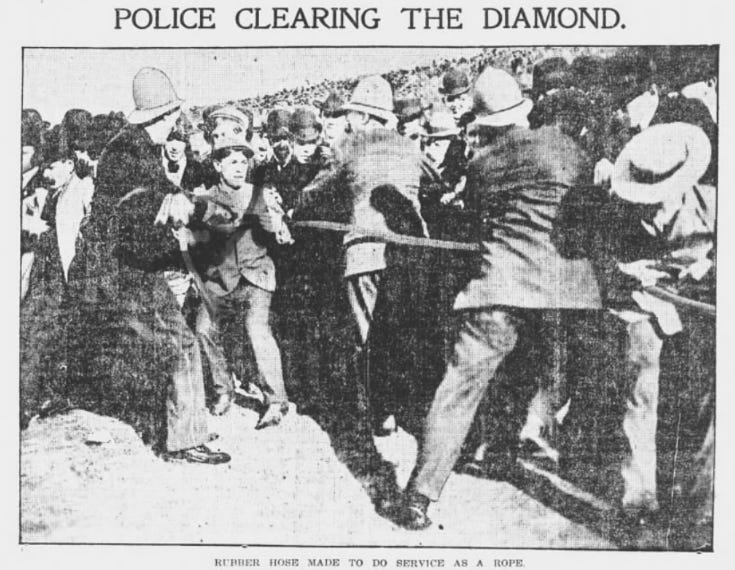
When fans didn’t seem intimidated by the officers’ short clubs, Smart distributed baseball bats for them to brandish instead. “Bats were used to tap people on the toes and swat them on the shins,” and several unruly young men “were made to see stars which no astronomer has yet mapped.” Smart reportedly kept one bat and wielded it himself.
The grandstand invasion was the afternoon’s truly dangerous moment, forcing even some of the Boston players to lend a hand. When two women were caught up in the pressing crowd and nearly crushed, outfielder Chick Stahl and a police officer helped them get to the safety of the dugout until order had been restored.
It took about 20 minutes of “hard work” and the arrival of 100 additional police officers to push the crowd “inch by inch” back into the outfield. You could analyze this scene like an 18th-century battlefield. The police worked the center while both teams formed lines, holding bats horizontally in front of them, and put pressure on the flanks. Major General Smart won the field back, but the rope line was destroyed and the crowds stayed much closer, just 50 yards behind the infield dirt.
Those territorial gains ended up deciding the game. The Pirates won on the strength of five doubles, and four of them were of the ground-rule variety, hit into the human wall that prevented Boston defenders from making what would have otherwise been routine catches.
Many in the crowd complained about the Pirates’ cheap hits, but a Pittsburgh loyalist shouted, “Fair for one as for the other,” but even that wasn’t true. After several early Pittsburgh “doubles,” the police surged into the outfield to push the crowd further back, allowing the Pirates’ outfielders more room to catch subsequent fly balls. Meanwhile, the Americans could not catch a break: In the second inning, Boston first baseman George LaChance (nickname: “Candy”1) hit what would have been an inside-the-park home run, but it only counted as a ground-rule double because of the crowd.
Chick Stahl said, “If it hadn’t been for the crowd and we had played on a clear field,” the Americans would have triumphed. One writer gamed this scenario out and figured Boston would have won by a score of 3-1. Instead they lost, 4-2.
Down two games to one in the series and departing for the ominous “City of Smoke,” things did not look good for the boys from the “City of Culture,” but a Boston writer reminded his audience that luck was no one’s loyal friend:
Luck seldom breaks even; it will follow one club for a while and then flirt with the next-door neighbor, ready to change its abode at any moment.
Pittsburgh started pitcher Deacon Phillippe five times in eight games.
Baseball players battled injuries back then, just as they do today, but the aches and pains of the Pirates’ pitching staff had a period-specific patina. Sam Leever, one of the Pirates’ co-aces, exacerbated an arm injury while trap-shooting, limiting his availability in the Series. In an even more Victorian bit of misfortune, 16-game winner Ed Doheny was declared insane and confined to an asylum in September.
These losses made right-handed Deacon Phillippe the Pirates’ only preferred starting pitcher. Phillippe held Boston to three runs (two earned) in the opener on October 1 and came back two days later to pitch another complete game while his teammates lofted balls over the human wall. Hailed as “Steady Man,” Phillippe was quoted in a Pittsburgh paper after Game Three and he was hyped:
I feel just as good now as I did before the game. My superb physical condition surprises even myself. I never felt better in my life. I could pitch again tomorrow. It was easy today. I never even thought of getting tired. If [player-manager Fred Clarke] will let me, I’ll pitch two more games of the series, and I should win them both. It’s easy money.
Phillippe was named the starter for Game Four, the first on the Pittsburgh leg, and bad weather allowed him an extra day of rest before he went out and pitched another complete game at Exposition Park. In recognition of his contributions, the team gave him a “diamond stick-pin” that day, and Barney Dreyfuss threw in a few shares of stock in the club.
And while he was certainly steady, Phillippe wasn’t invincible, and Boston’s three-run inning near the end of his Game Four start was a warning the Pirates did not or could not heed.
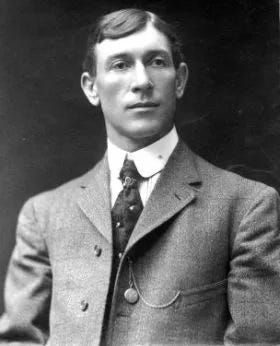
In Game Seven on October 10, Boston finally got to Phillippe, scoring seven times. The Pirates went back to the Steady Man for a must-win Game Eight in Boston on October 13. Despite being completely cooked, the pitcher held the Americans to three runs but lost when Bill Dinneen threw a complete-game shutout and won the first World’s Championship for Boston.
“Tessie” really did help the Americans win the first World Series.
Boston had some of the game’s first superfans, the “Royal Rooters,” an organization made up of mainly men and boys who congregated at the Third Base Saloon, one of America’s first sports bars. The saloon was owned by Michael McGreevy, dubbed “Nuf Ced” for the stock line he used to end baseball-related barroom debates he felt had run their course. The Rooters were famous for their cheering, their singing, and their commitment to attending every home game. There’s no question that these were some of baseball’s most enthusiastic fans, but many Royal Rooters, betting (heavily) on the World’s Series games, were invested in more ways than one.
When the series moved to Pittsburgh, a large contingent of Rooters went with it, riding on the same train as the team and boarding at the same station as some of the players. In the spirit of comity, Pittsburgh’s fan organization arranged a special section for their Boston guests, who showed up at Exposition Park accompanied by a full band and paraded on the field before the game.
The Pirates won Game Four, building a 3-games-to-1 lead over Boston. During the fifth game, the band and the Boston fans cycled through every peppy tune they could think of to try and stir the Americans’ blood. When their team took a six-run lead in the sixth inning, the band was playing “Tessie,” an artifact from a short-lived Broadway musical, The Silver Slipper. The song’s lyrics made it sound like it might be between two sweethearts, but in the play a woman sang it to her pet parakeet.
Pirates infielder Tommy Leach remembered the song as “a real humdinger,” at least until the Royal Rooters turned it into a tool of psychological warfare:
I think those Boston fans actually won that Series for the Red Sox. We beat them three out for the first four games, and then they started singing that damn “Tessie” song, the Red Sox fans did.
In the fifth game of the Series, the Royal Rooters started singing “Tessie” for no particular reason at all, and the Red Sox won. They must have figured it was a good-luck charm, because from then on you could hardly play ball they were singing “Tessie” so damn loud.
A news story on the series’ seventh game (the last one in Pittsburgh) confirms Leach’s recollection:
The Boston rooters marched on the field behind their band, which played “Tessie” and “Tessie” only. It was to the strains of “Tessie” that the first game was won by Boston and since that time the Boston rooters have not allowed the band to play anything else.
They sang it so much they could invent new lyrics and deliver melodious trash-talk on the fly, as they did when Boston beat Pittsburgh’s fourth-choice pitcher, Brickyard Kennedy, on a rare Phillippe rest-day:
Pittsburgh needs a few good pitchers,
Such as Boston’s pennant lifters.
Phillippe you are the only, only, only one.
When the Americans won three straight games to force the Series back to the Huntington Grounds, McGreevy and the other Rooters directors hired a much larger band, the 35-piece Boston Postal Carriers’ Band, to perform “Tessie” during Game Eight and brashly announced that the band had not been retained to perform at a potential Game Nine—there would be no need.
And there wasn’t. Boston won the first world’s championship on October 13, 1903, a victory made possible with clutch pitching, ground-rule doubles, and a song about a bird.



If you enjoyed this baseball history and want to support Project 3.18, consider becoming a paid subscriber.
You can also really help us by sharing this feature on socials or restacking it here on Substack. Publishing a story is how we get on base; please help spread the word and drive us home.
Best obscure baseball names of the first World Series:
Pittsburgh: Ginger Beaumont, Kitty Bransfield, and Brickyard Kennedy.
Boston: Candy LaChance, Hobe Ferris, and Chick Stahl.
The Dropkick Murphy’s version of “Tessie” is kind of a banger. With or without the inserted radio call of Joe Castiglione calling the final out of the 2004 World Series. As a Yankee fan, I rather prefer it without.