


Welcome to Project 3.18, where a fan-first writer tells strange and surprising stories from baseball history and culture.
If you enjoy what you read today, please subscribe to receive our free feature stories in your inbox. And if you’ve been here for a while, we could really use your support as a paid subscriber. Paid subscribers receive access to exclusive content and help keep this publication going and growing.

In 1880, New York’s Polo Grounds hosted its first professional baseball team, the Metropolitans. In 1963, the New York Mets—no relation—were closing the place down.
In September, the Giants, the old ballpark’s former tenants, kicked off the final homestand, followed by the Houston Colt 45s and the Philadelphia Phillies, who would help turn out the lights on September 18. Throughout these final home games, the Mets kept busy trying to distract from the team’s 47-97 record.
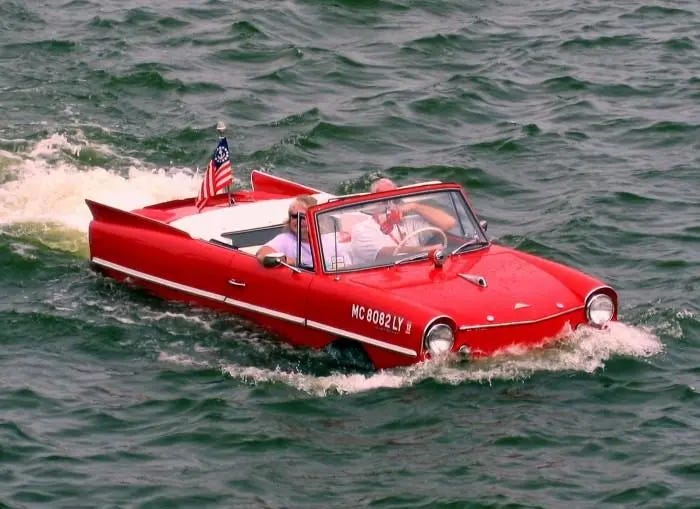
On September 10, the team held a fan contest to determine the “most valuable Met1,” a title obviously awarded on a curve. The winner would receive something called an “Amphicar,” described as “an auto which operates on both land and water”…and we just had to follow up on this:
Next the team honored Duke Snider, the 36-year-old former Dodger who was raging against the dying light of his storied Brooklyn/Los Angeles career in altogether different circumstances. At one point that season Snider had admitted he was having a hard time playing for a team that was eternally five runs behind. “I realize this isn’t the proper attitude to have, but that’s the way I feel. At my age, it’s not easy to generate enthusiasm over lost causes.”
On September 12, the Mets feted him anyway, bringing back nearly all of his retired Brooklyn teammates (plus a telegram from Pee Wee Reese: “Never thought I’d live to see the day when they have a night for you in the Polo Grounds.”)
Among other prizes, the exiled Duke of Flatbush got a 1964 Thunderbird, a color television, and a trip to literally anywhere in the world. His Mets teammates got him a golf cart. The baseball writers gave him a typewriter. Juan Marichal of the Giants gifted Snider two strikeouts on the way to shutting out the the Mets on four hits. “It was a fine night,” Snider said, “until the game started.”
So it often went for the Mets at the old Polo Grounds. The goose egg they laid for Marichal was the start of another terrific run of futility: they were shut out three games in a row, twice by the Giants and once by the Colt .45s2.
That third shutout was the Mets’ 28th of the season, putting them in second place behind the 33 shutouts of the Deadball-era 1905 Giants. They’d make it a race by getting shut out twice more, but in the end the 1963 Mets couldn’t even be historically bad; they were just terrible.
Most fan-bases would have rejected a team like that, but New York’s still-shattered National League fans were still on the rebound in the early 1960s—and willing to forgive pretty much anything.
In 1962, the Mets’ abyssal 40-120 inaugural season scandalized baseball and demonstrated that there were still some kinks of expansion in need of working out. Searching for a workable narrative, commissioner Ford Frick, a former newspaperman, said the Mets served to “illustrate the frailties of humankind.”
That was good enough for New Yorkers, who embraced their below-replacement players with religious fervor. The more inept the performance, the louder the cheers. Such fervent, unconditional love was new in baseball, and Mets fans were dubbed “the New Breed.” In their unique fandom, people didn’t root for the team’s success as much as they rooted, ardently, for their continued existence, and every day the Mets showed up for work was a thrill.
It was a thrill for some of the Mets’ players, too. If not for the league’s expansion from eight to 10 teams, many of them surely would not have had major-league jobs, and they knew it. Asked what was great about being a Met in 1963, one rookie, Larry Bearnath, answered earnestly: “There are so many positions open here.”
If anything, the fans seemed to love the Mets even more after their appalling first season. In the summer of 1963, a stumped Washington Post writer sought out Dr. Wladimir Eliasberg, an accomplished New York psychiatrist, seeking to understand how grown men and women could celebrate a team as bad as the Mets with such passion.
“It is mass suggestion,” Dr. Eliasberg explained.
It is as contagious as a disease. When a group stands up and yells wildly—as the Mets fans do—no one dares not to follow suit. Failure to do so would mean ostracism. It is characteristic that masses latch onto a cause that is apparently destined for defeat. With them there is no such thing as frustration.
Only this fanbase had reconstituted itself from the ruins of two others. The doctor believed the Mets were the unlikely beneficiaries of that unique pain and suffering. “This is the mechanism of rejection. When the Giants and Dodgers left New York [after 1957], their fans felt like orphaned children.”
The Mets were a shiny new toy, and once-bereft New Yorkers were determined to embrace the team and be seen embracing it. It was affection with an edge of wounded spite, directed at their West Coast betrayers.
The Mets were little better in 1963, but symptoms of what writer Jimmy Breslin dubbed “Metsomania” continued. The old Polo Grounds increasingly echoed with exploding firecrackers, mostly underneath or behind the stands, but onto the field, too. After a while, the crowds greeted each bang with a rousing cheer, as if explosives had become the New York equivalent of a rousing bugle charge.
New Breed fans also seemed partial to throwing stuff, usually food and paper trash. During a game on May 12, after the public address announcer warned fans to stop throwing trash on the field or risk a forfeited game, the trash-throwers obligingly pivoted to pelting one another. No rule against that.
The Polo Grounds’ outdated layout often required a large portion of the crowd to exit onto the field and out through a large center-field gate, but after the food fight a crowd of several hundred people lingered near the gate, which was also directly below the Mets’ second-level clubhouse. They chanted “We want Choo Choo,” calling for catcher Choo Choo Coleman—who notched a game-winning single against the Reds—until Coleman finally stepped onto the landing and waved. When the applause died down, the fans called for Duke Snider and Ed Kranepool, seemingly going down a list of the day’s contributors. In the clubhouse, Casey Stengel, the manager, saw where this was going. “Tell them I’ve left town,” he said, making for the safety of the showers.
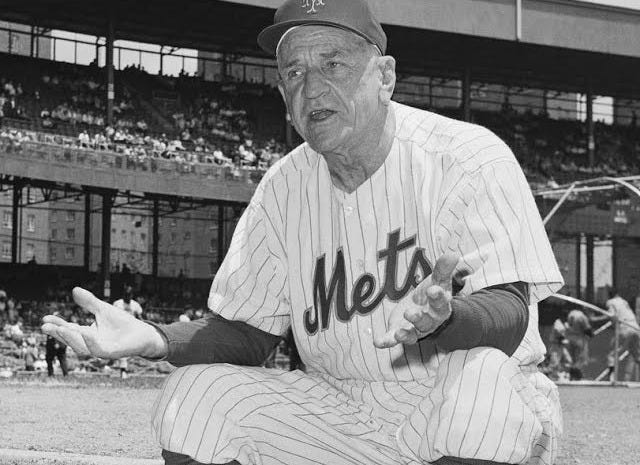
Whether he liked it or not, Stengel, the universally lauded skipper of a Yankees’ dynasty, was now at the head of a sectarian religion. Dr. Eliasberg said Stengel was “very important” to the fans’ misplaced enthusiasm. “This venerable figure offers the added comfort of a father, a leader, who knows and can do all.” Back in reality, the 73-year-old Stengel cut a comic figure in orange and blue, still hale but increasingly wizened and eccentric. Age had taken his curious patterns of speech to new heights. He became the easiest interview in the world: journalists had only to stick a microphone in front of the manager, ask a single opening question, and capture the resulting torrent of Stengelese.
During a typically stream-of-consciousness monologue for a promotional film at the end of the season, Stengel promised the club would be better in 1964. They had to be. “We’ve got to repay the money we’ve taken from the fans.”
But until a new season and a fresh start in their new ballpark in faraway Queens, William A. Shea Stadium, the Mets had to find other ways to express their gratitude. On September 15, 1963, they used words of affirmation.
Mets fans exhibited a need to express themselves from the beginning. In addition to cheers and chants, they used the written word, scaled up and painted on pillow cases and bedsheets, or printed on professionally designed placards.
“They make up wonderful placards,” Stengel said in his end-of-year monologue. “The placards are terrific.3 I even have to stop and look at them. I think I made fifteen mistakes this year reading the placards instead of watching the pitcher or watching the hitter.”
The fan-made “plackerds” Stengel admired were generally positive, boosting the team, patting themselves on the back, often tinged with a little gallows humor:
“Fifth place or bust”
“World Series tickets on sale HERE”
“All our bets are on the Mets.” (Seeing this one, a journalist warned readers that betting on the Mets was “not only illegal, but also the height of fiscal irresponsibility.”)
When vitriol was displayed, it was usually pointed west, at the Giants and the Dodgers and their scoundrel owners, Horace Stoneham and Walter O’Malley. O’Malley, perceived as the chief architect of New York’s National League-trauma, was in no danger of being forgotten:
“O’Malley is a FINK. May His Dodgers to the Bottom Sink”
As much as Mets fans wanted the world to know they’d moved on, some banners were little more than scars mounted on cardboard:
“The Bums Went Away But the METS Will Stay”
While the Colts and Mets fought to keep out of last place in the National League in their mid-September series, the baseball world was focused on a decisive clash between the Los Angeles Dodgers and St. Louis Cardinals. So consequential was this series that Don Drysdale was going to try and pitch through a serious attack of shingles which left him feeling “like I swallowed a blow-torch.” Against programming like that, a September “Battle for the Basement” at the Polo Grounds needed all the help it could get and the Mets designated September 15 as “Banner Day.”
The promotion helped draw nearly 10,000 fans despite unseasonable weather. Cool temperatures and sharp winds seemed to signal the Mets to prepare for hibernation; this team wasn’t built for autumn baseball, and wouldn’t be for quite some time.
The crowd that day was described as “impeccably behaved.” Throughout the game there was stamping and chanting. Bugles blew, accompanied by the clash of trash can lids repurposed as cymbals and the occasional snap of a firecracker in the outfield.
New York used the first six innings to run their scoreless streak out to 38 innings, but third baseman Pumpsie Green hit a two-out single in the seventh and accidentally ignited a full-blown rally, capped by a two-run home run by the scuffling but no-less-beloved Choo Choo Coleman. The score was 5-4 at the end of the inning and Mets fans had high hopes, but Colts pitcher Turk Farrell wisely (and correctly) dismissed the big inning as a fluke and proceeded to strike out New York’s last six batters.
In the fifth inning, the public address blared: “Will all those entered in the banner contest please report to the press gate in right field.” More than 400 fans gathered up their paintings and poetry and formed ranks for the parade in which their work would be judged.
The contest was loosely broken into single, double, and four-person efforts. The individual placards were usually paper or cardboard mounted on wooden picketing sticks, the two-person jobs were usually hand-printed on tablecloths and bedsheets. Some of the four-person banners measured 30 to 40 square feet.
When the parade began, the contestants re-entered the park through the center-field gate and proceeded down the lines to the blaring sounds of a George Gershwin march. A handful of beat writers serving as judges took notes from an infield platform. One of these, Newsday’s Stan Isaac, said he was looking for messages displaying the specific “joie de vivre” of the New Breed: the conviction that there was always something to celebrate if you lowered your standards far enough.
The line was so long, it took a half-hour for the last contestant to re-enter the park. The judges conferred and awarded first, second, and third place in each category. Top finishers received a season ticket to Shea Stadium’s opening season. Runners-up got four tickets to Opening Day, and bronze medalists took home an autographed baseball.
The large, four-person banner contest was won by a group borrowing from Charles Schulz’ Peanuts, depicting Charlie Brown and his friends pleading for improvement with the obligatory “Good grief…” The Mets and the Peanuts’ baseball team did have similar on-field struggles, and Schulz made more than a few references to Casey Stengel in his extensive body of work.
The runners up:
“You May Be Down on Your Cans, But You’re First with the Fans”
"I pledge allegiance to the Mets
of the National Baseball League
And to the Polo Grounds, for which it stands.
One team, under Casey, indivisible, with fun and excitement for all."
The two-person award went to a college student studying graphic design. His winning entry showed the wry humor that always went over big at the Polo Grounds.
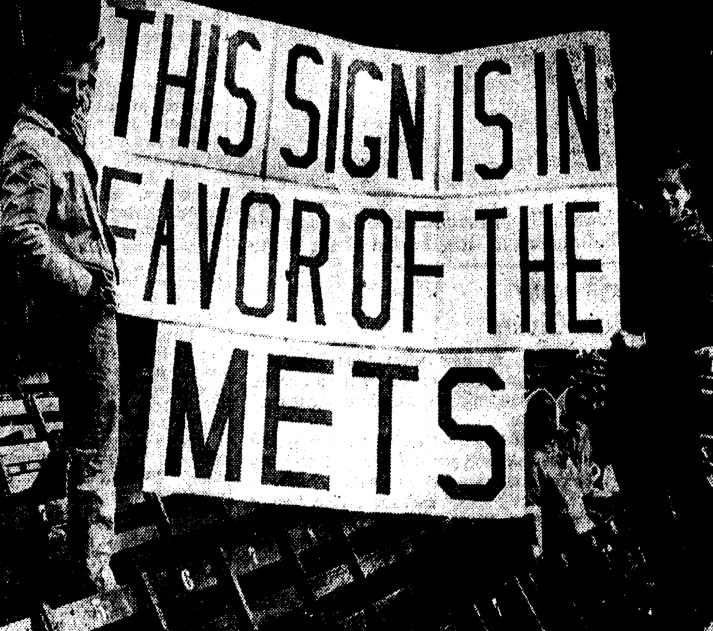
“There is no explaining why that sign is good,” Isaacs, one of the judges, said. “It just is.”
At least the artist could explain his process: “Everybody said it was my dumbest idea, so I made it.”
Generally, the more elaborate the effort, the less it resonated with the judges. After all, there was nothing polished about the Mets. Crude, heartfelt optimism did better:
“Casey for President”
“Up the Tree in ‘63, Off the Floor in ‘64”
“Let’s Beat the Bolts off the Colts”
And if criticism wasn’t rewarded, it was at least permitted:
“Have Mercy, Don’t Play Choo Choo”
After the contest ended, the Mets marched onto the field, each player carrying a large posterboard placard. They lined up in center field and one by one turned the cards over, revealing their own message:

Polite applause became a roar when a stooped figure belatedly jogged out of the dugout carrying a final card. When he reached the end of the Mets’ line, Casey Stengel raised the day’s final placard:
“!”
One writer called the demonstration “a triumph for the Mets.” In spelling and punctuation.
Several players reportedly didn’t appreciate being conscripted into participating. Choo Choo Coleman was among them (perhaps he’d seen the fan-made sign urging his benching). “We’re here to play ball, not to carry signs,” the catcher grumbled.
This was a strange hill on which to make a stand. After a rough-but-promising 1962, Coleman spent most of 1963 batting below .200 and looking profoundly uncomfortable behind the plate. He had that home run in the first game, but also made two errors. His batterymate, Al Jackson, added three wild pitches.
In the second game of the doubleheader, the other Mets mustered only three infield singles off a 19-year-old rookie only a year out of high school. Chris Zachary had never won a game in professional baseball until he met the Mets. It was another shutout loss for New York, whose ball-playing credentials were very much open to impeachment.
Stengel hated losing to the Colts, who were supposed to be the Mets’ peers in expansion-era misery. The manager called it “a disappointing, disgusting day. We had terrible fielding, poor hitting. Sure, they have good pitchers. [Zachary] wasn’t throwing up softballs, you know.”
Stengel was irritated with his men, especially those who had quickly dressed and hightailed it out of the park. “Some of them get out of here faster than they go on the field,” he complained. Stengel said he would have ordered extra practice for the next day, but the Mets were using the Polo Grounds for a tryout event. “I don’t want to ruin those tryouts. We might get some players.”
As far as Stengel was concerned, the day had one redeeming virtue: “The banners were terrific.”
Banner Day became an annual tradition for the Mets. The team held the second iteration at Shea Stadium on August 23, 1964. There was a confused, hopeful air in the new park that summer—between August 16 and August 21, the Mets had tied a club record by winning five straight games. Deeply held truths seemed open to question. “Is the Mets’ dynasty crumbling?” one placard asked. The Mets won both games against the Cubs that day, suggesting that perhaps it was.
In between the games, after a banner parade with over a thousand participants, six Mets players marched out on the field and unrolled a banner 100 feet long:
“To All Of the Mets’ Fans: You Are The Greatest.”
Another nice, grammatically accurate sentiment, but without a Stengel exclamation point, the message lacked a certain something—until the player bringing up the rear slipped and fell, taking a large chunk of the banner down with him.
Whether a staged pratfall or a happy accident, the day’s crowd of 27,000 cheered Rod Kanehl’s tumble harder than they had cheered anything all season. It seemed a sign that the Mets’ hapless dynasty would last a little longer—
—and that was fine with them.

If you enjoyed this baseball story and want to support Project 3.18, consider becoming a paid subscriber.
This Thursday, paid subscribers will receive an exclusive post celebrating some of the outstanding “baseball names” of the Women’s Pro Baseball League, and we’d love to send it to you.
You can also really help us by sharing this free feature story on socials or restacking it here on Substack. Publishing a story is how we get on base; please help spread the word and drive us home.
One More Thing:
We enjoyed this jam-packed segment of the promotional film “Let’s Go, Mets”, featuring testimonials from fans on the street, Casey Stengel’s cracked end-of-year review, and footage from the first Banner Day.
The fans awarded the baby-blue “Amphicar” to rookie infielder Ron Hunt (the second-most valuable player on the team by WAR). Given the nature of the prize, we suspect the true MVP, pitcher Carl Willey, didn’t mind being overlooked.
The team we know today as the Astros began life with the worst nickname in modern MLB history, awkward to say and awkward to type and read, regardless of your feelings on the 2nd Amendment. Period coverage of the Colt 45s labored around that clunky name; writers resorted to calling the team “Houston” or “the Colts,” which was a little like calling the Chicago Cubs the “Cubes”—two entirely different things.
All periods in Casey Stengel’s comments are invented by Project 3.18 and do not appear in his original oratory.
Excellent. That last story of the Mets' banner for the fans was the best.
Fun read Paul! Banner Day doubleheaders were so METS! I remember trying to get in line to get on the field with a banner I that was more like a ...placard! Didn't make it for whatever reason but remember only that the people waited in line forever leaving game one in the late innings and not getting back for game two until the game had been going on for awhile. It didn't seem all that sexy to me and I never bothered to try again. Wish I had.