


Welcome to Project 3.18, where a fan-first writer tells strange and surprising stories from baseball history and culture.
If you enjoy what you read today, please subscribe to receive our free feature stories in your inbox.
Late May, 1949 – Cleveland Indians in sixth place, 7 games back
It started, as many can’t-miss ideas start, during a barroom disagreement.
Charles “Charley” Lupica was having a drink with a friend at a watering hole in his East Cleveland neighborhood. Lupica was part-owner a local establishment variously characterized as a drug store, a confectionery, or a delicatessen. Whatever the business was, it had been a long day behind the counter.
Lupica’s happy hour was disturbed by loud voices from a nearby table, where four men were extolling the virtues of the New York Yankees and mocking the deficiencies of the Cleveland Indians, despite the fact that the Indians bested the Yankees and won it all in 1948. Hopes of a repeat were high in Cleveland and Lupica did not appreciate this kind of talk.
“I was 37,” he recalled, “I thought I could take apart the world.” He butted into the conversation and expressed his certainty that the Indians would again win the pennant. He also encouraged the gentlemen, if they loved the Yankees so much, to feel free to move to New York.
Their fateful response was something along the lines of, “Why don’t you go sit on a flagpole?”
The remark was a dismissive figure of speech, like someone saying, “Oh, get out of here,” but for some unknowable reason Lupica interpreted it as a challenge and accepted on the spot. He already had a flagpole, 16 feet tall, on top of his store.
He rounded up some neighborhood kids to help him build a platform around the pole overlooking the corner of Wade Park Avenue and 118th Street. At the stroke of noon on May 31, he climbed a ladder up to the four-foot by four-foot platform and vowed not to come down until the Indians reached first-place in the American League. That’ll show ‘em.
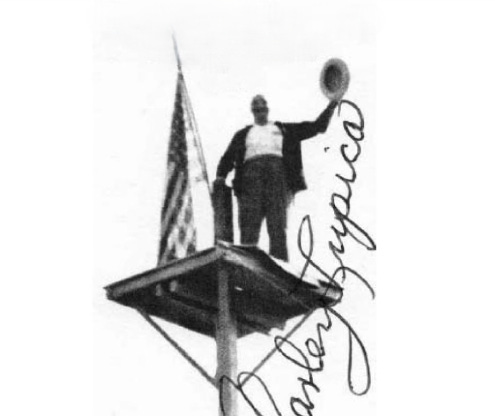
The Indians were in sixth place—out of eight teams—so Lupica must have known he might be up the pole for a while. If that was the case, some of his preparations didn’t show it. For his first afternoon and night on the uncovered wooden platform, nearly 20 feet above the roof and some 45-50 feet above the street, he took only a sleeping bag and a hat. The platform ended up being too small, even for a man of his short stature, so he slept wrapped around the pole and used his belt to lash himself to the figurative mast.
Traffic immediately backed up around store, requiring the Cleveland Police Department to assign an officer to the corner. A reporter and photographer from the Plain Dealer showed up. Since Lupica was out of earshot, his business partner, Ben DeMarco, did the talking, describing some of the logistics involved in the stunt. Lupica would get two meals a day, mostly sandwiches and drinks from the store, delivered via a bucket on a rope. With only a straw hat to protect him from the sun, the reporter observed that Lupica was already looking a little red.
DeMarco had to agree. “Tomorrow we’ll have to do something to take care of that. I think we ought to install a telephone, too. Then he can talk to his wife and kids.”
Charley and his wife, Augustine, had three children between the ages of six and 10, but that’s not all: On the day Lupica ascended to his perch, Augustine was somewhere in the vicinity of six months pregnant. Asked what Mrs. Lupica thought of the stunt, DeMarco said Lupica had made a persuasive case as to why his extended absence ”would be good for the family.”
“He’s a determined cuss,” DeMarco said. “He’ll probably be up there for quite a while. He thinks the Indians can do it.”
June 1 – Cleveland in sixth place, 7 games back
“Flagpole sitting” wasn’t always a gimmick. The practice is ancient; some early sitters abandoned their worldly lives altogether and climbed up on a rock or pillar to battle the elements and seek spiritual enlightenment. One of these, a 5th-century monk named Simeon Stylites, spent 36 years in a hut on top of a ruined tower. He didn’t descend until his body was carried down—the church made him a saint for that.
By the 1920s, there were actual flagpoles, and a stunt performer named Alvin “Shipweck” Kelly popularized the practice of ascending for the sake of publicity rather than piety. Kelly and many imitators did their “flagpole sitting” to set a record, promote a cause, or draw a crowd. The fad of the ‘20s was much less popular by the late 1940s, but it remained in the public vernacular through the dismissive, “Go sit on a flagpole,” the crack which had inspired Charley Lupica to do just that.
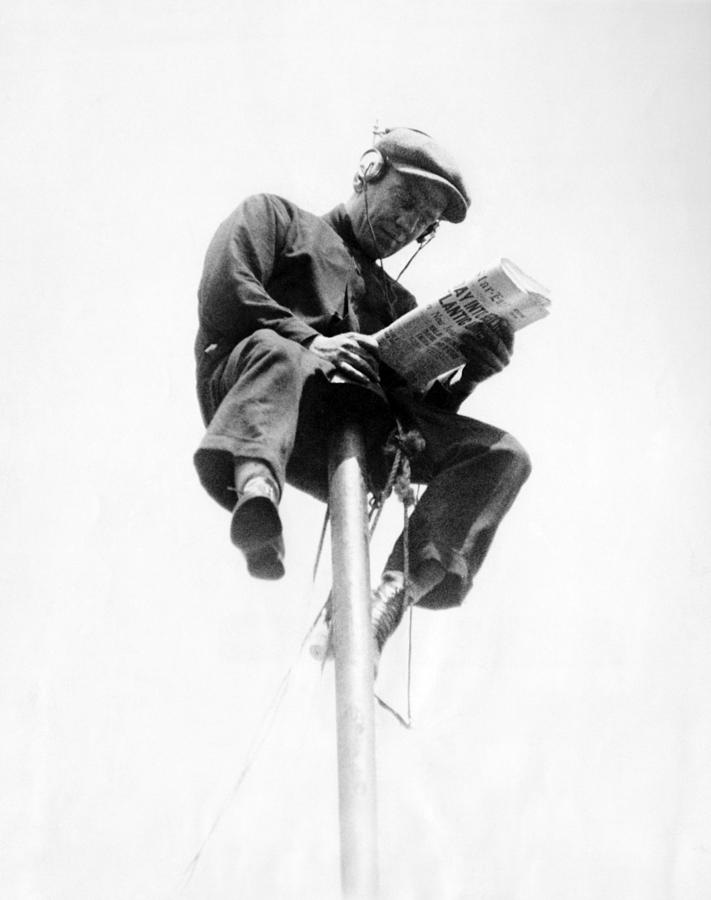
Kelly’s version of the stunt centered on physical endurance. He usually sat on nothing more than a metal stool or crossbar, consuming mostly coffee and cigarettes, and learned how to sleep sitting up with his thumbs jammed into specially placed holes. He aimed to stay up until his body gave out, and he topped out at an unfathomable 49 days.
Charley Lupica’s version of flagpole sitting was a mix of the physical and the psychological. There were three months left in the baseball season. To keep his vow to stay up as long as it took, he’d have to get comfortable.
On the second day he worked on extending the platform to create a few more feet of leg-room. The renovations helped, but the first night of June was unseasonably chilly, prompting the first quote from Cleveland’s newest pole-sitter: “I thought I saw icicles on the stars.”
June 2 – Sixth place, 8 games back
DeMarco was still acting as spokesman. “Charley’s not worried. He says the Indians are getting stronger every day.”
Lupica’s voice was hoarse from shouting down to the crowded street. “I’m feeling okay. I guess I’m getting to be a fixture up here.”
118th Street had become an impromptu high school reunion. Friends and associates Lupica had not seen in years popped up to wave and shout encouragement. The neighborhood bookmakers were also dropping by. Lupica always denied he had any financial stake on how long he could or would stay up, but pretty much everybody else in the area put at least a little money down. Some put down a lot.
June 6 – Sixth place, 9.5 games back
Lupica was taking salt pills to replace some of what he was losing in the Midwestern humidity—he’d eventually lose 15 pounds despite his sedentary routine. He’d gotten a portable radio and an oversized umbrella to shelter under. The prospect of foul weather worried him. Breakfast was poached egg, bacon, and pineapple juice. Dinner was baked ham. Everything went up (and down) in the bucket.
The health department had a problem with that. On June 6, Cleveland’s “sanitary police” issued an order for Lupica to cease and desist on the grounds that he had no camping permit and the “plumbing facilities” on his pole were insufficient.
The postal service regularly sent a mail carrier laden with packages and postcards up the ladder. The Boston Braves organization sent him red pajamas and best wishes. A week in, he’d become so famous the post office successfully delivered a congratulatory letter from out of state that gave his address as: ”Somewhere Over Cleveland.”
He adapted his routine around the things he couldn’t control. “I have to stay up until 3 or 4 o’clock every morning. If I don’t, the drivers below blow their horns to wake me. That wakes the neighborhood. So, I don’t get up until noon.”
Luckily, he was awake when the first two Indians players, pitcher Bob Lemon and second baseman Joe Gordon, drove over to get a look at him.
June 7 – Sixth place, 7.5 games back
Lupica’s lawyer sent a sharply worded letter to the authorities, reminding them that a pole above one’s property did not constitute a “public space” as the term was defined in the relevant city codes. Therefore, a taxpayer like Charles Lupica could do whatever he wanted in a bucket. The sanitary police stood down and Lupica stayed up.
He said his family had only come by to see him once. The weight of his commitment was setting in: “We’re expecting another child in about four weeks. If the Indians don’t make first-place by then, I’ll have to see the kid up here.”
Lou Boudreau, the Indians’ player-manager, stopped by to assure him it wouldn’t come to that. “He said he’ll try to get me down in three weeks,” Lupica reported. Even the great Satchel Paige visited. Lupica prized the photo the pitcher signed, but Paige was too cagey to make written promises:
Best wishes from Satchel Paige. Hoping that we will let Charlie down this year.
June 17 – Cleveland in fourth place, 5.5 games back
Boudreau backed up his words with a six-game winning streak. Up on the pole, Lupica was experimenting with a beard, something men of his generation did not do unless there were extenuating circumstances. He soon gave it up.
July 5 – Third place, 7 games back
“That’s where the Indians were when I started this thirty-four days ago,” Lupica groaned. “I didn’t think it would take them six months to get up to first place.”
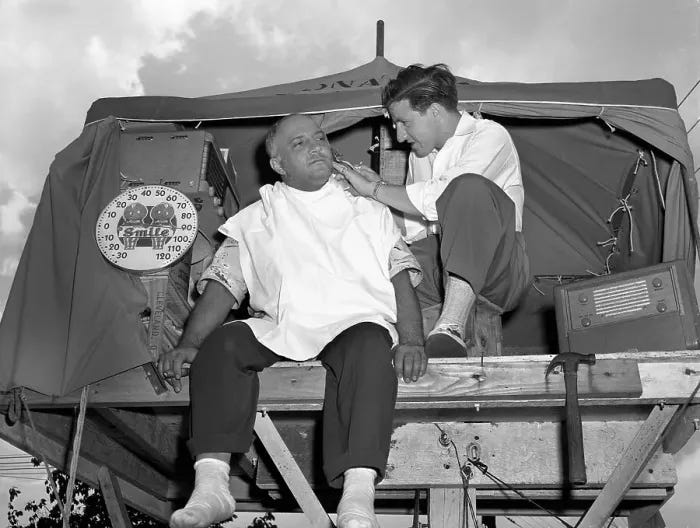
Conversations were easier, at least. He’d gotten a telephone, making it easier to talk with his wife. There were drawbacks to being reachable, however. A junior staffer at the Plain Dealer was assigned to call him every evening, and his number kept leaking and he was flooded with crank calls and people calling at odd hours. He had to change it four times.
In July, the Indians caught fire behind a run of outstanding starting pitching, but it was also one of the hottest summer months in Clevelanders’ recent memories. The thermometer affixed to the outside of his canvas awning regularly passed 100 degrees. The neighborhood kids celebrated the Fourth of July by shooting firecrackers towards his mostly wooden dwelling.
On July 6, the storm Lupica had been dreading finally hit. Before retreating indoors, people on the street begged him to come down, without success. “The wind was so bad, I was afraid I was going to be thrown off.” The endless pounding rain was a torment. “I thought this was Niagara Falls instead of 118th Street.” He couldn’t sleep until 4 a.m., but the next morning, when a writer called to check on him, he was his jovial self, reporting, “No rain in my basement.”
Lupica’s outlook was increasingly sunny as Cleveland went 14-4 between July 1 and July 19, looking more like the team that won a pennant the year before. They moved into second place in the American League on July 10, but that was still 5.5 games back of the relentless Yankees.
He spent the 47th day of his vigil planning his upcoming 38th birthday. For obvious reasons, it would be a small affair.
July 25 – Second place, 3 games back
His legs hurt, his back ached, and a tooth had begun bothering him. As if to buck him up, the Indians finally got within striking distance of the top of the standings.
On August 2, a Boston radio station arranged a telephone conversation between the nation’s two most famous flagpole sitters. In Boston, a woman named Ruth Ellis had been up on a platform for 19 days, while Lupica was at 63.
They spent seven minutes discussing the shared challenges of heat, noisy crowds, and what was delicately described as “the bathing problem.” Their causes, however, could hardly have been more different: Ellis was protesting the inability of her family to find housing at a reasonable rent. Lupica was up there more or less for glory.
“I hope your husband finds a house for you,” he said as they wrapped up.
“Thanks,” Ellis said. “And I’ll be rooting for the Cleveland Indians.”
It’s tough to guess the most exciting week in a person’s life across such distance, but we think the first week of August 1949 must have been up there for Charley Lupica. Boudreau and the Indians had missed their deadline, but as Augustine’s due date arrived, the Yankees finally heard footsteps behind them.
After winning both games of an August 4 doubleheader against the Washington Nationals on a day the Yankees lost, the Indians pulled to 2.5 games of first place. The team headed to Philadelphia for four games against the middling Athletics. Charley Lupica could practically smell dirt, and not a moment too soon.
The Indians won their first game in Philadelphia, but lost a half-game in the standings when New York swept a doubleheader against the St. Louis Browns. Then, disaster: Cleveland lost the next three games to Philadelphia and gave up half the progress they’d made all summer.
On August 7, the night of the second loss, Charles Lupica, Jr. was born.
Donated modern technology helped Lupica keep up with events from afar. Pictures were delivered, telephone calls were made, and he even got a portable television set (a gadget we didn’t know even existed in 1949) so he could watch camcorder footage recorded in his wife’s hospital room.
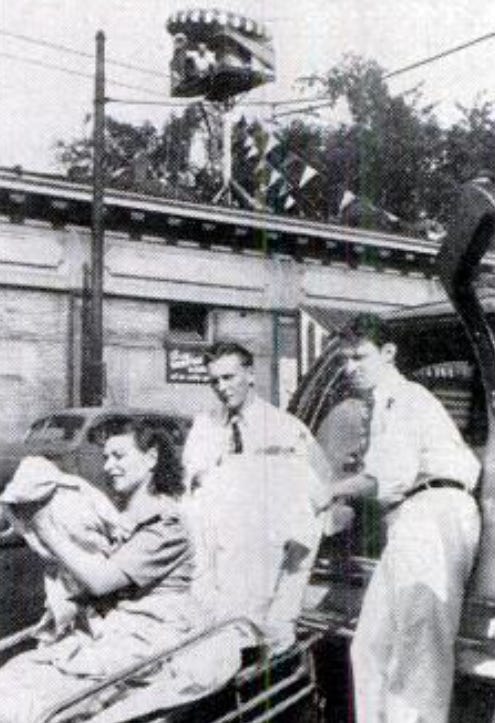
On August 8, the ambulance driving Augustine and Charles Jr. home from the hospital stopped under the pole, where Charley waved his hat to welcome his son into a world that was getting stranger by the day.
August 11 – Second place, 5.5 games back
With his 73rd consecutive day on the pole, Lupica passed one Milton Van Nolan of San Francisco, who’d held the American pole-sitting record of 72. In other news, the Indians lost and fell into third place behind the surging Boston Red Sox.
Lupica’s relationship with the people on the street was improving. Well into his third month up there, he had silenced his doubters and detractors. Even the neighborhood kids seemed to have let up. At the peak of his popularity he estimated well over 1,000 people a day were stopping by to get a look at the champ and wonder how far he could go.
August 28 – Third place, 6.5 games back
After beating the heat and the rain and the hecklers and even the urgent requirements of parenthood, a toothache had no chance. On August 28, Lupica’s dentist joined him on the platform to “clean out a bothersome tooth and put in a temporary filling.”
The Indians had lost four out of five, including two in a three-game series against the Yankees. It was becoming necessary for Lupica to clarify that he was not coming down until the end of the season…even if the Indians were mathematically eliminated sooner.
After a broiling July, August had been unseasonably cold, as had Lou Boudreau and his team, who went 18-14. Augustine Lupica received harassing phone calls from local gamblers who’d lost money by betting against her husband and wanted him to quit before they went broke. For months, Lupica had hoped to come down in triumph. As autumn began, he only hoped to come down.
September 14 – Third place, 7.5 games back
It had been 107 days since Charles Lupica first went up the pole for the Indians, and after another loss to the hated Athletics, the team was no closer than they’d been on that glorious spring day when he put his fate in their supposedly capable hands.
It was the season to transfer hope from the present to the future. “The [Indians] can win next year,” he said. “but it’ll take younger men with more hitting power.” As to which specific old men should go: “I don’t want to mention no names.”
He accepted that his ordeal would end with the 1949 season, maybe a little sooner: “I’m coming down before the last [home game] so there’ll be a bigger crowd to greet me.”
A few days later, Augustine was recovered enough to bring the baby up the ladder. Charles finally met Charles Jr.—who would later go by “Chuck,” help his father run the family’s moving business, write a book about him, and raise seven children of his own. “What a kid,” Lupica said of their meeting. “He didn’t even wake up.”
Elsewhere, the Indians started a six-game losing streak.
All through the summer, Bill Veeck, the owner of the Cleveland Indians, had taken care to stay out of Charley Lupica’s hard-earned spotlight. The men had similar tastes and shared a sense of showmanship, which Veeck recognized in his autobiography, Veeck as In Wreck, in which he described Lupica as “a magnificent and dedicated human being.”
Veeck lent a hand in quiet ways, reportedly paying for Augustine’s hospital bills and sending Lupica a portable heater to help stave off the autumn frost, but nothing in the record suggests the owner or the club had a direct hand in the stunt or were a regular partner in it. Charley was on his own, which is how he earned such admiration from Veeck:
There were those who were willing to give me credit for thinking up Charley’s gag, too; patently unfair to Charley. Flagpole sitters, like .300 hitters, are born, not made.
When Lupica’s glorious stunt seemed in danger of coming to a deflating end, Veeck sprang into action.
On September 22, the Cleveland Indians were mathematically eliminated from winning the American League pennant. On what must have begun as a bitter day above Wade Park Avenue, Lupica got an “awful nice” letter from Veeck, in which the owner proposed a mutually beneficial denouement.
If Lupica was willing, the Indians would figure out a way to get him and his flagpole into Cleveland Municipal Stadium. He would spend his last night aloft beyond the fence in left field and descend onto the ballpark dirt as a guest of honor before the team’s final home game on September 25. “Ain’t it wonderful?” Lupica said.
Veeck’s public-relations team found a “lift-truck business” (with the best insurance in the world, evidently) able and willing to saw off the flagpole and transfer the whole thing to a flatbed truck which would ferry it to the ballpark on the other side of town. All of this while Lupica himself remained in place.
“The flagpole was higher than the bus wires,” Veeck recalled, “which meant, we discovered too late, that we needed a special license to move him through the city, and even then we had to devise a long, circuitous route.”
On September 24, Lupica’s home for 116 days was disassembled. The pole and the mostly empty platform were cut down and driven to Cleveland Stadium in a parade of vehicles, drawing crowds all along the winding journey. Lupica ducked under tree branches and dangled his legs cavalierly over the side as he waved to legions of admirers. If he was in any way secured to the structure, it didn’t show.
September 25 – Fourth place, 10 games back
Shut up in an empty, cavernous stadium, the final night was the quietest, but Lupica was too nervous to sleep. He paced for hours around the pole, his constant companion for more days than he’d ever intended. Charley Lupica never used the word “asceticism,” but up on that pole, a “determined cuss” became the American League’s first practicing hermit monk—and a pretty darn good one.
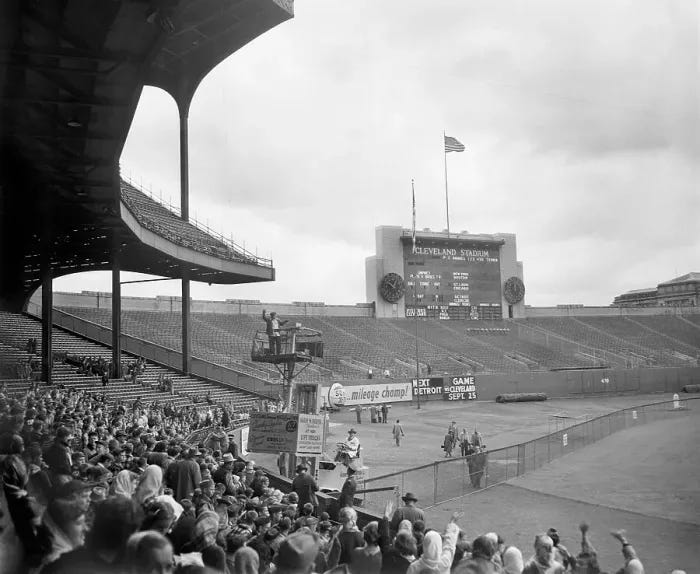
And then it was September 25, Charley Lupica Day. 33,977 people came out to honor the local soda jerk who had obliterated the pole-sitting record and taken their fandom to hitherto unimagined extremes.
A wailing ambulance started around the stadium warning track, followed by an attendant pushing a wheelchair and then the flatbed truck. On the platform, he wore a gray suit. The crowd roared, all for him. The saints never had it so good.
The procession ended at home plate. His wife and children were there to greet him, along with members of the Indians’ front office and the team band, playing “For He’s a Jolly Good Fellow.” Charley Lupica took off his suit coat, put it under his arm, and climbed down.
“It had to be a slow climb,” Veeck wrote, “because the photographers kept shouting at him to slow down so they could get their pictures. Charley, who did not seem to have anything against getting his picture in the paper, was nothing if not obliging.”
At 1:55 in the afternoon, 117 days later, he skipped the last few rungs of the ladder and jumped back to earth.
That last flourish was probably a mistake; his first few steps were unsteady. Three nurses swooped in but he waved them away. “Just let me stand here a minute. Oh, my ankles.”
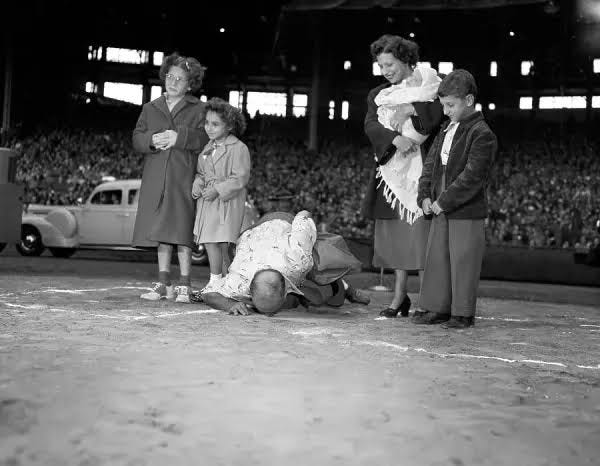
He stumbled to a waiting microphone and was introduced by Rudie Schaffer, Veeck’s business manager and right-hand man, who dispensed a Christmas’ worth of gifts. A bathtub, a four-poster bed, a radio, and a stove. Bicycles, tricycles, and strollers for the kids. Somebody shoved a puppy into the arms of eight-year-old Carl Lupica. (“In the confusion, the dog’s breed was not established.”)
Then a super-sized gag-gift (Veeck’s favorite): a 50-foot flagpole for the family’s front yard. And, “for your loyal support,” a new Pontiac sedan.
He tried out the bed. He kissed the family. He unsteadily got down on his knees and felt the dirt. He kissed that, too. Flashbulbs exploded. It was true: Charley Lupica never minded having his picture taken. He kissed home plate and rose, enjoying the orange-brown grit on his hands. “The good earth,” he declared, “is the finest stuff in the world.”
Regretting all the trouble they’d had caused, the Indians chipped in and got him a breezy, 7-1 win over the Detroit Tigers, which he enjoyed from a box seat. “They should have brought home plate up to me every day to kiss.”
The day he came down, the fourth-place Indians began their longest winning streak of the year. They won out from there, seven games in all. When the season ended on October 2, Cleveland was 89-65, eight games behind the first-place Yankees and pretty much right where Charley Lupica had found them.

If you enjoyed this baseball story and want to support Project 3.18, consider becoming a paid subscriber. Paid subscribers also receive exclusive bonus content.
This was a special one for us. Can you help get it out there with a restack? Or share it somewhere on social media.
Great ‘Stack, Paul!
What?! So crazy!!