


Welcome to Project 3.18, where a fan-first writer tells strange and surprising stories from baseball history and culture.
If you enjoy what you read today, please subscribe to receive our free feature stories in your inbox. And if you’ve been here for a while, we could really use your support as a paid subscriber. Paid subscribers receive access to exclusive content and help keep this publication going and growing.
The Chicago White Sox were in the midst of a prolonged slump in the summer of 1978. A year earlier, the South Side Hit Men had successfully covered up the team’s pitching deficiencies and homered their way into a thrilling season (and lucrative free-agent contracts elsewhere). Without the money to pay their stars, Bill Veeck, president of the White Sox, and his general manager, Roland Hemond, went back to the drawing board.
In May, during a particularly rough stretch, one frustrated fan tried to help out, paying for an unauthorized ad in the “Job Guide” section of the Chicago Tribune:
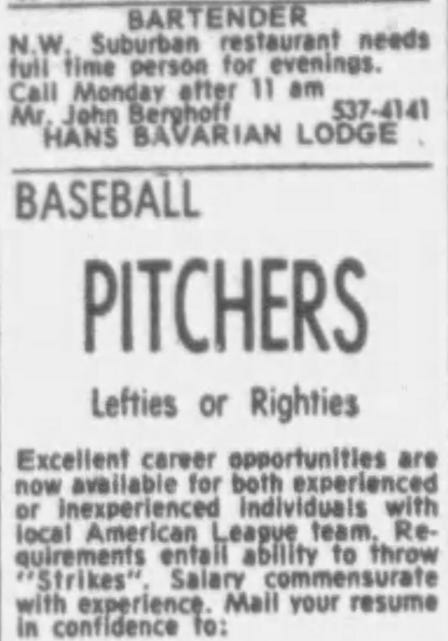
Interested parties were encouraged to apply via a local advertising agency and nearly 100 people did. Their applications, silly, sad, and serious, were forwarded to the White Sox. Bill Veeck promised to give them a look.
The White Sox owner was always game to “fool around,” and beyond appreciating a good gag, Veeck said he’d learned prospect due-diligence the hard way. He claimed that back in his time in Cleveland, in 1948, a friend of a friend moonlighted as a scout for the Indians, “just as a hobby.” Veeck said one day he got an urgent call from this bird dog, who said he’d turned over an unpolished, 16-year-old, power-hitting gem playing on a semi-pro team in Oklahoma.
“I gave our scouting people the name and told them to look him over,” Veeck recalled, years later. But the scouts doubted the substance of the tip and were slow to act. “By the time they saw the kid, he had signed with another club. His name was Mantle. Mickey Mantle.”
Whether or not that story was true, in 1978, Veeck and the White Sox were taking no chances on missing the pitching equivalent of the Commerce Comet. The owner swore he had nothing to do with the ad in the Tribune, but he and the Sox scouts sifted through the responses and came up with 46 serious applications: 39 righties, six lefties, and one man who claimed to be ambidextrous. All were invited to an in-person June tryout at Comiskey Park. If nothing else, it would be good publicity for the team.
Tom Renz, age 23, did prove to be ambidextrous. Alternately throwing left-handed and right-handed, he pitched off the mound of the left-field bullpen and some of his pitches (from either hand) even made it over the plate. There was just one problem: none of them hit 50 miles-per-hour on the radar gun doing most of the evaluation.
Renz had a good attitude about his performance: “Switch-pitching worked fine for me back home. I had to switch arms to keep the ball in the park. We had a short left field. Of course, that was in wiffle ball.”
Nearly all the candidates were White Sox fans (or the rarer “Chicago fans”—Renz, from Indiana, was planning to take in a Cubs game after the tryout). Otherwise, their backgrounds were as varied as their attire. Some wore baseball and softball uniforms representing recreational and semi-pro teams across the South Side and the suburbs. Others wore sweat pants, cutoff shorts, or jogging outfits. The oldest candidate was 39 and the youngest was 13. We’d like to imagine Veeck himself pushed that latter application into the “maybe” pile. No harm in giving a young fan a great memory in Comiskey’s left-field bullpen.
When all had shot their shot, none of the 47 “pitchers” who showed up proved of immediate interest. “On a scale of 1 to 10,” White Sox scout Steven Vrablik said, “I’d give everyone who showed up a 10…for courage.”
Vrablik said the team would follow up with a few marginal cases to offer developmental advice and stay in touch, but mostly the scheme had failed, as such tryouts nearly always failed. The days when a major-league-caliber player could be plucked off the sandlot or the factory field were long gone. By the late 1970s, the world was too small.
Veeck’s White Sox had been running their own tryouts for several years. The participants were a combination of people who’d written the team asking for a look and local players who had come to the attention of regional White Sox scouts, some of whom made the rounds between various well-regarded semi-pro teams, just in case. When a player piqued their interest, the scouts made introductions and invited him to a tryout.
In 1977, a lefthanded pitcher named Kevin Hickey received such an invitation. That summer, Hickey, 21 years old, had starred on a local semi-pro team, the Midlothian Cardinals. He was 6’ 1” and 170 pounds, with skinny, whip-like arms. He worked second shift as an arc welder at a local steel plant. Because of his job, he only pitched on weekends, but his manager tried to use him whenever he knew scouts were lurking nearby. That summer Hickey won nine games as a weekend warrior, striking out 86 batters in 71 innings. He even threw back-to-back no-hitters. After the second no-no, a White Sox scout appeared with an invitation.
Wearing his Cardinals uniform, Hickey showed up to Comiskey Park on August 17, 1977. His expectations for the tryout were mixed. On the one hand, he imagined a small affair, maybe 20-30 real contenders, giving him a chance to stand out. On the other hand, “I was told they never sign anyone from these tryouts,” he said. “I figured my chances were two—slim and none.”
Tryout camps were cheap to run and a reliable source of local goodwill, but Roland Hemond, the White Sox general manager, conceded the odds were long: “It’s a distinct rarity for an eventual major leaguer to come out of one of these camps, but you never know.”
Expecting a few dozen hopefuls, a dismayed Hickey joined a line of 200 other “prospects” aged 18-29. All shapes, sizes, and colors were represented. Some of the others were wearing jeans and sneakers. He spotted more than one plastic-looking glove. “They gave us each a paper number to pin on our back. I became very skeptical. I thought the whole thing was a big joke.”
He almost turned around and left, but when an early number was pinned on his back, he decided to stay.
I was the second guy scheduled to pitch. I remember the first guy vividly. He was a real hot dog. He did wind sprints in the outfield before he took the mound. And he kept juggling this leaded ball. He threw exactly three pitches and they told him to take a hike.
Then it was his turn on a major-league bullpen mound. A handful of anonymous men with clipboards regarded him blankly. One half-heartedly aimed the radar gun in his general direction.
“I just went out there and threw fastballs,” Hickey said. “I didn’t have any style at all—I was too upright in my delivery. But after a half-dozen pitches, I noticed the scouts were making notes on their clipboards and looking at each other kind of funny.”
They were also looking at the radar gun. The skinny-armed kid’s fastballs were hitting 95 miles-an-hour.
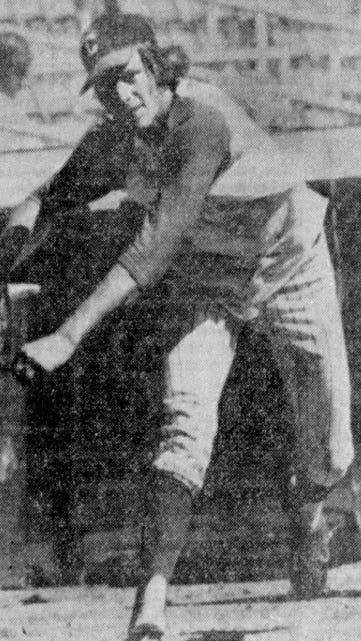
Hickey threw about 30 pitches. Toward the end, one of the scouts said, “Let’s see your curve.” Hickey threw what he thought was his curve. “That’s a slider,” the scout said. Hickey had to take his word for it.
Finally one of the men called a halt. “Thanks for coming in,” he said. “We’ll contact you.”
Inwardly, Hickey sighed. “I thought, ‘Sure you will.’”
Kevin Hickey was born in the White Sox’ shadow. He and his parents and four siblings lived on the 2700 block of West 36th Street in Brighton Park, a transportation hub and ethnically diverse neighborhood on Chicago’s South Side. As a free-range kid, he became a regular visitor to Comiskey Park, just a few miles straight east from his home. “I couldn’t afford good seats, so I’d usually sit behind a pillar in the left-field bleachers.”
Hickey started throwing against a brick wall in his backyard and grew into one of the most athletic kids in the neighborhood. He played baseball until his freshman year of high school, but dropped it to take an after-school job. After high school, he found work at the Ryerson Steel Company, and like tens of thousands of other Chicagoans, he nourished his soul playing 16-inch softball.
“Slow pitch” softball is serious about velocity. Instead of whipping the ball, which is softer and larger than the ball used in fast-pitch, pitchers must lob it, and any pitch coming in too fast is an automatic ball.
The sport was invented in the Chicago area and became a regional phenomenon. It grew in popularity among workers without the time or skills to succeed in baseball who still wanted to play, and it required only a ball and bat to play—no gloves. By the late 1970s the Chicago area alone had approximately 250,000 players. On the lakefront, sprawling Grant Park and its 16 diamonds were in constant rotation, each hosting two performances of “the greatest game on dirt” almost every day.
One of the best teams on the scene was the Chicago Bobcats. The Bobcats formed in 1951 and dominated the local competition by becoming the softball equivalent of the modern-day Dodgers, collecting the best players by offering them the opportunity to play with the best of the rest. When a national 16-inch tournament started in 1964, the Bobcats won 11 of the first 15 titles.
Skeptics liked to say slow-pitch softball was to baseball as ping pong was to tennis. “Writers who weren’t involved used to classify [softball] as guys running to second base where there was a beer waiting for them,” Eddie Zolna, the Bobcats’ player-manager, told a reporter in 1980. And softball was that, but it was also something else. “Although this is a simple game to play, it takes a great amount of ability to play it exceptionally well.”
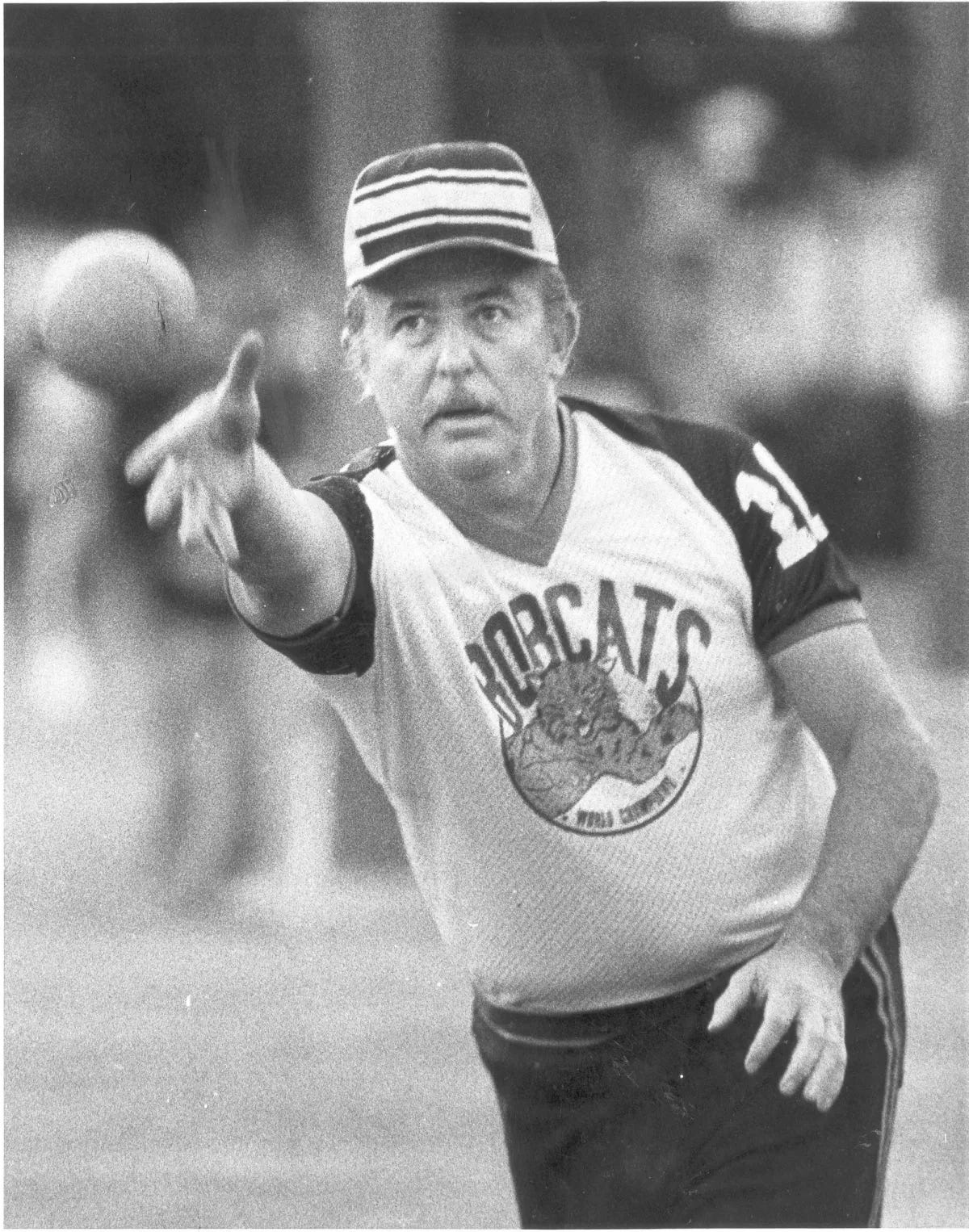
Kevin Hickey played it that way. After high school, Hickey hooked up with a softball team sponsored by his neighborhood bar, but his superior range and agility were quickly flagged. By the mid-1970s, Hickey was playing center field for the Bobcats, and sometimes taking freelance assignments for other teams, so long as the opposition didn’t recognize him and protest. He batted cleanup and did a lot of that. He once hit four home runs in one game off famed Chicago columnist Mike Royko, a 16-inch devotee. In 1976, Hickey pitched the Bobcats to another world championship.
Hickey’s softball career was derailed soon after that championship run. His job reassigned him from the first shift to the second, 4 p.m. to midnight, and the Bobcats were too serious to roster part-time players, even talented ones. A police officer who had watched Hickey play recommended he try the semi-pro Cardinals baseball team, which was open to more flexible arrangements. After whipping all those softballs in from the outfield, throwing a baseball from the mound was nothing for the newest Cardinal, who broke out as a hardball pitcher.
It’s possible the Sox scouts said, “We’ll be in touch,” to all the hopefuls who threw during the tryout at Comiskey Park, just to keep the line moving. But only one candidate actually heard back. On August 18, Hickey’s phone rang. It was the White Sox, asking if he’d be around that afternoon. Word went round the neighborhood from house to house and by the appointed time a small crowd was loitering around the front porch of the Hickey family home. Two White Sox scouts arrived with a professional contract.
“These guys came in and I thought it was a gag,” Hickey recalled. But there was a bonus of $500 on the table, and if he signed his name, he’d join the White Sox for spring training and be assigned to a farm team in 1978. Hickey and his dad huddled briefly and he signed.
When news of Hickey’s contract broke, Bill Veeck’s assistant, Charlie Ervanian, put it in context:
It’s been done before, but the chances are slim. This is the fourth tryout camp I’ve been at and this is the first boy I saw signed. There were other kids we still want to follow but he’s the only one we wanted to grab up quickly.
Hickey had beaten “one in a million” odds by coming away from a walk-on tryout with a professional contract, but he was still at the wrong end of the probability tables. Only five percent of minor-league players ever reached the majors. But compared to one-in-a-million, one-in-twenty must have seemed downright roomy.
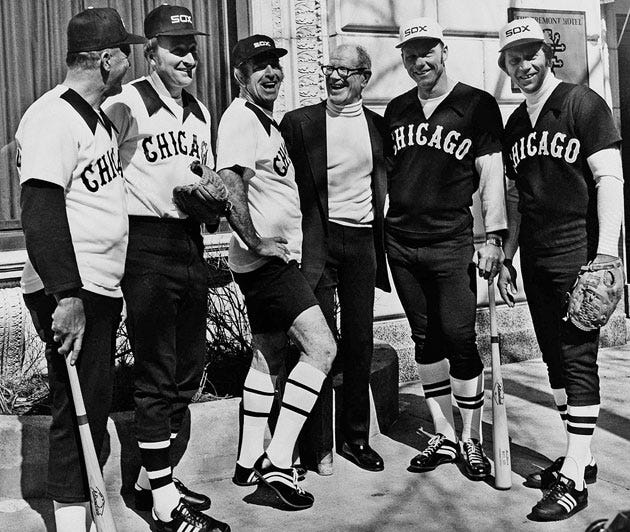
The White Sox’ newest prospect was invited to spend the remainder of the 1977 season at Comiskey Park and use his live arm to throw batting practice to the major-league players. He reported to Payne Field in Sarasota, Florida the following March. His alphabetically assigned locker was between major-leaguers Ralph Garr and Chet Lemon. He got a uniform. An ugly uniform, to be sure, but it was real.
Hickey encountered the first bump in his developmental road almost immediately. The Sox had planned to assign him to a rookie-league team based in Sarasota after spring training, but the club folded and the organization had more raw pitchers than it could cram into A-level Appleton. Hickey was not chosen for placement. The team told him to go home, keep pitching BP, and bide his time. “They said, ‘We’ll find a place for you, somewhere.’”
In limbo at Comiskey Park, “I would throw for about a half-hour,” Hickey said. “When somebody like [Angels pitcher] Frank Tanana was pitching against [the White Sox], they would have me throw hard in batting practice. Then I’d do my running and shag flies in the outfield.”
The team soon established a relationship with a new rookie league affiliate, the Highlanders of the Appalachian League, based in Paintsville, Kentucky. Hickey vividly remembered the un-PC moment when he received his first assignment: “When they sent me there, they asked me if I could speak ‘hillbilly.’ I said, ‘No, but I can learn.’”
Hickey struggled in Paintsville, giving up 37 hits and 23 walks in 33 innings. He told a local newspaper it was hard to adjust to small town life. “I was homesick. There are no bars or discos here.” Remember, this was 1978, when disco was practically everywhere.
He’d given up a full-time job to play baseball for next to nothing. He called home collect, asking whoever answered if they could help him out a little. His four siblings and parents all pitched in. “I’m sure my wife wrote checks I didn’t see,” his father, Don Hickey, said, “but I’m also sure she doesn’t know about the money I sent.”
With his family backing him, Hickey stuck it out. In 1979, he was promoted to the Appleton Foxes, but his performance wasn’t much better; he gave up 122 hits and 74 walks in 121 innings.
Roland Hemond said it wasn’t all bad—Hickey was averaging 2 strikeouts per 3 innings pitched. After 1979, he participated in a fall instructional league and pitching instructor Ron Schueler taught him how to throw a change-up.
“He picked it up in ten minutes,” Hemond said. “That’s quick for anybody, even major leaguers.”
Having a functional off-speed pitch let Hickey to dial down his fastball to a place where he knew where it was going. He issued only four walks and had an ERA of just 1.45 over 31 innings and got another invitation to spring training.
“He wouldn’t be coming if we didn’t think he could make it,” Bill Veeck said in 1980. “We were very impressed with him in the Florida Instructional League. For the first time, he got the ball over the plate.”
Hickey’s story had been lost in the lower minors, but in spring training he was back in the spotlight, and now his chances of actually reaching the majors were much better than five percent, adding even more interest. As always, Veeck was the sage.
“A lot of people will be surprised if Kevin makes our team this year,” the owner said. “But I will not be among them.”
In the end, Hickey didn’t make the team, but he was promoted again, to the AA White Sox in Glens Falls, New York. His numbers as a starter remained mixed, but the walk numbers were coming down, and he did much better against lefthanders.
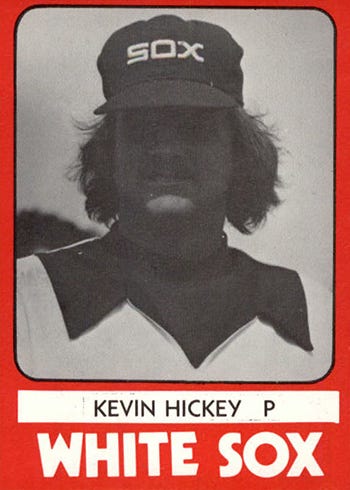
The cash-strapped White Sox were rebuilding and needed left-handed relief help. Schueler told Hickey he might have a shot to make the team in 1981, but “I don’t think he believed me.”
Hickey believed enough to spend the winter before 1981 working out with two big-league White Sox pitchers, Ken Kravec and Ross Baumgarten. He didn’t have a car, so his brother Tom drove him to Comiskey Park every day. Still living in the family home in Brighton Park, he did his evening stretch work in the living room.
As a crucial spring training neared, Hickey was desperately short on cash, but he thought of a way to stretch things out. Knowing that the first White Sox equipment truck would head south several weeks before the players did, he went to talk to Roland Hemond.
Hemond and Veeck had different styles, but they both cherished an underdog. Veeck loved the story, but Hemond saw an edge. Over the course of his many decades working in major-league front offices, Hemond was consistently drawn to baseball’s “unfortunates,” believing they were likely to work harder. “You pick players who have been stymied,” Hemond said in 1990. “They need a chance. I like that method.”
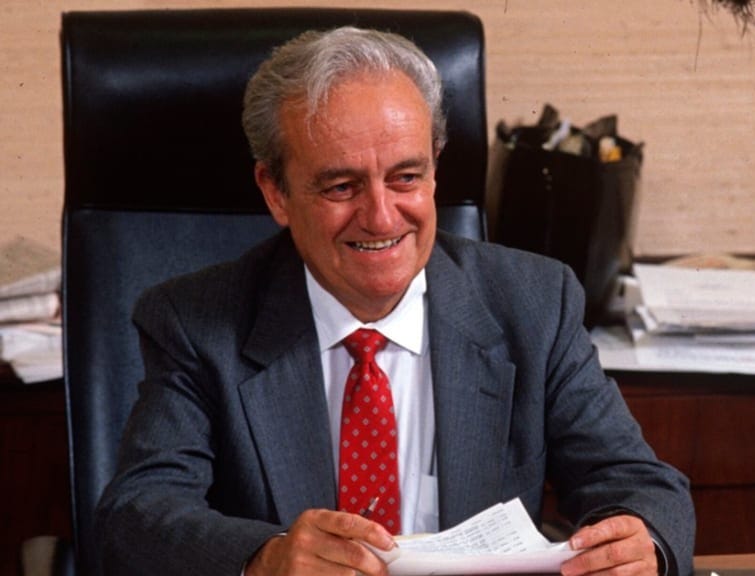
A month before spring training in 1981, Kevin Hickey approached Hemond, asking if he could cash in his team-purchased plane ticket and help drive the equipment truck from Illinois to Florida. Hemond’s radar went up. Here was a player who needed a chance, doing everything he could to hang on long enough to get one.
Reflecting on his time in the minors later, Hickey said, “I probably would have given up once or twice, except no one ever came up to me and said, ‘You can’t do it.’” Now it was Roland Hemond’s turn to keep his peace. The general manager could have let this cash-strapped marginal AA pitcher down gently, right there and then.
Instead, Hemond refunded Hickey’s plane ticket and found him a seat on the truck.

If you enjoyed this baseball story and are looking forward to the next one, consider becoming a paid subscriber and supporting what we do here.
You can also really help us by sharing this feature on socials or restacking it here on Substack. Publishing a story is how we get on base; please help spread the word and drive us home.
In the conclusion, Kevin Hickey goes from a one-in-a-million to one-in-twenty to one.

I broadcast at least one Glens Falls White Sox game for our college radio station that year, but I can’t remember if Hickey pitched. That was a good club, though - a number of future major leaguers including Ron Kittle & Greg Walker.
Very interesting story - well done!