


Welcome to Project 3.18, a free weekly publication where a fan-first writer tells strange and surprising stories from baseball history and culture.
This is the second part of a spring training story featuring a pioneering American aviator.
Here’s Part 1, if you need it.

When we left off, Wilbert Robinson, manager of the 1915 Brooklyn Dodgers, had made a manly boast, claiming he could catch a baseball dropped out of an “aeroplane.” In earlier years this would have been idle talk, but in the spring of 1915 Robinson and the Dodgers were working out in Daytona Beach, Florida, just down the street from a genuine pilot, Ruth Law, with her own plane and a demonstrated affection for stunts. Law agreed to help Robinson back up his words and the Dodgers’ trainer, Frank Kelly, volunteered to fly up and do the throwing.
On March 13, Law and Kelly hustled to her beachside hangar. Rainy weather had cleared the pilot’s schedule and the Dodgers’ game had been cancelled. Law had been flying for several years, but this would be the first time she flew in the rain; we wonder if Kelly knew that when he volunteered to go up in her single-engine biplane.
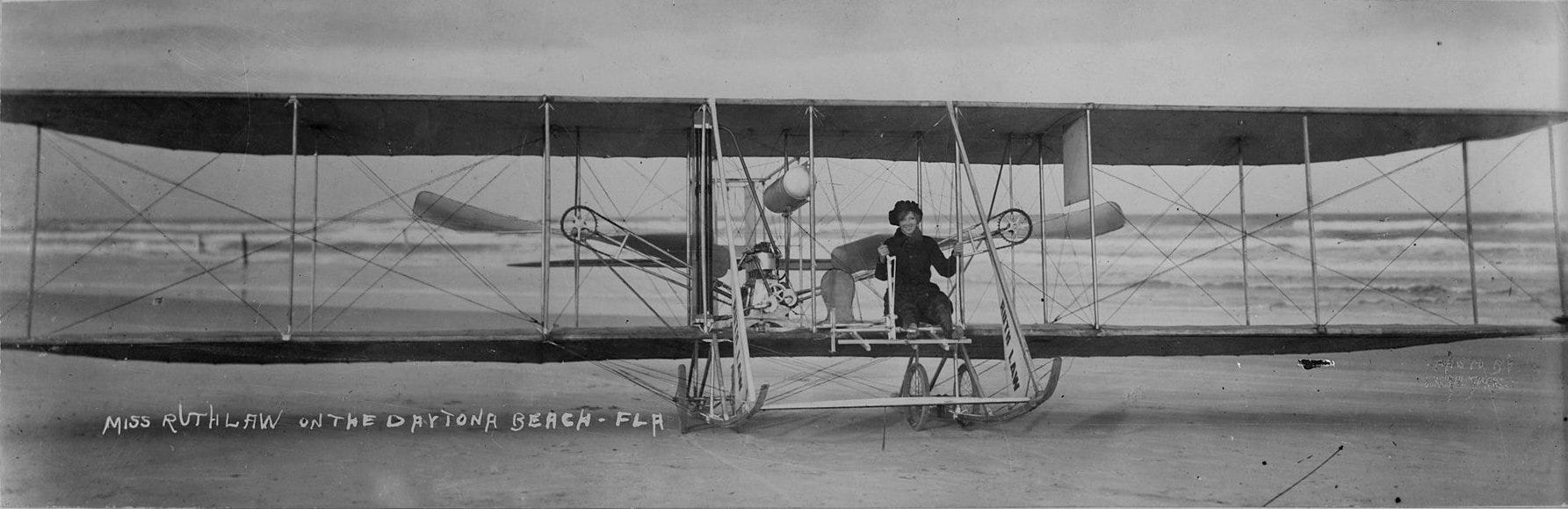
At the hangar, Law and her mechanic got the plane and passenger ready to fly. Preparations were nearly complete when the party realized they didn’t have a baseball.
In a 1958 account of what happened, Law said the ball was accidentally forgotten (though she herself seems to have forgotten Frank Kelly was even there). She told her mechanic about the snag, which threatened to derail the whole operation. The unnamed mechanic, a natural problem-solver, looked around the workshop and found a replacement in lunch sack. “Here,” he told Law, “you can use this. It’s about the size of a baseball.”
He tossed her a grapefruit.
Several Brooklyn newspaper accounts from the next day back up most of Law’s recollection. These sources said that Kelly had genuinely forgotten to bring a ball up with him. One account said Kelly “found” a grapefruit in the plane, which is absurd, as the Wright Model B had no fruit storage compartment. The other account said Kelly was “handed a large grapefruit as a substitute for the ball.”
Neither of those accounts suggested Robinson was the victim of a premeditated prank. Intending to drop a baseball but without one on hand, Law and Kelly pivoted to citrus.
Law pushed off and soon had her plane up in the air. She banked toward the ballpark and ascended up to at least 500 feet up. Some accounts said higher, but 500 seems right. Robinson would have known that it was possible to safety catch a baseball dropped from that height, because others had done it. Above that, no one knew.
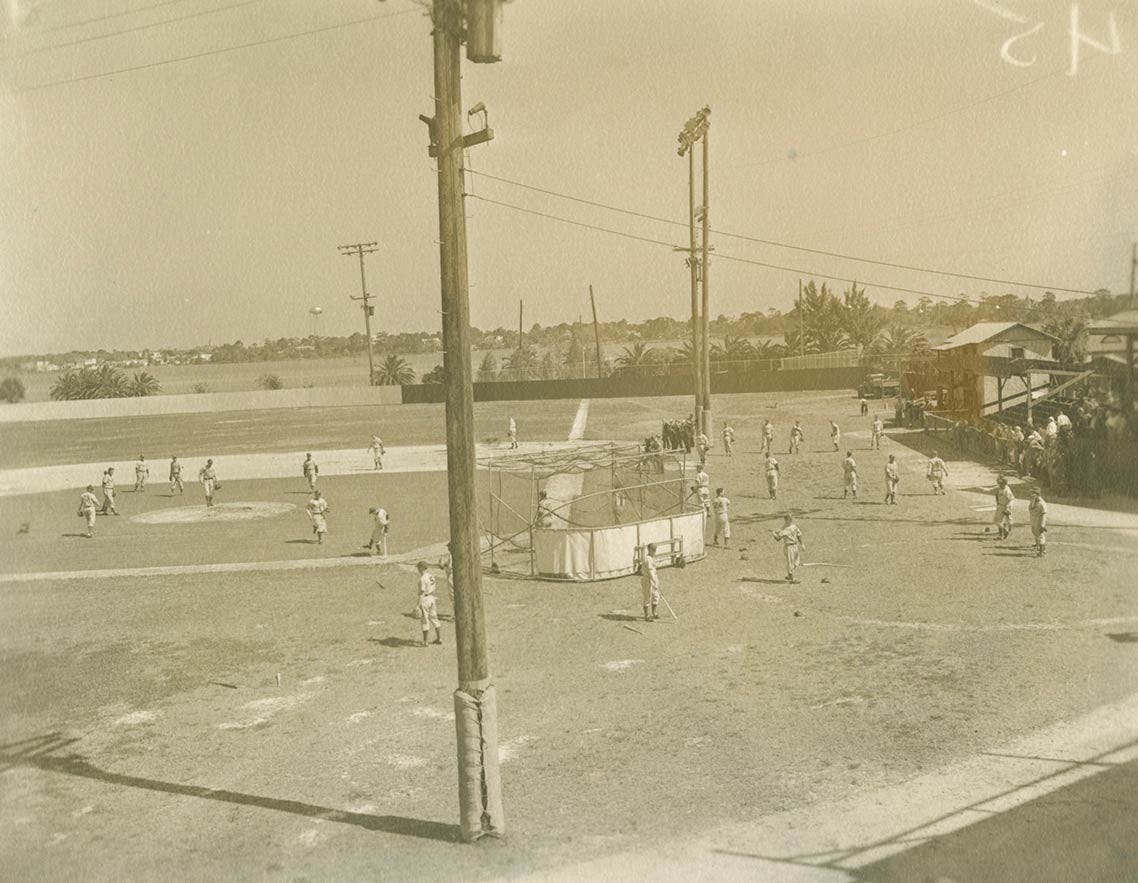
The old catcher had borrowed somebody’s gear and had his big mitt with him. The target was the pitcher’s mound, and the Dodgers grouped loosely around the diamond, scanning the skies.
Law approached at around 45 miles an hour. She had to keep both hands working two different control levers at all times, so it would have been difficult for her to line up a careful throw. That made Kelly an early bombardier, and he turned out to be a pretty good one.
Law circled over the park so Kelly could get a sense of how things moved underneath him. Once he had a decent gauge of this, Law moved off to line up a bombing run.
Robinson extended his his arms, searching for a target. He saw something drop and began running in tightening circles underneath “in great style.” He shouted at the knots of players. “Stand back, give me room!” The pea-sized object descended on a straight line into the pitcher’s box, a bullseye for Kelly. It swelled up to intimidating size as it got close. Robinson braced his legs and stretched his glove arm out to make the catch. He almost got it.
Robinson had gauged the ball’s path correctly, but he stopped just short of committing to the catch. Casey Stengel said he saw Robinson pull his catching arm back at the last second. Most accounts say the “ball” impacted on his left wrist, just past the portion covered by his mitt, and exploded, spraying his face and chest with unexpected pulp and juice.
The force of impact threw him backward into what was described as “a neat little somersault” as he tumbled to the ground, thinking, quite reasonably, that he had been maimed. The acid of the juice stung his eyes and he was covered in soft, fleshy chunks. He ended up seated on the diamond, feeling for the hole the “ball” must have bored into his chest.
Robinson eventually managed to clear his eyes and look down, seeing that he was covered in fruit. He was clutching his stomach and feeling gingerly through the yellow pieces of broken grapefruit and burst rinds when the Brooklyn players reached him. He looked up at them in anguish.
“Good God, it’s punctured my belly. Look, here’s the grapefruit I had for breakfast!”
Overhead, Ruth and Kelly congratulated each other on a successful mission. Daytona Beach’s resident aviator tipped the plane’s wings and flew off, leaving Wilbert Robinson to his fate.
The players howled with laughter, a callous sound in their manager’s ears, as he awaited the bitter end. They helped him to his feet and tried to explain that what he thought was his life’s blood was actually grapefruit juice. It took some time for this to sink in, but when it did, the great sports writer John Lardner said Robinson gave a “famous speech,” in the tradition of great American orators like Patrick Henry and Abraham Lincoln. Lardner recorded Robinson’s words for posterity: “XXX!!!XXVW!!-X”1
The players scattered, chased away by some of “the most blistering language ever heard” in the region. Kelly got more of the same when he returned to camp.
Stengel said that once Robinson figured out he’d been had, he pointed the finger in the outfielder’s direction, accusing Stengel of a plan to deceive him from the start. As best we can tell, this was not the case, but it began Stengel’s long and erroneous association with the stunt, which he eventually embraced.
“It was a good thing it was a grapefruit and not a real baseball,” Stengel pointed out, “or else it might have killed our manager. He would have liked it even less if it had been a ball.”
Robinson stalked off, wiping grapefruit off his face and muttering darkly. Some accounts say that he eventually realized the substitute spheroid had saved his life, but others said that for the rest of his life he insisted that if he had been thrown a ball, he would have caught it properly. Either way, there were no follow-up experiments that spring. One attempt was enough.
It’s a great story, and it’s absolutely true. You can quibble over the details of the operation or whether Robinson was pranked on purpose or by accident, and different versions of the story end in different punchlines (“...the grapefruit I ate for breakfast!” is by far our favorite), but the record clearly shows that Ruth Law (and Frank Kelly) went up with a grapefruit and threw a 500-foot bullseye to the unsuspecting manager waiting below, who, covered in yellow2, citrusy viscera, assumed he was dead.
But, is this really how Florida’s Grapefruit League got its name? Many latter-day accounts say yes, couched with qualifying language—“legend has it,” “the story goes,” etc.—but we’re not convinced. We weren’t able to find any sources that did more than circumstantially link the term to this story, and “Grapefruit League” doesn’t start showing up in the print record until nearly a decade later.
The first usage we found in a periodical appeared in 1923, in a nationally published article by John B. Foster, a pretty big name in sports writing at the time. In a March 15 report from Orlando, Florida, Foster mentioned that baseball’s commissioner, Kenesaw Mountain Landis, was touring baseball’s Florida-based clubs, which the writer referred to as “the Florida orange and grapefruit league.”
The name trickled into regular use after that, but never in connection to the story of Robinson and the grapefruit. It would be wonderful if the Grapefruit League was named in honor of this ridiculous escapade, but the truth is probably more pedestrian. There are a lot of grapefruits (and oranges) in Florida, making a pretty good emblem for an association of Florida-affiliated teams. Someone, perhaps John Foster, put two and two together.
The Dodgers seem to have gotten more comfortable availing themselves of Ruth Law’s flying service after the grapefruit incident. Several players were reported to have gone up with her on the afternoon of March 14. A few days later, the Daytona Daily News said 18 members of the club had taken flight.
Wilbert Robinson was not among them. He offered his free trip to the manager of the visiting Birmingham Barons, Carlton Molesworth, who also passed.
“Fifteen dollars is a pretty stiff price for a fellow to pay for a three-minute trip,” Molesworth said, “but I had one offered to me for free and I still turned it down, slick as a whistle. This gravity business that draws the people back to the earth with a sudden bang is a little too strong to suit me. I wouldn’t go up in one of those things if some kind friend should offer me fifteen spots to make the trip.”
One hulking Dodger prospect was seen climbing aboard on a Sunday afternoon. By the look of him, Bill Goodbread “wouldn’t be afraid of a whole cage of lions,” but his lip had a noticeable quiver and he admitted to a fear of heights.
Law “reassured him,” saying she would fly low and bring the plane down as soon as he gave a thumbs-down. Goodbread lasted about 100 yards before turning an alarming shade of green.
The parties soon went their separate ways in history. Robinson and the Dodgers left for a fine season in Brooklyn, while Ruth Law wrapped up her time as the Hotel Clarendon’s pilot-in-residence. The pay was steady—she might have been the first woman ever employed as a pilot—but taking tourists and terrified first basemen on short, routine flights left her unfulfilled. She sold her Wright Model B and purchased a new plane, a single-seat Curtiss Model D.
In November 1916, Law flew her Curtiss 590 miles from Chicago to New York, breaking the record for fastest nonstop flight by a man or a woman (“by any pilot,” Law liked to say). Long-distance flights were tremendously difficult in early aircraft. Law had to keep her left hand on the left stick that controlled the plane’s pitch at all times, and the right stick required only a little less attention. There was no practical way to consult a handheld compass, let alone a map, so she marked her compass readings on her flying gloves and cut her maps into small strips, wound into a special case that she could quickly unroll and consult while bracing the right stick with her knee. Backed by a strong wind blowing to the east, she averaged about 100 miles an hour at an altitude of 6,000 feet.
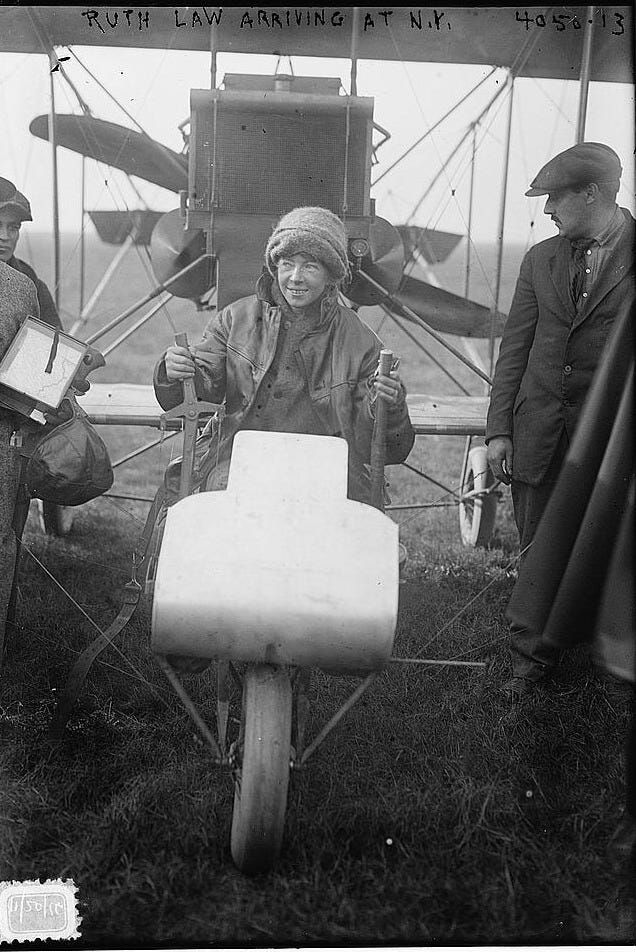
When the United States entered World War I, Law pushed the army to accept women as combat pilots. She wrote a passionate op-ed for an aeronautics magazine, pointing to what she and other female aviators had accomplished as proof they could contribute to the cause.
She wrote that if President Woodrow Wilson told her to “go get the Kaiser,” she would feel “a little remorseful at having to end a life,” but for the most part she would be all business, “watching my motor, dodging German planes, jockeying, dipping, darting to the spot where I would release my bombs.”
Law got all the way to France, but was not permitted to enlist or take a combat assignment. The military did give her plenty of work. She dropped Liberty Bond pamphlets and participated in exhibitions raising money for the Red Cross and Liberty Loans. To boost her visibility, the Army authorized Law to wear the uniform of a non-commissioned officer during these exhibitions; she was the first American woman to do so.
After the war, she started “Ruth Law’s Flying Circus.” Three pilots, three planes, and some breathtaking stunts. In one showstopper performance Law would unstrap herself from a plane’s passenger seat and creep out onto the wing, where she stood upright while the pilot went into three consecutive loops. The centrifugal forces kept her in place. Spectacles like that helped her earn up to $9,000 a week, though her fee was negotiable. She once did an exhibition for a woman’s suffrage campaign in exchange for a chocolate cake.
In the spring of 1919 she battled with another pilot, Raymonde de Laroche, in a back-and-forth altitude competition. On June 10 Law flew up to 14,700 feet, claiming the world record for a female pilot from de Laroche. The French pilot reclaimed her crown two days later, reaching 15,748 feet.
It was all in a day’s work for Ruth Law. In the late 1910s and early 1920s she was a household name in America and in Europe, heralded as the greatest woman stunt and exhibition flier, admiringly styled as “the Queen of the Air.”
On February 24, 1922, papers across the country announced that Her Royal Highness was retiring.
“People have lost interest in flying,” she was quoted as saying. “Besides, I have decided that it is better to be listed as a great ex-aviator than having my friends mourn my death.” Those fatalistic comments came as a surprise to many Americans—including the person who had supposedly made them.
In fact, the retirement announcement and the quote attributed to Law had been written by her husband and manager, Charles Oliver. Oliver did not so much as discuss the message with his wife before, or after, transmitting it. Ruth Law learned of her retirement at breakfast when she opened a newspaper.
In what must have been quite the confrontation, Law found out that Oliver, who had never been fully at peace with her life in the air, was nearing a breakdown. He told her that watching her crawl out on the wings of planes had become unbearable.
We try to be mindful of our biases here at Project 3.18. People deserve to be considered in the context of their own lives and times. Still, Charles Oliver’s behavior seems inescapably outrageous, a breach of his partner’s trust and agency. Even in 1922, his method seemed to raise some eyebrows. A few weeks later, Law gave an interview to a writer in Chicago, clearly on a mission to protect her husband and confirm that she was really retiring. Even with our biases at arms-length, some of it is tough to read.
“It’s my husband’s turn now. I’ve been in the limelight long enough. I’m going to let him run things hereafter—and me, too.”
“I’ve been married for almost ten years to Charlie Oliver,” she said, “and scarcely anyone knew who he was. And the poor boy was so worried about me all that time that every time I went up he lost a pound. It was a matter of choosing between love and profession. Of course, I’m just crazy about flying, but one’s husband is more important.”
She’d considered keeping a small plane for personal recreation but ultimately decided against it. “Mother earth is the best place to be. Flying steels the nerves and all that sort of thing, but there is such a warm and comfortable feeling when on the ground.”
The interviewer asked what must have been a pretty forward question for the time: Was Law retiring in “obedience to her husband’s command?”
“Mercy, no,” she said. “Husbands these days don’t ‘command.’ They request.”
Ruth Law lived at a time when women could more easily slip the bonds of gravity than those of cultural subordination. In the context of 1922, it was possible for Law, an advocate for women’s suffrage and gender equity, to lose a tie vote within her own marriage. Law went along with what her husband wanted, but she wanted people to know that somewhere in that mess, she had made her own choice.
The couple moved to California. Law participated in a number of civic and national organizations, including the Early Birds, a group supporting early aviation pioneers. She served on the board of the National Aeronautic Association. And she stayed on the ground.
What Charles Oliver did with his “turn” is not known today. He died in 1947.
In 1958, an aviation trade magazine caught up with Ruth Law. Then 71, the nearly forgotten Queen of the Air acknowledged that she walked away from flying out of concern for her late husband and rarely looked back. According to the interviewer, “Law’s early colorful career seems to her now as though it had happened to someone else.”
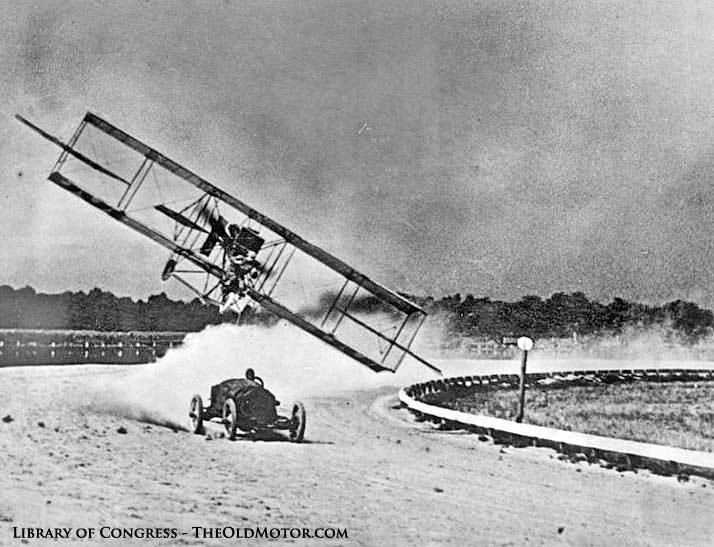
She had not forgotten, though. When prompted, she recalled a certain episode involving some baseball players and a grapefruit. She remembered swooping low between tall buildings, soaring over the trenches in wartime France, taking her plane through plumes of exploding fireworks, and racing automobiles around a track. Those races stuck with her. “I could always beat the autos on a half-mile track, but on a mile track they often won. It was really exciting to fly that low.”
Back in September 1921, six months before she consented to a surprise retirement request, Ruth Law, ringmaster of her own flying circus, wrote a series of autobiographical articles for a Michigan newspaper. She was 35, a wealthy business-owner at the top of her profession. The final article in the series tackled a question she got all the time: Would women “make good” in aviation?
When girls came to her seeking advice on becoming a pilot, Law confessed she was torn. Examining her own career, she saw challenges, disappointments, brutally hard work, and no small amount of what she perceived as luck. Given the headwinds these girls would face as pilots, Law wondered if she should advise them to stay on the ground, but she always ended up inviting them to try.
I would realize that perhaps this girl is capable and willing to work just as hard as I did. What one woman can do, there are bound to be other women who can do the same thing. What right have I to discourage them?

Today we learned that using symbols to stand in for profanity is called “grawlix.” The practice originated all the way back in 1901.
The only description of the grapefruit that hit Robinson was a color: “yellow.” This suggests it was not the common pink/red grapefruit, which has an orange rind. It was probably a white grapefruit, a more boutique variety today. Despite the name, white grapefruits are predominantly yellow.

Paul - Brilliant work, as usual. "The force of impact threw him backward into what was described as “a neat little somersault” as he tumbled to the ground, thinking, quite reasonably, that he had been maimed. The acid of the juice stung his eyes and he was covered in soft, fleshy chunks. He ended up seated on the diamond, feeling for the hole the “ball” must have bored into his chest.
Paul, another interesting & fruitful article. I’m just glad all this didn’t occur next to the Mexican border or they’d be dropping watermelons instead.