


Welcome to Project 3.18, where a fan-first writer tells strange and surprising stories from baseball history and culture.
If you enjoy what you read today, please subscribe to receive our free feature stories in your inbox. And if you’ve been here for a while, we could really use your support as a paid subscriber. Paid subscribers receive access to exclusive content and help keep this publication going and growing.
On February 19, 1944, Warren Giles, vice president and general manager of the Cincinnati Reds, announced the club had signed a left-handed pitching prospect. Nothing unusual about that, but two details of this particular signing were decidedly strange. Giles said the new pitcher would skip the minor leagues and go straight to the major-league club—but not until June, because before he could report, Joe Nuxhall, age 15, had to finish the ninth grade.
In response to manpower shortages, professional baseball teams, including the Reds, had relaxed certain standards in search of playable talent, and Nuxhall’s age immediately put him squarely among that motley crew of wartime baseball players. Giles acknowledged the team was being more creative than usual, but he insisted Nuxhall was a real prospect. “We aren’t signing him because of the war situation.”
But even if it wasn’t a stunt, the Reds weren’t going to shy away from the obvious angle. “He will report almost two months before his 16th birthday,” Giles promised. “It is possible that he will appear in a National League game at the age of 15.”
At the time of his signing, Joe Nuxhall could not drive, vote, work, or even shave, but he could turn heads. He was six feet, three inches tall, with a large head, a “lantern jaw,” a left arm likened to a tree trunk, and enormous hands that “hung like bunches of bananas.” No one could deny his was a frame to dream on.
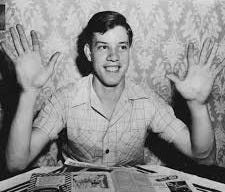
Nuxhall was already a sporting legend in his hometown of Hamilton, Ohio. As the center for the Woodrow Wilson Junior High basketball team, he practically delivered the school back-to-back championships. Nuxhall dominated his competition so thoroughly that the school principal didn’t let him play offense during “friendly” games, as it was unfair to the other kids. When he was allowed to shoot in competition, he scored an average of 21 points per game. But as good as Nuxhall was at basketball against other kids, he was even better at baseball—facing adults.
In the early 1940s, more than 500 major leaguers interrupted their careers to enlist or answer the summons of their local draft board. Still more professionals left the Negro Leagues and the minor leagues throughout the country. The war was a careless, rummaging hand inside baseball, plucking out what was useful and leaving behind a jumble of odds and ends. The pace of call-ups and send-downs increased dramatically as the remaining players were shuffled around to replace those gone to war, and every player who got a shot in the majors probably created a hole somewhere else.
The Reds were hardly the only team resorting to searching underneath the proverbial couch cushions for bats and arms. In 1943, Branch Rickey, the era’s baseball genius, sent form letters to 20,000 high school coaches nationwide, looking for projectable talent. 2,000 hopefuls attended the subsequent tryouts, and 400 of them received contracts to play in the Dodgers’ farm system. One of them was future Hall-of-Famer Duke Snider.
After a similar round of local tryouts, Philadelphia’s Connie Mack was intrigued by a skinny, 5’ 6” infielder and invited him to join the Athletics for spring training in 1944. Nellie Fox was 16 years old and so green he showed up wearing a Boy Scout pin in his jacket lapel. After that spring, Fox was sent down to the minors, but he’d be back.
The Reds, meanwhile, had bird-dog scouts scouring sandlots throughout the Ohio Valley, and they’d heard good things about an amateur pitcher named Nuxhall.
Orville Nuxhall worked in a factory making locomotives and diesel engines at the time. This was 1943, so his machinist’s job supported a wife and five children and left him plenty of free time to indulge in his passion for baseball. Tall and strong at 34 years old, Orville was well-known in Hamilton, Ohio’s Sunday Baseball League, where the hard-throwing right-hander was called “Ox,” and that’s who a few Reds scouts came looking for one Sunday in the summer of 1943.
They knew to find their quarry at the Hamilton sports complex, a baseball village in the city of 48,000 people. “There were four diamonds,” Joe Nuxhall recalled, “side-by-side, and there might be five thousand people scattered around. Most of the guys who played were older, sole providers for their families or had health problems that kept them out of the service.”
The scouts walked up to the first diamond off the parking lot, asking after Ox. They were pointed in the direction of Diamond No. 3, where Ox’s team was playing. The scouts were about to move off when the teams on this field, No. 1, changed sides and a new pitcher took over. He was left-handed, very young, and very tall.
“Who’s that?” the scouts asked.
“Oh, that’s Ox’s son.”
Ox’s son had been coming to the sports complex with his father since he was nine years old. “I pitched a little bit when I was twelve,” Joe said. “By the time I was fourteen I was pitching every Sunday.” At that point he was playing in a league where the youngest players were 18 and 19, but an exception had been made Joe, who regularly struck out 10-12 adult batters per game with an 80 mile-per-hour fastball.
Seeing that fastball, the Reds’ scouts stuck around a Diamond No. 1 a little longer.
Orville Nuxhall wasn’t forgotten. “They were just looking for people who had ability,” Joe recalled. At the end of the day Joe’s father received a contract offer to pitch for the Reds’ Class C team in Ogden, Utah, but he couldn’t make it work. “[Orville] had five kids to feed. He couldn’t take the gamble, but the way I always tell it is that I beat my father out for a job.”
The scouts didn’t offer Joe a contract right away, but they did invite him to a tryout at Crosley Field, the Reds’ home park. Like Hamilton’s rec league, the tryout was supposed to be for much older kids, but exceptions fell on Joe Nuxhall wherever he went.
Later that summer, while the Reds rested on an off-day in their schedule, “a motley collection of schoolboys” did their best in front of manager Bill McKechnie and his coaches. During the tryout, the grown-ups’ eyes kept drifting back to the rangy left-hander.
“I had terrific control that day,” Nuxhall remembered. “The catcher just stuck up his glove and I hit it. Nobody could have been more surprised than I was.”
At one point Nuxhall tried a few knuckleballs, but McKechnie redirected him. “Son, cut that stuff out. Stick with the fastball.”
In the war-depleted years, the eldest players on rosters often doubled as coaches, and that included outfielder Estel Crabtree, who got the best look at Nuxhall’s pitching.
“He was much too good for all the other kids,” Crabtree said a few months later. “And boy, how wild.”
I’m working as a plate umpire in a practice game and he’s got those batters diving and ducking, as wild as he is, and I’m diving and ducking back there too, believe me. He was so much better than the rest of them, I didn’t give him all the close calls. Every time I called a close pitch a ball, I could see him bristle. He was smart enough not to say anything, but he glared. I never got any dirtier looks from anybody.
The Reds had expected to be impressed with Nuxhall’s physical gifts, but here was the other essential ingredient: drive. “He’s going to make a pitcher, all right,” Crabtree said.
McKechnie, who had a sterling reputation for shepherding young pitching, agreed, and Joe became the second Nuxhall to be offered a professional contract to play for the Class C Ogden Reds. Like his father, he turned it down.
“We had a real good basketball team [at Wilson Junior High],” he explained later. “We were going for a third championship. I didn’t want to let the other guys down.”
But the Reds didn’t quite take no for an answer. Before Nuxhall’s school year/basketball season began, they invited him to accompany the team on a road trip to St. Louis and get a taste of life in the big leagues.
The Cardinals were World Series champions on their way to a second-straight pennant. Nuxhall made special note of Stan Musial, the right fielder about to win his first Most Valuable Player award. Musial got a hit in every game, and in the second game he went 4-for-5. The Reds lost three out of four, twice in extra-innings walk-offs, but for a 14-year-old sitting on their bench who had never been outside of Ohio, the series was an extended daydream.
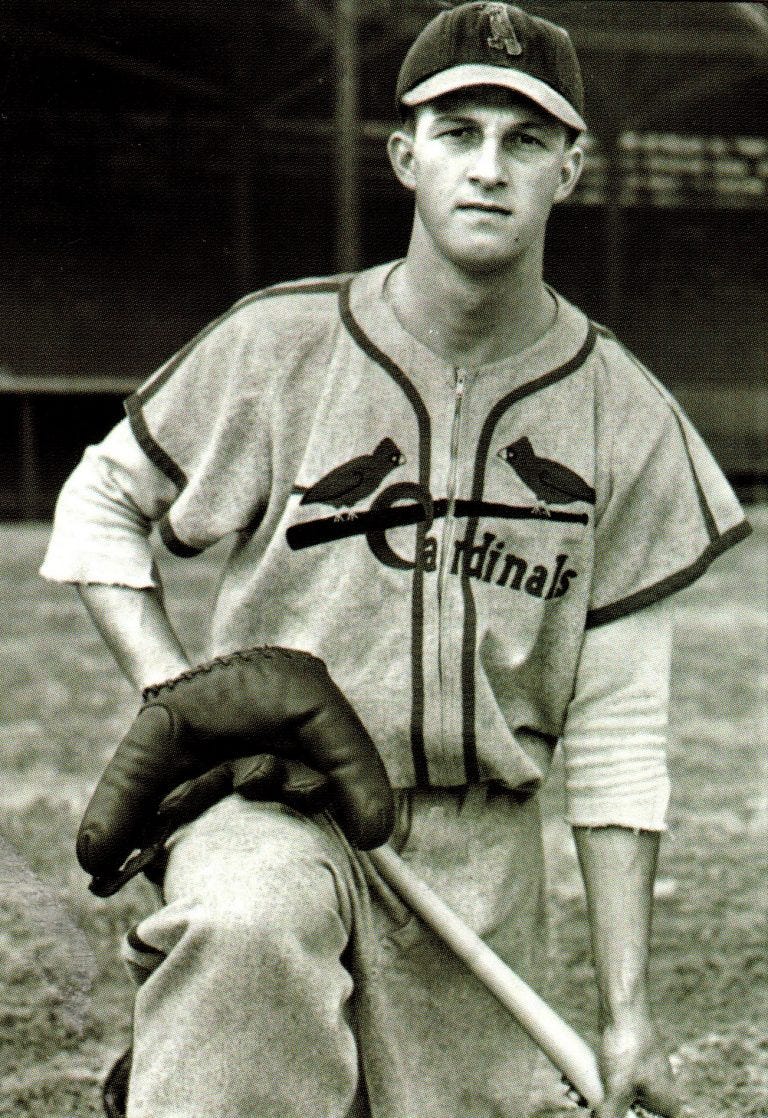
Cincinnati’s traveling secretary gave Nuxhall five dollars of walking-around money, and he blew it all in a batting cage he found near the park. Two Reds, second baseman Lonny Frey and catcher Tony DePhillips, took him out to dinner one night. Nuxhall ordered the steak, a big one.
He pitched batting practice before the games. “I learned a lot from the Reds [on that trip],” Nuxhall said in 1944. “They taught me to hide my grip on the ball, how to properly stand on the rubber, and some more things. But they didn’t tamper with my delivery. I threw the way I wanted.“ His fastball was up to 85.
With Nuxhall back on the floor, the Wilson Junior High basketball team completed a three-peat. Once that banner was hung, he turned his attention back to baseball, reopening negotiations with the Reds. On February 18, they had a deal. Sitting at the kitchen table of the family home on Vine Street, Orville Nuxhall signed an unprecedented major-league contract on behalf of his minor son.
Nuxhall received a $500 signing bonus and a monthly salary of $175. “These days, I probably would have been worth a buck or two more,” he observed in 1983, and the price of banana hands has only gone up since.
Nuxhall received special dispensation from the principal to miss school on April 18, Opening Day at Crosley Field, where he put on his Cincinnati Reds uniform and was introduced as a major leaguer to 30,000 fans.
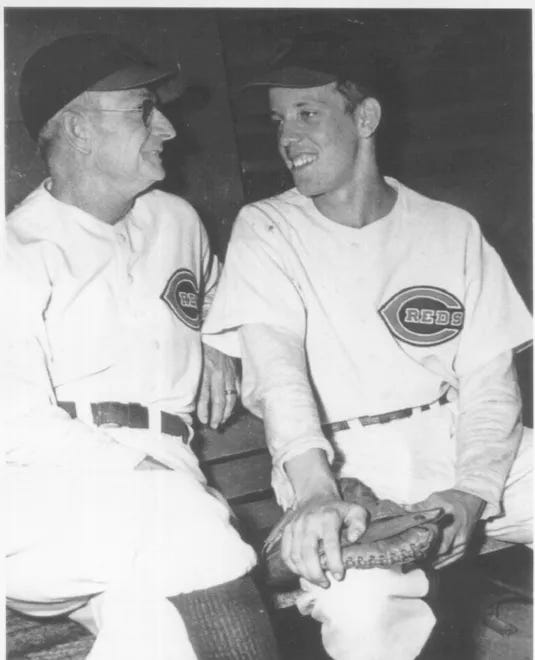
After the ceremonies, he made his way to the dugout bench, which seemed impossibly long. As he sat there, idly twirling his glove, Si Burick, a writer for the Dayton Daily News, made a careful study of this baseball curiosity.
Burick described Nuxhall “a little on the open-mouthed side,” but the kid seemed almost unnaturally cool and composed in the enormous moment. He got tired of sitting and solicited another rookie, catcher Joe Just, age 21, to warm him up. “He is no figure of grace walking,” Burick wrote. “Maybe he never will be. He’s big all over and knock-kneed. But he can throw it, all right.”
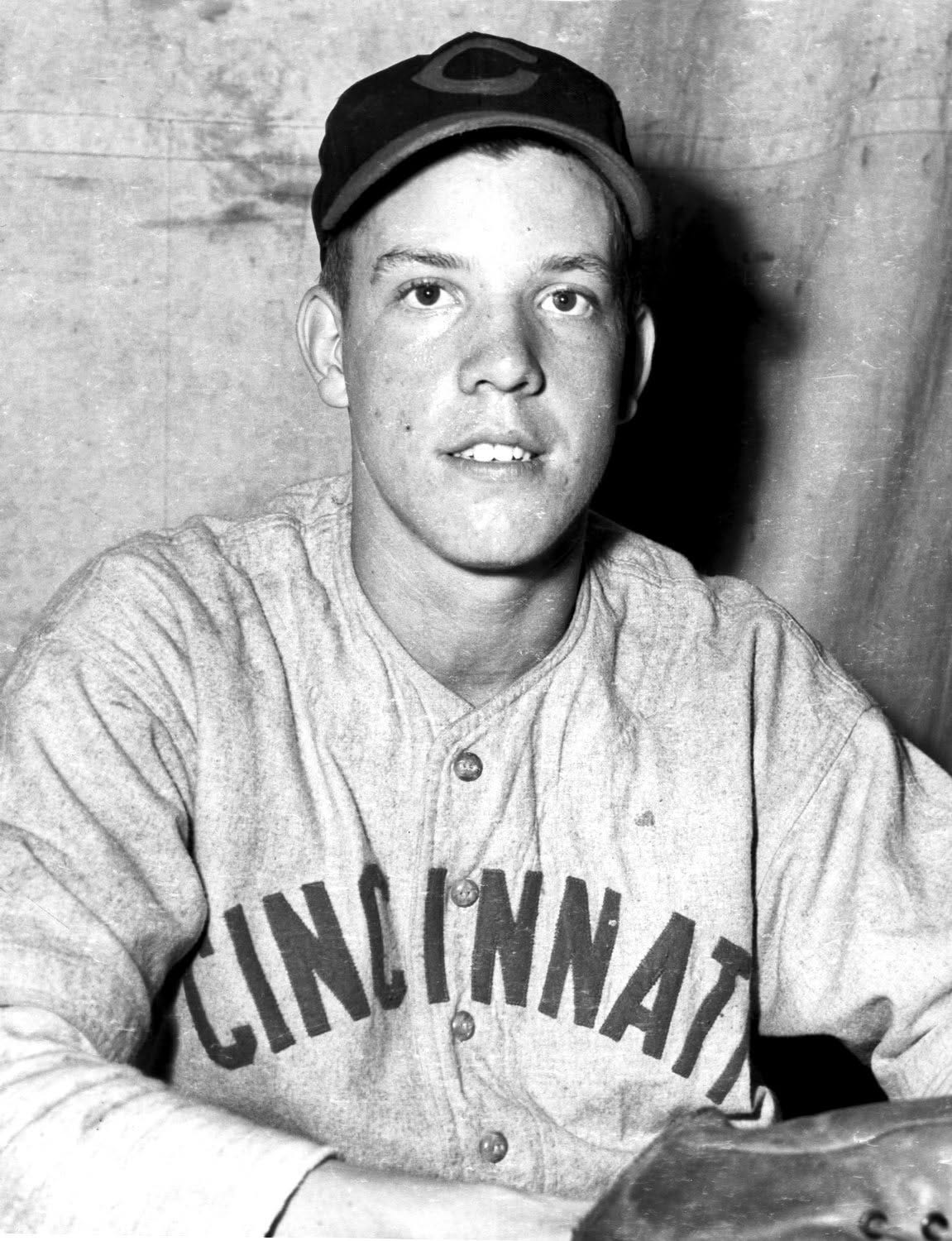
After warming up, Nuxhall wandered back to the bench. As the Reds played the Chicago Cubs, he sat next to center fielder Gee Walker, age 36, who struck up a conversation.
“All right, Joe,” Walker said. “Suppose you’re pitching out there today. What would you throw?” The boy jokingly demonstrated how he’d prepare a spitball, but Walker pressed him for a real answer.
Nuxhall frowned. “I don’t know anything about these guys. I’d have to depend on what my catcher knew about them.”
“In the jams, too?”
“I guess so.”
“Let me give you a tip, kid. And remember it now and for all time. In the jams, no matter what anybody else wants you to throw, you give the hitter what you consider your best pitch. That’s the best thing for you to do when you’re in a hole. Give him your best.”
“Thanks, Gee.” Nuxhall leaned back, staring out at the field.
Walker shook his head, bemused. “There isn’t a trace of excitement in him,” he told Burick, the writer. “No imagination, I guess.”
That spring, Nuxhall joined the Reds for weekend games at home, which amounted to no more than six dates. “No one worked with me too much,” he remembered. “I’d go to the field on Saturday and pitch a little batting practice. My control was terrible and sometimes I’d be lucky to get one out of ten over the plate. After batting practice I’d sit on the bench and watch the game.”
Nuxhall remembered showing up with only his dress shoes, but he soon inherited an old pair of baseball spikes. “The shoes turned up so much that the front spike never touched the ground.” He used a Johnny Vander Meer signature glove that was so broken-in he worried it was on the verge of disintegrating. He knew he must have been quite a sight, but “by golly, I was a big-league ballplayer.”
Too young to drive, he took a bus to the park, paying the 50-cent fare each way and walking six blocks from where the bus stopped to Crosley Field. His parents had their hands full with his younger siblings, and none of his family came out to the park with him. No one, Nuxhall included, expected he would ever actually pitch.
As the weeks went by, he grew restless. He decided he wanted to pitch. That was why he’d signed, and was presumably why Cincinnati had let him stay with the major-league club. “I hope I stay with the Reds,” he’d said after signing contract. “I figure I can learn more from the big leaguers than I can by going to the minors.”
On June 6, 1944, Allied forces began the long-planned invasion of Europe, storming the beaches of Normandy, and Joe Nuxhall graduated from junior high. Two days later, the Reds officially activated Nuxhall and several other newly signed players, bringing the team roster to 27. The organization had until midnight on June 15 to cut that number down to 25, but first they had to figure out what they had, especially with the new “men.”
Warren Giles, the general manager, said McKechnie would decide how to handle their rawest recruit, but offered a vote of confidence. “The boy is big and strong and looked very good in the times that I’ve seen him pitch. He’s got a real fastball.”
But that fastball was all he had. “My curve won’t fool anyone,” he told a reporter. “I call it a curve, but it’s nothing more than a roundhouse that is liable to wind up in the reserved seats.” Perhaps there was a knuckler, but McKechnie had already indicated he wasn’t interested.
On June 8, the Reds began a homestand with four games against the first-place Cardinals. Bucky Walters, Cincinnati’s best remaining pitcher, got the job done that day, allowing one run over nine innings. The two teams had scheduled an off-day on June 9, setting up a Sunday doubleheader, so they reconvened on Saturday, June 10.
It was a hazy summer day, and Crosley Field swam in heavy, humid air, but there was nothing heavy about the balls flying off the Cardinals’ bats. Unlike the war-depleted Reds, the defending National League champions had managed to fend off the draft lottery gremlins and remained at nearly full strength. With shortstop Marty Marion, center fielder Johnny Hopp, the brother battery of Mort and Walker Cooper, and Stan Musial, one jealous Cincinnati writer described the Cardinals as “the only team in the majors which even remotely resembles a big-league outfit.”
These big-leaguers chased starter Bill Lohrman, another call-up, during a six-run second inning. At least Lohrman recorded a few outs. His replacement, Ed Huesser, gave up four straight hits and two more runs scored. Nuxhall watched his teammates’ struggles with wide eyes, thinking, “Geez, these guys can hit.”
A third Reds pitcher, Buck Fausett, staunched the flood to a steady stream, allowing five more runs over the next six innings. Every Cardinal had at least one hit and most, including Mort Cooper, the pitcher, had two or three.
When Fausett gave up two runs in the eighth inning, McKechnie threw in the towel. The Reds were losing 13-0, and there was nothing left to do but try out some of the team’s new pitching before the upcoming roster deadline. McKechnie knew who he wanted to see first.
“Joe!”
Down at the far end of the bench, Nuxhall didn’t react. There was no reason McKechnie would want to talk to him in the middle of a game. He figured the manager was calling for Joe Just, who’d taken over at catcher during the blowout.
“Joe!”
Nuxhall turned and found McKechnie looking right at him. Now that he had the kid’s attention, the manager jerked his head in the direction of the Reds’ sideline bullpen.
“Go warm up.”

In the conclusion, Joe Nuxhall makes history and—for the first time—Project 3.18 exposes the shadowy figure who made it all happen.

If you enjoyed this baseball story and want to support Project 3.18, consider becoming a paid subscriber.
You can also really help us by sharing this feature on socials or restacking it here on Substack. Publishing a story is how we get on base; please help spread the word and drive us home.
Over on Clear the Field:
Ted and I revisit an intergenerational battle at Detroit’s Tiger Stadium in 1980, when a normally patient executive is pushed to his breaking point by beach balls, loose change, and strategically hidden flasks of rum.

Nuxie's story is a great one, and I don't want to spoil part 2 for anyone who doesn't know how the kid's career turned out, but he owns a record that absolutely will never be broken.
The sad part of the story is that there was an entire population of highly skilled and willing ball players who could've helped prop up MLB and fill some of the war time vacancies. They just had the wrong skin color.
Imagine how they felt watching the Reds sign a 15 year old kid. Or the Browns sign a dude with 1 arm (Pete Gray) and the Senators use a pitcher with 1 leg. I mean, kudos to Pete and Bert and Joe but it must've been quite an insult to the men.
This is a great story, Paul. Really looking forward to part 2.