


Welcome to Project 3.18, where a fan-first writer tells strange and surprising stories from baseball history and culture.
If you enjoy what you read today, please subscribe to receive our free feature stories in your inbox. And if you’ve been here for a while, we could really use your support as a paid subscriber. Paid subscribers receive access to exclusive content and help keep this publication going and growing.
This is the story of the 1944 debut of Joe Nuxhall, the youngest player to ever appear in a Major League Baseball game. Here’s the set-up, if you need it:


“Joe, warm up!” Bill McKechnie yelled. After eight innings, McKechnie’s team was losing, 13-0. Three pitchers had already been torched by the Cardinals’ offense, and the Reds’ manager figured Joe Nuxhall, even at age 15, couldn’t be any worse.
Hearing his name, Nuxhall looked at the manager. He pointed to his chest, as if there might be another Joe Nuxhall pitching for the Reds he hadn’t met in his brief time with the team. Me?
McKechnie nodded. You.
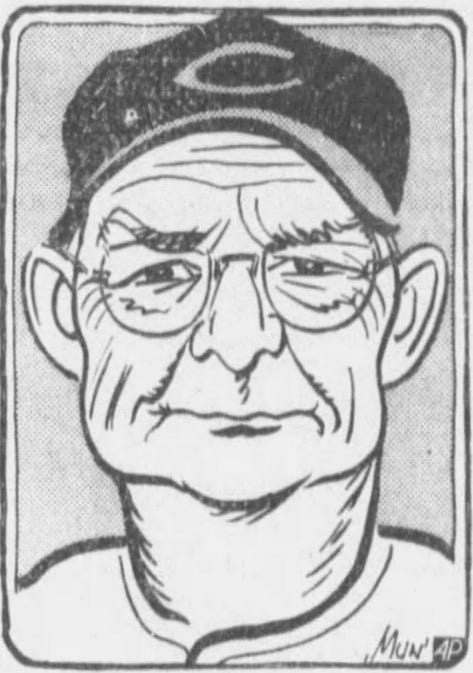
“This was the fifth or sixth big league game I’d ever seen, and I was just sitting there like a spectator,” Nuxhall recalled. “One second you’re admiring the scenery and the next second you’re being told to get in the game. Changes your thinking a little bit.”
He clutched his deteriorating glove and clambered up the dugout steps in donated spikes with turned-up toes. He made it up the first two steps but the last step got him and he spilled out of the dugout and nearly fell on his face. He could smell the dirt. Some in the crowd of 3,510 people laughed; His teammates were nice enough to cover their faces. He walked—carefully now—to the sideline bullpen in short left field, but his face was as red as the “C” on his cap.
Al Lakeman, age 25, greeted him in the bullpen. Lakeman was the bullpen catcher, with limited big-league experience during the war years. Barely more than a kid himself, he began warming up a pitcher 10 years younger.
“In the bullpen at Crosley Field you threw toward the left-field fence,” Nuxhall said. “Poor Al couldn’t even touch the ball. I sent him up the terrace three or four times chasing my wild pitches. He would yell ‘follow through,’ and this, that, or another thing, but I was throwing the ball over his head and all over the damned place.”
Soon it was the top of the ninth. Lakeman gave Nuxhall an encouraging pat on the back and half-shoved him toward the vacant pitcher’s mound.
The Reds’ catcher was Joe Just, age 21, another fringy wartime player with limited game experience. Like Nuxhall, Just was only in the game because McKechnie had given up on winning it. Communication between the inexperienced battery was not a problem. “He didn’t need any signs,” Nuxhall said, “because all I could throw was a fastball.”
At the Nuxhall family home, Joe’s mother, Naomi, was listening to the Reds’ game on the radio, some white noise in the room while she did the ironing. All of a sudden she heard play-by-play announcer Waite Hoyt say a name she never expected him to say. She put the iron down with trembling hands.
“I was in another room,” Don Nuxhall, one of Joe’s younger brothers, recalled. “I heard her yell, ‘Joe’s in the game!’” Don couldn’t tell if she was excited or distressed.
Joe Nuxhall never forgot his bewilderment out on that mound. He didn’t recognize many of the batters he faced, starting with Cardinals infielder George Fallon. All he could do was shove it and hope for the best.
Nuxhall’s first pitch in the major leagues was a strike. Fallon worked a full count and grounded out, and the kid had cleared the first step. The Cardinals’ pitcher, Mort Cooper, batted second. Nuxhall threw another first-pitch strike and Cooper swung through it. The next three pitches were well out of the zone, but Nuxhall got another swinging strike and another full count. Cooper walked and the Cardinals’ lineup turned over.
Even young Joe might have recognized the Cardinals’ starting center fielder, Johnny Hopp, but Hopp was out of the game, replaced by a reserve outfielder named Augie Bergamo. Nuxhall started Bergamo with two swinging strikes, then threw a wild pitch that went to the backstop while Cooper advanced to second. Bergamo fouled two pitches then hit a lazy pop-up caught by the Reds’ shortstop.
Nuxhall had cleared the second step. His wildness had served him, keeping the Cardinals from digging in. “They knew I was throwing nothing but fastballs, but nobody was ready to stand in there. They didn’t know where the ball was going and neither did I.”
The next batter was third baseman Debs Garms, a left-handed former batting champion. Nuxhall started strong again, getting two quick strikes. He was on the third step now. He glanced idly at the on-deck circle, and what he saw there made him do a double-take.
“I knew who Stan Musial was,” Nuxhall said. “I look up and there he’s standing. That’s when I realized exactly where I was.” Nuxhall was like Wile. E. Coyote, running blithely off a cliff with no difficulty—until he stopped to look down.
I thought, “Geez, three weeks ago I was pitching against 12-, 13- and 14-year-olds, seventh, eighth, and ninth graders. Now here’s Stan Musial in the on-deck circle.” After that it was, ball one, ball two, ball three, ball four. I walked Garms and all hell broke loose.
Garms trotted to first and Musial stepped into the box. Nuxhall watched him dig in comfortably, coiling his body into the famous corkscrew stance. Nuxhall vividly remembered seeing the “6” on the back of Musial’s jersey.
“The thing that amazed me,” Nuxhall said, “is that the Cardinals were ahead 13-0, but Musial was standing there like it was a 1-0 game. I would have thrown him a curve, but I didn’t have a curve. All I had was a fastball.”
He was in a jam, and it was time to try out Gee Walker’s advice. Nuxhall reared back and threw his best fastball. Decades later, he could still see that same ball “zoom by” in the other direction. “Wham! He hit a rope to right field, absolutely shillelaghed it. That one loosened my knees.”
The runners advanced a base. No one scored, and there were still two outs. He’d given up his first hit in the big leagues to Stan Musial. Nothing to be ashamed of, but according to one writer, the kid “fell apart like ashes” after that.
First baseman Ray Sanders walked and drove in a run. Just, the catcher, trotted out to the mound to try and settle Nuxhall down. “Boy, that was as useless as anything. I didn’t even hear what he was saying.”
Walker Cooper, the Cardinals’ catcher, walked and another run scored. Left fielder Danny Litwhiler walked and a third run scored. It was almost mesmerizing.
Nuxhall surely did not recognize Emil Verban, another late-inning substitute for St. Louis, but Verban gave him something to remember, another ringing single that drove in two more runs.
Bill McKechnie had seen what he needed to see. He popped out of the dugout and marched briskly to the mound. “Well, son, I think you’ve had enough,” he said, gently. He stuck out his hand for the ball.
Nuxhall walked off the mound in a daze, his head low and his eyes on the ground. Returning to the dugout, he passed over the marks he’d made earlier, tumbling onto the field. He could still smell the dirt.
A writer in 1944 spoke with Nuxhall after the game. The young pitcher dropped into a chair and seemed preoccupied with the Reds emblem on his shirt. “I’m lucky,” he said. “Never thought I’d be pitching in the big time at fifteen. Guess lots of kids would like to do that.”
Warren Giles, the Reds’ general manager, chimed in. “You did all right,” he said, trying to buck Nuxhall up, “until Stan Musial came to bat.”
The boy nodded. “Guess then is when I was really nervous. Things weren’t going right. I walked the next three men…I don’t know who they were.” He apologized to the reporter. “You see, sir, I don’t know all their names yet.”
Later in life, Nuxhall recalled being summoned to Giles’ office. “He was very nice to me. He said, ‘Go down [to the minors] and get some experience.’”
With no family or friends in attendance, there was nothing for Nuxhall to do but walk the six blocks to the bus station, pay his 50 cents, and ride back to Hamilton. Two days later he boarded a train bound for Birmingham, Alabama, home of the minor-league Birmingham Barons.
Nuxhall knew what people wanted when he told the story of that first game, and in four different decades he often wrapped it up with a gauzy, dreamy what-if:
I’ve often wondered what might have been if I had gotten that third strike to get out of the inning. It might have been interesting. Maybe I could have stayed up there for a season or two until the guys got home from the war. Maybe they would have said, “Let’s take another look at this kid.”
Perhaps a butterfly’s wings might have pushed him safely past Stan Musial and over that treacherous third step, but his experience in Birmingham suggested otherwise. “I had a hard time getting started there. I’d throw batting practice. I hit two or three guys and the manager said, ‘Hey, that’s enough.’ They wouldn’t even let me throw batting practice.”
He eventually got a chance in Birmingham, similar to the one he’d gotten in Cincinnati, for better and worse:
They decided to promote the fact that I was there to try and put some more people in the stands: “Come out and see the fifteen-year-old kid pitch.” So, the day comes and there’s a good crowd, ten thousand people. But I only lasted a third of an inning. I walked five, gave up a hit and five earned runs.
Coming off the field, he threw his glove out into the crowd.
Nuxhall didn’t travel with the Barons, so he hung around the ballpark, Rickwood Field, also home to the Birmingham Black Barons of the Negro American League. One of his enduring memories of that summer was watching Satchel Paige, then pitching for the Kansas City Monarchs, perform his famous gum wrapper trick, spotting his pitches so perfectly it looked like they were traveling on wires.
All told, Joe Nuxhall pitched one inning in 1944, giving up three hits, 10 walks, and two wild pitches, producing an ERA that looked like a basketball score. He knew it didn’t look good. “I’m sure many people thought, ‘Well, that’s the last we’ll ever see of that kid.’”
Nuxhall spent spring training with the Reds in 1945. He was farmed out to Syracuse, the Reds’ upper-level farm team, where he was still a decade younger than many of his teammates. After struggling with the Chiefs, the Reds sent him to Class D ball in Lima, Ohio. Now he was only a few years younger than his teammates and he finally had success, making 16 starts and going 10-5. He struck out 119 batters—and issued 145 walks. With all the servicemen returning to the game in 1946, Nuxhall left to finish high school, where the former major-leaguer was the biggest fish in more ways than one.
He returned to the minors in 1947 and began the difficult work of maturing. “Control and my temper were the biggest two things that held me back. I was my biggest enemy. I’d get mad at myself when things started going wrong, then everything would mushroom. Blowing up won’t get you anywhere. It took a while before I finally learned that.”
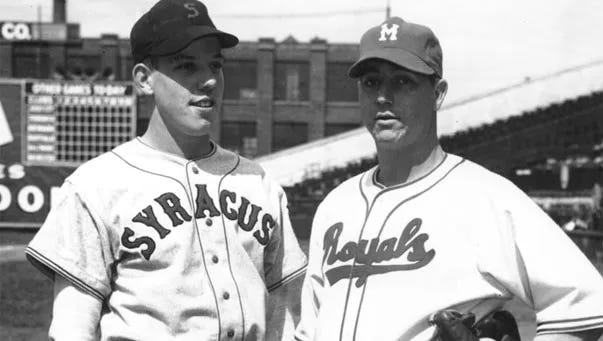
He was famous for being rushed into the major leagues, but baseball took its own time with Joe Nuxhall. The kid who’d never left home lived all over the eastern half of the United States: Syracuse, Lima, Muncie, Columbia, Charleston, and Tulsa, working on his confidence and developing a slider to play off his fastball. In 1952, Nuxhall, age 23, was called up to the Cincinnati Reds.
“You’ve got to be patient,” he said in 1983. “That might be the problem with the young players today—being in a big hurry to get somewhere and never really getting there at all.”
Joe Nuxhall’s wartime stint with the Reds remains a moment to dream on. That it didn’t work out (and probably set the young man back) pales in comparison to the fact that it happened at all.
But how did it happen? How he appeared in a major-league game is no mystery: Nuxhall was like Chekov’s pitcher—as soon as he appeared on the Reds’ bench, it became inevitable that McKechnie would put him into a game, if for no other reason than curiosity.
The tougher question is how Nuxhall ended up on that bench to begin with.
Later in his life, he seemed to follow the predominant narrative. These were strange, desperate times: “Just because of the timeframe, the situation, the war. There were a lot of players in the service and they were looking for anyone with ability.”
Star-depleted teams were also looking for publicity, and Nuxhall theoretically checked a lot of boxes there. This kid could be a story, even a draw in Cincinnati: Come watch Hamilton Joe try to pitch one past Stan Musial! A match-up like that blurred the line between serious competition and spectacle, but these were pragmatic times, too. Local kid. 85-mph fastball. Good publicity. Why not sign him?
Fine, sign him, but why put him directly into the major leagues? The minor leagues still existed. A farm team was the obvious place to stick a 6’ 3” child with a live arm. The Reds would have wanted to fill the big-league roster with players who could help them right away; from that perspective, Joe’s father, Orville, would have been a better bet to try to eat some innings. Everyone in the Reds’ organization would have known what major-league batters were going to do to a 15-year-old with one pitch, but they put Nuxhall in a Reds uniform anyway. Why?
We’ll tell you why:
Because Joe’s mother made them do it.
Our evidence comes from local news accounts in the spring of 1944, when Nuxhall signed his pro contract with the Reds. The team insisted he was a legit talent. McKechnie said that if Nuxhall had been 18 or 19, he’d be a touted prospect instead of a curiosity. “This is no wartime blossom who will fade in big-league baseball.”
Warren Giles defended the unorthodox signing, saying, in part: “Two other clubs wanted him and he would have been signed, war or no war.” Even if he never named the other teams, Giles certainly acted like a man with competition; that competition meant the Nuxhalls had leverage. Naomi Nuxhall put it to good use.
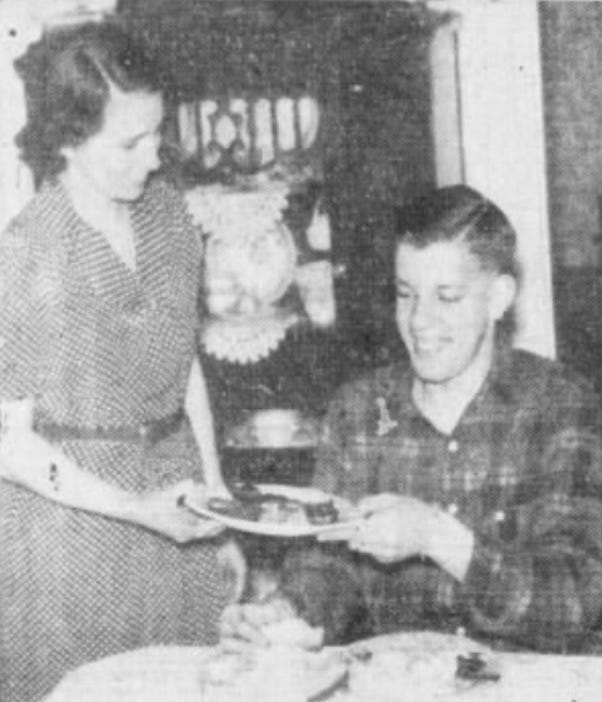
In early April 1944, right around Nuxhall’s field trip to Opening Day, the Dayton Journal Herald visited the Nuxhalls in their home. Naomi did most of the talking for the family. Like any mother in that situation, she admitted she was wary of putting too much on her son:
“At first I was a little skeptical of his becoming a ballplayer. He’s still only a boy. That St. Louis trip last year was the first time he was ever away from home. You see, I couldn’t think of Joe going all the way to Birmingham by himself…”
…but, Naomi had told the Reds’ representatives, she was willing to let him take the bus to Crosley Field:
[The Reds] had to replace a Birmingham contract with one from Cincinnati before I agreed.
That was how a 15-year-old kid ended up on a major-league roster. The war, yes, the publicity, sure, but it happened because Naomi was playing hardball in the kitchen-table negotiations. The Nuxhalls had walked away from two minor-league contract offers a year earlier. Either the Reds stashed Joe Nuxhall on their major-league roster to appease his mom or they risked losing a talented local prospect who had other, out-of-state suitors.
If Naomi Nuxhall had stayed quiet, her son would have become merely the youngest prospect on the Birmingham Barons. Instead, he made history as the youngest person to ever appear in a Major League Baseball game…and then became the youngest prospect in Birmingham.
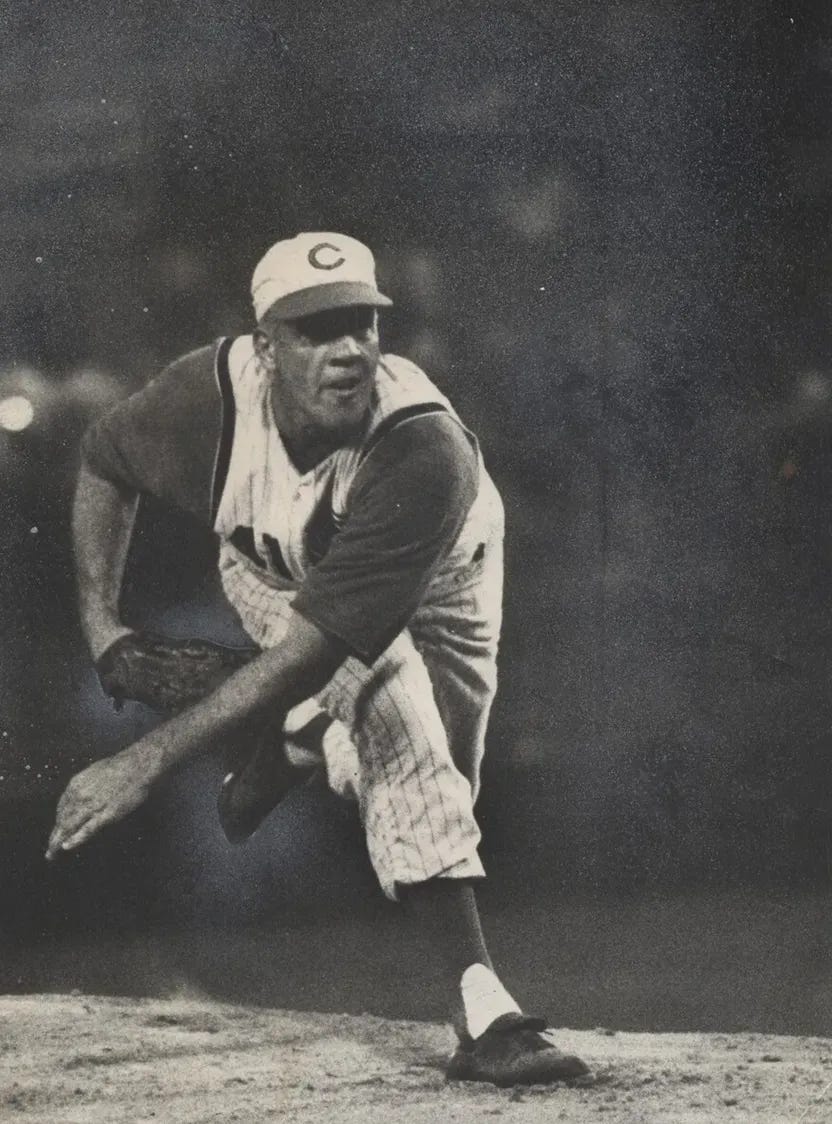
Once he made it back to Cincinnati, Joe Nuxhall stuck there for the vast majority of the next 15 years. He was an All-Star in 1955 and 1956. The child prodigy turned out to be a late bloomer: His best season came relatively late in his career, in 1963, when he went 15-8 with a 2.61 ERA.
On September 22, 1963, Crosley Field bid farewell to Stan Musial. Musial was retiring after the season, and on the occasion of his final appearance in their park the Reds presented their ancient nemesis with a cake and a rocking chair.
The pitcher assigned to usher Stan the Man out of Cincinnati was Joe Nuxhall. The Reds’ comeback ace was brilliant that day, allowing just one hit in the first eight innings of a complete game, his 14th victory. The hit didn’t come from Musial, who struck out in the first and flied out in the fourth. He was ceremonially removed from the game in the fifth inning, and he doffed his cap to the appreciative crowd and ran off the field.
A few minutes after Musial’s departure, Nuxhall climbed out of the home dugout and headed back to work. The Reds’ old lefthander wasn’t as spry as he’d once been, but the boards of the dugout steps never gave him any trouble—he knew them too well.

Project 3.18 is independent and ad-free thanks to readers who subscribe.
If you enjoy what we do here, the best way to support us is with a paid subscription. For roughly $1 per week, you can help us continue telling incredible baseball stories.
We’ve thrown two features at you in two days, but we’re going to be off next week, so it will even out. We’ll be back after the Fourth of July. Be safe and have fun!
Well-crafted 2-parter, Paul. I knew I should have had my mother negotiate my first contract - I would be in a much better position now.
Fascinating story of how a young talent got ‘used’ in my opinion by his own mother. I understand what she was doing but that didn’t make it right.
The timing of the war is what allowed her to get away with it, but in reality I highly doubt this incident would ever repeat.
Interesting nonetheless!