


Welcome to Project 3.18, a free weekly publication where a fan-first writer tells strange and surprising stories from baseball history and culture.
Have you ever seen a news report on a rescued fisherman, found days or even weeks after his disabled boat got swept out to sea? He’s starved, bedraggled, and defiantly, triumphantly alive. In the 1970s, the San Diego Padres were that guy.
Geography was against the Padres from the start. While teams like Boston and Atlanta could claim a whole geographic region for their fanbase, San Diego was hemmed in: Mexico to the south, fortress Los Angeles to the north, the Pacific Ocean to the west, desert to the east, all the way to Phoenix. It shouldn’t have worked, and it almost didn’t.
By 1973, the Padres’ first owner, C. Arnholt Smith, had given up. Since entering the National League in 1969, his team had never won more than 63 games and annual attendance seemed hard-capped around a half a million. After four years of futility, Smith realized his pockets weren’t deep enough to sustain a bad team in a tiny market.
At the same time, civic leaders in Washington D.C. wanted to get back in. Washington had lost the Senators at the end of 1971, when another spurious owner, Bob Short, rustled the local team and fled to Texas. When Smith made the Padres available, Washington interests were quick to raise the city’s hand.
The two parties reached an agreement. The 1974 National League schedule was drawn up with the assumption that the Padres would be in Washington. Things went so far that one of the Padres’ pitchers, Dave Freisleben, was enlisted to model a new Washington uniform design:
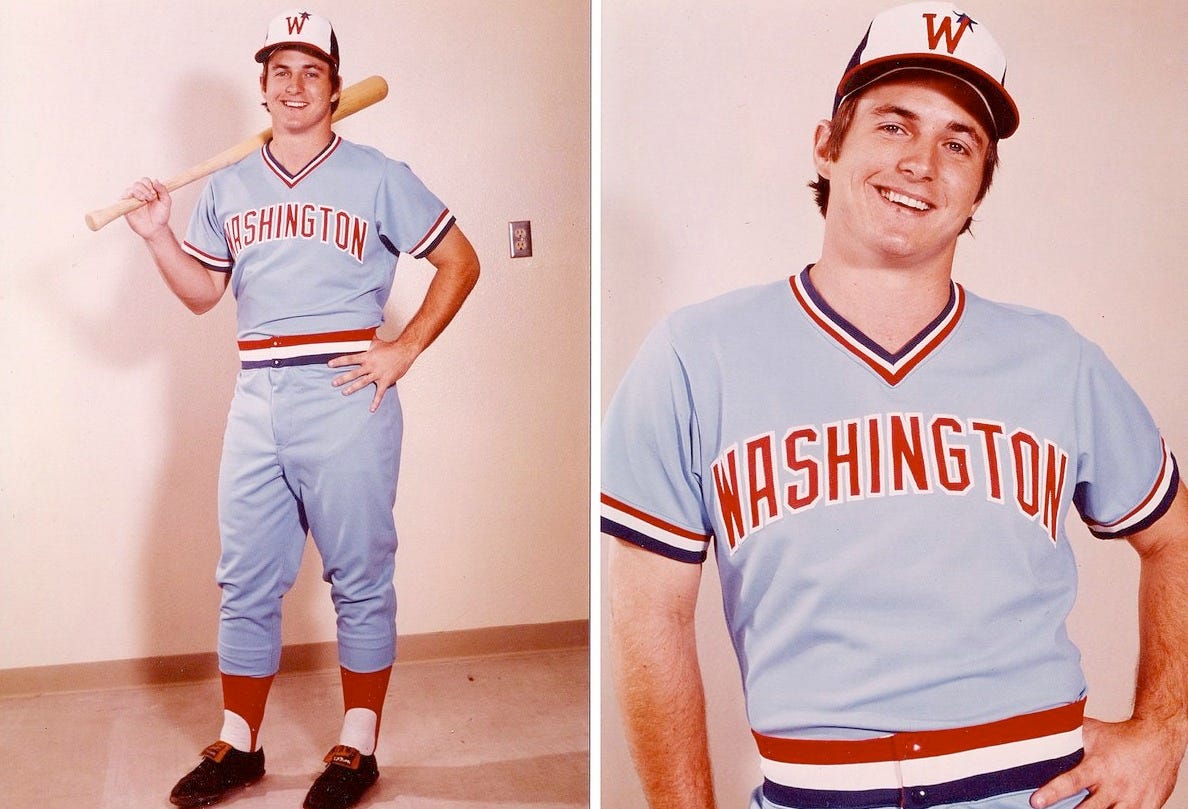
In reality, it would have been almost impossible to wrest the Padres out of San Diego in 1974. The team was still entangled in an expensive, multi-year lease at San Diego Stadium and the city was preparing a legal offensive designed to inflict maximum pain on Major League Baseball for moving the team. The Washington agreement was doomed, but the Padres faced a grim, uncertain future.
Reading the newspapers on his yacht off the coast of Florida, Raymond A. Kroc followed the Padres’ messy plight with increasing interest. Kroc, the chairman of the McDonald’s Corporation, was transitioning into a part-time role with the company he founded and looking for a multi-million-dollar hobby. Baseball had always interested Kroc, a longtime resident of the Chicago area who came of age in a Cubs heyday in the late 1920s, admiring stars like Riggs Stephenson, Kiki Cuyler, and Hack Wilson. Kroc made several attempts to acquire the Cubs, but the only thing more powerful than new fast food money was old chewing gum money, and the Cubs’ owner, Philip K. Wrigley, rebuffed him.
Kroc saw the floundering Padres as an easier mark in a city with better weather. He arranged a meeting with Smith. The conversation between the man with limitless resources and the man in over his head was brief:
“How much do you want for the team?”
“Twelve million dollars.”
“Done.”
The two shook hands, snuffing out Washington’s hopes for another 30 years.
“Ray was a great guy and a great man,” recalled Padres pitcher Randy Jones, who won the 1976 Cy Young Award in San Diego. “If it hadn’t been for him, we would have been in Washington. Everything at the ballpark was packed up until he bought the club.”
Kroc was a celebrity during his first visit to the Padres’ spring camp in Yuma, Arizona. 72 years old, slightly hard of hearing, and worth somewhere around $500 million, Kroc gave a welcome address to the team as they sat cross-legged in the outfield grass.
“He gave us incentive,” catcher Fred Kendall said. “In the past, ownership has been so weak financially that we’ve felt like poor relatives to the teams we’ve been playing. Mr. Kroc told us he didn’t intend to throw money away, but that it was there if we earned it.”
Someone asked Kroc: “Why would you want to buy the worst team in the National League?”
“Well,” he said, “McDonald’s wasn’t very big at one time, but it’s pretty big now.”
There were other reasons for excitement that spring. The Padres had a new manager, John McNamara, hired away from a coaching job in San Francisco. Kroc had retained the Padres’ experienced baseball leadership, the father and son duo of Buzzie and Peter Bavasi, who had acquired a few aging “name” players over the winter, including former Cubs infielder Glenn Beckert and Willie McCovey, the Giants’ slugging first baseman. Despite two arthritic knees, the 36-year-old McCovey practically frolicked in Yuma, setting such a pace that even the younger players couldn’t keep up.
But even in baseball’s season of perpetual hope, there were warning signs. The Padres committed 22 errors in 10 exhibition games and gave up 22 unearned runs. This was the kind of play that led the 1973 Padres to 102 losses, but the newcomers tried to stay positive. “Fortunately,” McNamara said, “most of the errors have been made by people who won’t be playing for us regularly.”
The fans seemed willing to buy that argument, and after five moribund years, interest—and season ticket sales—showed signs of life.
The Padres opened the 1974 season on the road, with a three-game series against the Dodgers, a rising power in the NL West. The Dodgers made quick, authoritative work of the Padres, sweeping them 8-0, 8-0, and 9-2, but the new owner dismissed the early returns. “They’re snake-bit,” Kroc said of the team, “and they’ve got the yips. They’re overanxious, trying too hard, too tense. We’ll get it straightened out.”
On April 8, the night before the Padres’ home opener, Kroc was feted at an annual preseason dinner. “That was a lost weekend,” he told the crowd of civic boosters. “Our season opens tomorrow night.” He urged patience. “These men are professionals, and they’re going to win for us.”
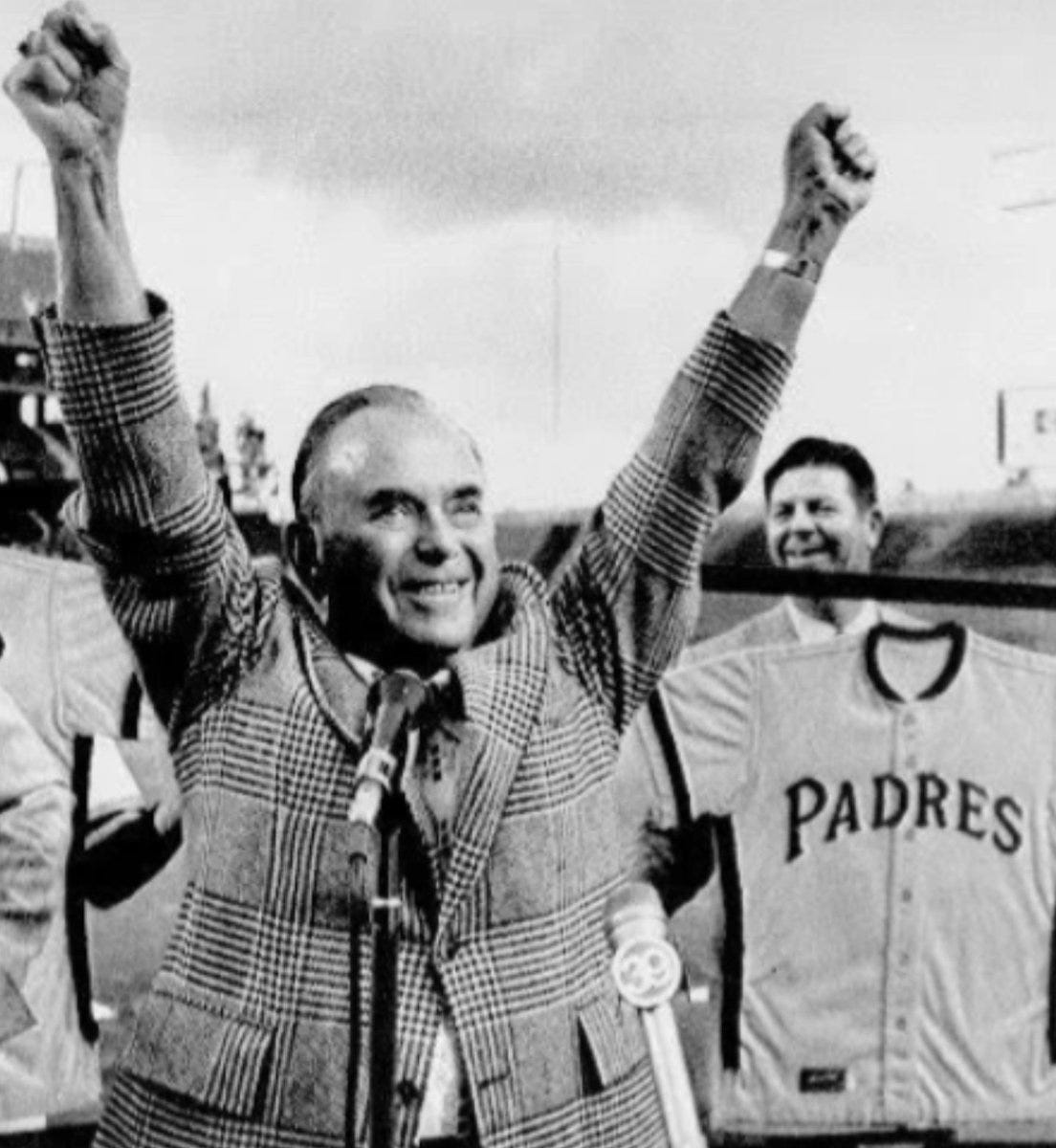
Kroc’s rescue had inspired San Diego, and 39,083 people bought tickets to the opener on April 9, the second-largest baseball crowd the city had ever produced. In an on-field ceremony before the game, the feisty owner addressed the fans, buoyed by the full park and the standing ovation he’d received.
“All I can tell you,” he said, “is with your help and God’s help, we’re going to give them hell tonight!” Hell was indeed given, but not in the manner Kroc predicted.
San Diego’s woes continued against the Houston Astros. The starter, Steve Arlin, recorded just three outs in two innings and gave up six runs before being pulled. Three (regular) players, including McCovey and Beckert, committed errors. The Padres loaded the bases in the fourth but the inning ended when Matty Alou, another veteran, got doubled-up off first base, thinking there were two outs when there was only one.
The score was 7-2 in the eighth inning when the Padres’ fifth pitcher of the day, Mike Corkins, gave up three hits and the Padres’ third baseman, Derrel Thomas, made the team’s third error. Two more runs scored and it looked like the Padres might open the season 8-0, 8-0, 9-2, 9-2. As soon as the top of the eighth inning ended, Ray Kroc gave them hell.
The owner went to the park’s public-address booth and told the announcer to put him on. The announcer flipped on the microphone and informed the crowd Ray Kroc had something to say. One booth over, the Padres’ longtime lead broadcaster, Jerry Coleman, told his producer to pick the announcement up on a field mic so listeners at home could also hear from the new owner.
“Ladies and gentlemen,” Kroc said, “I suffer with you.” There were cheers and laughter.
Before the owner could explain his suffering, a naked man, a streaker, appeared in the outfield, dashing toward an open tunnel entrance on the other side of the park. A roar went up from the crowd, and Kroc raged over the public address system.
“You damn streaker! Get him out of here! Throw him in jail!”
The runner was gone after a few seconds, with puffing security guards trailing in his wake. Kroc composed himself and resumed his version of FDR’s “Day of Infamy” address:
Ladies and gentlemen, I have some good news and some bad news. The good news is that we outdid Los Angeles for an opening night crowd. They had 31,000 fans and we have 39,000. I thank you.
And now the bad news: I have never seen such stupid ballplaying in all my life.
The field microphone picked up more laughter and a hearty cheer. Kroc rose and left the booth.
Still on the air, Jerry Coleman could only manage, ”That was Padres owner Ray Kroc.” Coleman admitted it wasn’t his most articulate moment. “I just didn’t know what to say.”
Before Kroc decided to address the fans, he and Buzzie Bavasi had been sitting together in the nearby executive’s suite. Bavasi got a phone call: one of the clubhouses had sprung a leak. He excused himself and as he got on the elevator he heard Kroc’s voice on the PA, thanking the fans for turning out. “I thought, ‘That’s nice of Ray.’” The elevator doors closed and he missed the rest.
When the leak was dealt with, Bavasi returned to the skybox-level and only then did he learn how Kroc had concluded his remarks. “I was stunned,” Bavasi said. “I talked to him immediately, but there was nothing we could do.”
The players had never been put on blast before, and their shoddy play continued. With two outs in the bottom of the eighth, the Astros’ third baseman, Doug Rader, made a costly error, allowing Derrel Thomas to redeem his earlier mistake with a single that scored a run. Cito Gaston doubled to score two more. The score was 9-5, and it almost seemed like Kroc’s tough love was working, but the Astros got out of the inning and both sides faced the minimum in a scoreless ninth. The Padres had their fourth-straight loss and a lot to think about.
After the game, McNamara closed the clubhouse and held a brief meeting with the players, who quickly dressed and left the stadium. Only Willie McCovey remained behind.
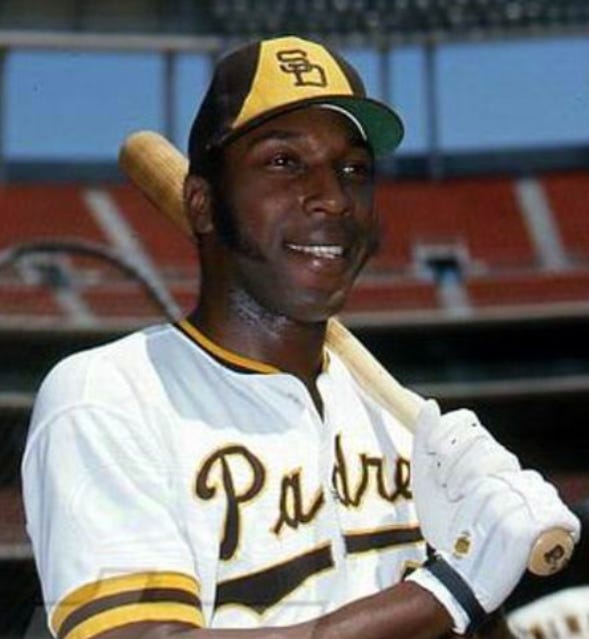
That spring, McCovey had been elected the team’s representative to the players’ union, the MLBPA. By then the players had learned (the hard way) that the job of player rep was best suited to the biggest star with the largest contract. Lesser-known player reps had a tendency to disappear, released or traded on some pretense by resentful front offices. McCovey made $140,000 and he wasn’t going anywhere. The other Padres had decided he would respond to Kroc’s comments on their behalf:
I’ve played baseball for 19 years and I’ve never been called “stupid” before on the PA system by the owner. None of us appreciate being called stupid. I have nothing but respect for the man, but we’re professionals, and we deserve better than that.
I don’t think this has ever been done in the history of baseball. I’m shocked and disappointed that it happened and I wish, somehow, that it could be taken back.
I think there will be some kind of meeting between the players and the front office, or the sting of that statement is going to be on the players’ minds for a long time to come.
The Astros, who didn’t need Kroc for job security, were less tactful. “I’ve managed in Latin America under owners that were nuts,” Preston Gomez, the manager, said, “but I’ve never seen anything like this happen before. Mr. Kroc is good for keeping baseball in San Diego and I congratulate him for that, but somebody has to talk to that man.”
“I couldn’t believe it,” pitcher Claude Osteen said. “He’ll have to learn that you can’t buy success in this game. At least it’s never been done before.”
But the line of the night, one which would come back to haunt him, emerged from the uncareful mouth of Houston’s Doug Rader, a noted “flake,” which was baseball slang for someone with impulse control issues. “What a bunch of horse****,” Rader said. “He thinks he’s in a hamburger convention dealing with a bunch of short-order cooks.”
The entire baseball world reacted to Kroc’s verbal broadside. Bowie Kuhn, the commissioner, delegated: “President Feeney is handling this matter with Mr. Kroc.”
Chub Feeney, the president of the National League, legislated, decreeing that henceforth, only a team’s public address announcer would be permitted to use the stadium microphone.
And Marvin Miller, the executive director of the Major League Baseball Players’ Association, ran for his typewriter and hammered out a vicious scolding:
The action of Mr. Ray Kroc demeaning the players over a public address system at the ballpark is resented by the players, the players’ association, and I am sure by baseball fans.
The players who were castigated publicly as “stupid” by the baseball owner whose expertise is based on a grand total of four games as an owner are entitled to a public apology. The players of the San Diego and Houston clubs have demonstrated by their restraint in the face of Mr. Kroc’s inexcusable insults that their intelligence far exceeds his.
Press opinion, as dried-out and crusty as the last French fries left in the warming tray, tended to favor Kroc, lauding him for his “candor” and for calling out his underperforming employees. Why did Kroc owe an apology to the team that led the league in losses and finished dead-last in batting with a .244 team average in 1973? “The Padres have been palming themselves off for years as a major-league baseball team,” one Team Kroc columnist grumbled. “Who owns this ballclub, anyway? If an owner can’t criticize his own team, who can?”
Damage control began the next night. Kroc had left town on a “preplanned” trip back to Florida, but he was accessible by phone. If the Bavasis hadn’t set Kroc straight in the wake of his outburst, his wife, Joan, certainly did. “I phoned home after the game,” Kroc said, “and my wife gave me hell. I never should have gone on [the microphone]. We were playing bad ball. We weren’t giving the fans the kind of show we wanted to give them. I think my statement was misconstrued. What I mean was, well, sometimes you have a partner in golf who goofs one. You give him the needle. It was an impulsive thing.”
Kroc admitted the night’s exhibitionist had given him the needle. “The streaker just added gas to the fire. It was so frustrating.”
The owner promised an apology to the players was forthcoming. “I don’t want to get off on the wrong foot. I hope the fans will understand and I want the ballplayers to support me, too.”
Before the game on April 10, the Bavasis held a clubhouse meeting with the players. “It was something that was needed and I believe it helped,” Willie McCovey said. The Padres went out and lost, 9-1, in front of a sparse crowd of 7,800 people who weren’t mad, just disappointed.
Kroc got in touch with McCovey over the phone and made what the player deemed an earnest apology. “The players are satisfied, and the matter is closed,” McCovey said. “We want to get down to the business of winning ballgames for Mr. Kroc and the fans of San Diego.” The Padres went out and lost, 9-1, again.
By the end of April it was clear that Ray Kroc’s first year in baseball was going to teach him the humility that franchising restaurants never had. The Padres lost 13 out of their first 16 games and committed 24 errors along the way. Blowouts were common, and the owner continued to offer rather colorful commentary.
“I bought the team to have some fun,” he said, “but it’s proving to be about as enjoyable as a wake—my own.”
“The pitching hasn’t been good,” Kroc went on, “but in most of the games we would have lost anyway, even with great pitching. You still have to get some runs, you still have to support the pitcher with fielding, you still have to run the bases like somebody other than a knothead.”
After the Cincinnati Reds dropped 10 runs on the Padres in the first game of an April 21 doubleheader, Kroc was back at his wits’ end. “You can’t sit idly by and let this continue.” He called Buzzie Bavasi and told the executive to do something—anything. Bavasi called McNamara, and told the manager to do something—anything. McNamara had an idea. He ordered the team to discard their new white shoes and put on the black shoes they’d worn in 1973. In more familiar footwear, the Padres won the second game against the Reds, won the next two games after that, and went on an 11-3 run.
Obligatory:
Kroc had gotten off to a bumpy start with the players, but the fans seem to have gotten the message. The owner was a fan, and every self-respecting fan had, on at least one occasion, lambasted their team. Kroc just happened to have access to a public address system when his meltdown moment came. With an owner that passionate, many people in San Diego felt new hope.
“Ray was one of the best owners I ever met,” Buzzie Bavasi said in 1990. “Actually, I think we made some fans that night.”
From that point on, Kroc tried to keep a lower profile, but with a team that lost 102 games, the same as the year before, it wasn’t easy. In a visit to spring training the next year, Kroc told a reporter that his first season as an owner had taught him patience and tolerance. He had hardly finished speaking when the Padres’ center fielder misplayed a low, sinking liner, leading to a triple. The owner, still on the record, threw up his hands.
“That was a stupid way to play that ball,” Kroc said. “Why didn’t he dive for the ball, the way Hack Wilson used to?”
Spoken like a true fan.

Over on Clear the Field:
The fuss over the new ABS challenge system has exemplified what Mark Twain cited as history’s tendency not to repeat, but to rhyme. In our latest podcast episode, Ted and I discussed a rhyming moment from 1976 when an electronic video scoreboard and instant-replay sent the umpires running for cover.

Now he knows how we feel when you put down an excessive amount of money for a Fish Filet and you see the cheese is not only half a slice but as in his cheeseburgers it is SO thin you can see thru it.
HA! Sorry Ray - guess you can’t ‘have it your way.’
Somewhere, George Steinbrenner is still mad he never got a chance to do this. I rather miss the days (the 1970s and 80s, really) when MLB owners were characters.