


Welcome to Project 3.18, a free weekly publication where a fan-first writer tells strange and surprising stories from baseball history and culture.
Note: Two days after we released this story, Ted Turner passed away at age 87. We aren’t even done writing it, and it’s sad to know we’ve lost the main character. Turner’s legacy goes beyond baseball and far beyond a small, silly moment in 1977, but this moment is as good a window into the person behind the billions as any moment can be. We’ve all wanted to put on a uniform for a day. Turner could, so he did.

If May 11, 1977 wasn’t the worst day of Dave Bristol’s life, it surely must have been the weirdest.
Bad days abounded for Bristol that spring, because he was the manager of the Atlanta Braves, a last-place team in 1976 that looked even worse a year later. When the Braves lost to the Chicago Cubs on May 8, it was their 14th consecutive defeat.
On May 10, before a doubleheader against the Pittsburgh Pirates, Bristol held a team meeting to try and reach his increasingly depressed and disillusioned players. “I stressed that there were some young players getting a chance to show they can play,” he said of the conversation. “I said if it was too much for them, any of them could just whisper in my ear and we’d do something about it.”
It was, he felt, his best team meeting since joining the Braves at the beginning of 1976, and he saw the players pep up. Even though the Pirates were a much better team, “I felt good about those games.” The Braves might well have won that night except for Pittsburgh’s Dave Parker, who was scorching hot, hitting above .400, and doing his best work whenever he batted against the Braves. Losing by scores of 3-0 and 2-1, Atlanta’s futility streak jumped to 16 games.
On the morning of May 11, Bristol walked into the hotel lobby after a late breakfast and ran into Bill Lucas, the Braves’ Director of Player Personnel (essentially the general manager). Lucas looked troubled. “Ted wants to talk to you about some things.”
“Ted” was Ted Turner, the media mogul who owned the team. Turner, concerned by the ongoing losing streak, had left his preparations to sail a yacht in the upcoming America’s Cup races to come to Pittsburgh and diagnose what ailed his ball club. Now he wanted to speak with the manager.
Bristol “figured the jig was up right there.” He had been dismissed from managerial roles in Cincinnati and Milwaukee, and his Braves had not won since April 22. “I’d taken that walk before,” he said of the uncomfortable journey to Turner’s suite on the hotel’s eighth floor.
Turner was his usual self, fast-talking, energetic, and a little awkward. The owner was clearly excited about something, but he didn’t seem like a boss about to hand out a pink-slip. After some brief preliminaries, Turner showed his cards.
“I got a crazy idea,” he told Bristol. “I want to take over managing the club for ten days and then have you come back.”
Bristol was standing by a window, and for some reason all he could think to do was reach over and lock it shut. As he did so, Turner kept talking, but after that first sentence, the manager (?) struggled to follow the thread of the plan. He finally broke in.
“Now hold on a minute. Does this mean I’m finished as the Braves’ manager? Let’s get it out in the open.”
“No! No! No!” Turner shook his head. “It doesn’t mean that at all.” He and Lucas suggested that Bristol might “go around and see some games,” take a scouting trip, “while this was happening.”
“Ted, you know I’ve always given you my honest opinion,” Bristol said, “I don’t know if [taking over as manager] would be a good thing to do.”
“I know,” Turner said, “but the club is in trouble and I want to go down there and see what it’s like from the dugout.”
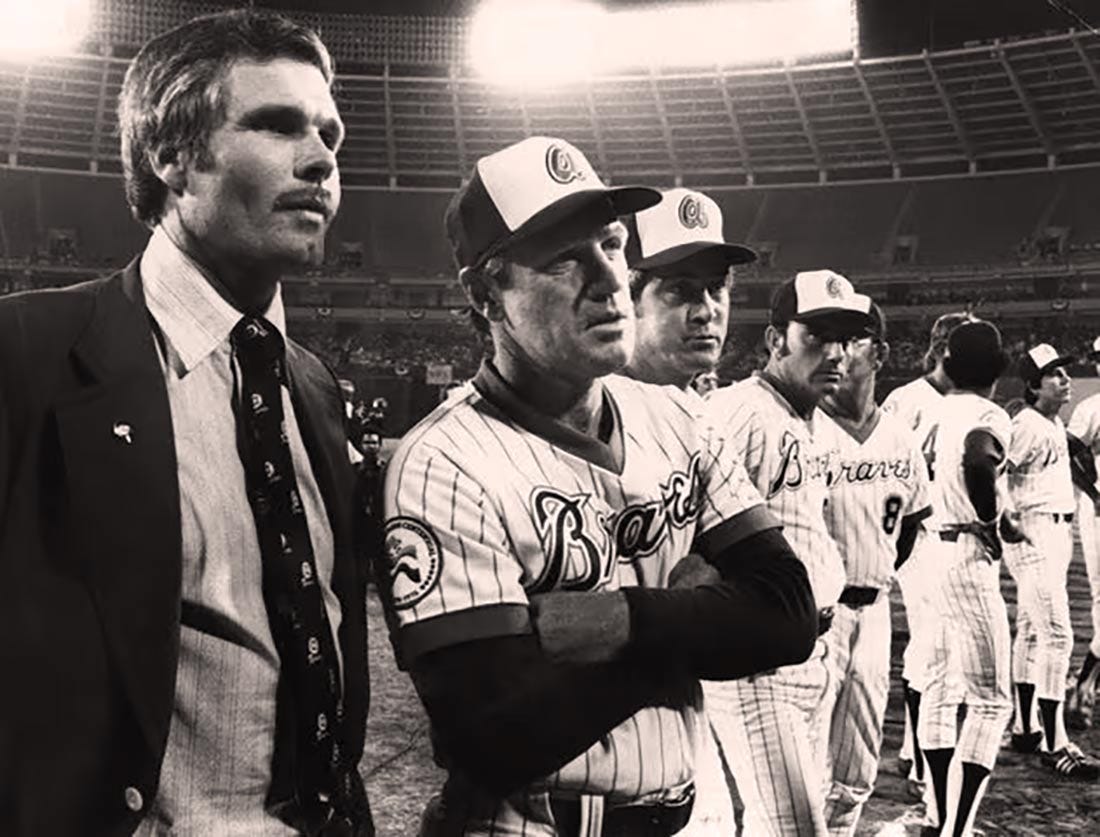
After discussing the mechanics of the handoff, the two shook hands and parted amicably. Bristol was dazed; as far as he could tell, he wasn’t fired, but he wasn’t especially employed, either.
When word of what was happening started to spread, a clever reporter somehow managed to track Bristol to the Pittsburgh airport. “I’d rather not answer questions,” Bristol said. “It’s a strange thing to happen to a man.” Undeterred, the reporter asked him where he was headed.
“I’m going home for a couple of days to take a long, hard look at Dave Bristol. If I’m in this position, I must be doing something wrong.”
When Ted Turner purchased the Atlanta Braves in January 1976, knowledgeable acquaintances warned him that baseball was unlike other businesses. A pocket dimension with its own rules of economics, more than one successful industrialist had come to regret buying into his boyhood dreams.
There was much to be wary about in Atlanta. Without Hank Aaron and his assault on Babe Ruth’s home run record, the 1975 Braves were merely a back-end team in the National League West division. Without Aaron, the Braves’ attendance fell by nearly 450,000 people between 1974 and 1975. Still, Turner went ahead and bought the team.
“I bought the Braves for two reasons,” he said in 1977. “One, to get an autographed ball without pleading for it, and two, to get good seats.”
Turner’s lack of baseball experience was increasingly common among owners in the 1970s, as old baseball families gave way to men writer Roger Kahn dubbed “new adventurers” from diverse economic backgrounds, sharing deep pockets and “a patriotic, Messianic complex.”
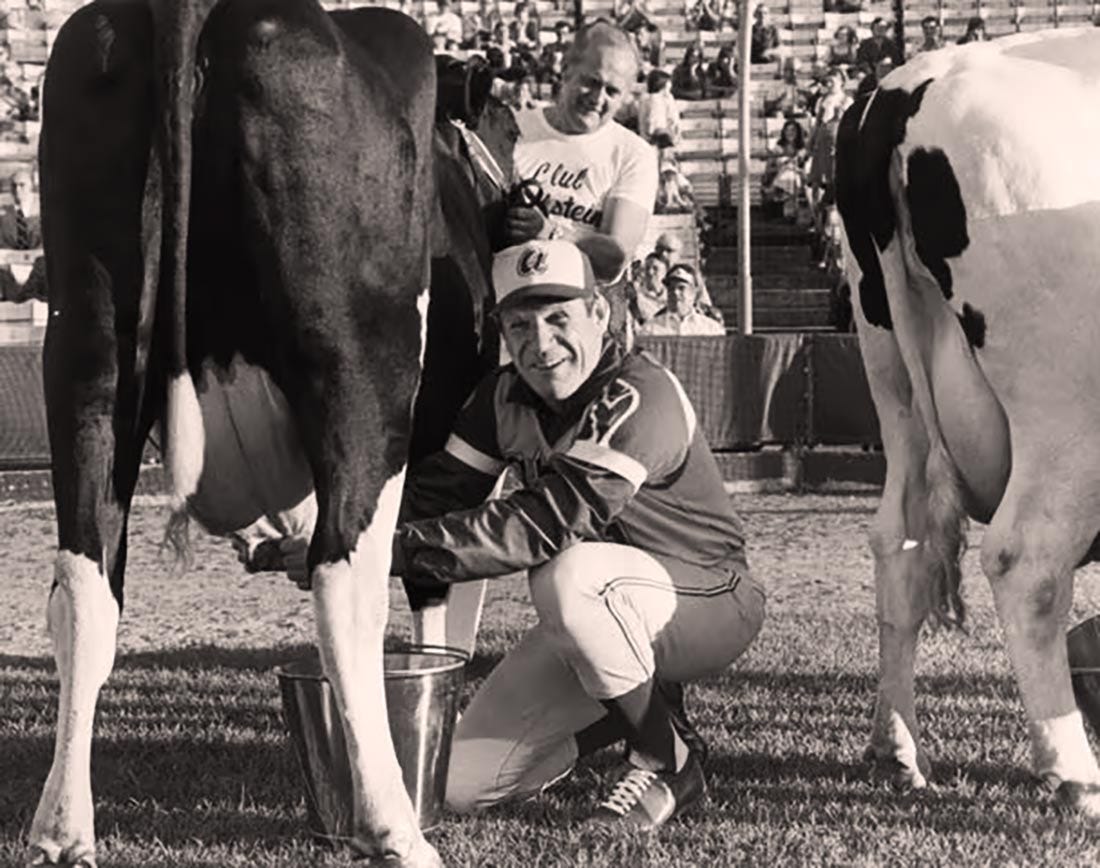
After Turner took over, the Braves’ organization leaned hard into the gimmickry that had taken root in other corners of small-market baseball. Braves games soon featured ostrich races, mattress stacking contests, cash scrambles, and events called “feeds” in which huge numbers of fans were served plates of spaghetti and ice cream. During a farm-themed event, Turner had Bristol, the last hire made by the team’s previous administration, take a turn milking cows.
When the team hosted a “mini-Olympics” featuring the Braves and Phillies, no one from the Braves would compete against the Phillies’ closer, Tug McCraw, in a race pushing a baseball from first base to home plate using only noses. Turner showed his tendency to step into the breach and raced McGraw himself. He lost, emerging with a lacerated nose and forehead and a bloodstained baseball he proudly showed off on his desk.
Wherever he sighted a baseball taboo, Turner increased to ramming speed. He threw parties for the players, regularly visited the clubhouse to mingle, and even held a small-ante poker game attended by a few of his uniformed employees. That drew Turner’s first chiding from Chub Feeney, the president of the National League.
“What do we have,” Turner complained, “two classes of people—players and owners—and no fraternization? We played poker. For a dollar limit. You played four hours, you could lose maybe thirty dollars. I feel you ought to be friendly with people and not be penalized for that.”
In addition to friendliness and penny stakes, Turner tried big money in various ways. He invested in the stadium, installing an expensive and problematic Video Matrix scoreboard. In 1976 he promised Bristol and the players a $500 bonus for every win over 81 (zero dollars were paid out) and a 5% salary bonus for every 100,000 fans over 900,000 that season (again, no money distributed). These were pretty unorthodox incentives at the time; in his Manhattan fortress, Bowie Kuhn, the commissioner of baseball, shifted uncomfortably, but held his peace.
Turner broke the owners’ collusion against pioneering free-agent Andy Messersmith, whose December 1975 grievance exploded teams’ open-ended, unilateral control over their players. Messersmith was coming off an outstanding season and free to sign with any team, but the owners collectively managed to forget his number. Three months after he took over the Braves, Turner learned a talented pitcher was still available and promptly bid against no one to sign Messersmith to a three-year contract worth a million dollars, a breathtaking amount of money. Some of his peers never forgave Turner for wrecking their plans to turn the rebellious Messersmith into a cautionary tale.
Messersmith also featured in Turner’s first direct clash with baseball’s arbiters of taste. Turner got his start in business taking over his father’s billboard company, and as a callback to those days, he tried using space on Messersmith’s expensive back for publicity, assigning the pitcher the number 17, where Turner’s WTCG television station could be found on Atlanta dials, and printing “CHANNEL” instead of Messersmith’s last name. The human billboard didn’t stay up for long; Chub Feeney brought out his veto, declaring the nickname had to go.
Despite the addition of Messersmith’s live arm, the 1976 Braves never recovering from a 13-game losing streak in May. Turner spun as fast as he could. “I’m not losing,” he insisted. “I’m just learning how to win. You’re supposed to start on the bottom. We’re coming. We’ll get there. It’ll take better than these to get me down.”
When the Braves finished in last place again, Turner grew reckless in his efforts to hurry the journey along. He set his sights on San Francisco outfielder Gary Matthews, a top free-agent-to-be. A few drinks in at a cocktail party in the fall of 1976, Turner shocked Bob Lurie, the Giants’ owner, by promising to beat whatever offer Lurie made to keep his star. When the Braves signed Matthews for five years and $1.8 million, Lurie complained to the commissioner that Turner had tampered. Kuhn opened an investigation.
Over the course of several surreal conversations, including an extended Old-West-themed analogy in which Turner compared himself to George Armstrong Custer, the ill-fated cavalry officer, the owner begged the commissioner not to take Matthews away, offering to accept corporal punishment instead. In January, Kuhn suspended the Braves’ owner for the 1977 season and took away the team’s first-round draft pick.
Turner sued. “If Kuhn charged me with gross incompetence, with [the Braves’ record] I wouldn’t blame him,” he said, but the charge of tampering he vowed to fight. A judge enjoined his suspension while the case was litigated and the owner began the 1977 season a free man.
In Kuhn’s 1987 autobiography, Hardball, the then-retired commissioner devoted a chapter to Turner and their 1977 showdown. Kuhn spent his entire commissionership wrangling colorful characters, but even in that menagerie, Ted Turner stood out.
“To an outsider, Turner is incomprehensible,” Kuhn wrote. “With paper and pencil I can scarcely do more than scratch the surface of his personality.” Still, he tried, reaching for something—for the lawyerly Kuhn—that was almost poetic: “There was something unreal about Ted, as if he were not so much flesh and blood as a kaleidoscopic galaxy of swirling emotions.”
Kuhn pulled no punches in his book, listing several owners he disliked and one—guess who1—whom he despised. Despite their legal wrangling, he didn’t have such ill will towards Turner. Rather, the Braves’ owner’s impulsive, zesty approach to life seemed to fascinate the careful commissioner, always stuck being the adult in the room.
Turner’s expansive, almost child-like enthusiasm frequently pushed him into places where owners didn’t usually tread. He was often seen vaulting onto the field after games to congratulate winning pitchers and home run hitters. Dave Bristol didn’t seem to mind the encroaching presence of his boss’ boss, and he didn’t recall Turner as much of a meddler in 1976. However, one interaction seemed more like foreshadowing when an exiled Bristol reflected on it a year later:
“Now, one time, he did ask me if he could be the bat boy. But he never said anything about coaching.”
Around noon on May 11, 1977, Turner had pounded on Bill Lucas’ door. Inside, he told Lucas he’d decided to go “into the trenches” and manage the team himself.
“It’ll be a bombshell,” Lucas warned him. “People are going to be on us, especially the press.”
“So what?” Turner said. Could any publicity be worse than losing 16 games in a row? He’d already made up his mind. “If I had thought about it for a long time, I wouldn’t have had the guts to do it.”
During the conversation with Bristol, the manager told Turner that he had scheduled another closed-door team meeting for that afternoon, to try and rally the players after the encouraging signs of life they showed the night before. Now Bristol was gone, but Turner decided to keep the meeting and run it himself.
After addressing the minor change in org chart, Acting Manager Turner gave the team his version of a pep talk. Where Bristol had offered support, Turner was all performative machismo, telling the Braves to “get tough,” “get angry,” and “act like men.”
For some players, the approach seemed to work. “It was one of the most stimulating clubhouse talks I’ve ever heard,” infielder Jerry Royster said. “He laid it on the line. He told it like it should have been told. He never ceases to amaze me. Every time he opens his mouth, something good comes out.”
“For all his eccentricities,” Bowie Kuhn recalled, “or perhaps because of them, Ted generated loyalty in people.” The new manager gave the players what Kuhn would have considered a vintage Turner performance: “right off the top of his head, without calculation or premeditation2—spontaneous emotional combustion.”
The media bombshell Lucas had warned of detonated soon after that closed-door meeting. The clubhouse staff worked quickly to put the Braves’ owner in a suitable uniform, and every news outlet wanted that picture. Turner wore number 27, but unlike some of his other high-profile personnel numberings, this one had no significance.
“I’m not interested in uniform numbers,” he told reporters. “I’m interested in game-winning numbers. I’m sick and tired of people asking me why we weren’t winning. I kept saying it was injuries. Now I can see for myself.”
Because major-league rules forbade any unsigned party from participating in a game, Turner hurriedly signed an official contract for a coaching position with the Braves. Asked what he’d entered as his salary, the owner had a quick retort: “About two million dollars in losses.”
When it was time for batting practice, the press trailed the uniformed Turner like a cloud of flies. He took the manager’s usual position behind the batting cage and watched stoically, refusing to respond to shouted questions.
That night, 6,800 Pirates fans watched the first owner-managed game since October 1, 1950, the final appearance by the Athletics’ legendary Connie Mack. Ted Turner was no Connie Mack, but to his credit, he wasn’t trying to be. He relied on third base coach Vern Benson and bullpen coach Chris Cannizzaro on points of strategy, and while he signed the night’s lineup card, he sent Jeff Burroughs, the Braves’ right fielder, to deliver it to the umpires at home plate in the interest of avoiding a scene.
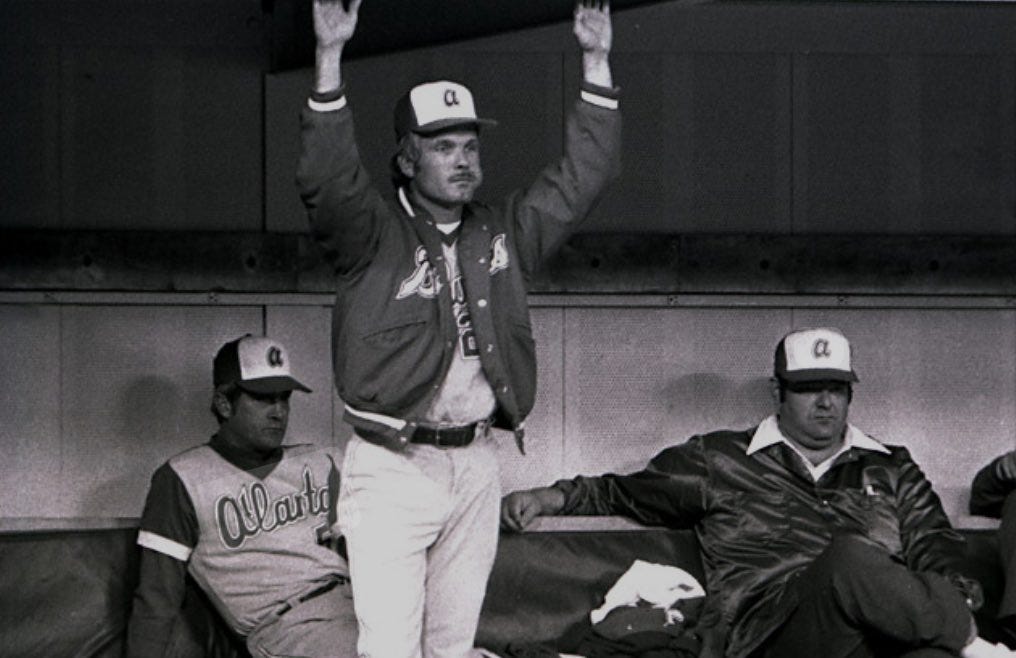
Normally a frenetic pacer, Turner forced himself to be relatively still. He mostly sat or stood at the dugout steps, encouraging the players in his usual fashion, clapping and shouting “Alllll riiiiiight.” Phil Niekro earned several such accolades in his eight strong innings, but the knuckleballer (0-6 to start the season) gave up a run in the first that put the Braves behind the eight ball again. Atlanta rallied in the second to tie the game, 1-1, but seeing such atypical signs of life in the Braves, Dave Parker uncoiled again with a solo home run in the third.
Turner’s busiest inning was the ninth. The score remained 2-1, and the Braves had a pinch-runner, Pat Rockett3, on first base with Phil Niekro’s spot coming up.
Cannizzaro emerged from the Braves’ dugout to consult with Benson, still coaching at third, on who to use as a pinch-hitter. Turner listened in. “We decided to use Darrel Chaney,” he said, “because he was our only right-handed hitter left.”
The collective decision was a good one; Chaney hit a booming double. Pat Rockett streaked like a…well, you know, and was sure to score and tie the game, except Chaney’s ball bounced off the springy artificial turf and exited the playing area six inches over the outfield wall. It was a ground-rule double, forcing Rockett to stop at third. Cannizzaro emerged again to talk to the umpire, and Turner followed, hands stuffed in his jacket pockets. There was a brief discussion of the ground-rule double, and after the game a reporter asked Turner, essentially, if he knew what was going on at that point.
“Sure I know what a ground-rule double is,” Turner said. “I may be dumb, but I’m not stupid. The only stupid thing I’ve done is buy this franchise.” He looked around. “I’m just joking, fellows.”
With Rockett 60 feet away from tying the game and the winning run in scoring position, the Pirates brought in their best reliever, Goose Gossage, to get the last out. From the dugout steps, Ted Turner had a great view as the Braves’ losing streak grew to 17 games.
Seated shirtless behind the manager’s desk with an unlit cigar in his mouth and his first game under his belt, Turner seemed at ease as he gave the customary post-game interview.
“You know, when you’re snakebit, you’re snakebit,” he said. “What can you do? I was proud of the way the guys played and it looks like our pitching is coming back, the way Phil Niekro threw the ball.”
Asked if he had a good time in the dugout, Turner said, “It’s better than sitting in the stands. I can spit my tobacco on the floor in there.” In the stands, even the team owner was required to expectorate into a paper cup.
Turner assured the writers he’d be back to spitting in a cup soon enough. “Plans are for Bristol to come back a week from Monday. I’m not mad at anybody, I’m just mad at losing.”
He was determined to be the one to end the streak. “I’ll be back again tomorrow,” he declared. “I don’t want to be remembered as an 0-1 manager.”
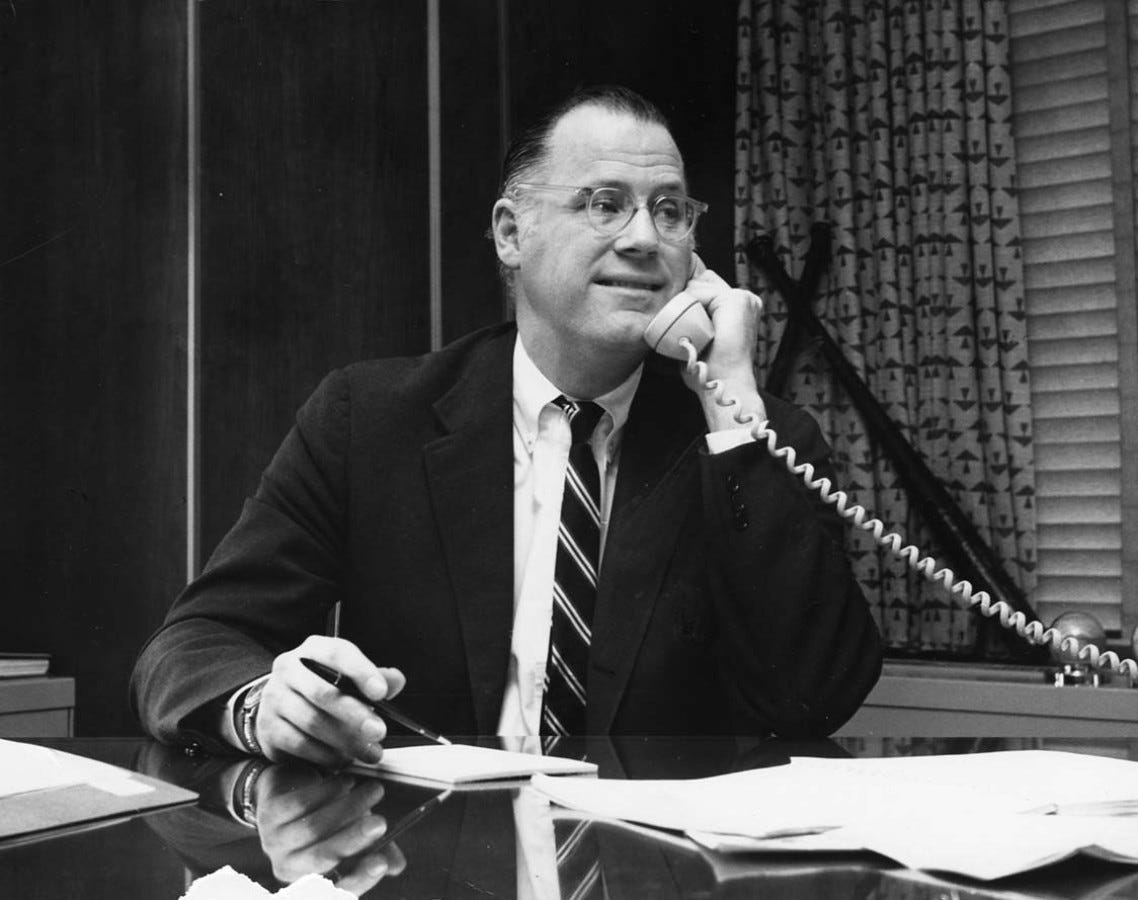
Around the time Turner made those comments, someone called Bowie Kuhn, bringing the commissioner strange tidings from Pittsburgh:

In the conclusion, Ted Turner’s unfinished business and a brief history of managerial cosplay.

The A’s Charles O. Finley was the commissioner’s chief nemesis, warranting several chapters in which Kuhn didn’t bother striving for poetry: “[Finley] had few redeeming virtues as far as I was concerned. One more like him and I would have gone to work for [players’ union director] Marvin Miller.”
”Calculation and premeditation” were Bowie Kuhn’s version of “rock and roll.”
Of course the pinch-runner’s name was Pat Rockett. Who writes this stuff?
Paul, you’re prescient - I just read Ted Turner’s obituary. Just promise me that you won’t write about me for a very long time.
The Yankees lost one of their beloved announcers yesterday. John Sterling announced 5420 regular games & 211 post season. He was 87 - born on July 4th like Steinbrenner.