


Welcome to Project 3.18, where a fan-first writer tells strange and surprising stories from baseball history and culture.
If you enjoy what you read today, please subscribe to receive our free feature stories in your inbox. And if you’ve been here for a while, we could really use your support as a paid subscriber. Paid subscribers receive access to exclusive content and help keep this publication going and growing.
Last week Project 3.18 took a look at some archaic superstitions from the 1890s, when silk socks could not be red and a fan claiming responsibility for a winning streak might get put on the team payroll. These were the old, old days, but we found an intriguing quote from Jim McGee, a team psychologist in the 1990s, who said superstition was as an enduring a baseball tradition as wooden bats. The game hadn’t changed much in a hundred years, so all that old-time “magical thinking” still worked.
This week, we’re using McGee’s claim as a prompt. Surely players in the 1990s were a little more rational than their 1890s predecessors…right?

In 1978, a cultural anthropologist named George Gmelch wrote an influential article connecting modern-day baseball players to a very different group: the fishermen of the Trobriand Islands, an archipelago off the coast of New Guinea.
Doesn’t “George Gmelch” seem like a wonderful baseball name? Turns out, it was—the same George Gmelch spent 1965-1967 in the lower minor leagues, mostly in the Detroit Tigers’ system, playing first base and outfield. According to Gmelch’s BR Bullpen page (which we would bet a quarter he wrote himself), “Baseball remained an interest throughout his academic life, and he published a number of well-received works on the subject.”
Gmelch took his first big swing in cultural anthropology by writing “Baseball Magic,” an article that successfully used superstition to link celebrity millionaire athletes to the Trobrianders, an isolated, traditionalist people who measured wealth primarily in yams.
As an anthropology student, Gmelch had studied the islanders’ religious practices, which included a repertoire of magic spells for influencing the natural world. Gmelch was especially interested in the elaborate rituals Trobriand fishermen performed to ensure success and safety when they fished in the open ocean, where yields were uncertain and weather could be the difference between coming home with food and not coming home at all. The Trobrianders also fished in sheltered lagoons much closer to home, but they had no rituals or magic for lagoon fishing. They didn’t need them.
In this far-away setting, Gmelch recognized the dynamics of a major-league infield. On defense, a player’s skill was enough to control the outcome. Defense was baseball’s lagoon. Pitching and hitting were the equivalent of the open ocean, high-risk, high-reward activities in which a rogue variable could ruin even the best performance. Just like the Trobriand islanders, baseball players loaded up on superstitious rituals—but only when their abilities weren’t enough.
As a player, Nomar Garciaparra, infielder for the Red Sox, Cubs, and Dodgers, insisted he didn’t have any rituals at the plate, but he’d admit to having a routine, one for which he was famous:

Step 1. Adjust arm band on right arm.
Step 2. Tap home plate with bat.
Step 3. Touch helmet bill and end of bat.
Step 4. Touch helmet bill again.
Step 5. If first at bat or critical situation, make sign of cross on chest.
Step 6. Balance bat on right shoulder, yank batting glove on left hand.
Step 7. Use right hand to tug on right glove.
Step 8. As many 1/16th-speed practice swings on tip-toes as time allows.
Garciaparra knew his batting routine was a lot, but he objected to the idea that it was irrational. He had an objective and he was achieving it. “I’m just doing it to get everything tight,” he said in 2006. “I like everything tight. That’s all it is, really.”
There was a little more, perhaps: “
We do something every single day, we’ve got to play, and you’re expected to be the best every single day and you can’t control it. It’s on television for everyone to see. That’s why routines come in for me.
Garciaparra was asked what would happen if he didn’t follow his routine, but for this particular hitter, that was like asking what would happen if he batted with his eyes closed. “Why wouldn’t I do it?”
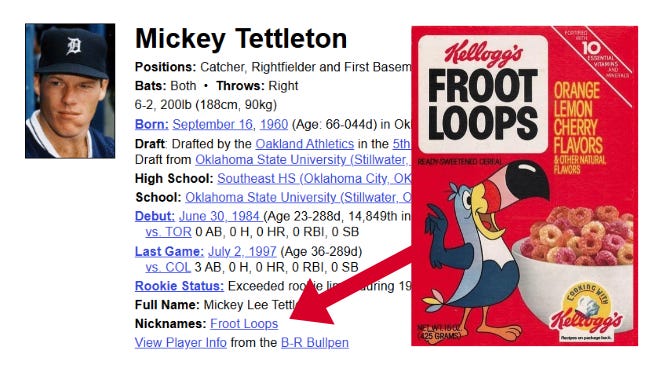
According to Gmelch et al, a ritual is “a set of required behaviors in which there is no empirical connection between the means and the desired end.” Some required behaviors appeared more rational than others, but with no empirical link between “keeping it tight” and hitting .372 (as he did in 2000), Garciaparra’s routine met the clinical definition. Two-time All-Star Mickey Tettleton operated much further away from rationality. There was a long stretch when Tettleton believed his offensive performance hinged on eating Froot Loops for breakfast.
Many baseball routines are shared. Most hitters take practice swings, and most pitchers throw warmup pitches. Humans are creatures of routine, and, if nothing else, their familiarity can provide comfort. Seeking comfort or assurance via a routine is perfectly rational, but for superstitious players, it didn’t stop there. In other words, regularly enjoying a bowl of Froot Loops (and the resultant pink milk) before a game could be a routine, but doing so to stay on a heater at the plate (as Tettleton did) was a ritual.
Food rituals were common. Pasta seems to have been a favorite. Bert Blyleven enjoyed spaghetti and meatballs before his starts, saying he “didn’t feel right” on the mound otherwise. Dodgers manager Tommy Lasorda added complexity to the dish, literally and figuratively. He preferred to eat linguini with clams before night games, but depending on whether the team was facing a left- or right-handed pitcher, the sauce would be red or white.
Hall-of-Fame infielder Wade Boggs, one of the most ritual-dependent players of the 1980s and 1990s, was famous for eating chicken before every game. According to Gmelch, that started when Boggs was a rookie in 1982, when he identified a correlation between his multi-hit games and his chicken dinners. In 2021, Boggs said he started the chicken habit to help sell a 1983 cookbook and stuck with it after having an excellent year at the plate.
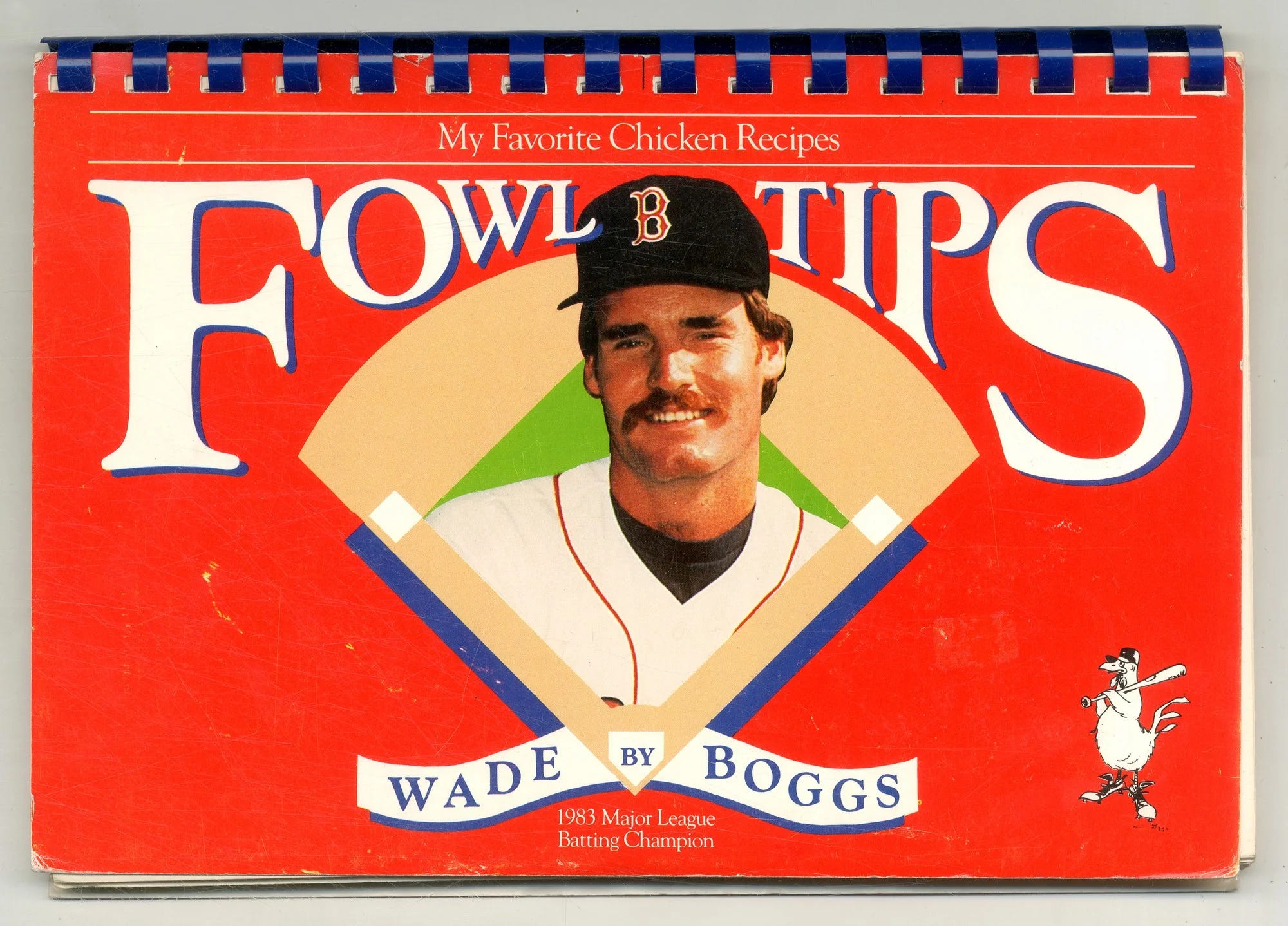
Pitcher Gaylord Perry, the famed greaseball artist, was also partial to a good bird, believing “there are outs in chicken.” Boggs and Perry were both active in 1982 and 1983, and their chicken-on-chicken battles presumably stalemated in fielder’s choices or walks.
Like Garciaparra, slugger Dave Parker said he didn’t have superstitions. But…“there is this thing I do with gum,” he said in 1992, “but it’s not a ritual.” Every time he went to bat, Parker took a cup with four sticks of gum in it. Just before he reached the on-deck circle he’d eat the gum and chew it through the at-bat. When it ended, he’d blow a final, cathartic bubble, spit out the gum, and sit in a specific place on the bench with the empty cup next to him. No one could touch the cup. Littered with unassuming relics like that, major league dugouts could be difficult spaces to navigate. A major-league coach reflected to Gmelch:
You’ll see every guy sitting in the same spot every night. It’s amazing, everybody in the same spot. And don’t you dare take someone’s seat. If a guy comes up from the minors and sits here, they’ll say, “Hey, Jim sits here, find another seat.” You’ve got a routine and you adhere to it and you don’t want anybody knocking you off it.
According to psychologists, most rituals start when something good happens and the beneficiary can’t easily explain why. Major league hitters are, by definition, the most skilled people on earth at their profession. Their skill level is a relative constant even though their game-by-game performances are up and down. When they have success, hitters tend to look for anything out of the ordinary that might have been causal: What did I do differently today that I can do again tomorrow?
Some more obsessively inclined players could build these lucky habits brick-by-brick into behavioral prisons. “You can’t really tell what’s most important,” a minor-league pitcher told Gmelch, “so it all becomes important. I’d be afraid to change anything.”
A century earlier, there was no talk about obsessive-compulsive behaviors, but in the 1990s some “colorful” habits could be seen as diagnosable symptoms. Players like Wade Boggs and Nomar Garciaparra got close to that threshold, and some lesser-known players, like Brian Holton, a reliever with Baltimore in 1990, were in even deeper:
I get dressed the same way every day. Then I button just three buttons of my warm-up jacket. I go and get a towel and wrap it around my neck, and the tag always has to be on the right side. I put two cans of [chewing tobacco] in my pocket, one from spring training and a new one. In my left pocket I carry a lasso. I found a piece of rope in San Diego once and made a lasso out of it and we went on a winning streak. I always sit in the same seat in the bullpen and the dugout. I come up on the mound from the first base side. I wipe the rubber four times with each leg and spin around clockwise. I catch the ball with one foot on the dirt and one foot on the grass.
The opposite of a ritual is a taboo, something you don’t do, usually in an effort to keep the good times rolling. Most individual taboos start the same way rituals do, just reversed. Something bad happened today, so what was different that I can blame it on? Even Gmelch, the Tigers farmhand-turned-anthropologist, admitted to falling into this trap as a player: “Twice the author ate pancakes before games in which he struck out three times; after that he swore off eating pancakes during the season.”


Taboos are more likely to be single-step than rituals, and perhaps because of this they are easier to practice collectively. When that happens, a taboo can become a norm. One of the biggest and most familiar baseball taboos is a prohibition on interacting with a pitcher during a no-hitter, especially discussing their performance. This one isn’t entirely irrational; distraction or over excitement are real concerns in that situation. Nor is the common taboo on stepping on the white foul lines (some conscientious players feel doing so is disrespectful to the hardworking grounds crew).
It is generally taboo to share bats (with some notable exceptions) and some hitters used to feel quite strongly about keeping pitchers away from their bats, fearing their offensive ineptitude might be catching.
And this leads us to the last anthropology term: “fetish.” (No, not like that.) The word has gone on quite a journey in the last century or so, but its original meaning goes back several centuries further. A fetish is an object that a person or people believes provides “supernatural” power to aid or protect. In baseball, fetishes are often pieces of equipment used at what proves to be the start of a run of desired outcomes. The rope lasso reliever Brian Holton kept in his uniform pocket was a fetish. As strange as it is to say, our grandmother’s stuffed dog, featured in last week’s post, is a fetish.
Many professional players have regarded bats and balls as physical vessels containing intangible outcomes. Detroit Tigers pitcher Mark Fidrych was famous for his suspicion that some balls had “hits in them” while others did not. A ball used to make a hit had chosen a side. “I didn’t want to see that ball again,” Fidrych said. At least put back in a ball bag, “so it would goof around with the other balls in there. Maybe it will learn some sense and come out as a pop-up next time.”
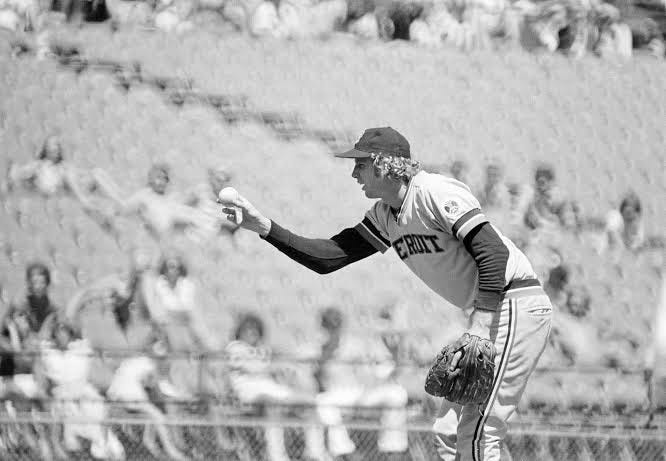
Back when bats were thicker and lasted longer, some players thought they contained only a finite number of hits. The great Honus Wagner was probably the most famous “hit-counter.” When one of his bats gave up its hundredth hit, it was time to part ways.
Discussing Garciaparra’s habits, a sports psychologist named Ken Ravizza challenged Yogi Berra’s position that it was unwise to think and hit at the same time. “Unless you’ve got something to do when you go up to the plate,” Ravizza said, “it’s hard not to think.”
To George Gmelch, that explained why there are relatively few rituals associated with the act of defending. On defense, there was almost no time to think. Compare the amount of time a player has to field a ball to the time they spend in an at-bat, hitting or pitching. Plus, in baseball’s defensive lagoon, the outcome lay entirely in the player’s hands. “[The defender] knows that, better than 9.7 times out of 10, he will execute his task flawlessly,” Gmelch wrote. “With odds like that, there is little need for ritual.”
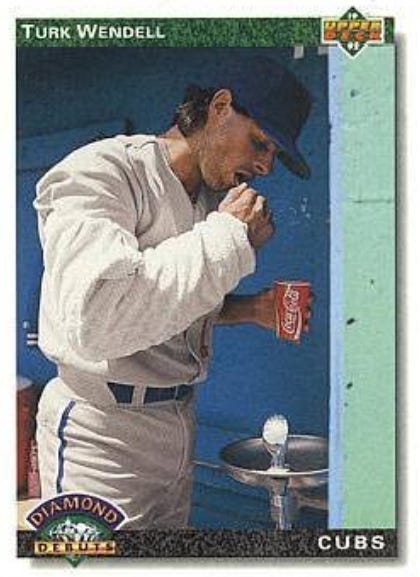
The Final Boss of 1990s superstitions is commonly held to be either Boggs or a right-handed pitcher named Turk Wendell, who pitched for the Cubs and the Mets, mainly in relief, between 1993 and 2004.
There is no doubt Wendell was profoundly eccentric, with a cornucopia of strange habits, quirks, and tendencies. He chewed black licorice and brushed his teeth between innings. He refused to wear sanitary socks, saying they were a waste of money. He crouched when his catcher stood and refused to pick up a ball to start an inning unless it had been rolled to the mound. He drew crosses in the dirt and decorated his truck with a plethora of crosses, Native American-themed trinkets, and so many animal skins, bones, and teeth (Wendell was an avid hunter) that it looked like “a Santeria sacrifice” had been performed in the vehicle cabin.
But Wendell doesn’t necessarily deserve the superlative “Baseball’s Most Superstitious.” He was clearly an obsessive person, but many of his habits were performed not out of an irrational belief that they would lead to baseball outcomes, but because they made him feel comfortable. It’s probably best left to the psychologists to sort out, but we see a subtle but important rationality there.
Baseball superstitions require a belief that certain actions or inactions have a direct impact on a player’s performance or game outcomes. That wasn’t often the case with Wendell. Take his insistence on waving to his center fielder and receiving a wave in return. In 1993 he told the New York Times he started doing that in high school, when the center fielder was his best friend. The greeting made him feel good, so he kept doing it. What’s irrational about that? Wendell was a behavioral hoarder—once he got comfortable doing something, it was hard to let go, so mostly he didn’t.
I’d put Nomar and Mark Fidrych in that category, too. These were people of extraordinary habit who liked to break their difficult, highly visible tasks into a series of small steps. Some behaviors they shared did rise to the criteria of magical thinking: Garciaparra, Fidrych, and Wendell all had such a powerful aversion to stepping on the foul lines when entering and leaving the field that they leaped over the entire dirt basepath.
Thinking he might just be an attention-seeker, Wendell’s teammates were often initially skeptical of him. And while his habits never stopped being annoying (and, with the no-sock thing, a little gross), other players usually decided Wendell wasn’t trying to stand out—he was doing what he needed to do just to function.
“He doesn’t sit on the front step and brush his teeth in front of everyone,” Cubs manager Jim Lefebvre said. “He goes off and does it out of the way.” Big difference, at least in baseball culture.
In the 1990s and today, routines and their weird cousins, superstitions, remain a fundamental coping mechanism, practiced everywhere from fishing canoes in the middle of the Pacific Ocean to the buffet spread in a major league clubhouse. That was what George Gmelch found so compelling. “[Superstition] is a reminder that we’re no different,” he said in 2005. “Sure, these tribal people have all these beliefs and practices that seem so weird—but look at what we do. It’s the same thing.”
The things baseball players obsess over have necessarily changed over the years; looking for a lucky pallet of wooden barrels would be a waste of time today. But the tenets of superstition—rituals, taboos, and fetishes—are as they ever were. Some people need them, most don’t, and those who do always catch a little grief from everyone else. Even the grief part has kept up with the times, as you can see on Mickey Tettleton’s Baseball Reference page:

You can really help Project 3.18 by sharing this feature on socials or restacking it here on Substack. Publishing a story is how we get on base; please help spread the word and drive us home.
One More Thing
There’s one superstition from the late 1990s and 2000s (too late for George Gmelch, who surely otherwise would have mentioned it) that strongly suggests baseball players have only gotten weirder over time. This one started when Oakland A’s slugger Jason Giambi was gifted a gold lamé thong.
We won’t have a Monday feature story next week, but our Project 3.18 Partners will get a special report on the skimpy bathing suit that became a guaranteed slumpbuster. We’ll even include a comprehensive list of the players (yes, that’s plural) who have admitted to wearing it under their uniform.
If you can support all the work we do at Project 3.18 with a paid subscription, we’d love to send this vital piece of cultural anthropology to you!