


Welcome to Project 3.18, where a fan-first writer tells strange and surprising stories from baseball history and culture.
If you enjoy what you read today, please subscribe to receive our free feature stories in your inbox. And if you’ve been here for a while, we could really use your support as a paid subscriber. Paid subscribers receive access to exclusive content and help keep this publication going and growing.
In the Beginning… / Au Commencement…
Charles Bronfman, the founding owner of the Montreal Expos, was an unlikely pick to design the team’s first mascot, but when you run the place you get to hand out the assignments. Clearly in need of a creative outlet, in 1977 Bronfman tasked himself with “designing a mascot that was very modern, just like [Montreal’s Olympic Stadium].” His take on modernity ended up being pretty futuristic, featuring black leather gloves, pointed shoulders, and a airlock-type turtleneck, topped by a baseball head that ripped off New York’s Mr. Met in theory if not in practice. The result, even Bronfman admitted, was…disconcerting. “It was so outstanding that it scared the heck out of the kids and was despised by just about everyone.”
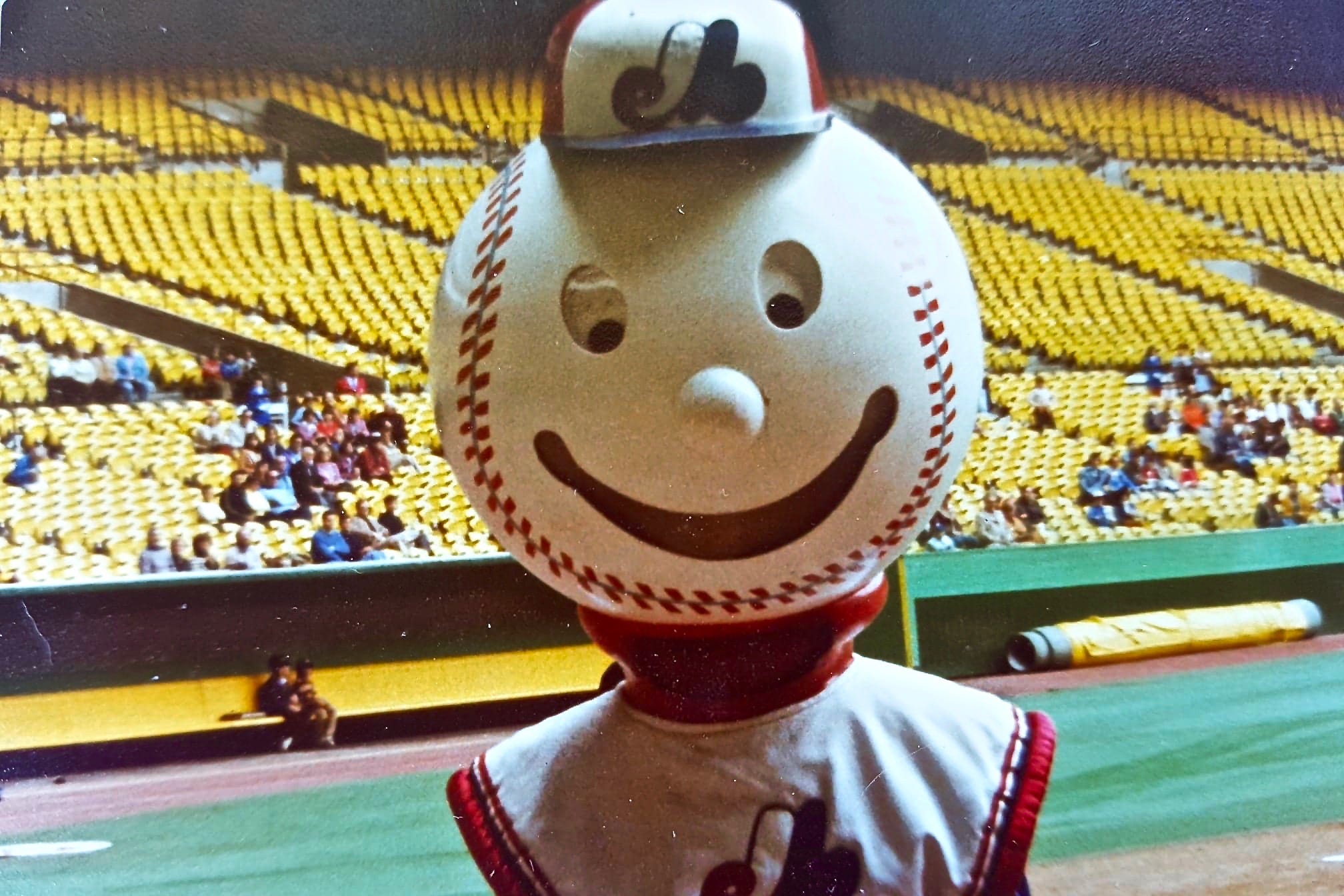
Bronfman’s creation, dubbed “Souki” (a non-French name assigned, sight unseen, by an ad hoc committee), debuted in 1978. It would have taken a gifted performer to bring any warmth into that character, but instead the Expos gave the job to a guy some of his own colleagues described as a “street tough.” Without any natural charisma and so top-heavy he couldn’t kneel or bend over, Souki stalked the lower sections of Olympic Stadium, stiffly greeting wary fans and putting fear into the hearts of children. In 2020, several longtime Expos’ employees recalled watching kids flee from Souki as if he had just stepped out of a baseball-themed nightmare.
Perhaps putting a rough character in the suit was a good thing. Rodger Brulotte, the Expos’ traveling secretary at the time, once saw Souki get sucker-punched by an angry fan. The performer told his assailant he’d be back, sans costume, an inning later to take his revenge. After that, Brulotte remembered, “we told ourselves we might not have the right guy inside the suit.”
At least Souki’s second performer never threatened to fight anyone, despite receiving similar treatment. A member of the radio team, Paul Houde, recalled a later incident:
It’s the end of September, it was cold at night, the Expos lost and I think Souki scared a kid. So the guy says, “Hey Souki, you’re done tonight!” and he punches Souki in the face. It was the first time I had ever seen a mascot get punched. The ball that made up Souki’s head caved in. It probably didn’t hurt the [performer]—but he was so used to being a mascot that he grabbed his head and started acting like he was hurt.
At the end of his first season, the Expos’ marketing team determined that Souki had to go. Instead of simply retiring the mascot, they offered him symbolically to a fraternity at the Université de Montréal, who was interested in administering the character’s last rites during a pledge event. Brulotte, the Expos’ traveling secretary, was assigned to inhabit the costume during Souki’s symbolic death. We swear, all of this is true.
“I want people to scream…”
After Souki was offered up to the frat boys, Bronfman retired as a character designer and the Expos brought in real experts to start over. They commissioned Harrison/Erickson, a studio run by Bonnie Erickson, a designer who helped Jim Henson create many of his iconic Muppets characters, to design the Expos’ next mascot. Erickson was a hot commodity after helping the Phillies’ create their own supersized Muppet of uncertain taxonomy, the Phillie Phanatic.
The Expos’ team took an active role in the design process, vetoing a purple character and requesting bright orange, a nod to the team’s first star, the red-headed Rusty Staub, “Le Grand Orange.” They also replaced a drooping anteater-like nose with a short one Brulotte described as a bit more “typical of a Québécois nose.”
Brulotte recalled the conversation that named the new character. Roger Landry, the Expos’ Vice President of Marketing, said he wanted people to be so excited when they saw the mascot that they cried “Youppi!”—the French version of “Yippee!” or “Yay!” And what better way to guarantee that reaction than by making that the name, right down to the exclamation point, which became part of Youppi!’s official moniker and the symbol he wore on the back of his oversize Expos jersey.
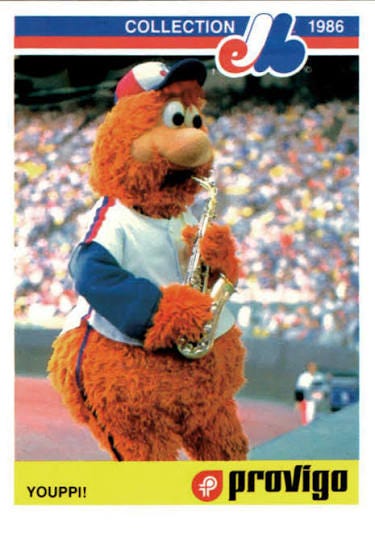
Youppi! debuted at Olympic Stadium on April 14, 1979. His first performer was a 25-year-old Expos fan named Denis Desaulniers, who successfully auditioned for the part.
Though the exclamation point is part of Youppi’s official name, we’re omitting it for purposes of readability. And, since we’re here, a word on gender. The performers who brought the mascot to life were all men, but Youppi is technically androgynous. With that said, we’ve followed the usual convention and applied he/him pronouns.
Inspired by the trailblazing antics of Ted Giannoulas, the performer inside the Famous Chicken of San Diego, Desaulniers brought Youppi to life as “a teenager that never grew up,” a mischief-maker who loved grabbing attention during slow or transitional moments. Unlike Souki, the orange hominid was agile and durable enough to drop to his knees and solicit ice-breaking hugs from skeptical children. Youppi’s warmth made all the difference—but Desaulniers wore a motorcycle helmet inside the costume, just in case.
Making History
Desaulniers portrayed Youppi until 1983. His replacement, Jean-Claude Tremblay, was as much a costume technician as comedian, and his two-year tenure brought major upgrades to Youppi, including more secure google eyes and modular, washable parts. The latter was essential as the original costume, not washable, had something of a funk. No wonder Desaulniers left.
Tremblay’s talent as a comedian may have been lacking. On August 30, 1984, the San Francisco Giants were in Montreal. In the third inning of the game, the team’s mascot, identified as “Youppie” in San Francisco accounts, went too far, reportedly “making fun of the waistline” of first base umpire John McSherry.
McSherry, normally a genial presence on the diamond, struggled with his weight throughout his umpiring career, and Youppi’s mean-spirited taunting struck a nerve. McSherry wasn’t going to take that disrespect from a mascot, especially one with a paunch of his own, so he threw the offender out.
The ejection could have been assigned to Tremblay, the man inside the suit, but according to official records kept by Retrosheet, it was assigned to the character. That’s probably correct. McSherry probably didn’t even know who the performer was. That night, Youppi became the first costumed mascot to ever be thrown out of a major-league game. That scrap of history was mostly lost in the night’s 4-3 Giants victory, but it was history. The mascot had entered his name (and exclamation mark) on the eternal register of bad actors, alongside malcontents like Earl Weaver, Leo Durocher, and John McGraw.
The Mascot Wars
The 1980s were the costumed mascots’ “Bad Boy” era (we’ll leave Mrs. Met out of it), and Youppi was hardly the only source of trouble.
In May 1987, the Pittsburgh Pirates suspended their own mascot, the Pirate Parrot, after an incident in a game against the Dodgers. During that game, umpire Fred Brocklander made a controversial call, initially ruling that outfielder Andy Van Slyke had caught a line drive hit by the Dodgers’ Steve Sax. The umpire changed his mind and decided Van Slyke had trapped the ball, putting Sax on base and earning the ire of fans at Three Rivers Stadium.
Shortly after that play, the Pirate Parrot rode his motor scooter onto the field and acted like he was about to toss a bucket of water on Brocklander, later throwing a plastic ball at the embattled official. The team found this conduct worthy of a one-day suspension. The performer inside the suit, Tom Mosser, apologized, saying he had missed the controversial call while getting ready to perform; his targeting of Brocklander was an unfortunate coincidence.
Mosser’s miscue highlighted the toughest part of his job. Mascots had to situate their performances to the events of the game, requiring them to keep one googly eye on the play-by-play while preparing and executing context-appropriate bits and stunts. It was a lot to keep track of. Like the umpires, sometimes they missed things.
In August 1987, during a game at Olympic Stadium, Chicago Cubs reliever Willie Hernandez was knocked out of a game by the home team, and Youppi’s third performer, Claude Hubert, was waiting for him on top of the visitors’ dugout, pretending to reel the pitcher in like a prize fish. Hernandez was so unamused he threw his glove at the mascot—and missed. The odd-shaped missile flew 12 rows into the stands and hit a woman in the mouth. She subsequently sued Hernandez for $500 and kept his glove. Hernandez said he didn’t care. “It didn’t have any outs in it, anyway.” Youppi somehow escaped litigation.
On August 28, 1988, Tommy Lasorda decided to make a stand. The manager of the Los Angeles Dodgers had watched for several years as the Phillie Phanatic marched a stuffed doll wearing a “Lasorda” shirt onto the field and stomped on it with his size 56 shoes. This time, Dave Raymond, the Phanatic’s longtime performer, ran over the doll with his three-wheeler, a move he later admitted was too much, even for the Phanatic’s slapstick sense of humor. Lasorda marched out of the dugout and confronted the mascot, retrieving his likeness and using it to bludgeon the Phanatic, who fell to the ground in surprise.
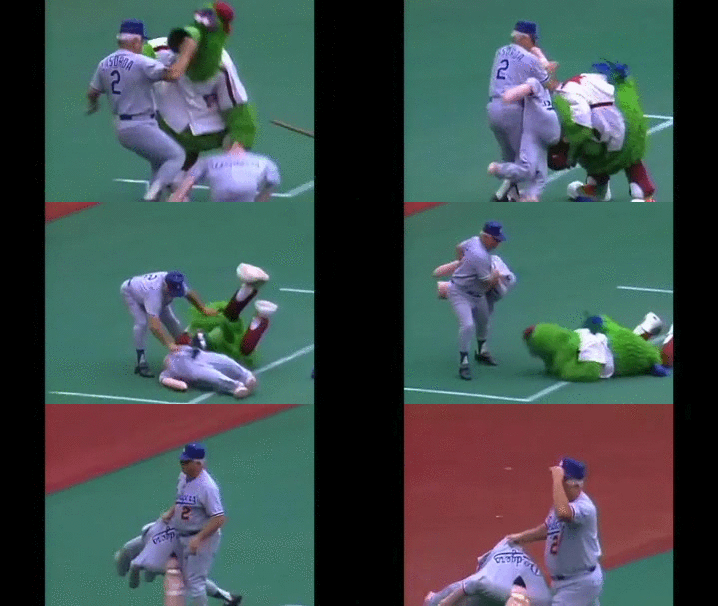
The manager departed with the doll but quickly turned it over to Philadelphia authorities, who gave it right back to Raymond. Inside his green creature suit, the performer was unhurt. He said he’d initially assumed Lasorda was doing a bit. “But he hit me over the head, yanked at the [costume]’s head. I finally crawled off to the camera booth. I said, ‘Okay, the gloves are off.’” Raymond brought the dummy back out two innings later and fed it pizza. (Sorry, we don’t have a gif of that.)
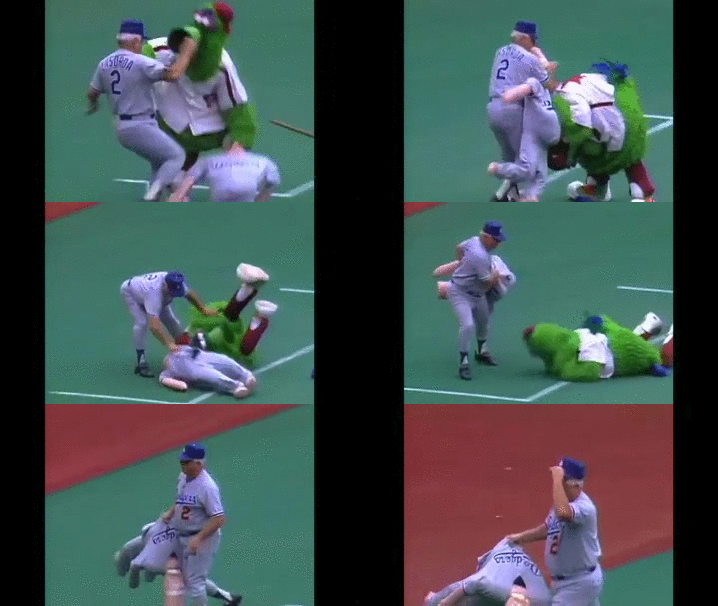
Lasorda confirmed he’d been serious and clarified the Phanatic’s offense. The manager didn’t mind being the butt of a joke, but the mascot had disrespected Dodger Blue. “I like the kid,” Lasorda said of Raymond, then 31, “but what he did wasn’t entertainment. I love the Dodgers and it wasn’t right for him to stomp on the doll with the uniform. There were a lot of kids there, and he’s showing them violence. He didn’t need to do that.” What message Lasorda hoped the kids would take from his own actions is not clear.
In the wake of the tussle, an ESPN commentator suggested MLB’s mascots needed to band together to protect themselves from the assaults of baseball codgers like Tommy Lasorda. He even attributed words to this effect to Youppi, saying the Expos’ mascot had called for unionization and a lawsuit against the Dodgers’ manager.
The Expos were quick to shoot down the report: “Youppi doesn’t talk to reporters or anyone else.” He didn’t talk at all, in fact. Like many of his peers (and unlike his predecessor), the Expos’ mascot had no mouth and was performatively mute.
That should have cleared things up, but perhaps Lasorda missed coverage of Youppi’s denial. Whatever beef existed between the two simmered until August 1989, when the thin-skinned manager helped Youppi make history again.
“One of those nights.”
On August 23, 1989, the Expos hosted the Dodgers at the Big O. Any game started by Orel Hershiser and Pascual Pérez promised to be a pitching duel, but the 0-0 score after nine innings hinted at the possibility of something much grander. In fact, this was Canada’s version of the Rick Camp Game.
In the top of the seventh inning, for instance, the Expos seemed to have pulled off a thrilling triple play, but in a subsequent conference the umpires reversed the initial decision, sparking a string of arguments. Overseeing such a tense and frustrating game put Tommy Lasorda was on edge. Meanwhile, Youppi had stationed himself on top of the Dodgers’ dugout. “Perhaps I was making a little more noise than usual,” Hubert, the performer, said later.
His heavy footsteps irritated Lasorda. Television cameras picked up the manager shouting “Get the f*** off my dugout.” He then addressed a third party, probably third-base umpire Bob Davidson: “I don’t want him jumping on my dugout.” Youppi clambered down and made the sign of a halo over his head.
Hubert knew he was playing a dangerous game. “Well, I knew [Lasorda] didn’t love mascots,” the performer told mlb.com in 2022. “Because he did something with the Phillie Phanatic.” Nevertheless, Hubert had to keep needling. That was the job.
Meanwhile, the pitchers’ duel continued. Pérez departed after eight innings, Hershiser after seven. An ensemble cast of nine different relievers, most working multiple innings, kept the double shutout going.
By the eleventh inning, Youppi had slipped into something more comfortable, donning oversized pajamas and a nightcap. The weary mascot found a comfy spot to nap: the roof of the Dodgers’ dugout. Youppi belly-flopped into a prone position, alerting Lasorda to his presence.
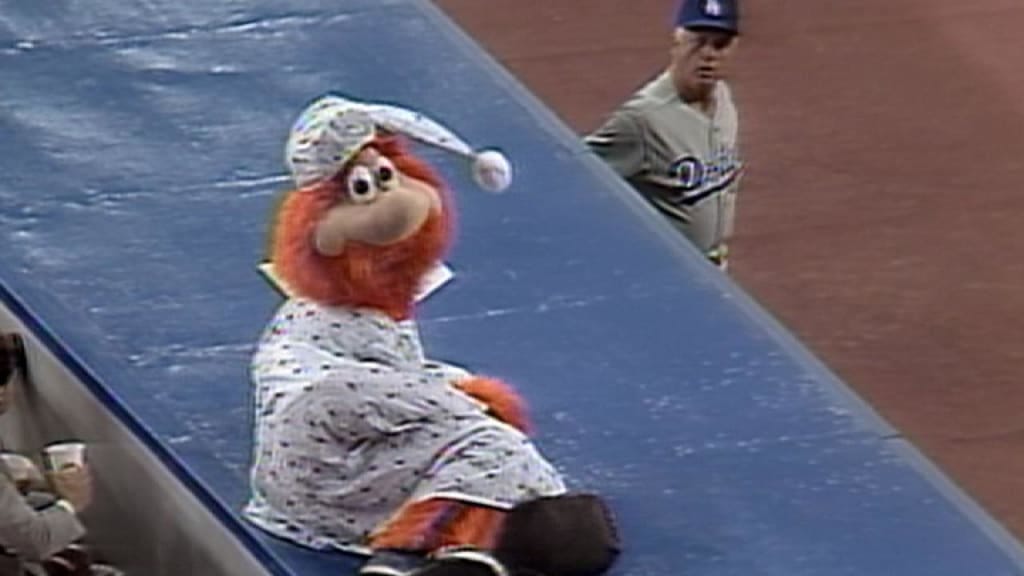
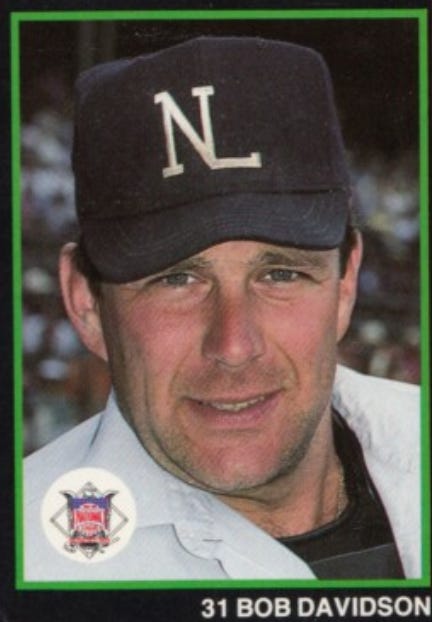
The manager emerged from the dugout and tossed more barbed words in Youppi’s direction. Seeing the mascot antagonizing Lasorda again, umpire Bob Davidson took matters into his own hands. He stopped play and ordered Youppi to leave the game. The lovable monster had been ejected again.
Hubert admitted to at least one noisy pratfall on top of the dugout as he put himself to bed, but in his version of events, a group of kids sitting behind the dugout were banging their feet on the roof, creating the clamor that drew Lasorda onto the field. “The first thing he saw was me,” Hubert recalled. “I explained it wasn’t me [making the noise], it was the fans. He understood, but [Davidson] thought Tommy was yelling at me, so he said, ‘Youppi, get out of the game.’”
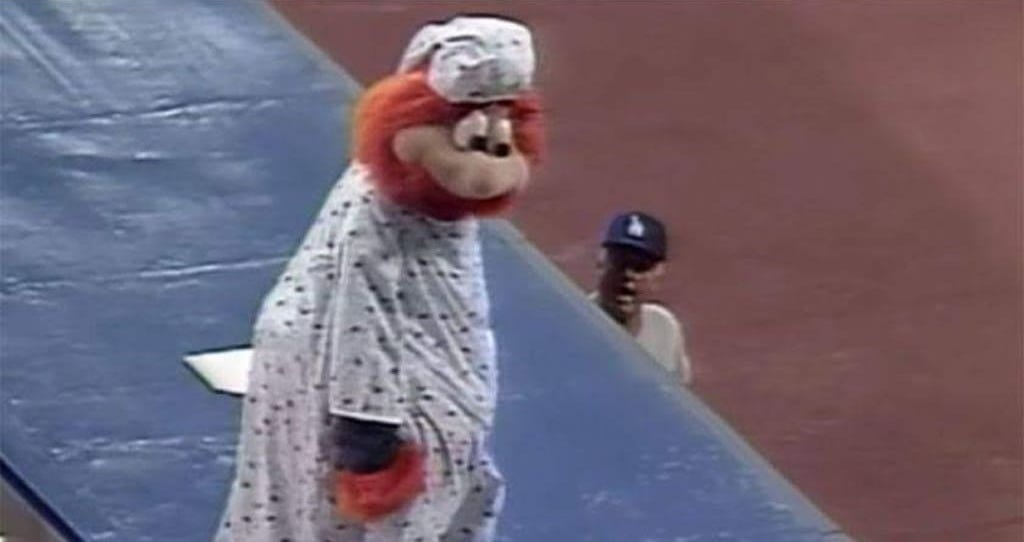
Youppi picked up his pillow, shook his head, and departed for the concourse, earning cheers from the dwindling crowd. At first, the Expos’ staff weren’t sure if Davidson was trying his hand at comedy or if he had really ejected a mascot for napping. They made discreet inquiries and Davidson assured them he had no sense of humor whatsoever.
While the mascot stayed out of sight, chants of “Youppi, Youppi, Youppi…” picked up steam, peppered with feedback for Davidson. “I got booed a lot [as an umpire],” the umpire said. “But they booed me pretty good that night.”
Davidson worked 3,911 games between 1982 and 2016. He ejected 166 players, managers, and other parties during his career, including Youppi. None of that was particularly noteworthy. Other umpires had issued hundreds more ejections and even Youppi had been ejected before. But as the twelfth inning proceeded amid a groundswell of support for Youppi, Bob Davidson did something that no umpire had ever done.
Either to restore peace or regretting his zealousness, Davidson allowed Youppi back onto the field—as long as he stayed away from the Los Angeles dugout. It was the first ejection-reversal in history. No other banished offender had ever been allowed to return, even if the umpire decided he’d been too hasty. In the midst of such a tight game, Davidson probably didn’t appreciate the historical counter he’d moved from 0 to 1.
In the 16th inning, Expos right fielder Larry Walker was on third base and catcher Mike Fitzgerald (who worked the entire game) hit what appeared to be a walk-off sacrifice fly. The Dodgers protested, saying Walker had left the bag too early. Davidson said nothing and the Expos celebrated, until finally somebody threw the ball to third base. Davidson called Walker out, confirming the Dodgers’ suspicions and erasing the win. “It was one of those nights,” Davidson said later.
In the 22nd inning, Dodgers backup catcher Rick Dempsey hit a solo home run, only his second of the season, driving a hanging curve ball over the left field fence. Rather than pump his fist or cheer, Dempsey only shook his head. The Expos could not answer in their last at-bat. Dempsey threw out a runner attempting to steal and the six-hour marathon was over.
The game tied the record (by innings) for the longest Los Angeles Dodgers game ever and broke the record for longest Expos game in the history of the franchise. It was also the longest shutout loss for any team since the Mets put up a 24-inning goose-egg in 1968.
“I have never in my life seen a game like this,” Lasorda said. “Never. Not ever.”
Youppi’s banishment was merely a footnote in most accounts, and if a writer lingered at all, most assumed it was the mascot’s first ejection. Only Jayson Stark, then a baseball writer for the Philadelphia Inquirer, with an assist from the Expos’ publicist, Rich Griffin (the same joker who put Olympic Stadium’s roof on the Disabled List in 1991), correctly marked this as Youppi’s second ejection. But no one apparently noticed that an umpire had performed baseball’s first un-ejection.
Claude Hubert remained inside the orange suit until 1991. He remains the only mascot performer to be ejected from two baseball games, but seems to have kept a lower profile after 1989. The Mascot Wars continued elsewhere, as baseball’s fur-suited instigators kept pushing the limits of baseball’s unique brand of performance art, often at Tommy Lasorda’s expense. As always, the Phillie Phanatic was in the vanguard, though, we must point out, the Phanatic has never been ejected.
The Dance
Dave Raymond, the performer inside the Phanatic, kept up his dummy bit even after Lasorda ripped it out of his furry hands and beat him with it in 1988. He continued upping the ante on a semi-annual basis, smashing souvenir Dodger batting helmets and even destroying cans of Ultra Slimfast, a diet drink powder Lasorda prolifically endorsed. During a July 1991 series at Veterans Stadium, the Phanatic did all of the above and Lasorda boiled over again:
I’ve worn three uniforms in my day and been as proud as a man can be of all three. Wore the Boy Scout uniform, the uniform of the U.S. Army, and the Dodgers’ uniform, and I don’t want to see some idiot making a spectacle of them. If he wants to entertain, if he wants to dance, that’s great, but I don’t believe in demonstrating violence at the ballpark.
At least this time he used his words.
Dave Raymond used his, too. “Tommy talks about the Dodger uniform,” Raymond said. “What about the way I feel about the Phillies’ uniform? This is our ballpark. That’s why I did the bit today.”
Baseball has always taken itself so seriously. The antics of the anarchist mascots of the 1970s and 1980s became a healthy check on the natural puffery of purist lifers like Lasorda, a check the fans embraced. Mascots walked a dangerous line and regularly overstepped, but the game’s enduring popularity depended on a mix of timeless tradition and a little modern irreverence.
Raymond tried to wordlessly make that point the night after Lasorda put their strained relationship back in the spotlight. The Phanatic brought his dummy out again, this time dancing with it, to the sounds of the Beatles’ “I Want to Hold Your Hand.”

Project 3.18 is independent and ad-free thanks to readers who subscribe.
If you enjoy what we do here, the best way to support us is with a paid subscription.
For roughly $1 per week, you can help us continue telling incredible baseball stories and enjoy exclusive bonus subscriber content.
Youppi! Has followed in the steps of Bo Jackson and Deion Sanders (well, more accurately Tom Glavine and Kirk Mccaskill) and is a two-sport mascot. Now regularly appearing at the Bell Centre, home of the Montreal Canadiens. I’m glad he’s found work.
Great stuff today Paul!