


Welcome to Project 3.18, where a fan-first writer tells strange and surprising stories from baseball history and culture.
Happy Father’s Day to all who celebrate! From the Griffeys to the Bells to the Carays to the Wendelstedts, sometimes the national pastime seems like one big “take your kid to work” day, and we’ve got a special story today along those lines.
If you’re a dad, enjoy, and if you’re not a dad, enjoy—then send it to a dad so they can enjoy it, too.

Bill Veeck, the owner-operator of the Indians, Browns, and White Sox, loved the seedier aspects of his job. He moonlighted with security staff, helping break up fights—and coming away the shiners to prove it—and enjoyed visiting with the gamblers, who were as much a part of the ecosystem in his ballparks as the umpires and concessionaires. Just as the un-incarcerated Johnny Cash loved singing songs about prison life, Bill Veeck loved getting as close to trouble as decorum allowed.
“You meet all kinds at the ballpark,” he said in 1978, prefacing a story about John Dillinger, the famous bank robber of the 1930s. Dillinger was a customer at a time when Veeck was an employee of the Chicago Cubs.
Dillinger couldn’t miss a Cubs’ game, even when he was one of the most wanted crooks in the country. He started out with box seats behind the dugout. When the cops started chasing him and he became more widely known, he moved to the bleachers in the outfield.
Things got so bad for him he had to get a face job so he could still see the Cubs. After he got the face job, he still sat in the bleachers. We knew who he was even after the face job. One day the cops got a tip that he would be in a particular spot in the bleachers and they had more cops than I’ve ever seen all over the place. They didn’t know the guy in the spot, but it was Dillinger. He watched the game right in the middle of them and after it was over he got up and walked right through them.
That’s a typically Veeckian anecdote, presenting the ballpark, in this case Wrigley Field, as the great equalizer in which Americans from all walks of life could congregate. Criminals like Dillinger “were just customers to me,” Veeck said. In his ideal world, cops sat next to criminals, enjoying the same game, and he had the honor of selling everyone their tickets.
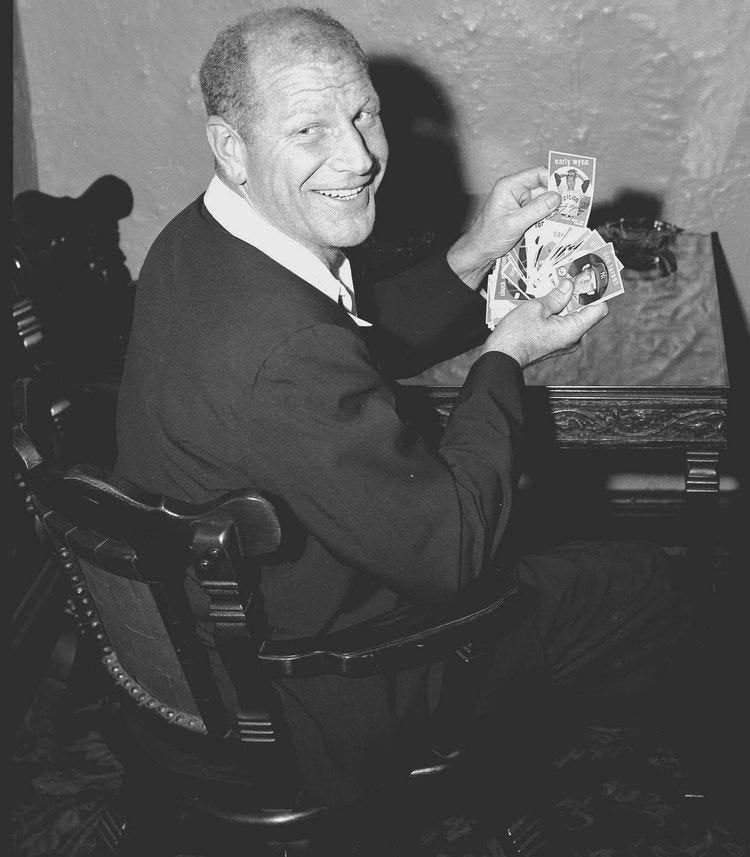
He inherited this ethos from his father, William L. Veeck, a much more upstanding man by all appearances, but practical when it came to business. He once showed his son a desk at Wrigley Field, piled high with money from the day’s ticket proceeds. “You know, Bill,” he said. “It’s a very interesting thing. You look at that money and it all looks exactly the same, doesn’t it? You can’t tell who put it into your box office. It’s all the same color, the same size, the same shape. You remember that.”
William L. Veeck, who Bill always called “daddy,” was a product of small-town Boonville, Indiana. Born in 1886, William began his career working for his father, a wagon builder and cabinet maker, but he gravitated towards the newspaper business. He took a production job at the town paper and began a career in journalism.
When his son, William Jr., was born in 1914, William Veeck was a sports writer working for the Chicago American newspaper. Writing under the pen name “Bill Bailey,” William wrote commentary without fear or favor, and the Cubs, a middling team during this period, came in for their share of criticism. Some of Bill Bailey’s even-handed comments attracted the attention of William Wrigley Jr., who was then a minority shareholder in the Cubs.
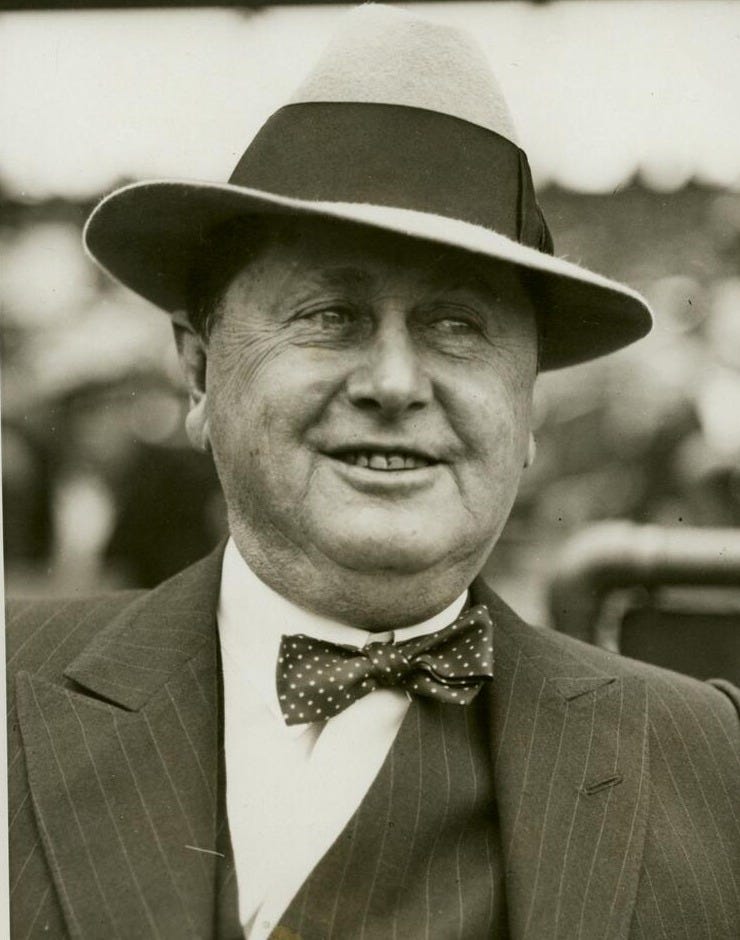
Wrigley found out who Bill Bailey was and invited Veeck to dinner. In the best version of the story we’ve seen, in Wrigleyville, by Peter Golenbock, “during their conversation, William Veeck described the Cubs by saying, ‘My infant son [that would be Bill] could throw his bottle farther than the team can hit.’”
Wrigley was either irritated or delighted, saying, “If you’re so smart, why don’t you see if you can do a better job?” He was about to take over as principal owner of the team, so this was both a taunt and an offer of employment. Veeck accepted.
Bill Veeck described Wrigley, a chewing-gum mogul, as “a well-upholstered, jovial man who liked people and knew what made them tick.”
Bill described his own father as dignified above all else. William was “Mr. Veeck” to everyone, leaving his son to find identity in informality, inviting people to call him Bill. Others remembered William Veeck as an “upright” and “starchy” man who became a patriarch and counselor for the Cubs’ players.
The two Williams ushered in a miniature golden age on the North Side. Shortstop Woody English said the players “got a new straw hat every spring and a new felt hat every fall.” Salary holdouts were rare, and Veeck seems to have enjoyed the “write in what you feel you deserve,” gimmick at contract time, a tactic that won admiration from the players, who inevitably wrote in less than they were actually worth.
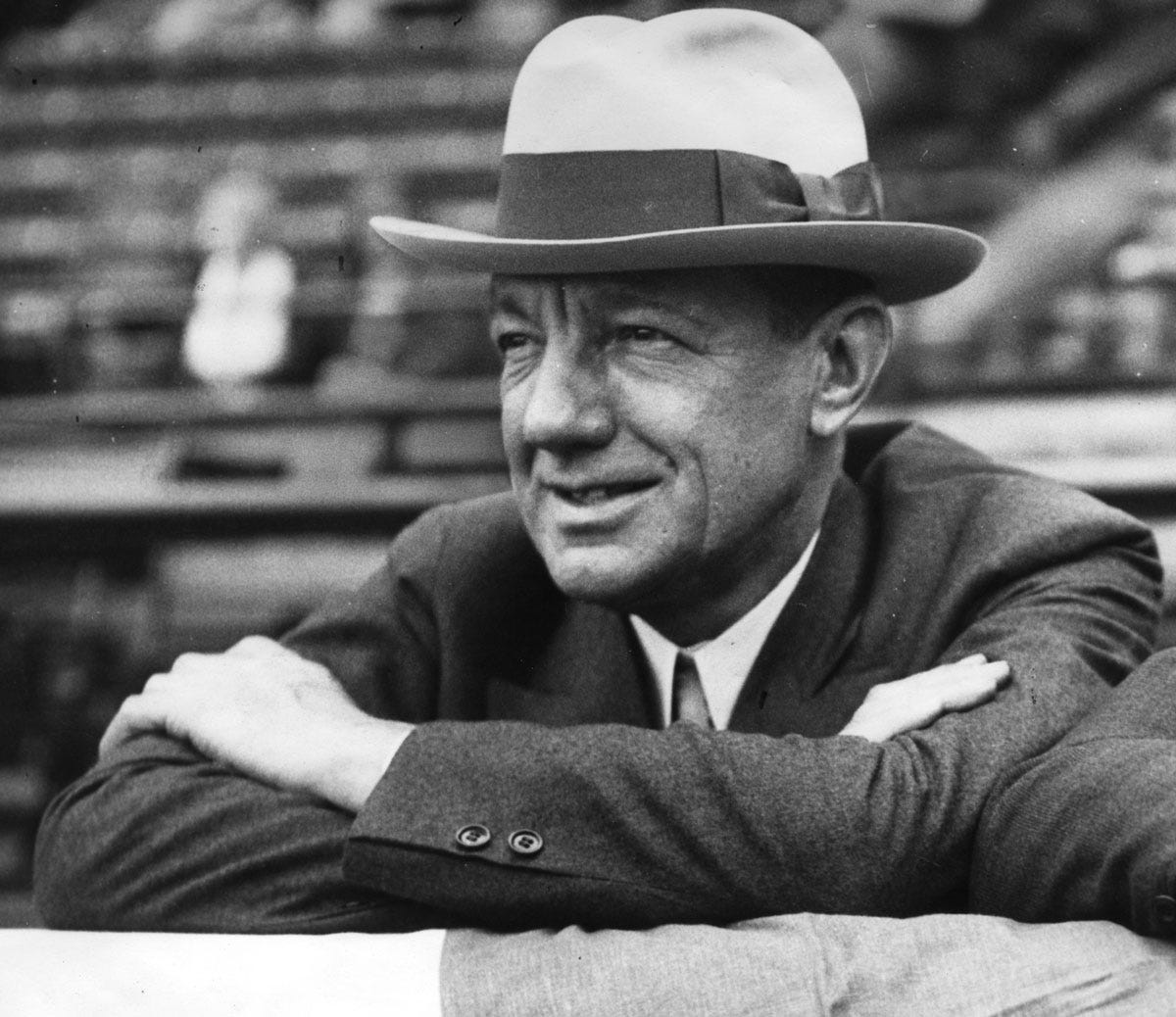
“Veeck and Wrigley were two great men,” English recalled, “such decent fellows. To us ballplayers they were like fathers, part of our family. They took care of us.”
Veeck even covered for the players whose hard-drinking proclivities made life more complicated in the Prohibition era. As long as they showed up in playing shape, that was good enough for Veeck, who also employed this approach at home. Young Bill recalled frequenting a speakeasy as a teenager—until his father found out. William confronted his son at home, but instead of punishing him, he invited him to have a drink with dinner, saying he didn’t think Bill should be drinking, but “it’s a sorry state of affairs when you do something away from home that you can’t do here.”
William Veeck didn’t shy away from the kind of ambitious thinking that got him the Cubs’ top job in the first place. He persuaded Wrigley to invest in advertising and radio broadcasting, and was rewarded by the sight of out-of-state license plates on cars parking in the vicinity of Wrigley Field on game days. He suggested shifting the Cubs’ usual crowd by attracting more women with steeply discounted Friday tickets. “Ladies’ Days” became a runaway hit, attracting upwards of 20,000 female fans, although, according to a contemporary verse, the ladies could be pretty rough:
I saw a wounded baseball fan tottering down the street,
Encased in bandages and tape, and bruised from head to feet;
And as I called the ambulance, I heard the poor guy say:
“I bought a seat in Wrigley Field, but it was ladies’ day.”
Veeck was not, however, a miracle worker. The Cubs spent many of his 14 years as president stuck behind perennial powerhouses in New York, St. Louis, or Pittsburgh, but they won pennants in 1929 and 1932 and annual attendance at Wrigley Field more than doubled during his tenure.
William Wrigley died suddenly in January 1932. Control of the Cubs passed to William’s son, Phillip. Phillip was a capable hand in the Wrigley Chewing Gum Company, a technocrat and tinkerer with no preexisting or discernible interest in baseball. As Bill Veeck wrote in his 1962 memoir, Veeck—As in Wreck: “If [Phil Wrigley] has any particular feeling for baseball, any real liking for it, he has disguised it magnificently.”
Still, Phillip announced he was keeping the Cubs after his father’s death: “The club and park stand as memorials to my father. I will never dispose of my holdings in the club as long as the chewing-gum business remains profitable enough to retain it.”
At first, this was a relatively light burden for Phillip to bear. He had one direct report, the doughty William Veeck, who controlled all aspects of the organization. Both men preferred this arrangement.
In the fall of 1933, the Cubs were finishing up a third-place season. During a mid-September series against the New York Giants, William Veeck reportedly sat in the stands despite cold and wet conditions, and this was said to have brought on a nasty case of influenza. He rested at home for several weeks but failed to improve, and he was admitted to St. Luke’s Hospital in Chicago on September 29, where tests revealed a much more serious condition: leukemia.
By October 3, his condition had become critical. Some reports said he had pneumonia, but the interaction between his underlying illness and whatever he’d picked up sitting in the stands at Wrigley was and is unclear. His doctors administered oxygen therapy when he began to have trouble breathing and he rallied briefly on October 4, holding conversations with his immediate family and John Seys, a long-time Cubs vice president, at his bedside. We don’t know what William Veeck said to his son, but we do know what he said to Seys. The Cubs were about to begin the annual City Series exhibition against the White Sox, a cherished postseason activity. “If anything happens to me,” William Veeck reportedly said, “I want the series to go on.” He lapsed into unconsciousness that night and never awoke, dying early in the morning on October 5.
The game went on, but the bereft Cubs looked “listless and dispirited” in a 2-0 loss to the White Sox, while flags flew at half-staff overhead. “He was the fairest, squarest fellow that ever lived,” Cubs manager Charlie Grimm said. “He was a true friend to every man on the team. His death is a great shock to us.”
A funeral was quickly planned for October 7, and no less than commissioner Kenesaw Mountain Landis stepped in, ordering the City Series postponed so the Cubs’ players could attend the services.
Bill Veeck was attending Kenyon College when his father became ill. He drove home and was with William for at least the last week or so of his life. This time became a core memory for Bill, 19 years old, and it also became, later on, one of his most colorful stories, as told in his memoir:
The doctors told me there was no hope. They also told me that the last thing a dying man can hold in his stomach is wine. I had done little enough for my father, I knew, and I was determined that he would go out in some comfort and some style.
Prohibition had just ended. The bootleg supply was drying up; the legitimate wineries were not yet in full production. But there was one man in Chicago, I knew, who would know where the best champagne was to be had. Al Capone. I knew him slightly from the ballpark and I knew some of his boys even better.
I hurried to Al Capone’s headquarters at the Hotel Metropole and told him what I wanted and why. “Kid,” he said, “I’ll send a case of champagne right over.” The case was there when I got back. Every morning during those last few days of my father’s life, a case of imported champagne was delivered to the door.
The last nourishment that passed between my daddy’s lips on this earth was Al Capone’s champagne.
Marvelous story. We’ve got Bill’s love for his father, his craftiness and determination, his associations with baseball and criminality, and a connection to another famous (perhaps the most famous) Chicago figure of the period. There’s just one problem:
It can’t be true. Like, at all.
There are two cracks in Bill’s story. First, the setting. Al Capone did have his “headquarters” at the Hotel Metropole—between 1925 and 1928. After that, Capone relocated his operation to a different Chicago hotel, the Lexington. Well, that’s not a big deal; Bill probably just mixed up the order of Capone’s gangland fortresses. Happens to us all the time. But by 1933, when William Veeck fell ill, Capone was long gone from any hotel, and that brings us to Flaw No. 2.
In October 1931, two years before William Veeck died, Al Capone was sentenced to 11 years in federal prison for tax evasion. He began serving that sentence, with much fanfare, at Atlanta Federal Penitentiary, in May 1932. He was still there in 1933. Here’s a fun tidbit we found from that summer:
Al Capone is playing on the Atlanta prison’s baseball team. Too bad the prison doesn’t boast of a tennis team. Al used to be quite a racketeer, you know.
Now—we’re really stretching here—maybe Bill was trying to say that he went to Capone’s suites at the Lexington and met with somebody there, an associate still running the booze business. Nope. The judge who oversaw Capone’s conviction went to great lengths to ensure the hotel lair was cleared out in 1932, after Capone was put on a train heading south.
And lest we believe Bill misspoke (miswrote, actually, which is harder to do), here he is in 1978 telling the same story to a journalist, who lauded Veeck’s “astounding recollection of the past.” As far as we can tell, this is the only version of the story that exists outside of Veeck’s memoir.
I knew Al because he was a great customer at the ballpark. This was during Prohibition days. He was a great fan of the Cubs.
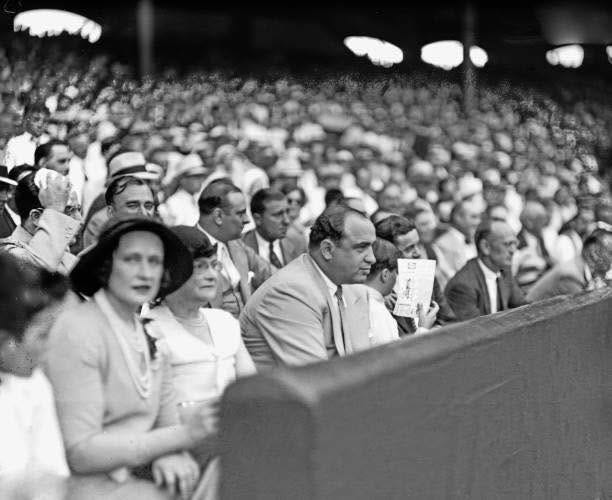
I’ll tell you a story about Al. My daddy was dying of leukemia. He was in a Chicago hospital. Long after he couldn’t keep anything else in his stomach, he could keep champagne down because the bubbles would keep it from coming up. The doctors told me champagne would be good for him, but you couldn’t get it legally during Prohibition.
I went down to the hotel Al worked out of. When I went in, I told his boys downstairs I wanted to see Mr. Capone. They called him and he told them to send me up. They frisked me first. When I got past the guards to him, he asked how my father was and I told him that was the reason I was there. He asked me what he could do. I told him I needed some champagne, the kind he drank, not the kind he sold. He got one of his boys to get a case and the guy followed me to the hospital. From that day until my daddy died, there was a case of champagne in his room every day.
There can be no doubt that this story portrays Bill conversing directly with Al Capone, who was also known at that time as Federal Inmate No. 40886. This is “pants-on-fire” stuff.
What is true in this story? The timing of Prohibition ending. The 21st amendment was in the process of being ratified by the states in the fall of 1933, so obtaining champagne would have required some extralegal assistance. And Capone was certainly an enormous Cubs fan, as we explored in an earlier post:

Researching that piece led us to this one, because we realized the dates were problematic. Our hope was to find some angle that showed Bill Veeck was merely fudging the truth of the encounter, adding a little extra juice for narrative purposes, as he often did, but given the dates and the particulars involved, we can only conclude that this story is a whopper through and through, made out of whole cloth for reasons known only to the craftsman.
Anyone who knows anything about Bill Veeck knows he was a long way from George Washington by truthfulness. Phillip Wrigley certainly knew it. He hired Bill into the Cubs’ organization after his father died, and the two sons of Cubs became peers for many decades. “His father was a very high-class gentleman,” Wrigley recalled, “thorough and serious-minded, which Bill certainly wasn’t.”
Bill was far too wild for Phillip’s tastes, and the younger man would have to strike out on his own before he could start giving away lobsters and ice cakes and shooting fireworks all over the place. But even Phillip appreciated “Young Bill’s” charm: “He’s always got an idea for a good story,” Phillip said in 1975. “The story’s not always accurate, but it’s always a good idea.”
Even Veeck admitted tall tales were part of his legacy. After he left baseball in 1981, he told a reporter, “I miss a lot of people, a lot of conversation, a lot of lies being told and the ones you are telling.” Everybody did it; he just did it the best.
But it surprised us to find such an intimate anecdote, featuring Bill holding a cup of champagne up to his dying father’s lips, to be entirely made up. Perhaps it happened just as Bill said, except the benefactor was some no-name, no-neck gangster and not the most notorious man in the country. The story really pops with Capone’s name and reputation, and the man who told it put a high premium on entertainment: “Nothing beats a well-told tale.”
He was right about that. The Capone anecdote was heavily trafficked when Veeck’s memoir was released in 1962 and frequently cited in many later profiles of his life. Later versions sometimes had Capone trading champagne for season tickets, but that is both implausible–Veeck was just a college kid, not yet working for the Cubs and far too smart to promise Capone something he didn’t have—and makes for a poorer tale; Veeck himself never told that version.
In the chapter on his father, titled, “A Man of Dignity,” Bill Veeck told many stories which seem true. Together, they portray a boy who watched and took notes while his father navigated the many complexities of running a baseball team with class and integrity. “I am not going to say I had a ‘close’ relationship with my father,” Bill wrote.
He was 37 years old when I was born. He was my father and I was his son and there was never any nonsense that we were pals or could be pals. I had something more with him. I admired my father and I liked him.
That, certainly, was true.

Here’s to the dads out there. May your champagne be legal and consumed in happy moments today, yielding true stories to be told for years to come.
Project 3.18 is independent and ad-free thanks to readers who subscribe.
If you enjoy what we do here, the best way to support us is with a paid subscription. For roughly $1 per week, you can help us continue telling baseball stories for all occasions.
Programming Note
We’ll be back tomorrow with the much-anticipated conclusion to Joe Nuxhall’s major-league debut. We’ll be off next week, so you’ll have time to catch up.
So the story about young Bill planting the ivy on Wrigley Field’s outfield walls may not be true, either?
Kool story Paul, as usual! Maybe you can stretch them a bit longer (not lying of course) as they end way too soon.
Happy Father’s Day!