


Welcome to Project 3.18, a free weekly publication where a fan-first writer tells strange and surprising stories from baseball history and culture.
For baseball fans in 1921, it must have been impossible to imagine that Babe Ruth could get any better.
In 1919, his last year with the Boston Red Sox, Ruth pitched in 17 games, mostly at the start of the season, compiling a 9-5 record. But as the Red Sox fell out of contention, Ruth wanted to focus on hitting and playing the outfield, where he’d had some success. The offensively focused version of Ruth hit 29 home runs to set a new single-season record.
Ruth was sold to the New York Yankees before 1920, and that fateful transaction effectively ended his career as a pitcher. The Yankees wanted a slugging outfielder, and it became apparent that they had gotten a pretty good one. Ruth immediately assaulted and pulverized his own record. Despite not hitting a home run in the first two weeks of the season, he finished with 54 of them. Baseball fans today, appreciating the game in our context of Ruth, Mantle, Maris, Aaron, and Ohtani, simply cannot reproduce the experience of baseball fans in 1920, who watched Ruth reshape not just a sport but perhaps even the laws of physics.
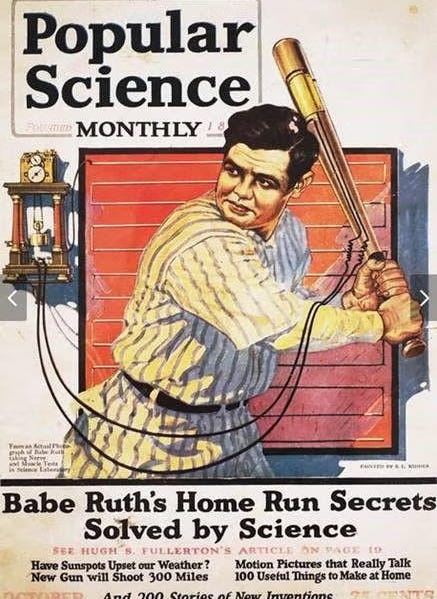
But one unicorn player did not a champion make: Ruth’s first Yankees team finished in third place in the American League, just a few games behind the Cleveland Indians and the Chicago White Sox. Those three teams each finished with 95 or more wins, and the rest of the American League was essentially kindling.
That included the Detroit Tigers. After three straight pennants between 1907 and 1909, the Tigers spent the next decade bouncing around the middle of the league. Most of the stars of those teams were gone, with the exception of Ty Cobb, who remained an offensive force, regularly flirting with a .400 batting average and 200 hits a season, and Donie Bush, a steady, productive presence at shortstop. After the Tigers finished in seventh place in 1920, Frank Navin, the team’s owner, dismissed long-time manager Hughie Jennings, whose whistling, whooping tactics no longer inspired as they once had. Seeking a new manager, Navin was inspired by the success of the 1920 Indians, who made their best player, center fielder Tris Speaker, the manager and promptly won a world championship under his direction.
Cobb, understanding that he was not a “people person,” did not particularly want to become the Tigers’ manager, but Navin made him an offer he could not refuse, raising his salary from $20,000 to $33,000 to take the helm (this move saved the tight-pocketed Navin money because giving Cobb a raise was still cheaper than hiring a standalone replacement). The job didn’t make Cobb any friendlier, but he was an earnest teacher with plenty of wisdom to impart. Feared by some and respected by nearly all, Cobb got his first Tigers club off to a strong start in 1921.
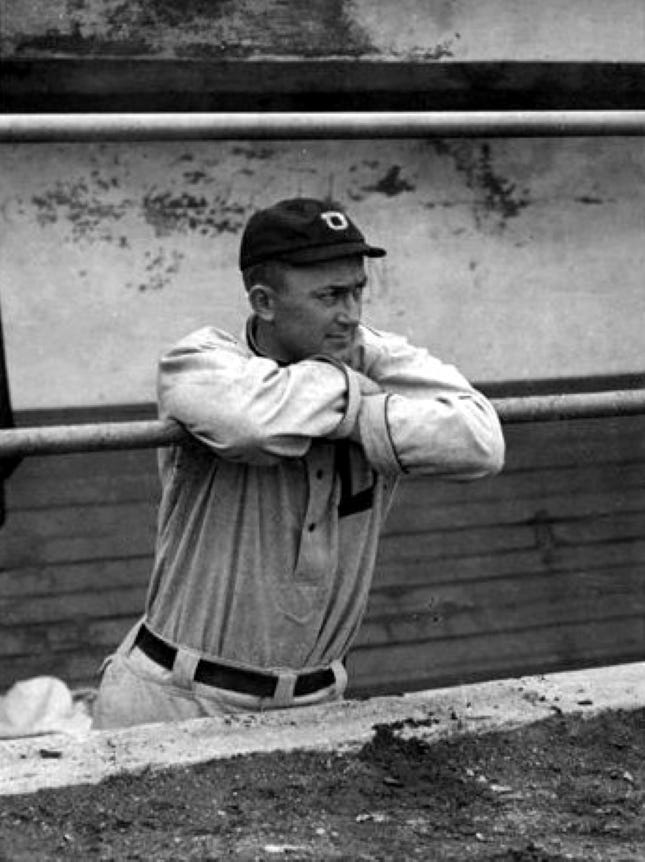
On June 10, the “Tygers” were 29-25, in third place and looking like a contender. Detroit was in the midst of an extended road trip necessitated by the train-dependent schedules of the era. When teams left town they often visited all seven of the other cities on the circuit before returning home, and after playing in Detroit for most of May, the Tigers were mostly on the road in June and early July. They began their road trip well enough, taking 3 of 4 from the Philadelphia Athletics and splitting a four-game series with the Washington Nationals. Next up: New York and the 29-21, second-place Yankees.
There was no Yankee Stadium in 1921. The Yankees had been renters since 1913, sharing the Polo Grounds in Manhattan with their landlords, the New York Giants. The Polo Grounds layout in 1921 wasn’t as strange as it would become a few years later, but it was plenty quirky, with shorter distances down the lines and a center field wall, as much as 483 feet away from the plate, that was thought to be practically unreachable.
The series opened on June 11 in front of 28,000 fans. Coming into the game, Ruth had hit 17 home runs, which was roughly on pace with his 1920 performance. Many newspapers (and not just in New York) devoted an entire section of their sports coverage to Ruth, tracking his season’s round-trippers, the pitchers he victimized, and how his progress compared to the year before. So far, so good.
In the seventh inning of the game, the Tigers were winning, 6-3. Cobb had been a nightmare all day, scoring two runs and driving in two. He lashed two doubles, a single, and walked twice, making every at-bat a misery. Cobb knew that the home run ball was revolutionizing the sport—1920 is generally considered the first year of the “modern” or post-dead-ball era—but he wasn’t going to tinker with what had been, for him, a tremendously successful formula. While others hammered away, he continued cutting opposing teams to pieces. Despite taking over the responsibilities of manager, Cobb was still hitting over .400, an implacable, thrumming engine that drove the Tigers’ offense from station to station.
Two Yankees reached in the bottom of the seventh, bringing up Ruth, who represented the tying run. For the other six teams that might face Babe Ruth in this situation, a clear protocol had already been put in place: walk him. Ruth’s 150 walks in 1948 set a record, and opposing teams were mocked for what was deemed a lack of courage. In St. Louis, a scornful local newspaper reframed a series between the Browns and the Yankees as a chance to “pay a dollar and see Babe Ruth walk.”
There was serious discussion about a rule change that would somehow “force” teams to pitch to Ruth, but until somebody came up with something workable, the law of the land was clear: If the Yankees’ slugger had a chance to tie the game or take the lead, put him on base and let somebody else make you regret it.
Ruth had walked in the first and the sixth, but these were probably relatively competitive walks issued by a pitcher, Jim Middleton, who was nibbling at the corners. There were two outs in the seventh when Ruth came up again, and Cobb came in from center field to give Middleton his orders. This time he was to “pitch his head off” to the Babe.
No doubt feeling a little silly, Middleton challenged Ruth with his best stuff, and the hitter “gratefully slugged the ball into the stands in right,” tying the game. The cheers at the Polo Grounds “took on the proportions of an earthquake,” and many fans tipped their caps to Cobb for creating an unforgettable moment. The Yankees scored a final run in the bottom of the ninth to walk off the Tigers and take the first game of the series, 7-6.
It was inevitable that Ty Cobb and Babe Ruth would dislike each other. When Ruth transitioned to the outfield around the same time that the Leagues seemed to introduce a livelier baseball, the so-called “jackrabbit ball,” he was essentially opening a new, exciting restaurant across the street from the diner Cobb had run successfully for more than 15 years. Not many people possess the strength of character it would have taken Cobb, in that position, to welcome such a newcomer in the neighborhood.
Even at the time, it was clear that Ruth was replacing Cobb as the avatar of the game, a new brand of baseball he was forging with his mighty, clubbing swings. This process didn’t erase Cobb and his legacy: any baseball fan today remembers Cobb, which is kind of remarkable when you consider he did his best work well over a century ago. But almost anyone today—whether or not they know much about baseball, sports, or history—can still tell you at least a little about Babe Ruth.
According to Robert Creamer’s biography, The Babe, Cobb hung onto an early rumor perpetuated by Ruth’s teammates in Boston, claiming that the then-pitcher didn’t regularly change his underwear. Long after Ruth’s rise to greatness, Cobb liked to greet Ruth with the same line: “You fellows smell something around here? Oh, hello, Babe.”
Cobb said much the same thing in his autobiography: “Whenever I’d pass near him on the field, I’d make some little remark or gesture, such as, ‘Seems to me there’s a polecat around here.’”
Cobb also indulged in one of the other popular tactics for razzing Ruth, mocking his striking physical appearance. The top-heavy Babe, a refrigerator on sticks with a big head, round face, and a flat nose, was hardly the perfect specimen of athleticism, and many players delighted in comparing him to a gorilla in a flannel uniform.
Where Cobb was exacting and repetitious with insults, Ruth preferred to improvise, and Cobb recalled with grudging admiration that Ruth was a virtuoso with profanity, with a repertoire of epithets and curses that left scorch marks in the most uncouth dugouts. And while Ruth didn’t seem to ever stay angry for long, he could hold on to offenses long enough to weaponize them. Playing angry did not suit Cobb’s ruthless, cerebral style, but grudges made Babe Ruth swing harder.
July 12 was a warm Sunday in Harlem. 34,000 souls (a New York Tribune writer, Charles Taylor, insisted the fans could be fans on weekdays, but on Sundays they were “souls”1) came for the rivalry and a Ruth home run and no one left disappointed.
The first pernicious domino was pushed over during batting practice before the game. According to the Detroit Free Press, the trouble seemed to have been a resentful photographer, who asked Ruth if he would pose for a picture with Cobb. Ruth was apparently mad about some verbal shot Cobb made the day before, and he refused the photographer “in some unkind way.” With no photo to take, the photographer headed Cobb’s way and made sure to mention what Ruth had said. From that point on, “the dispositions of both men were aflame.”
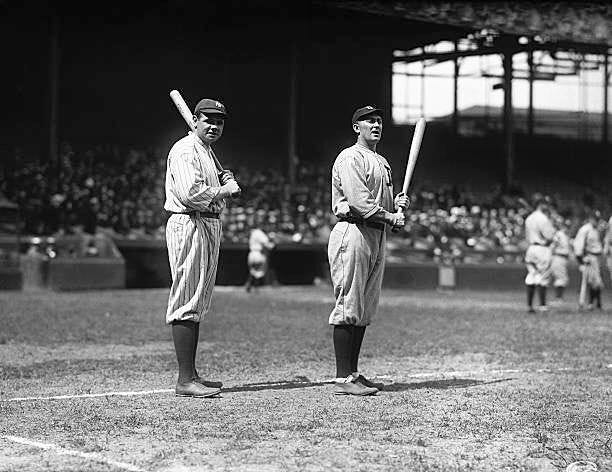
The slighted Cobb approached the Yankees’ dugout, where he “illustrated the best way he knew what a gorilla looks like,” including pushing up on his nose. Ruth unleashed that famous purple vocabulary, and the two men drew closer until the umpires, Tommy Connolly and Bill Dinneen, intervened, sending the two stars back to their separate corners.
There was a regular chance for the two rivals to follow up during the game: they were both playing center field and often passed near each other when the teams changed sides. During these changeovers, Ruth and Cobb were observed “making faces” at each other and continuing their verbal sparring, Cobb with his needle and Ruth with his cudgel. It’s possible that the two enjoyed the back-and-forth, but their teammates were watching the combative behavior and taking notes.
The scoring began in the top of the third, when the Tigers scored two off New York starter Bob Shawkey. Ruth led off in the fourth, facing a soft-throwing Detroit pitcher named Harvey “Suds” Sutherland. The Babe hammered a 2-2 pitch foul into the right field stands, but Sutherland fooled him on the next pitch, tempting Ruth into taking a vicious cut that missed. A piercing whistle and mocking shout rang out from deep center field.
Ty Cobb disdained the “swing-crazy” style of baseball Ruth was popularizing. To the Tigers’ manager, baseball about intelligence as well as physical skill. A savvy ballplayer took whatever the game gave him and turned it into something useful: a bunt, a stolen base, an intentionally placed line-drive single. Cobb had painstakingly built a towering career from these bits and pieces. He felt Ruth was dumbing down the game, bulling his way every through every at-bat: ball come, swing hard. Cobb and other purists believed no batter with Ruth’s strikeout numbers could be considered a truly great hitter.
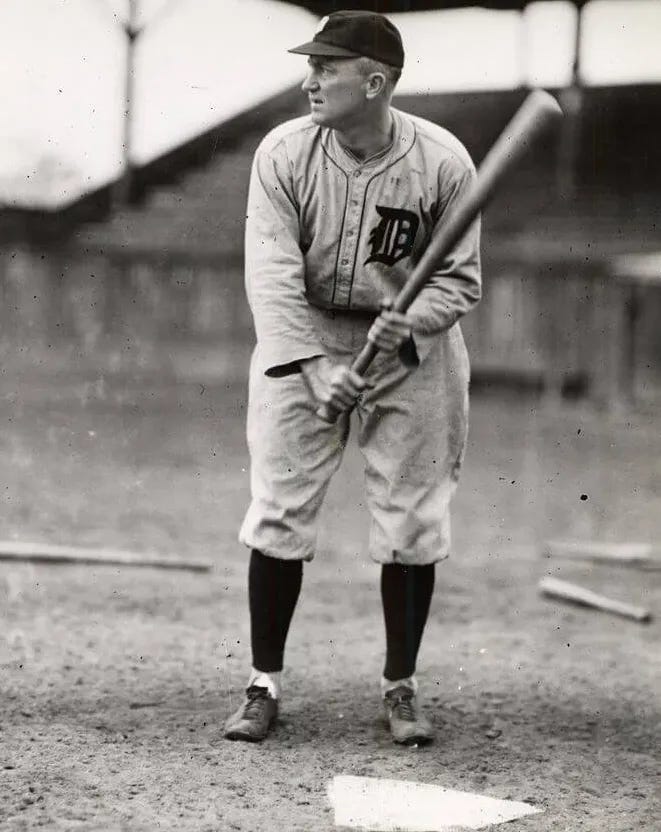
In the bottom of the fifth inning, the Yankees came to life. New York’s catcher, Wally Schang, singled, and Shawkey, the pitcher, laid down a bunt. The Tigers tried to get Schang at second base, and may have done it. The shortstop, Donie Bush, said he tagged Schang when he momentarily came off second base. Dinneen, the umpire, wouldn’t go for it and left Schang where he was. By modern standards, Bush lost his mind in the ensuing argument, “waving light jabs” at the umpire’s stomach and jaw. The Free Press characterized this as “playful remonstration,” and maybe it was, because Bush was not ejected for assaulting an official. One batter later, the Yankees’ shortstop, Roger Peckinpaugh, cleared the bases with a triple.
Now Bush renewed his argument, and this time he apparently threw a baseball in anger at Dinneen. For this, at last, he was thrown out. Umpires today certainly don’t have it easy, but umpires “back when” had things so much worse.
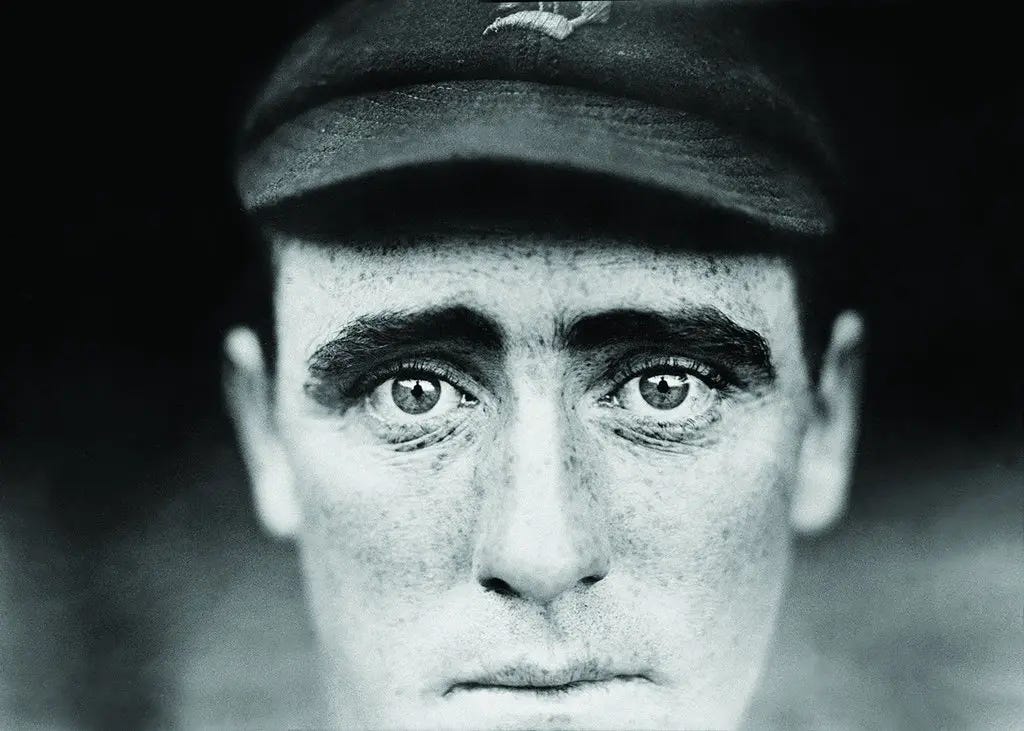
Next up was Ruth. Some reports say Sutherland tried to walk the Babe, throwing three outside pitches and intending to throw a fourth, only to miss and put it through the strike zone. Ruth had never given up on the at-bat and he pounced, swatting the ball into the right field upper deck. It was his 19th home run, his third in three days, and he was now ahead of his record 1920 pace.
Cobb ran in, arguing that the ball was foul, to no avail. He changed gears and went after Sutherland, berating him for the costly mistake. Perhaps as punishment, the manager left Sutherland to his fate and returned to center field. The pitcher gave up four more hits before getting three outs, and the Yankees built an 8-2 lead.
Ruth given his answer to Cobb’s earlier mocking whistle, and as the sides changed again, the two stars had another frank discussion on the merits of their respective offensive philosophies. This one nearly ended in blows. “They glared at each other and lifted their arms to a sparring position,” but Bill Dinneen, no doubt breathing hard by this point, and a few players separated the two before any punches were thrown.
Sutherland (and Cobb) had dug Detroit into a deep hole, but they kept clawing. In the sixth inning, the Tigers’ first baseman, Lu Blue2, hit a two-run home run, but in true dead-ball fashion he kept the ball in the park the entire time he rounded the bases. When the inning ended it was 8-5, New York.
Ruth batted again in the sixth and doubled with the bases empty. He was thrown out trying to steal third. It was often said of Ruth, even in his prime, that he was faster than he looked but not as fast as he thought he was.
For whatever reason, Ruth and Cobb appeared to have a friendly interaction in the seventh, but by then the rest of the players were stuck in “fight” mode. In the top of the eighth, the Tigers scored three runs to tie the game at eight apiece. After the tying run came home, there was a collision at home plate, involving Schang, the Yankees’ catcher, and another party we can’t quite pin down. The blow-up drew all the players off the benches “like smoke out of the funnels of a trans-Atlantic ocean liner.” Schang removed his mask, a sure sign he meant business, and advanced on Lu Blue, the runner at first. The ragged umpires intervened, but this battle was quickly forgotten when, behind the pitcher’s mound, Babe Ruth and Ty Cobb found each other again.
Ruth apparently started this one, as Cobb tried to keep his player, Blue from tangling with Schang. Cobb’s anger flashed as Ruth unleashed more of his Baltimore industrial school vocabulary and the conflict grew so serious that Miller Huggins darted in between them.
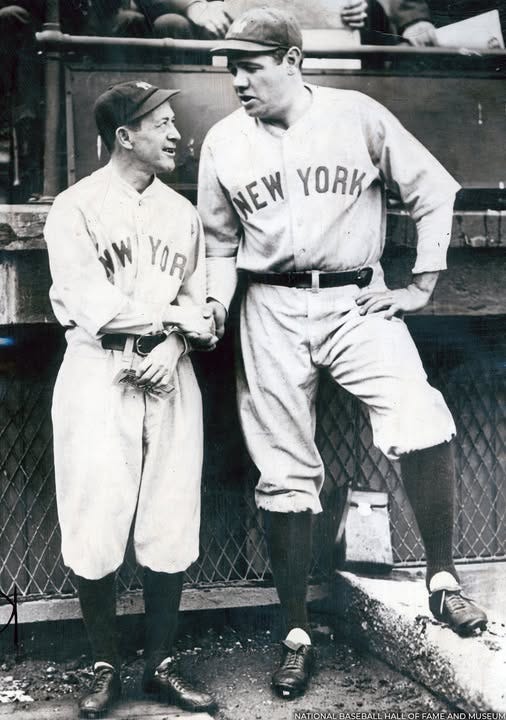
It was humorous to see Huggins, half as big as Ruth and weighing about 50% of what the slugger does, trying to budge the Babe. Huggins sunk his spikes in the dirt for a plunge and hit Ruth headlong without so much as budging him.
Ruth brushed his diminutive manager off but by then Dinneen was in his ear, dispensing some “fatherly advice.” One writer tipped his hat to Huggins for “preventing a riot,” but fights were now cropping up everywhere, as random players like Eddie Ainsmith and Ping Bodie began issuing open challenges to all comers. The verbal battles only ended when Lu Blue agreed to fight one of the Yankees’ coaches, in a trial by combat under the grandstands after the game.
The Yankees scored four runs in the bottom of the eighth to break the tie. Peckinpaugh hit the decisive home run, and Ruth doubled and scored to build up the 12-8 New York victory.
The game had been a jackrabbit’s holiday, with 21 hits by the Yankees and 19 by the Tigers. Ruth had a home run, two doubles, and a walk. Cobb finished with two singles in five at-bats, keeping his batting average at a respectable .401.
But the extracurriculars were the story, leading to a delay-filled game that took two hours and 50 minutes to decide, forever by the standards of the era. Only two things were missing, the New York Times wrote:
A keg at third base, as the contest bore all the other markings of a game between the married and the single men at the firemen’s clam bake. And a 24-foot ring which would have sped many quarrels along.
Capitalizing on the other side’s leaky pitching, both Ruth and Cobb had played up to their billing in the first two games of the series. Cobb’s Tigers had lost twice, but they still seemed to be in the thick of things, both in the four-game series and in the standings. What they didn’t yet know was that the events of the second game had doomed them.
No punches had been thrown that day (except at the umpire), but the sting of Ty Cobb’s relentless needling didn’t fade when Babe Ruth left the park. The Yankees’ star laid awake that night in his hotel residence, seeing red. After two more games trapped in the Polo Grounds with Ruth and his grudge, the 1921 Tigers would never recover.

In the conclusion, Babe Ruth takes his hurt feelings out on the record books. Bring a tape measure.

New York City only began permitting Sunday baseball in 1919, and the novelty of a Sabbath-day grudge match had yet to wear off.
Why is this the first time we’re hearing about a baseball player named Lu Blue? Real name: Luzerne Atwell Blue. Tremendous.
Two heavyweights going at it - good stuff, Paul.
If I may—Lu Blue is not only one of the all-time great baseball names, but he was also a pretty darned good player. Kind of comparable to Luis Arraez. Lower BA than Arraez, but with a lot more walks and a lot more runs scored.